Nirrti: Genetics and Weaponized Evolution
Alebran reached Stargate Command alive, coherent, and visibly human. Minutes later, every cell in his body began to fail. His blood vessels swelled, his tissues broke down, and the man who had escaped Nirrti’s laboratory collapsed into water before medical personnel could identify a treatment. The first concern was that he carried another hidden bomb like the one once implanted in Cassandra. The truth was worse. Nirrti had learned to write failure directly into the human body.
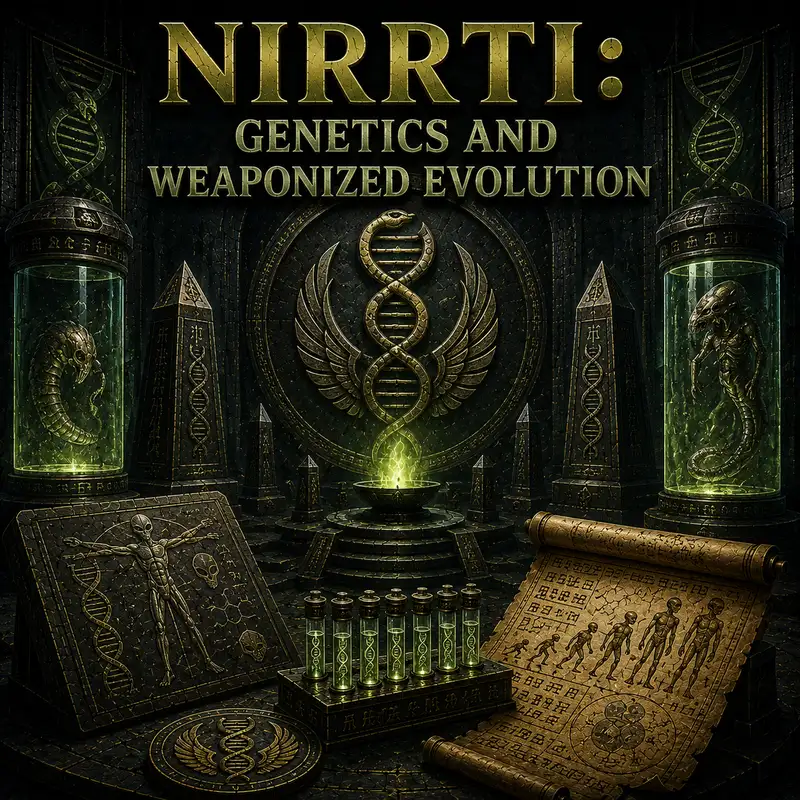
That death reveals the central problem posed by Nirrti. Other Goa’uld sought stronger fleets, larger Jaffa armies, and more productive mining worlds. Nirrti pursued power through biology. She wanted to create a Hok’taur, an advanced human whose abilities would make an extraordinary host. Her experiments combined selective breeding, engineered retroviruses, genetic scanning, direct DNA manipulation, and religious control over captive populations. She called the process evolution. In operational terms, it was a weapons program conducted on generations of people who had never agreed to become test subjects.
Nirrti was a recognized System Lord, but she rarely appears with the conventional mass associated with rulers such as Apophis or Cronus. Later intelligence described her as possessing only a small Jaffa force and fewer resources than the leading Goa’uld. That limitation helps explain her strategic approach. A minor fleet could not dominate the System Lords by direct confrontation. A ruler who developed a host with telepathy, telekinesis, enhanced perception, or superior cognition might bypass the need for a larger army by changing what one commander could do.
The Goa’uld already gained substantial advantages from human hosts. A symbiote acquired a human body, memories, language, social access, and the physical interface needed to operate technology. Nirrti’s idea was to improve the platform itself. A telepathic host could expose deception and hostile intent. A telekinetic host could disarm guards or defeat physical barriers without carrying a weapon. Enhanced senses could improve surveillance. Greater neurological capacity might increase technical understanding or command performance. The screen record never shows Nirrti completing such a host, but it makes the attraction obvious.
Her first known experimental population lived on Hanka, a world visited by S G Seven and later by S G One. The residents had been observed for months before a biological disaster killed the village and four members of the Earth team. Cassandra, a young girl, appeared to be the only survivor. She carried traces of naquadah in her blood but showed no symptoms of the infection that had killed everyone around her. That apparent immunity helped persuade Stargate Command to evacuate her.
The evacuation was exactly what Nirrti expected. Inside Cassandra, a device grew around the heart by drawing on iron, potassium, organic material, and naquadah already present in her body. Medical treatment unintentionally supplied some of the materials and electrical stimulation needed for the device to mature. Its reaction intensified near a Stargate. Had Cassandra been sent through at the wrong moment, the explosion could have destroyed Earth’s gate and much of the Cheyenne Mountain complex.
This was biological warfare shaped around humanitarian behavior. Nirrti did not need an agent inside Stargate Command. She created a wounded child whom Earth personnel would refuse to abandon. The victim served as carrier, concealment, and moral pressure. S G One’s compassion became part of the delivery mechanism. The plan failed when Samantha Carter recognized that Cassandra’s condition improved as she moved farther from the gate and remained with her at an isolated nuclear facility. Once distance interrupted the reaction, the device became inert rather than detonating.
The Hanka attack established several characteristics that remained consistent throughout Nirrti’s career. She combined biological and technical systems. She planned around the target’s likely response. She treated entire populations as expendable security measures. She also preferred deniable methods. A plague, a refugee, and a hidden device could destroy an enemy gate without requiring Nirrti to expose a fleet to return fire.
Years later, Cassandra’s survival revealed that Hanka had been more than a staging area for the bomb. At approximately sixteen years of age, she developed a high fever, hallucinations, abnormal brain activity, and an electromagnetic field strong enough to interfere with equipment. She began moving objects without touching them. Her symptoms matched a condition Hankan villagers had called the mind fire, which appeared in adolescents and was treated through a solitary ritual in the forest.
That ritual led to an underground Goa’uld laboratory. Stargate Command concluded that Nirrti had been manipulating the population over multiple generations. Children carrying useful changes became ill as the engineered retrovirus activated. Nirrti treated them before the transformation killed them, allowing them to return to the village, mature, and pass altered genes to their descendants. Each generation moved incrementally toward the Hok’taur she wanted.
The word evolution requires care here. Natural evolution acts across populations through inherited variation and selection over time. Nirrti imposed the selection, engineered the viral catalyst, decided which children survived, and controlled which altered genes continued into the next generation. Stargate Command accurately described the earlier program as eugenics. It was not a civilization naturally developing new abilities. It was a breeding project in which a Goa’uld determined who would reproduce and who would disappear.
The method was slow, but it offered one advantage over direct alteration. Changes that became stable and heritable might produce a reliable line of advanced humans rather than one fragile experimental subject. Nirrti could observe each generation, correct failures during the initiation rite, and preserve combinations that appeared useful. Her patients interpreted the intervention as divine healing. The community itself then protected the secrecy of the process by preventing outsiders from interfering with children believed to be touched by the gods.
Cassandra became dangerous because she had left Hanka before receiving the intervention that normally stopped the adolescent transformation. The retrovirus continued rewriting her DNA while her brain activity and electromagnetic output rose beyond what her body could tolerate. Telekinesis appeared, but so did organ stress and the possibility of death. Nirrti had produced evidence that the program could generate extraordinary abilities. She had not produced a safe transition.
By then, Nirrti had already demonstrated that scientific ambition and political ambition were the same project. During negotiations over Earth’s possible inclusion in the Asgard Protected Planets Treaty, she entered Stargate Command as one of three System Lord representatives. Weapons were prohibited. Nirrti carried phase-shifting technology that made her invisible, attacked Cronus and Teal’c, and arranged the scene to make Teal’c appear responsible.
The assassination attempt was an intelligence operation disguised as personal violence. Cronus was one of the most influential System Lords. His death during a treaty summit could have shattered the negotiations, provoked an attack on Earth, and removed a major rival. Framing Teal’c exploited a known grievance between Cronus and the son of the First Prime he had executed. Nirrti used technology developed for conflict with phase-shifted enemies to penetrate security that had been designed around visible weapons and known participants.
The plan failed because Samantha Carter used a Goa’uld healing device to save Cronus, Teal’c remembered an invisible attacker, and Stargate Command bluffed Nirrti into revealing fear of information Earth did not actually possess. Detection equipment exposed her as she attempted to escape. Cronus and Yu took her prisoner. The episode placed Nirrti among the most technically inventive System Lords, but also showed a recurring weakness. Her operations depended on secrecy so complete that one unexpected sensor could collapse the entire design.
Cronus’s later death removed the ruler holding her. Nirrti returned to Hanka when Cassandra’s transformation activated, apparently to determine whether the experiment had finally succeeded. S G One entered the abandoned laboratory, recovered biological material and equipment, and unknowingly triggered systems that alerted her. Using phase-shifting concealment, Nirrti followed the team back through the Stargate and entered Cheyenne Mountain without appearing on ordinary surveillance.
Cassandra detected her. Residual naquadah and earlier Goa’uld alteration allowed the young woman to sense a nearby symbiote even when Carter could not. Security personnel used weapons designed to expose phase-shifted Reetou and captured Nirrti inside the base. Stargate Command now possessed a living System Lord who knew enemy politics, genetics, stealth technology, and the history of Cassandra’s condition. It was an intelligence opportunity unlikely to be repeated.
It was also a medical hostage situation. Nirrti offered to stop Cassandra’s transformation in exchange for freedom, her invisibility technology, and a blood sample from the most advanced survivor of the Hanka program. General Hammond rejected the sample and initially refused release. Teal’c argued that Nirrti’s information could benefit both Earth and the Jaffa even if Cassandra died. The argument was strategically defensible and personally brutal. A commander was being asked to trade one child’s life for knowledge that might save entire populations later.
Doctor Janet Fraiser reduced the issue to its human scale. Cassandra was not a specimen or potential source. She was Fraiser’s daughter. When medical options failed, Fraiser entered Nirrti’s holding room with a weapon and made clear that bargaining time had ended. Hammond had already accepted a narrower agreement. Nirrti would cure Cassandra and receive only her freedom. Earth would not provide the blood sample that could allow her to continue from Hanka’s most successful result.
Nirrti reversed the transformation with Goa’uld medical devices and walked through the Stargate. She warned that without Cassandra’s blood she would have to begin again. Earth had achieved a medical and moral success. It had also released an enemy scientist who had exterminated a planet, attempted to destroy the Earth gate, and tried to murder a diplomatic delegate inside Stargate Command. The decision saved Cassandra. It did not prevent the next laboratory.
Nirrti found another human population on a world later reached by a Russian S G team. The survivors believed a plague had devastated them before she arrived. She exploited their desperation, brought selected people into a mountain fortress, and used an advanced machine to alter their DNA directly. Samantha Carter believed the device may have been built by the Ancients, although its exact origin was never confirmed. Nirrti had moved from multigenerational selection to real-time genetic resequencing.
That change transformed the tempo of the program. On Hanka, useful traits had to be carried through families while Nirrti waited for adolescents to mature. The resequencer could scan a person, display genetic structures, and modify them during a single session. A process that once required generations could now be accelerated through repeated trials. The scientific gain was enormous. So was the casualty rate.
Alebran escaped the fortress and reached Earth through the Russian team. He explained that Nirrti had altered him, declared him well enough to return home, and sent him back to a village where everyone was already dead. His outward appearance had been restored, but the changes inside remained unstable. His cellular collapse at Stargate Command suggested either a programmed delay or a failure Nirrti fully understood and concealed. Lieutenant Colonel Evanov later died in the same manner after being placed inside the machine.
The deaths created an urgent operational requirement. Nirrti possessed a device capable of producing advanced humans, and she was using a captive population as disposable test material. Her small Jaffa force made a direct raid appear feasible. General Hammond placed O’Neill in command of S G One and the Russian team whose reconnaissance had identified the fortress. The mission objective was initially capture or assassination, but medical reality soon required Nirrti alive because no one else knew how to stabilize the people she had changed.
The combined force crossed the gate, approached through forested terrain, and found only a small number of Jaffa in prepared positions. Carter and Jonas Quinn created a diversion with C four and rifle fire. Teal’c seized a fixed Jaffa weapon while O’Neill prevented a runner from raising the alarm. The assault element entered the fortress quickly. The perimeter fell. The real defense waited inside.
The altered humans refused rescue. Wodan possessed telekinesis strong enough to remove weapons, hold people against the floor, stop a bullet in flight, and operate heavy metal barriers without touching them. Egar could read thoughts. Other subjects displayed or were suspected of possessing enhanced senses and strength. They believed Nirrti had saved them from disease and that continued treatment was necessary for survival. Their dependence was partly real because the modifications were unstable. Their loyalty was built on a lie about who had caused their suffering.
Nirrti had created a security force without issuing conventional weapons. Wodan and Egar captured Teal’c, Jonas, O’Neill, Carter, and Evanov, stripped their radios, and confined them in the same cells used for the experimental population. Egar detected O’Neill’s intention to kill Nirrti. Wodan neutralized trained soldiers through thought alone. The raid had defeated the Jaffa perimeter and still failed because the laboratory subjects themselves protected the scientist.
This was weaponized evolution in its most immediate form. The altered abilities had operational value before Nirrti achieved a stable Hok’taur. Telepathy defeated deception. Telekinesis defeated normal disarmament procedures and made cover less reliable. The subjects could serve as guards, collectors, and research assistants while Nirrti retained only a small conventional force. Yet their powers also created the central control problem of her program. Every improvement made them harder for her to dominate.
Nirrti tested the captured personnel in the resequencer. Carter emerged weak and dangerously altered. Evanov suffered the same fatal cellular breakdown as Alebran. Jonas produced a different result. His ancestors had been taken from Earth thousands of years earlier and developed separately on Kelowna. Nirrti concluded that those generations had moved him closer to the transformation she sought. She offered to enhance him and suggested they could rule together.
The offer exposed her actual objective. Nirrti was not primarily building a public medical system or a standardized army. She was searching for the genetic pathway to personal supremacy. She considered Carter as a possible host and Jonas as a candidate for enhancement and partnership, though any partnership with a Goa’uld who treated entire populations as unnecessary would have had a predictable personnel-retention problem. The research population existed to identify useful traits and absorb failure until Nirrti could claim the result.
O’Neill’s team could not defeat Wodan physically and could not persuade the altered people with ordinary argument. The decisive intelligence operation came from inside the experiment. Egar had been forbidden to read Nirrti’s mind because she had taught him that a god’s thoughts were beyond question. O’Neill and Jonas focused on that prohibition. If Nirrti was telling the truth, inspection would confirm it. If she feared inspection, the reason mattered.
Egar finally looked. He discovered that Nirrti had murdered hundreds of their people, killed Alebran, allowed Evanov to die, and intended to dispose of the remaining subjects when they were no longer useful. Her entire command structure collapsed at the moment a telepath tested the official story. Wodan disarmed her Jaffa, killed them, lifted Nirrti from the floor, and broke her neck despite O’Neill’s attempt to keep her alive long enough to repair Carter.
Nirrti’s death should have made the medical crisis worse. Instead, Egar used the ability she had created to take the operating knowledge from her mind before she died. He restored Carter and began reversing the mutations throughout his community. The people then chose to destroy the resequencer after making themselves whole. Carter understood the scientific value of the machine and briefly hoped to study it. The survivors understood its political meaning more clearly. To them, it was not a research platform. It was the instrument that had reshaped their bodies, killed their families, and taught them to worship their captor.
The decision denied Earth access to technology far beyond its genetic science. It also prevented another faction from repeating Nirrti’s work with a new population. Possessing the device would not have meant understanding it, reproducing it, or using it safely. Egar could recover procedures from Nirrti’s mind, but Stargate Command did not acquire the industrial knowledge, safeguards, or ethical legitimacy required to operate the system. One functioning machine was not a medical revolution. It was an unsecured laboratory with a body count.
Nirrti came closer to producing advanced humans than most Goa’uld came to improving the species they ruled. Her work demonstrated that human biology in the Stargate setting contained pathways to telepathy, telekinesis, enhanced cognition, and other abilities. It also demonstrated the difference between capability and control. Her results were unstable, individual, difficult to reproduce, and frequently fatal. The one community that could operate the device intended to erase the program rather than continue it.
Her strategy failed for a reason deeper than poor security. Nirrti wanted subjects powerful enough to make her supreme and obedient enough never to threaten her. Those requirements moved in opposite directions. Telepaths could discover deception. Telekinetics could ignore guards and weapons. Enhanced humans could question the claim that their abilities came from divine favor. The closer she came to creating the perfect host, the closer she came to creating a person who did not need her.
Nirrti weaponized evolution by turning inheritance, illness, adolescence, and genetic difference into instruments of state power. Hanka provided generations to select. Cassandra provided proof that the traits could emerge. The resequencer provided speed. Captive populations provided the casualties. What she never developed was consent, loyalty, or a political system capable of surviving the truth. Her final experiment killed her because the human weapons she created acquired the one ability every false god fears most: the power to examine the god and decide she was no longer necessary.