Oberoth and the Asuran War Machine
The Asuran fleet began falling back toward its homeworld after seven warships were destroyed in a week. Isolated vessels had become easy targets for the Daedalus and Apollo, whose new Asgard beam weapons could tear through an Aurora-class hull before its crew adapted. Concentrating the survivors around Asuras promised safety in numbers, surface-based drone support, and the protection of a fortified industrial world. It also placed most of the Asuran military in one system. Oberoth had responded sensibly to a campaign of ambushes. He had also assembled the target his enemies needed.
Oberoth’s war machine was among the most formidable forces ever created in Pegasus. It possessed self-replicating personnel, Ancient-derived warships, multiple zero-point modules, a planet-scale industrial base, sophisticated intelligence systems, and a command network able to share information across vast distances. Yet its greatest advantages were also its most dangerous weaknesses. The same connectivity that coordinated the Asurans allowed hostile code to spread among them. The same homeworld that supported rapid construction concentrated their population and industry. The same leader who demanded unity repeatedly treated disagreement as malfunction rather than warning.
Oberoth was identified as the first of the human-form Asurans and became the dominant leader of the civilization that emerged after the Ancients tried to destroy their experiment. The screen record shows a High Council and other senior Asurans, so he should not be described as a monarch in the ordinary human sense. His authority was nevertheless unmistakable. He decided the fate of prisoners, directed military action, controlled access to the collective’s resources, and held subordinates personally accountable when they challenged him. Formal institutions existed. Oberoth set the acceptable range of policy inside them.
The society beneath that leadership was neither a single mind nor a collection of completely independent machines. Each Asuran possessed an individual identity, but periodic merges allowed new information and code to pass through a powerful subspace connection. The arrangement offered extraordinary command advantages. Intelligence gathered by one group could be distributed quickly. Technical improvements could move through the population without years of retraining. A destroyed body did not necessarily erase the pattern from which it had been formed. The network also gave the ruling collective a way to reset dissenters and restore programming that an individual had chosen to reject.
Asuran personnel presented a logistical problem very different from a human army. They did not require agricultural systems or the Wraith feeding economy. Nanite bodies could withstand injuries, move through solid barriers under some conditions, probe minds, and be reconstructed from available material. Casualties therefore imposed less permanent demographic damage than they would on Atlantis or the Wraith. No food convoy or biological replacement pool set the normal limit on campaign duration. The Asurans had solved personnel replacement more thoroughly than most militaries solve payroll. Their ships, power systems, and cities still required material, energy, fabrication, maintenance, protected construction time, and control of the routes connecting those assets.
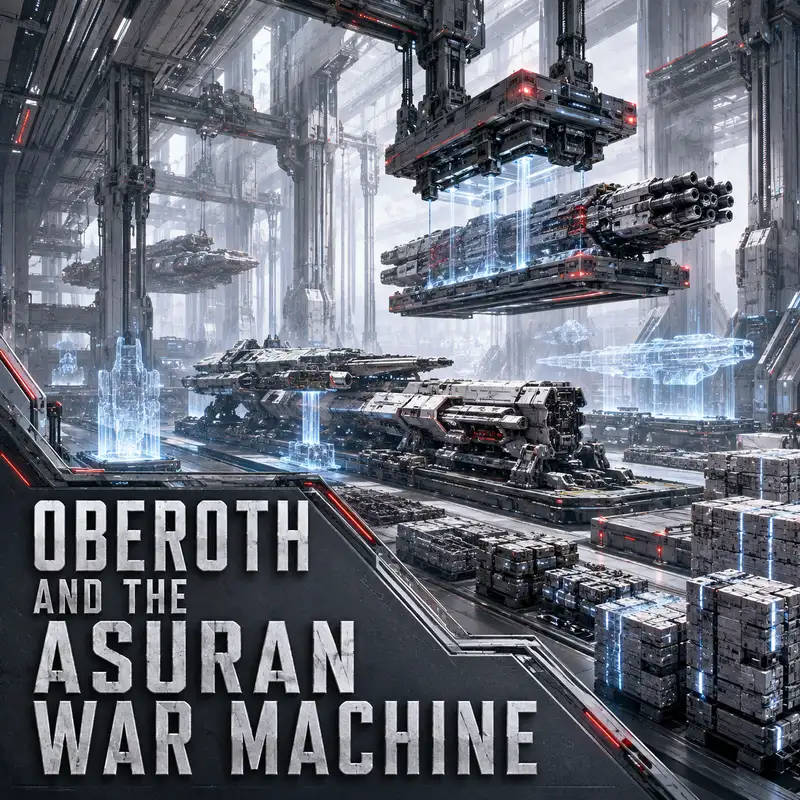
Asuras supplied those requirements on a civilizational scale. Its immense city could hold millions. Its inhabitants manufactured zero-point modules and reproduced Lantean architecture with a level of confidence Atlantis personnel could only study from a distance. The planet also contained abundant neutronium, the dense raw material from which Asuran nanites were formed. Their warships were not normally loose clouds of nanites shaped into temporary hulls. They were conventional physical vessels built from ordinary material, which meant nuclear weapons and beam fire could destroy them. That distinction defined the Asuran war economy. Individual machine bodies were highly replaceable. Aurora-class ships remained industrial products, and the shipyards producing them were strategic targets.
Oberoth also controlled an intelligence system more intrusive than conventional reconnaissance. Asurans could enter a captive’s mind, build convincing false experiences, extract memories, and use the results to reconstruct personalities. Their city systems and subspace network allowed rapid correlation of what had been learned. This gave Oberoth access to information that a human interrogator might never obtain. It also encouraged a dangerous assumption. If memory could be searched directly, he could mistake access to information for complete understanding of the person providing it. Several of his most serious defeats began when a prisoner used that confidence against him.
Before Atlantis arrived, the Asurans had spent thousands of years rebuilding in isolation. The Wraith had once disabled their original directive to attack them, and Oberoth’s faction did not resume the war on its own. Instead, Asuras accumulated population, power, and technology while remaining outside the political order of Pegasus. This was not pacifism. The aggression placed in Asuran base code remained, and Oberoth’s government preserved a profound grievance against the Ancients. The war machine existed before it had selected an active campaign. Atlantis gave it both a target and an excuse.
Oberoth’s first encounter with the expedition began as strategic deception. He presented the Asurans as surviving Ancients who had separated from Atlantis during the war with the Wraith. Their city, technology, and physical appearance supported the claim. Once Elizabeth Weir revealed that humans from Earth occupied the original city, Oberoth detained the visitors and ordered their minds searched. He learned that Atlantis had survived, understood something of Earth’s position, and confirmed that the expedition possessed Ancient knowledge without Ancient power. The supposed diplomatic contact had become target development.
His response was to launch an Asuran city-ship toward Atlantis. The vessel carried three zero-point modules and enough capability to destroy a city defended by a weakened expedition. The objective was retribution against the inheritance of the Ancients rather than renewed war against the Wraith, the enemy the Asurans had originally been created to fight. That choice revealed Oberoth’s priorities. He possessed the strength to influence the balance of Pegasus, but directed the first major operation seen by Atlantis toward historical vengeance. Military power served the grievance around which his authority had formed.
Niam’s dissent exposed the political fracture inside the machine state. He and others believed the aggression in their code prevented ascension and wanted Rodney McKay to remove it. Oberoth tolerated discussion only until it interfered with his decision. McKay modified Niam, discovered the subspace network, and inserted a temporary command error that froze the other Asurans. The prisoners escaped after setting the city-ship’s three zero-point modules to overload. Oberoth’s first strike on Atlantis ended with the destruction of the attacking city and the apparent loss of everyone aboard.
Oberoth later reappeared on Asuras, demonstrating that destruction of one body had not ended him while his pattern remained available to the collective. That resilience should have encouraged a doctrine based on dispersion, redundancy, and political flexibility. Instead, it reinforced his belief that losses could be reversed and opposition corrected. Niam was remotely reset after leaving the city-ship, turning a willing defector back into an attacker. To Oberoth, disagreement did not have to be persuaded. It could be overwritten. That principle made internal control efficient and strategic warning increasingly difficult to hear.
The Asuran seizure of Atlantis after surviving Lanteans reclaimed the city showed how quickly Oberoth’s wider organization could act. An Asuran force arrived, overcame the programming that had once prevented harm to the Ancients, killed the Lantean personnel, and occupied the city. Oberoth was not shown commanding the assault in person, but it was consistent with the policy of his dominant faction. Atlantis was recovered only when Earth personnel adapted anti-Replicator technology to the city’s shield emitters and disrupted the occupying bodies. The operation proved that the old safety command was no longer dependable and that Asuran forces could conduct strategic raids beyond Asuras.
Earth reconnaissance then discovered the next phase of Oberoth’s buildup. Images taken a few weeks apart showed empty construction areas becoming crowded with Aurora-class warships. The speed of production alarmed the International Oversight Advisory because the Asurans knew Atlantis’s location, had already demonstrated the ability to occupy the city, and possessed ships that could eventually threaten Earth. Waiting for a planet-wide anti-Replicator weapon under development at Area Fifty-One meant accepting an unknown number of new hulls and crews. The political response was preemption. The Apollo arrived in Pegasus carrying the Horizon weapons platform and orders for a surgical first strike before Oberoth could decide where the completed fleet would be used.
Horizon carried six Mark Nine nuclear warheads and four decoys. The targets were warships, shipyards, and other military facilities rather than the entire Asuran population. The attack achieved detonation on all six primaries, and post-strike analysis indicated that the selected targets and many secondary structures had been incinerated. Tactically, the mission worked. The Asurans lost ships and industrial capacity before they could launch them. Strategically, the strike was incomplete by design. It damaged the war machine without destroying the civilization capable of rebuilding it.
Oberoth’s forces answered with a weapon that demonstrated genuine operational innovation. They placed a Stargate inside an orbital satellite and established a wormhole from Asuras. An energy beam fired into the homeworld gate emerged near Atlantis, powered the satellite, sustained its shield, and struck the city. Because the local Stargate was already part of the connection, Atlantis could not dial another address. The system combined long-range fire, continuous external power, gate denial, and a protected firing platform. It avoided committing a fleet to the range of Earth’s anti-Replicator defenses.
The beam forced Atlantis to exhaust power on its shield, attempt submersion, and finally lift from the ocean to escape through hyperspace. The city survived, but it left Lantia, suffered serious damage, and nearly became stranded when its depleted zero-point module failed during flight. Weir was critically injured when the beam grazed the central tower. One limited Earth strike against Asuran shipyards had produced the displacement of an entire expeditionary base. Oberoth’s retaliation did not merely answer destruction with destruction. It changed the geography and command conditions of the war.
Atlantis eventually required another zero-point module to survive, which brought Sheppard’s team back to Asuras. Weir’s reactivated nanites allowed her to connect with the Asuran network while the team stole the power source. Oberoth detected her and engaged her through the same mental interface his people had used on prisoners. Weir delayed him long enough for most of the team to escape, but she was captured. During the operation, McKay found the dormant command directing the Asurans to attack the Wraith and uploaded a reactivated version into the central system.
The change transformed Oberoth’s accumulated fleet into an active war machine. Asuran ships began attacking Wraith forces across Pegasus. The Wraith attempted to use the deactivation method that had worked in the ancient past, but modifications to Asuran base code prevented the old solution from succeeding. Oberoth now commanded a civilization pushed back toward its original military purpose by hostile intervention. He did not become an obedient weapon of Atlantis. The attack directive identified an enemy. Oberoth’s government still determined how the campaign would be conducted and what losses it considered acceptable.
The resulting doctrine targeted more than hive ships. Asuran forces began destroying human settlements to deny the Wraith their food supply. From a narrow systems perspective, the logic was direct. Remove the resource and the enemy starves. From the perspective of the people living on those worlds, the distinction between culling and extermination was not particularly comforting. Oberoth’s war machine treated civilian populations as components in Wraith logistics. The Asurans possessed enough intelligence to understand that humans were sentient. Their choice to destroy them was strategic policy, not an unavoidable error in target recognition.
Oberoth also directed force inward against dissidents. A faction seeking ascension separated from the mainstream collective, built a duplicate of Atlantis, and created flesh-and-blood copies of members of the expedition from stored memories. Oberoth’s ships found the settlement and bombarded it. One dissident supplied the copies with the core of an Asuran tracking system before the city was destroyed. That device could locate Oberoth’s Aurora-class vessels throughout Pegasus. His suppression operation eliminated a rival center. It also handed Atlantis the intelligence needed to hunt the war machine ship by ship.
The tracking data produced the first reliable operational picture of Asuran fleet strength and movement. After the first ambush, Samantha Carter counted thirty-seven enemy vessels still active, placing the initial total at thirty-eight. The exact distribution among patrols, attacks, and home defense shifted as the campaign continued. What mattered was that Atlantis could predict where individual ships would emerge from hyperspace within a useful window. Oberoth had a large fleet. His enemies had acquired the schedule, and even a powerful warship is vulnerable when two opponents with stronger beam weapons are waiting at the exit.
The Daedalus and Apollo split up and attacked isolated Asuran vessels. One week of operations destroyed seven ships. The Asurans adapted by withdrawing the surviving force toward Asuras, where approximately thirty warships could support one another under protection from surface drones. This was a rational answer to attrition and an acknowledgement that Earth’s beam weapons had changed the tactical balance. It also surrendered initiative. The fleet stopped threatening dispersed human worlds and became tied to defense of the homeworld, its population, and the factories needed to replace losses.
Oberoth’s decision created safety in numbers while magnifying strategic concentration. Asuras held the principal population, the central data systems, the zero-point modules, the neutronium used in Asuran construction, and the industrial infrastructure behind the fleet. The subspace collective linked the inhabitants. The warships gathered in orbit. A conventional enemy might have required years of blockade and bombardment to reduce such a fortress. Atlantis instead looked for a method that would treat every Asuran body as part of one physical and informational system. The war machine had concentrated exactly where its shared nature could be exploited.
The coalition assembled against Asuras was an achievement Oberoth had done little to anticipate. Atlantis brought the Daedalus and Apollo. A Wraith faction committed seven hive ships because the Asuran campaign threatened every hive’s survival. The Travelers contributed vessels, including their recovered Ancient warship, after Asuran attacks endangered human trading partners. These forces did not trust one another and had no intention of remaining allies after the battle. They agreed on one operational requirement: prevent the Asuran fleet from entering hyperspace long enough for McKay’s plan to affect the nanites below.
McKay created a purpose-built Replicator named Fran to carry modified bonding instructions into the Asuran population. Once activated on the surface, she would increase the attractive force among nearby nanites. The effect would spread as more bodies were pulled into the growing mass, eventually drawing nanites from ships in orbit. The plan did not attempt to outproduce Oberoth or breach every warship. It attacked the physical rule holding Asuran bodies together. That was the technological equivalent of discovering that an army’s soldiers, communications, and ammunition all depended on the same vulnerable frequency.
The allied fleet entered the system and engaged roughly thirty Asuran warships while surface drones joined the defense. Earth beam weapons targeted hulls and hyperdrives. Traveler drones intercepted a vessel attempting to escape. Wraith ships absorbed losses while keeping the Asurans occupied. On the planet, Fran entered a populated area and the nanite mass began forming faster than expected. The Asuran response remained focused on the visible fleet engagement. By the time crews began dissolving out of their ships and streaming toward the surface, the operation had moved beyond anything conventional maneuver could reverse.
Every Asuran nanite within reach joined the mass. Towers collapsed as their inhabitants flowed outward, and warships became empty hulls in orbit. The original plan called for overloading zero-point modules at the correct moment, but the weight of the mass destroyed the subterranean power grid before the sequence could begin. Sensors then revealed abundant neutronium beneath the surface. McKay increased the attraction until the mass pulled that dense material toward itself and sank toward the planetary core. Pressure caused an implosion, Asuras broke apart, and the remaining Asuran ships were destroyed with it.
The battle eliminated Oberoth, the principal homeworld, and most of the mainstream Asuran military. A separate dissident group survived elsewhere, which means the destruction should not be described as the absolute extinction of every Asuran consciousness. The war machine, however, was gone. Its defeat did not come from a stronger production base or a fleet that matched it ship for ship. It came from intelligence supplied by dissidents, code knowledge gained through earlier contact, weapons transferred by the Asgard, a coalition formed among enemies, and an attack on the common physics of Asuran bodies.
Oberoth’s command had produced extraordinary resilience at the tactical level and dangerous rigidity at the strategic level. He could rebuild a body, replace a ship, restore unwanted programming, and punish a breakaway faction. He could not persuade dissidents, build durable alliances, or recognize that repeated coercion was creating sources for his enemies. His network distributed knowledge quickly, but also distributed vulnerabilities. His homeworld enabled industrial recovery, but made the civilization dependent on one concentrated system. His authority suppressed uncertainty until uncertainty arrived as an allied fleet.
The Asuran war machine failed because it was designed around control rather than political purpose. Oberoth inherited aggression, but he chose where to direct it. He used Ancient power to avenge the Ancients’ betrayal, treated human populations as enemy sustainment, and answered dissent by rewriting or destroying the dissenter. The machine state could manufacture almost everything needed for war except trust outside itself and honest warning within it. When Asuras finally collapsed, the fleet in orbit lost more than a planet. It lost the single center Oberoth had made too powerful to question and too important to survive without.