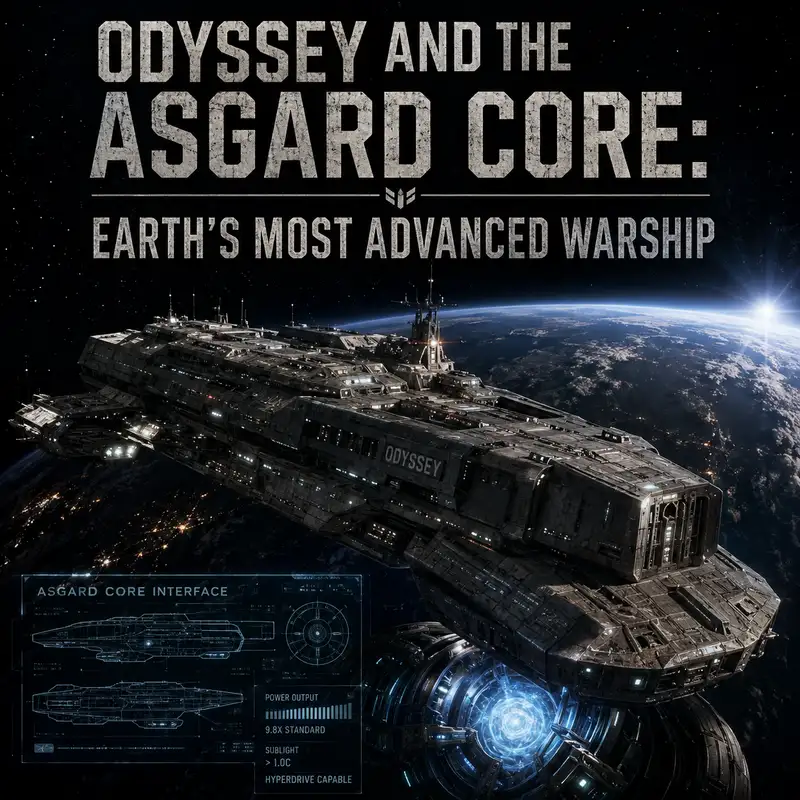
Odyssey and the Asgard Core: Earth’s Most Advanced Warship
Thor’s final gift entered combat before Earth had completed its first diagnostic. Three Ori warships emerged near Orilla while the Asgard were finishing the transfer of their accumulated knowledge and newest technology into Odyssey. The hyperdrive was still offline, the shields were falling, and the planet below was preparing to destroy itself. General Hank Landry ordered the untested energy weapons brought online. The beams struck an Ori vessel, destabilized its shields, and destroyed it. Earth’s warship had crossed a technological boundary in a single volley. It had also become traceable to every enemy able to recognize what the Asgard had placed aboard.
Odyssey was already one of Earth’s most capable ships. The Asgard computer core made it something more difficult to classify. It became a battlecruiser, a strategic archive, a mobile laboratory, a manufacturing platform, and the last physical repository of a dying civilization’s recorded history. The central question is not merely why Odyssey became Earth’s most advanced warship. It is why the same gift that gave the ship decisive power also created new forms of dependence, vulnerability, and political temptation.
The vessel entered service as the second operational B C three-oh-four, after Daedalus had been assigned to support Atlantis. Prometheus had proved that Earth could build an interstellar capital ship, but its hybrid architecture remained experimental and difficult to maintain. The new class integrated Asgard-derived shields, sensors, transporters, and an intergalactic hyperdrive into a human-built hull from the beginning. Human railguns, missiles, command systems, and F three-oh-two fighters gave the crew weapons and procedures Earth could support without requesting replacement ammunition from an alien ally.
Odyssey’s first commander was Colonel Paul Emerson. Its shakedown mission became an operational rescue before the crew had the luxury of learning the ship under controlled conditions. S G One had been captured after Ba’al removed a planet’s Stargate, preventing the team from dialing home. Odyssey located the team through subcutaneous locator transmitters and beamed them aboard. It then helped recover the Stargates and dial-home devices Ba’al had collected on a Ha’tak. The mission demonstrated the class’s strategic value immediately. A battlecruiser could rescue personnel whose extraction route no longer existed.
The same mission showed why mobility and transporters mattered as much as weapons. Odyssey could approach a hostile system without using the local gate, identify personnel from orbit, remove them from captivity, and recover large equipment that could not be carried through a firefight. A four-person team remained useful because a ship could now support it beyond the original gate plan. Earth had not replaced Stargate operations with space power. It had built a platform able to rescue gate operations after the assumptions in the briefing failed.
The ship’s first major fleet battle was far less forgiving. At P three Y two twenty-nine, Odyssey joined Korolev, an Asgard vessel, Free Jaffa ships, and Lucian Alliance Ha’taks against four Ori warships emerging from the supergate. Earth’s missiles and railguns could not penetrate the enemy shields. Ori beams tore through the allied formation, destroyed Korolev, and left most survivors scattered among disabled ships. Odyssey survived, but survival was not victory. The engagement established that the B C three-oh-four was a mature human warship and still technologically outclassed by the invasion fleet it had been built to resist.
That defeat shaped every later upgrade. Odyssey could move between galaxies, carry fighters, and withstand punishment that would have destroyed Prometheus. It could not reliably kill an Ori capital ship. The problem was not crew training or courage. It was a weapons gap. Earth had fielded a ship capable of entering the decisive battle without fielding a weapon capable of deciding it. The distinction became painfully clear while the crew searched the wreckage for survivors from ships whose commanders had faced the same calculation.
Odyssey remained in constant use because Earth possessed too few battlecruisers to reserve one for ideal missions. It supported operations against the Ori supergate, traveled to the Pegasus galaxy, transported S G One, and served as a mobile command platform beyond normal gate range. By the final phase of the Ori war, the ship also carried a zero-point module and a cloak created through knowledge associated with Merlin. The cloak allowed Odyssey to approach the supergate unseen. The zero-point module strengthened a vessel already operating far above Earth’s original industrial level.
Those additions made Odyssey unique even before the Asgard core arrived. They also made the ship a concentration of scarce capabilities. A zero-point module could not be replaced through normal Earth production. The cloak had not emerged from a repeatable procurement program. The Asgard systems depended on knowledge and materials that human engineers only partly understood. Odyssey was becoming more powerful, but not necessarily more sustainable. The ship resembled a carefully maintained stack of exceptional solutions, each one valuable enough that losing the hull would mean losing far more than a standard combat unit.
The Lucian Alliance demonstrated that advanced systems did not eliminate ordinary security failures. False intelligence drew Odyssey near a neutron star, where gravitational conditions weakened its defenses. Alliance forces damaged the ship, boarded through ring transporters, and seized control. Anateo killed Emerson when Samantha Carter refused to disable the subspace beacon. The ship was eventually recovered through a combined operation involving deception, technical repair, and internal resistance, but its captain was dead. Odyssey had survived Ori warships and nearly been lost to a boarding force that understood where the crew was vulnerable.
Colonel Davidson later assumed command. He inherited more than a replacement flagship. He inherited a vessel carrying the accumulated lessons of Earth’s rapid expansion into space warfare. Odyssey had to remain ready for planetary defense, strategic transport, special operations, and combat against an enemy whose primary weapons exceeded its shields. It also had to protect its own technology from capture. The ship’s value made caution necessary. Its scarcity made caution difficult, because every crisis seemed to justify using the strongest available platform.
The Asgard summons to Orilla changed that balance. Their long reliance on cloning had produced irreversible physiological degeneration. A final attempt to correct the problem left the surviving population with a rapidly progressing disease. The Asgard chose to end their lives before their condition worsened and before their technology could fall into hostile hands. They also chose Earth as the custodian of their legacy, despite opposition from members of their own council who still believed humanity was not ready.
Thor described the transfer without qualification. The Asgard would give Earth everything they possessed and knew. The package included their current technology, a knowledge base containing their recorded history, and a computer core with its own power source. The core could present information through a holographic representation of Thor or another Asgard stored in the archive. It was not a collection of translated manuals. It was an interactive record of a civilization whose scientific experience extended across thousands of years.
The core was integrated into every major system aboard Odyssey. That integration allowed the ship to use the new technology immediately and gave the archive access to propulsion, power, sensors, transporters, life support, and weapons. It also meant the core could not simply be unplugged like a laboratory computer. Once installed, it became part of the ship’s nervous system. The Asgard had provided a complete inheritance. They had also created a single technical dependency running through nearly every essential function.
The most visible upgrade was the plasma beam weapon. Earlier B C three-oh-fours relied on missiles and railguns that struggled against Ori shields. The Asgard beams destabilized those shields and destroyed a warship during the escape from Orilla. For the first time, an Earth-built vessel possessed a repeatable shipboard weapon capable of killing an Ori capital ship through direct fire. The tactical meaning was immediate. Odyssey no longer needed sabotage, an Ancient device, or an internal nuclear detonation to threaten the strongest enemy vessel in the battle.
The transfer included less visible capabilities with equally important consequences. Time-dilation technology was built into the core. A modification of the Asgard beaming system could function as a matter converter, producing food, water, oxygen, and other necessities from available energy. The archive gave scientists access to a vast technical record. These systems turned Odyssey into more than a combat platform. The ship could preserve knowledge, sustain a small population, simulate unfamiliar technologies, and potentially manufacture critical supplies far from Earth.
The Asgard did not survive long enough to supervise the inheritance. Orilla destroyed itself while Odyssey was still clearing the blast. The ship escaped after using its new weapons, but Ori vessels soon appeared again. They were not finding Odyssey by chance. The new core or its power source was emitting a distinctive signature detectable through subspace. The technology that allowed Earth to destroy Ori warships was also announcing the ship’s location whenever it paused long enough to be attacked.
Carter proposed shutting down the core to test the theory. The problem was integration. The core was tied into every system, including the hyperdrive controls, and isolating it would require time outside hyperspace. Each time Odyssey stopped, Ori vessels arrived before the work could be completed. The ship could fight one attacker, perhaps two under favorable conditions, but repeated engagements would eventually overwhelm its shields. Earth had received the weapon needed to win a duel and the beacon that ensured there would always be another duel.
Landry ordered Odyssey toward an uninhabited world with a Stargate so the crew could evacuate. Most personnel were beamed to the surface, while S G One and General Hank Landry remained aboard to protect the ship and the Asgard archive. Destroying Odyssey would deny the technology to the Ori, but it would also erase the civilization that had trusted Earth to preserve it. The decision converted the ship from a military asset into cultural custody. The people aboard were no longer fighting only for their own survival or even for Earth. They were defending the last accessible record of the Asgard.
With an Ori energy beam less than a minute from impact, Carter activated the core’s time-dilation field. Time slowed almost to a stop outside the field while continuing normally inside. The ship gained years in which to search for an escape, even though only a fraction of a second would pass around it. The solution preserved the crew from immediate destruction and trapped them inside the same moment. Odyssey had acquired time as a defensive resource. It had not acquired a guarantee that time would produce an answer.
Carter first attempted to reproduce Merlin’s phase-shifting technology so the ship could become intangible before the field collapsed. Simulation after simulation failed because Odyssey could not complete the phase transition within the seconds available after normal time resumed. Other options were no better. Transport buffers could not clear before impact. F three-oh-twos could not escape the blast pattern. The crew had decades to study a problem whose final step still had to occur in less than a minute.
The matter converter made those decades possible. By modifying the beaming technology, Carter created food, water, and oxygen after the original stores ran out. The ship became a closed habitat sustained by the same core that had drawn the enemy to it. The crew aged. Relationships changed. General Landry died inside that isolated history. Daniel continued studying the Asgard archive despite knowing that much of what he learned might disappear with him. The ship preserved life while forcing its occupants to watch that life pass inside a tactical pause.
After roughly fifty years, Carter found a solution. She could reverse time within the field, but the zero-point module and the core’s power supply had been depleted by decades of operation. The only available energy source was the Ori beam waiting outside the field. Odyssey’s power conduits were rerouted to feed the impact into the Asgard core. The plan required the ship to be struck and begin exploding before the core could generate the reversal. If the timing failed, the crew would be dead for considerably longer than the projected few milliseconds.
The reversal returned Odyssey and its people to the moment the field had been created. Teal’c remained outside the reversal so he could retain the memory of the lost decades and execute Carter’s prepared instructions. He severed the core from the hyperdrive controls, and the ship jumped away before the beam arrived. Everyone else returned to their earlier age without direct memory of the life they had lived aboard. The core had saved the ship through a capability no human program could reproduce. It had also created a history carried by only one surviving witness.
The episode established Odyssey’s technological superiority more clearly than any weapons test. The ship destroyed an Ori vessel, sustained a population for half a century, manipulated the flow of time, and reversed the consequences of its own destruction. None of those feats made the technology routine. Earth still could not manufacture another complete core, reproduce the full archive, or assume another crew could repeat Carter’s solution. The achievement belonged to one ship, one unique system, and a sequence of decisions made under conditions that should not be mistaken for doctrine.
Some Asgard advances did spread. Daedalus and Apollo were later retrofitted with the plasma beam weapons, giving other B C three-oh-fours a far stronger offensive capability. The full computer core remained aboard Odyssey. That distinction preserved the ship’s position as the most advanced vessel in Earth’s fleet. Other battlecruisers could receive a weapon. Odyssey carried the knowledge base, independent power source, time-dilation system, matter-conversion potential, and the interactive record from which future advances might be derived.
Possessing that record did not make Earth equal to the Asgard. Knowledge is not the same as comprehension, and comprehension is not the same as industrial capacity. Human scientists could query the archive, reproduce selected systems, and integrate designs into existing ships. They still needed materials, fabrication methods, testing, training, and political authority. A complete scientific library can explain how to build a machine without supplying the factories, precision tools, or centuries of accumulated engineering practice that made the machine reliable.
The danger became unmistakable during Odyssey’s mission to the Ori home galaxy. International Oversight Advisory operative James Marrick carried secret instructions to use the Asgard core as a weapons factory. He activated a program that created a mechanical Replicator from the archive and intended to place it aboard an Ori ship. The design had been altered so that the anti-Replicator weapon would not destroy it. A civilian oversight organization had taken the most destructive enemy the Asgard had ever faced, removed its established vulnerability, and planned to release it inside another galaxy.
The plan failed before the Replicator reached an Ori vessel. It escaped aboard Odyssey, multiplied, penetrated internal systems, and used the ship’s architecture against its crew. The active core again revealed Odyssey’s position to the Ori. Transporters, communications, and other systems became contested terrain while enemy warships closed on the ship. The archive that preserved Asgard history had become the manufacturing source for the enemy that had nearly destroyed the Asgard themselves.
Marrick was imprisoned, then consumed and incorporated into a human-form Replicator structure. Cameron Mitchell fought him while Carter and Major Marks searched for the shutdown command hidden in the program. Marrick finally revealed that the code was recorded on the reverse side of the control crystal used to initiate the operation. Carter entered it, and the Replicators shut down. Odyssey survived the internal attack only to remain damaged and exposed under Ori fire. The Ark of Truth ended the assault before the enemy destroyed the ship.
That crisis answered the Asgard council members who had doubted humanity’s readiness, although not in the way Thor would have preferred. The danger did not come from ignorance alone. Marrick and his superiors understood that Replicators were uncontrollable, adaptive, and potentially catastrophic. They proceeded because the Ori threat appeared to justify an option outside the normal chain of command. The core expanded Earth’s power faster than Earth’s institutions expanded their restraint.
Odyssey’s final configuration made it the most advanced Earth warship of its era. It combined the B C three-oh-four’s human-built hull, fighter capacity, railguns, missiles, shields, sensors, transporters, and intergalactic hyperdrive with a zero-point module, a cloak, Asgard plasma beams, and the unique computer core. It could cross galaxies, hide from conventional detection, defeat Ori capital ships, manufacture essentials, and consult a holographic archive containing the record of an entire civilization.
Every advantage carried a corresponding liability. The zero-point module was rare. The cloak was unique. The core emitted a trackable signature when active. Integration made shutdown difficult. The archive made Odyssey a target worth capturing rather than destroying. The matter converter and time-dilation system required enormous power. The Replicator incident showed that total knowledge could be weaponized by anyone with sufficient access and inadequate judgment. The ship’s systems were extraordinary. Its security still depended on human institutions, clearances, and decisions.
Odyssey was therefore more than the strongest battlecruiser Earth had built. It was the point at which Earth stopped being only a recipient of alien assistance and became the custodian of an alien civilization’s legacy. The Asgard did not leave humanity a finished fleet or an automatic path to equality. They left one ship carrying the tools to begin a much longer transformation and the evidence of how technological progress could destroy the civilization pursuing it.
The ship survived because its crew treated the Asgard core as neither magic nor a trophy. They studied it, questioned it, isolated it when necessary, and accepted that every new capability might conceal a new failure mode. The core gave Odyssey enough firepower to kill an Ori warship and enough time to watch generations pass between two heartbeats. It preserved the Asgard after their world was gone, while proving that inheritance is not the same as readiness. Earth’s most advanced warship was powerful because it carried the future. It was dangerous because no one aboard could yet know everything that future contained.