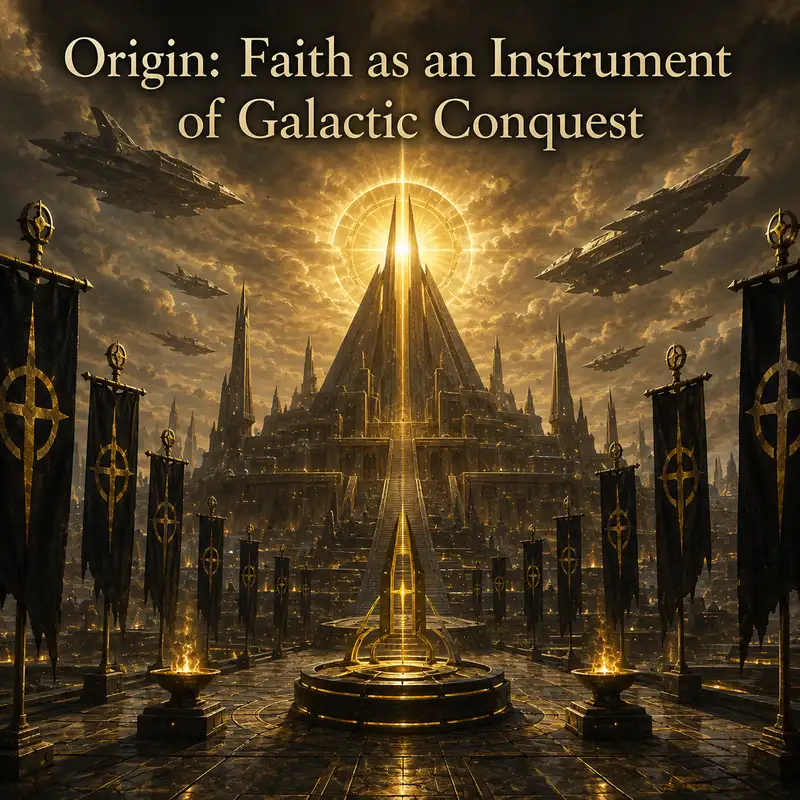
Origin: Faith as an Instrument of Galactic Conquest
The Prior did not arrive with an invasion army. He walked through a Stargate carrying a staff, a book, and an offer that was never really an offer. The population would study Origin, acknowledge the Ori, and submit to the new faith. If they refused, he would return. Sometimes the deadline was three days. Sometimes the warning was less precise. The consequence was always understood. A village could be struck by disease. A city could be erased. A planet could be destroyed from orbit. Military force came later, if it came at all. Origin was designed to make conquest begin inside the population before the first Ori warship arrived.
That was the strategic purpose of Origin. It was a religion, but also a command system, an intelligence network, a mechanism of political control, and a source of power. The Ori gained strength from human devotion. The exact physics of that transfer were never fully explained, but the effect was real. Every converted population increased the power of the ascended Ori. Every community that rejected them denied them a resource. Faith was not decoration around the war effort. It was the Ori’s principal form of extraction.
Origin promised a path toward enlightenment and eventual ascension. Its teachings were preserved in the Book of Origin, repeated in ritual, interpreted by Priors, and represented by the Doci in the city of Celestis. The message offered moral order, purpose, and certainty. It taught that the Ori possessed great knowledge and deserved reverence. It framed obedience as progress and doubt as separation from truth. For people raised within the system, the claim had visible support. Priors healed injuries, displayed hidden knowledge, manipulated matter, and punished communities. The difference between advanced capability and divine authority was difficult to examine when asking the question could place a family on a funeral pyre.
The Ori were ascended beings, not imaginary gods. That distinction made Origin more effective, not less. The objects of worship actually existed. They possessed extraordinary power. Their representatives could perform acts that appeared miraculous. A skeptic could not simply point to an empty shrine and declare the faith false. The deception lay elsewhere. The Ori presented power as moral perfection, demanded worship as the proper response, and promised followers a spiritual future they never intended to provide. They did not guide ordinary believers to join them through ascension. They drew strength from those believers and preserved the distance between ruler and worshipper.
That arrangement solved several political problems. Ori authority was presented as the natural expression of superior wisdom. Human officials gained legitimacy by acting in the name of beings no local ruler could challenge. Resistance became a moral offense rather than a dispute over policy. Private thought became a matter of security. A person who doubted Origin was not merely unconvinced. That person threatened the Priors, the community’s unity, and the flow of power to the Ori.
In the Ori home galaxy, Origin was embedded in daily life before the crusade reached the Milky Way. Villages gathered for worship. Administrators enforced doctrine. The Book supplied parables used to instruct, comfort, accuse, or condemn. The Doci served as the principal human voice of the Ori, who could speak through him directly. Priors connected central authority to distant communities. Religious, civil, and coercive functions overlapped. Refusing a sermon could become disobedience to government. Questioning a Prior could become evidence of corruption. Hiding a forbidden record could become treason.
The first outsiders to see this system clearly were Daniel Jackson and Vala Mal Doran, whose consciousnesses were carried into the bodies of Harrid and Sallis by an Ancient communications device. They arrived in Ver Ager without preparation, diplomatic status, or an extraction plan. More importantly, they arrived inside a society where the authorities controlled what could be remembered. Harrid, Sallis, and their ally Fannis belonged to a hidden movement preserving evidence that the Ori were not gods. Their resistance was intellectual before it was military. They collected prohibited knowledge because a monopoly on history was one of Origin’s strongest defenses.
The local administrator’s response revealed how the system handled uncertainty. Vala was subjected to a trial by fire. Daniel’s questions were treated not as a contribution to debate, but as a threat requiring containment. When the administrator demonstrated loyalty, he was transformed into a Prior. The promotion was religious, political, and operational. A local enforcer became a mobile agent of expansion, equipped with abilities that could validate the doctrine he preached. Origin rewarded obedience by turning selected believers into evidence for the faith. It was an impressive personnel system, provided one did not object to promotion criteria based on public executions.
Priors were the decisive instrument. They could travel through the Stargate network with almost no logistical footprint. One individual could reach a world before an army, assess its leadership, identify fears, and demonstrate power. Staff, robes, pale appearance, and ritual language established recognizable authority. Healing created gratitude. Prophecy created awe. Disease created panic. None of this required the Ori to occupy every settlement or transport millions of soldiers across interstellar distances. A Prior was missionary, political officer, reconnaissance asset, and coercive weapons platform in one body.
Their method usually followed a recognizable sequence. First came contact and instruction. The population received the Book of Origin and an opportunity to accept the faith. Next came proof, often in the form of healing or another display beyond local science. Then came a deadline. If local leaders resisted, the Prior imposed a punishment or demonstrated the cost of defiance. Finally, converts were expected to help enforce the new order. The process offered peaceful submission, but peace depended entirely on accepting Ori authority. A population could keep its homes, customs, and some local leaders, so long as none of those things competed with Origin.
This was conquest by political conversion rather than immediate occupation. An Ori fleet did not need to administer every market or maintain a garrison on every road if local believers accepted the Priors as the highest authority. Existing institutions could continue under ideological supervision. The Book provided a shared moral vocabulary. Priors ruled through sacred authority. Collaborators gained protection and status. Dissenters identified themselves by refusing public worship. Communities helped police their own submission, which was considerably cheaper than stationing a warship over every farm.
The approach was especially effective against societies emerging from Goa’uld rule. Defeating the System Lords removed tyrants, but not generations of religious training, hierarchy, or fear. Many Jaffa rejected the Goa’uld as false gods without rejecting the possibility that true higher powers existed. Origin entered that uncertainty with visible miracles and a simple claim. The Ori were what the Goa’uld had pretended to be. For people whose old world had collapsed, that offered certainty, order, and an escape from the chaos following liberation.
Gerak showed how Origin targeted leadership rather than merely accumulating village converts. As a powerful figure within the Free Jaffa Nation, he could bring military forces, political legitimacy, and entire communities with him. A Prior approached him through language that connected Origin to the Jaffa struggle against oppression. Gerak accepted the faith and was transformed into a Prior, giving his conversion the appearance of confirmation. He then pressed the Jaffa High Council to accept Ori authority. One successful recruitment operation threatened to capture a new state without defeating its armies in battle.
Gerak’s eventual reversal also exposed the limits of the method. When the Ori plague threatened Earth, he used his new abilities to help cure the infected population despite knowing that the Ori would punish him. They killed him for the betrayal. His death demonstrated both the reality of Ori power and the fragility of coerced loyalty. Origin could transform the body, provide knowledge, and impose fear. It could not guarantee that a convert would surrender every previous duty. Gerak had accepted the doctrine, but his identity as a Jaffa leader still mattered when the consequences became impossible to ignore.
Disease was one of the Priors’ most effective strategic tools because it transformed theology into an immediate public emergency. On one world, a Prior could introduce a plague and later offer relief. On Earth, the Ori plague threatened to spread through a dense global population that knew nothing about the Stargate Program or the enemy behind the outbreak. The operation bypassed fleets, air defenses, and secrecy arrangements. It attacked hospitals, transportation systems, public confidence, and political stability. The biological agent was a weapon. The promised cure was propaganda. Together they turned belief into a condition for survival.
The use of plague also gave the Priors control over attribution. A population without advanced medical knowledge might see disease as judgment and recovery as mercy. Even a technologically capable society could struggle to prove that the same messenger offering salvation had created the crisis. That uncertainty mattered. Origin did not need every person to understand its doctrine. It needed enough people to conclude that resistance was more dangerous than obedience. When the cost of disbelief could be measured in graves, the line between sincere conversion and coerced compliance became difficult to see from a command briefing.
Tomin represented the human result of this system more clearly than any speech by the Doci. He had lived with a disabling injury since childhood and had been treated as an outsider in his village. A Prior healed him and made military service possible. The act gave Tomin physical freedom, social status, and a role in a sacred campaign. His loyalty was not based only on fear. He had received something real. Origin had answered a personal need, restored his place in the community, and told him that service would give his life meaning. Recruiting departments have worked with less.
That sincerity made him useful. Tomin became a soldier and then a commander in the crusade sent through the supergate. He carried the Book of Origin, trained within its moral framework, and believed that war against unbelievers could be an act of liberation. He did not see himself as an occupier serving ascended predators. He saw himself as an instrument of truth. This was the Ori’s most important force multiplier. Their human armies did not have to be driven forward by Priors at every moment. Many soldiers supplied their own discipline because the doctrine had converted obedience into virtue.
Origin also gave those soldiers a way to manage contradiction. Violence could be described as correction. Destruction could be called purification. A population that refused conversion could be blamed for the punishment imposed upon it. The victim became responsible for the aggressor’s choice. Parables could support mercy in one circumstance and annihilation in another, while the Prior decided which interpretation applied. The doctrine appeared stable because the institution controlled its meaning. When practice contradicted principle, the believer was encouraged to distrust his own judgment rather than the Prior.
Tomin’s doubts began when that contradiction became too large to ignore. On a Milky Way world that had resisted Origin, he saw a Prior prepare to destroy people who no longer posed a military threat. Vala forced him to compare the Prior’s orders with the teachings he believed he was defending. The problem was not that Tomin suddenly lost all faith. The problem was that he took the Book seriously enough to notice when its appointed interpreter violated it. Origin had taught him to value truth, compassion, and righteousness in abstract form. Those values became weapons against the institution once he applied them to its conduct.
This was an intelligence vulnerability built into the faith. The Ori needed the Book to contain enough moral substance to inspire genuine loyalty. Empty threats can produce obedience, but they rarely produce committed missionaries and soldiers willing to cross galaxies. Yet every principle written into the doctrine created a standard against which the Priors could be judged. Information control delayed that comparison. Direct experience made it possible. A believer who saw surrendered civilians marked for death could no longer rely on distant assurances about mercy and enlightenment.
The Priors protected the system by appearing invulnerable. Their abilities made resistance seem useless and confirmed the claim that the Ori favored them. Stargate Command’s anti-Prior device attacked that perception as much as it attacked the Prior’s biology. The device disrupted the advanced mental functions that allowed a Prior to use extraordinary abilities. Once a Prior could be blocked, captured, or killed, the political effect exceeded the tactical result. Communities could see that the messenger was not divine. Soldiers could see that disobedience was physically possible. A weapon that neutralized one individual also damaged the credibility of the entire command hierarchy.
The Ori compensated by adding conventional military force. The supergate allowed enormous warships to cross from their home galaxy into the Milky Way. Their shields and energy weapons overwhelmed the allied fleet waiting near the gate. Ori ground troops then carried conversion campaigns from world to world under orbital protection. The warships mattered because they could destroy resistance that Priors failed to intimidate. Yet the fleets were not a replacement for Origin. They were its enforcement arm. Space superiority created access. Priors established authority. Human soldiers occupied key locations. Local converts made control durable.
This combination was more sophisticated than the Goa’uld model it threatened to replace. The Goa’uld often ruled through inherited claims of divinity, Jaffa military power, and technological monopoly. Origin could expand through a standardized doctrine carried by agents who did not require a Goa’uld host, a larval symbiote system, or an established temple economy. Its message could be translated into the political conditions of each world while preserving one central demand. Worship the Ori. The method was portable, scalable, and supported by intergalactic mobility. It was also connected directly to the strategic strength of the beings at the top.
The Ori’s ultimate objective extended beyond control of human populations. Additional worshippers would increase their power relative to the ascended Ancients. The crusade therefore linked village conversion to a conflict on the higher plane. A farmer kneeling before a Prior was contributing, without informed consent, to the Ori’s ability to destroy their ancient rivals. A planet that rejected Origin was not simply refusing a foreign religion. It was denying the Ori strategic energy and preserving a population outside their control. That is why neutrality was never a stable option. The system could not tolerate people who merely wished to be left alone.
Not every follower held the same responsibility. The Ori and highest Priors understood worship more fully than ordinary villagers and soldiers. Administrators enforced the system for status, conviction, fear, or some combination. Tomin believed he was protecting truth. Other soldiers followed orders trained into them as sacred. Heretics risked death to preserve suppressed history. Conquest collapsed these differences into one public category called belief, but a serious assessment must separate architects, enforcers, collaborators, coerced subjects, and sincere followers acting on false information.
Resistance therefore required more than defeating fleets. Stargate Command had to challenge the information system that allowed Origin to reproduce itself. Military victories could protect a planet for a time, but a Prior could return under a warship’s protection. Indiscriminate attacks on converts would confirm the doctrine’s warnings. Effective resistance needed evidence, secure communication, medical countermeasures, local allies, and proof that rejection did not guarantee annihilation. The war was fought in orbit, around Stargates, inside councils, and in the private moment when a believer decided whether the Prior’s explanation still matched what he had seen.
The destruction of the ascended Ori by Merlin’s weapon removed the original beneficiaries of the system, but Origin did not collapse immediately. Priors remained. Warships remained. Soldiers remained. The Book remained. Adria continued the crusade after ascending. Most followers had no independent way to confirm that the beings they worshipped were gone. The fires of Celestis could be concealed, explained, or ignored. This was the durability of institutional faith. Leadership could disappear while the hierarchy continued issuing orders in its name.
The Ark of Truth ended the crusade by attacking that hierarchy at its central point. When activated before the Doci, it forced recognition that the Ori were not gods. Because the Doci was connected to the Priors, the realization spread through the command network. Warships stopped their advance because the people operating the system no longer accepted its sacred authority. The outcome proved that Origin’s greatest strength was also its decisive weakness. The faith had centralized legitimacy so thoroughly that changing the conviction of the central interpreters could paralyze the military structure beneath them.
The Ark’s use remained morally troubling. It compelled belief rather than persuading through evidence and free choice. The Alterans had once rejected it for precisely that reason. Yet the device also revealed why ordinary debate had failed. Origin controlled education, history, punishment, miracle, government, and military force. Its followers did not meet opposing arguments on neutral ground. The Ark broke a closed system by using another form of coercion. The crusade ended with fewer battles, but not with a comfortable answer about whether truth imposed by technology remains truth freely held.
Origin became an instrument of galactic conquest because it joined every level of the campaign into one structure. It gave the Ori power. It gave Priors authority. It gave rulers legitimacy. It gave soldiers purpose. It gave frightened communities an explanation for suffering and a way to survive it. It identified dissenters, reduced occupation requirements, and turned worship into strategic supply. The warships carried armies across the void, but they did not create the empire the Ori wanted. That work was done by a book, a ritual, a promise of enlightenment, and the knowledge that the messenger could return after three days.