Pegasus Before Atlantis: The Ancients, Humans, and the Wraith
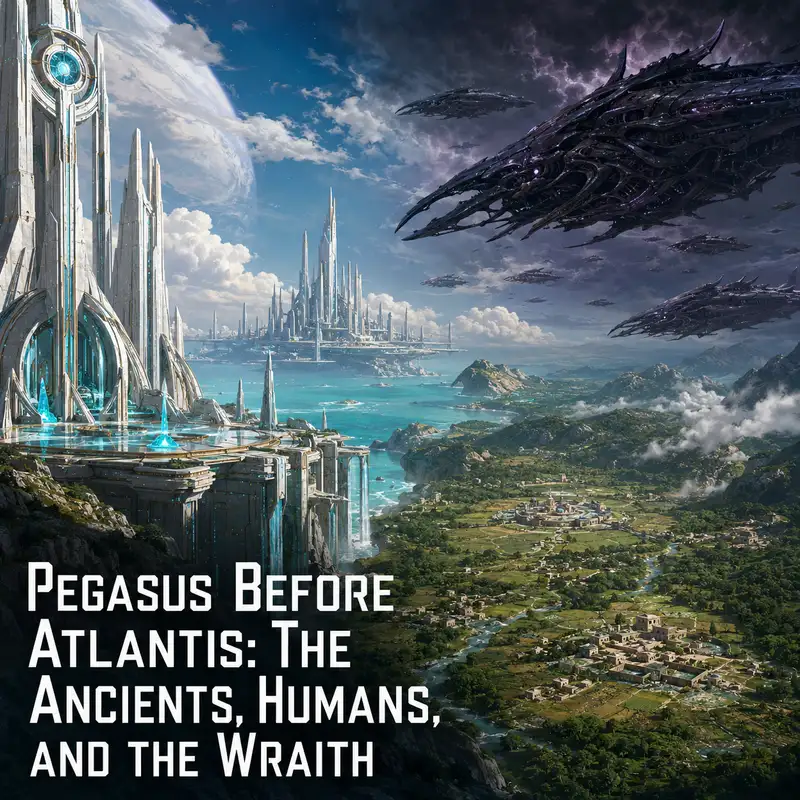
The last transport approaching Atlantis did not reach the city. It was carrying Lanteans toward what had become the final defensible position in the Pegasus galaxy, but Wraith forces destroyed it before it could land. Inside the city, the remaining council faced a decision that no civilization likes to record in its monuments. Atlantis could still survive behind its shield. The civilization that had built it could not. The city was submerged, its Stargate was prepared for one final evacuation to Earth, and millions of years of Lantean history in Pegasus ended with a retreat through a doorway their own people had constructed.
That withdrawal explains the Pegasus galaxy encountered by the later expedition better than any catalog of Ancient devices. Pegasus was not an untouched frontier waiting for explorers. It was the aftermath of a failed civilizational project. The Ancients had arrived with extraordinary science, established a network of worlds, and helped human life spread across the galaxy. The Wraith had transformed that network into the geography of a feeding system. Human societies survived between those two legacies, surrounded by Ancient ruins, connected by Ancient Stargates, and periodically harvested by an enemy whose existence was tied to humanity itself.
The Ancients who settled Pegasus were survivors before they became conquerors, colonists, or ancestors. A devastating plague had swept through the Milky Way millions of years earlier. Some Ancients died. Some pursued ascension. Others left the galaxy in physical form. Atlantis, already a mobile city and technological center, crossed intergalactic space and settled on the ocean world later known as Lantea. The precise date remains approximate, but the migration occurred several million years before the modern Stargate era. From Lantea, the newcomers built what became a second great phase of Ancient civilization.
In Pegasus, they were increasingly known as the Lanteans, while later human peoples often remembered them simply as the Ancestors. They built cities, laboratories, observatories, defensive stations, warships, power systems, and a new generation of Stargates. Their civilization could move a city between galaxies, draw enormous energy from zero-point modules, and deploy drone weapons capable of destroying capital ships. It could also make the classic strategic mistake of confusing technical superiority with permanent control. A civilization may dominate every measurable category and still fail to understand the political, biological, and demographic system growing beyond its borders.
The Lanteans did more than occupy a few fortified worlds. Their own surviving account states that a thousand worlds eventually bore human life. The screen continuity does not provide a complete census or a precise description of every method used. Some populations may have been directly seeded, while others developed under conditions shaped by Lantean intervention. What is clear is that human societies became widespread throughout Pegasus, and that the Stargate network linked many of them. The Lanteans created not merely colonies, but an inhabited strategic environment whose future depended on decisions made at Atlantis.
That network offered remarkable mobility, but it did not produce a unified human state. A Stargate can connect two settlements in moments. It cannot by itself create common law, shared command, industrial integration, mutual defense, or political trust. Those require institutions. The Lanteans possessed the institutions and knowledge needed to use the network as a civilizational system. Most human worlds did not. They inherited destinations without inheriting the complete map, transportation infrastructure without strategic coordination, and powerful ruins without the training or energy sources required to operate them.
The same distinction applied to defense. Lantean power rested on more than individual weapons. It depended on trained crews, manufacturing, maintenance, command networks, energy production, secure bases, and the ability to replace losses. Atlantis was formidable because it sat at the center of that system. Human villages that later found an Ancient control panel or a damaged device did not thereby inherit the civilization that had designed it. Advanced technology without an industrial base is often less a capability than an archaeological responsibility, especially when the nearest technical support office abandoned the galaxy ten thousand years earlier.
The Wraith emerged inside this Lantean-created environment. The best-supported explanation begins with the Iratus bug, a native predator capable of feeding on humans and using the stolen vitality to heal itself. Doctor Carson Beckett later proposed that these creatures fed upon humans introduced into their ecosystem and gradually incorporated human genetic characteristics. Over a long period, the interaction produced the humanoid species known as the Wraith. The exact biological sequence is not fully documented, and the Lanteans did not deliberately design the Wraith as a weapon. Their responsibility was more indirect and, in some ways, more unsettling. They created the conditions, spread the human population, and failed to recognize the danger until it had become a rival civilization.
Wraith biology shaped Wraith strategy. They could regenerate severe injuries when properly fed, live for extraordinary periods, communicate telepathically, and organize themselves around queens, commanders, warriors, and drones. Their ships were grown rather than assembled in the conventional human sense, and their technology shared the same organic character. Most important, they required humans as food. That need was not a side issue in Wraith politics. It was the foundation of their military economy, territorial behavior, and relationship with every human world in Pegasus.
The Wraith were not one centralized empire. They operated through hives, each with its own leadership, loyalties, territory, and interests. Queens exercised powerful authority within their organizations, but no permanent galactic government directed every hive. Rivalry was normal. Cooperation occurred when the stakes were high enough, particularly during the war against the Lanteans, but unity was conditional. This decentralized structure made the Wraith difficult to defeat strategically. Destroying one hive did not remove the species. Capturing one commander did not collapse the political order. A technologically superior opponent could win repeated engagements while failing to eliminate the dispersed system that generated new forces.
The first major Lantean error appears to have been intelligence failure. Their own final record admitted that they encountered the Wraith with overconfidence, unprepared for an enemy whose powers rivaled their own and whose numbers exceeded theirs. The phrase matters. The Wraith did not need to match Lantean science device for device. They needed enough mobility, enough ships, enough warriors, and enough access to human populations to survive losses that the Lanteans could not replace as easily. Superior weapons can produce favorable exchange ratios. They do not guarantee victory when the enemy controls the demographic and logistical depth of the theater.
At first, Lantean warships could destroy Wraith vessels with frightening efficiency. Drone weapons, advanced shields, faster hyperdrives, and powerful sensors gave them a decisive tactical advantage. That advantage encouraged increasingly aggressive operations. Lantean ships pushed deeper into Wraith-controlled territory in an effort to destroy hives at their source. The logic was understandable. The execution was dangerous. Long-range offensive patrols extended the fleet away from secure support, exposed predictable routes and objectives, and treated the enemy as a collection of targets rather than an adaptive intelligence network.
The Wraith eventually captured three Lantean warships, each powered by a zero-point module. Later Wraith testimony identified that capture as the turning point. The modules were taken to a vast cloning installation, where a queen’s limited production of warriors could be copied on an industrial scale. Within weeks, Wraith numbers reportedly increased hundreds of times over. The precise figure comes from a Wraith commander and should not be treated as an audited military return, but the facility itself confirms the basic mechanism. The Wraith converted captured Lantean energy technology into mass, and mass changed the war.
This was technological asymmetry in reverse. The Lanteans possessed the more advanced civilization, but the Wraith used one captured component to strengthen the part of their system that mattered most. They did not need to reproduce the full zero-point module industry. They only needed to operate the modules long enough to power a unique production facility. The result was not elegant. It was operationally effective. The Lanteans had lost sophisticated ships. The Wraith had gained a force-generation system. One side measured the loss in platforms. The other translated the loss into an army.
Once the numerical balance shifted, Lantean tactical superiority became harder to convert into strategic success. Every ship committed to defend a colony was a ship unavailable elsewhere. Every human world threatened by culling created a rescue requirement. Every lost outpost reduced intelligence coverage and repair capacity. The Wraith could pressure many locations, accept losses, withdraw, and return. The Lanteans were defending a network of inhabited worlds against an enemy that viewed those same worlds as supply. The geography the Ancients had created now favored the predator that could exploit it most ruthlessly.
The human populations paid first. Wraith attacks were not conventional occupations designed to collect taxes or administer territory. Darts swept over settlements, captured people through culling beams, and transferred them into storage aboard Wraith vessels. Some victims were fed upon quickly. Others became cargo for later use. Communities were broken without any need for a permanent garrison. Fields, workshops, families, and local governments could be left physically intact while the population required to sustain them disappeared. The military objective was not control of the village. It was control of the harvest.
The Lanteans attempted several responses beyond fleet combat. Defensive satellites protected key approaches. Atlantis itself retained a shield capable of surviving prolonged bombardment. Ancient commanders searched for vulnerabilities in Wraith systems, and at least one damaged warship tried to carry crucial intelligence back to the city. That message never reached the high council. A weakness discovered but not communicated is not an operational advantage. It is a historical footnote, which is a particularly expensive category of intelligence.
Late in the war, the Lanteans also turned to self-replicating nanotechnology. They created microscopic machines intended to attack the Wraith at the cellular level and programmed them with extraordinary aggression. The machines replicated, combined, and eventually formed humanlike beings modeled on their creators. These machines became the Asurans. When the project failed to behave as the Lanteans intended, they tried to destroy it and erase the record. Some survived. The weapon program became another independent civilization, carrying its creators’ aggression without their restraint and their intelligence without their political loyalty.
The Wraith later found a way to deactivate the Asurans’ command to attack them. That achievement is easy to overlook because Wraith technology is often described as inferior to Ancient technology. Inferior does not mean unintelligent. The Wraith adapted, infiltrated, captured, reprogrammed, and exploited. Their victory was not produced by numbers alone. Numbers became decisive because Wraith leaders repeatedly found ways to turn Lantean assumptions against them. The Ancients relied on superior systems. The Wraith targeted the conditions that made those systems useful.
As the war continued, the Lantean defensive perimeter contracted. Colonies and protected worlds were lost. Satellites were destroyed. Ships failed to return. Atlantis became the final stronghold, protected by its great shield and supplied by whatever resources remained within the city. The siege lasted for years. Wraith weapons could not simply punch through the shield, but the city could not restore a vanished civilization outside it. Holding the capital had become tactically possible and strategically meaningless.
This is the central contradiction of the final defense. Atlantis could resist, but resistance no longer offered a path to victory. The Lanteans lacked the numbers to reconquer their former territory. Human worlds beyond the shield were exposed. The fleet had been reduced, the enemy retained overwhelming strength, and the last evacuation transport was destroyed before reaching the city. A fortress is valuable when it protects a force capable of acting beyond its walls. When that force is gone, the fortress may preserve survivors while confirming the loss of everything they were meant to defend.
About ten thousand years before the modern expedition, the Lanteans chose evacuation. They submerged Atlantis beneath Lantea’s ocean, leaving the shield active and the city concealed. The surviving population departed through the Stargate to Earth. Special preparations ensured that the city might one day rise again, although time travel complicated the exact sequence of those preparations. The essential outcome remained unchanged. The builders left. The human populations of Pegasus did not.
The survivors who reached Earth could not recreate Lantean civilization among the comparatively early human societies they found there. Some lived out their lives among those populations. Some left through the Stargate. Some pursued ascension. Their departure closed the active intergalactic connection centered on Atlantis and ended organized Lantean power in Pegasus. It did not end the Wraith. It did not evacuate the human worlds. It did not dismantle the gate network. The war concluded with one side leaving the theater and the other inheriting it.
Wraith victory produced an unusual postwar order. The hives controlled the galaxy without governing it in the manner of a conventional empire. They did not need ministries on every planet, permanent occupation forces, or public loyalty. They required access. Human societies could farm, trade, worship, feud, and develop between cullings as long as they did not become too dangerous or too difficult to harvest. The Wraith maintained dominance through mobility, fear, selective destruction, and the certainty that they would eventually return.
Their own biology imposed limits on that system. An active Wraith population required more human lives than Pegasus could continuously provide. Large numbers therefore entered hibernation, sometimes for generations, while smaller caretaker forces monitored feeding grounds and conducted limited operations. When the major hives awakened, they culled on a broad scale, consumed the accumulated population, and eventually returned to dormancy. The cycle allowed human numbers to recover enough to sustain the next harvest. It was population management conducted by predators, not government, and its apparent stability depended entirely on the suffering of worlds unable to stop it.
For human societies, survival favored behaviors that looked irrational to outsiders. Large cities attracted attention. Industrial activity created signatures. Centralized states produced valuable targets. Military success could be temporary because the destruction of one raiding force might invite a larger response. Some communities dispersed. Some concealed technology. Some preserved oral warnings and ritual preparations for culling. Some traded through the Stargates while revealing as little as possible about their homes. The safest society was not necessarily the strongest. It was often the one the Wraith overlooked.
This pressure helps explain why Pegasus contained many human cultures but no durable interstellar human alliance when the Earth expedition arrived. The gate network made contact possible, yet culling punished concentration and cooperation. Worlds had different experiences, different memories, and different estimates of Wraith strength. Trusting strangers could expose a settlement’s address, resources, or defenses. A coalition large enough to matter would also be large enough to notice. The Wraith did not have to prevent every diplomatic agreement. They only had to make the cost of visible organization unbearable.
Different societies developed different answers. The Athosians combined farming, hunting, trade, and knowledge of other worlds, while carrying a deep cultural memory of the Ancestors and the Wraith. The Genii hid an industrial and military state beneath the appearance of an agrarian society, pursuing nuclear weapons and planning for a future uprising. Other worlds sought biological defenses, geographic isolation, Ancient protection, or simple obscurity. More advanced states sometimes built armies and cities, but development invited culling if it became visible. Pegasus produced ingenuity in abundance and strategic depth in very short supply.
The Ancients remained present everywhere as memory and absence. Their ruins offered shelter, danger, power, and false hope. Their Stargates sustained trade and escape, but also preserved a network whose routes could be exploited by hostile forces. Their technology inspired reverence because later humans could see what had once been possible. It also encouraged myths that the Ancestors might return, intervene, or judge. Most did not. Ascended Ancients generally followed a policy of noninterference, and isolated exceptions only emphasized the rule.
The Wraith, meanwhile, became more than an enemy in human culture. They were a calendar, a demographic limit, a reason to abandon cities, and an explanation for missing generations. Their presence shaped military doctrine before many societies possessed formal militaries. Early warning mattered more than holding ground. Evacuation mattered more than victory parades. A concealed shelter could be more valuable than a fortress. The practical question was rarely how to defeat the Wraith forever. It was how to ensure that enough people survived the next visit to rebuild.
Immediately before the arrival of the expedition from Earth, Pegasus was therefore neither at peace nor in continuous open war. It existed under an armed ecological cycle. Most Wraith slept. Human societies recovered unevenly. Caretakers watched. Old grudges and local rivalries continued beneath the larger threat. Ancient machines waited without instructions, damaged by time or dependent on power sources nobody could replace. Atlantis remained beneath the ocean, intact enough to matter and empty enough to become a prize.
The Ancients had helped fill Pegasus with human life, built interstellar roads, and created technologies capable of defending worlds. They had also introduced human populations into the environment from which the Wraith emerged, underestimated the resulting enemy, lost the systems needed to protect those populations, and departed without resolving the consequences. The Wraith inherited the network and turned human civilization into a renewable military resource. The humans inherited neither side’s full power. They survived in the space between Ancient ambition and Wraith appetite.
That was Pegasus before Atlantis returned to history. The galaxy was already organized by an old war, even during the long periods when most of its victors slept. Atlantis was not simply a lost city waiting to be rediscovered. It was the abandoned headquarters of a defeated power, the only direct bridge back to Earth, and a symbol remembered by people whose ancestors had been left outside its shield. When the expedition stepped into its gate room, it did not enter an empty galaxy. It reopened the capital of a war that had never truly ended.