Power and the Dive Into a Star
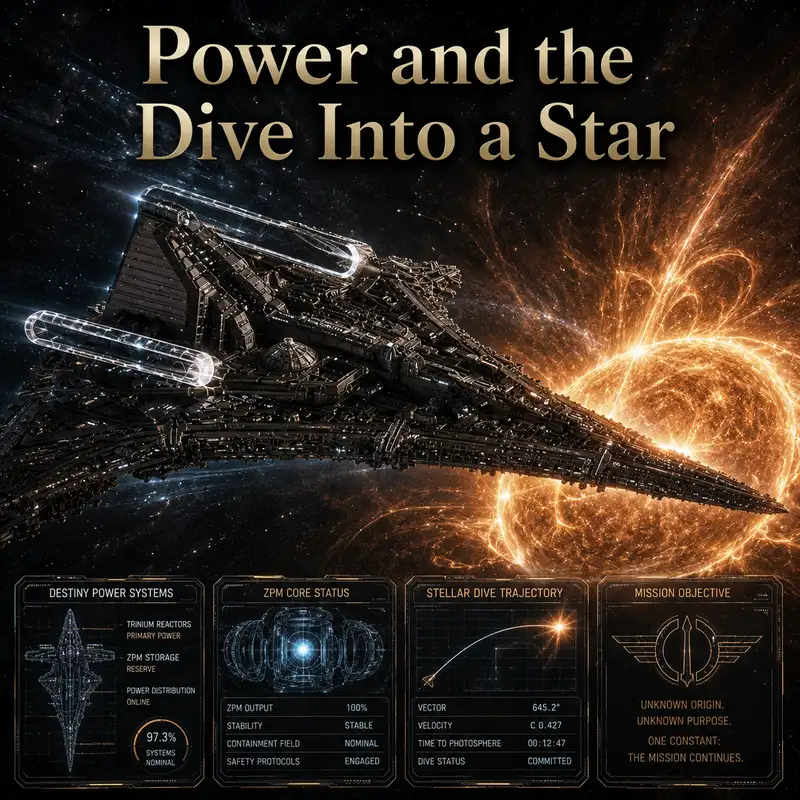
Destiny crossed the upper atmosphere of a gas giant on emergency power and emerged aimed directly at a red star. The crew had no control of propulsion, no access to the ship’s core systems, and no way to determine whether the altered course was deliberate. Seventeen people were loaded into the only working shuttle. Everyone left aboard prepared to die. Then the hull failed to break apart, the shields continued holding, and structures lowered from Destiny’s underside as the ship entered the star. The survivors had mistaken refueling for collision because Destiny understood its own logistics better than its new crew understood the ship.
The dive revealed the most important fact about Destiny’s power system. The vessel was designed to cross galaxies without fuel depots, tenders, replacement reactors, or an Ancient industrial base waiting along the route. It could replenish itself from stars. That capability made a voyage lasting more than a million years possible, but it did not provide unlimited energy. The ship still depended on functioning collectors, power cells, shields, navigation, and access to a suitable star. The central question was therefore not simply how Destiny survived the dive. It was how a self-refueling system became both the foundation of the mission and one of its most dangerous strategic vulnerabilities.
The crisis began almost as soon as the survivors from Icarus Base made the ship habitable. They had already sealed a major atmospheric breach and restored carbon-dioxide removal with minerals recovered from a desert world. Those victories consumed time and energy while technicians explored compartments they could not read. Personnel activated consoles, tested weapons, searched laboratories, powered Earth equipment, and tried to understand systems built for Ancient operators. Colonel Everett Young also authorized an unsuccessful attempt to dial Earth. Nicholas Rush warned that the ship’s reserves were critically low, but he could not access power, navigation, or propulsion well enough to explain the entire problem.
Destiny responded by shutting itself down. Lights failed across occupied compartments. Consoles went dark. The Stargate became unusable. Propulsion and most internal systems appeared dead. Only life support and a reduced level of shield protection remained active. Rush described the ship as sequestering its last energy beyond his reach. To the humans, that looked like exhaustion. To Destiny, it was triage. The automation had removed power from every function that did not immediately preserve the vessel and its occupants. The ship was not out of energy in the absolute sense. It had withdrawn the remaining energy into protected priorities that the crew did not yet understand.
The distinction mattered because power aboard Destiny was not one common pool available to anyone standing at a console. Access was restricted, distribution was automated, and the ship could overrule human use. The Stargate had been active for much of the previous day and required substantial power. The failed effort to reach Earth consumed more. Uncoordinated experiments added smaller demands at exactly the wrong moment. None of those actions alone necessarily caused the emergency. Together, they accelerated the draw on a vessel whose storage system had degraded across immense time. After the first recharge, Rush and Eli Wallace estimated that the cells held less than forty percent of their original design capacity even when considered full.
The power emergency was also an accounting failure. The expedition did not possess a verified load list showing what every Ancient system consumed, which circuits were isolated, or how much reserve the ship required for its next maneuver. Riley’s improvised charging plate could recharge Earth batteries but could also destroy them if left connected too long. Laboratories might contain lifesaving equipment or become drains on a system already near collapse. Young therefore ordered personnel to stop activating devices until Rush could establish priorities. On a normal vessel, power management would be a standing engineering function supported by gauges, procedures, and trained watch teams. On Destiny, it began as a dispute between a commander asking for usable information and a scientist who could see the danger without yet being able to quantify it.
That figure changed the meaning of the star dive. Destiny could still recharge, but it could not recover the performance it possessed at launch. A damaged battery reaches one hundred percent of its present capacity, not the capacity printed in a million-year-old manual. The ship’s systems had endured age, combat damage, component failures, and long periods without an Ancient maintenance crew. Recharging replaced spent energy. It did not rebuild power cells, repair shield emitters, restore failed conduits, or recover closed compartments. The stellar system kept Destiny moving. It did not make the ship young again.
The design made sense for an autonomous intergalactic mission. A conventional fuel supply would eventually run out, and placing depots across uncharted galaxies would require the very infrastructure the expedition was meant to create. Stars were abundant, detectable at great distance, and distributed throughout the regions Destiny intended to cross. The vessel could use its own navigation data and information from the seed ships to select appropriate systems. In effect, the Ancients made stellar objects part of the supply network. That was elegant engineering, although it gave the term roadside assistance a rather ambitious scale.
The exact conversion process is not fully established in the surviving record. Destiny visibly lowered a series of collection structures as it descended beneath the stellar surface, and its power reserves then began to recover. The ship’s crew described it as being powered by the stars themselves. The visual evidence supports a system that captures energy or energetic stellar material and channels it into rechargeable cells. It does not establish a complete reactor diagram, collector efficiency, storage chemistry, or output comparable to a zero-point module. Any more precise description would move from operational history into speculation.
The apparent speed of the recharge should not be mistaken for proof that any star could be used under any conditions. Destiny selected its approach, protected its hull, deployed the collectors only after reaching the proper region, and withdrew when the cells had accepted what the ship could safely store. The crew did not choose the first star, control the depth of the dive, or determine the acceptable thermal and magnetic environment. Later experience showed that Destiny normally preferred particular stars and could reject a more dangerous option. The recharge system was autonomous because the sequence demanded precise navigation and because a mistake would expose the vessel to an environment against which there was no secondary line of defense.
What the record does establish is the relationship among collectors, shields, and stored power. Destiny had to spend energy before it could gain energy. The shields protected the hull against heat, radiation, magnetic activity, pressure, and gravitational stress while the ship reached the collection zone. The collectors could then replenish the reserves. If the ship lacked enough power to maintain the shield during entry, the refueling system would become unusable at the moment it was most needed. It was the interstellar equivalent of needing enough fuel to reach the fuel point, except that missing this particular fuel point involved several thousand degrees and no convenient shoulder on which to park.
That requirement explains Destiny’s severe power conservation before the dive. Rush believed the ship had preserved every remaining unit for life support. The later evidence suggests that the protected reserve also supported the shield and the maneuver itself. From the crew’s perspective, turning off laboratories, lights, communications, and the Stargate looked like a slow death. From the ship’s perspective, those shutdowns were prerequisites for survival. Destiny had an operational plan. Its failure was not technical. Its failure was communication. The intended Ancient crew would presumably have understood the warnings and sequence. The Icarus survivors saw only darkness.
The ship then exited faster-than-light travel near a system centered on a red dwarf. The crew initially regarded the stop as improbable good fortune because several planets might support liquid water. Scott and the scientists also identified a gas giant whose gravity could alter Destiny’s trajectory. They interpreted the maneuver as a slingshot toward the inner system and possible refuge. The ship passed through the giant’s outer atmosphere under heavy turbulence. Once clear, its course pointed not toward safety but directly toward the star.
The gas giant maneuver was part of the recharge approach. Destiny used the planet’s gravity and atmosphere to alter its velocity without spending propulsion energy it no longer possessed in abundance. That was strategically efficient and psychologically disastrous. The humans correctly understood the mechanics available to them, but not the objective. They assumed the ship was helping them reach habitable planets because habitable planets were what they needed. Destiny was solving a different emergency. A vessel can execute the correct maneuver and still appear suicidal when the people aboard do not know the mission plan.
Young had to command on the information available, not on the explanation Destiny would provide later. Rush calculated that the ship would be torn apart before reaching the star. Scott examined whether the shuttle engines could push Destiny off course, but the available thrust was far too small. The crew lacked access to the main engines and could not command the ship to turn. Waiting for the automation to reveal itself was not a reasonable survival plan when every specialist believed the vessel was about to be destroyed. Young therefore prepared to save as many people as the shuttle could support.
The shuttle created a logistics problem disguised as a rescue. Its life support could sustain seventeen people, not the entire expedition. Scott and Lieutenant Tamara Johansen were selected directly because the group needed a pilot and a medic. Fifteen additional seats were assigned by lottery. Supplies had to be loaded, reducing the number of passengers the shuttle could carry safely. A possible refuge planet existed in the system, but it had not been fully surveyed. One candidate was frozen, another was too hot, and the third sat behind the star until late in the approach. The people chosen to live were being sent toward a world that might permit survival without providing anything resembling a settlement.
Young removed his own name from the drawing. Rush did the same because he regarded dying aboard Destiny as preferable to abandoning the mission for an uncertain life on a planet. The lottery distributed opportunity, not safety. It also prevented the armed military contingent from simply taking every seat. Young retained two places for essential skills, then used chance for the remainder. That decision did not eliminate resentment, but it gave the process a legitimacy that personal selection could not have achieved. When command has seventeen seats and more than eighty candidates, fairness becomes another form of life support.
The shuttle launched while Destiny continued toward the star. Scott moved away far enough to avoid the expected destruction and began evaluating the least hostile planet. Those remaining aboard recorded final messages, prayed, sat with friends, or withdrew into private compartments. Rush apologized to Eli for involving him in the Icarus Project and admitted that he had no solution. His behavior matters because Young later suspected that Rush might have understood the recharge system and staged the crisis to strengthen his position. The evidence supports the opposite conclusion. Rush was exhausted, frightened, technically locked out, and genuinely convinced the ship was dying.
The first indication that the prediction was wrong was not the deployment of the collectors. It was the continued existence of the crew. Destiny entered the stellar environment without the expected turbulence, structural failure, and lethal heat. Rush recognized that those effects should already have occurred. The shield was still functioning. Systems began returning throughout the ship, and the lights came on section by section. The vessel had redirected energy from survival mode into restoration as the collection process began.
The collectors then lowered and Destiny descended into the star. Power flowed back into propulsion, internal systems, and communications. Once the reserve was sufficient, the ship climbed out and accelerated away. The maneuver revealed an automated sequence with several distinct phases: conservation, approach, shielded entry, collector deployment, energy storage, withdrawal, and return to faster-than-light travel. The crew had observed the sequence backward. They saw systems die first and concluded the ship was failing, when those shutdowns were the preparation that allowed the recharge to occur.
Survival created an immediate extraction crisis. The shuttle was still outside and lacked the acceleration needed to intercept Destiny after the ship regained power. Scott could see the larger vessel but could not cross its path. Young could not simply order Destiny to slow. Rush calculated a course that sent the shuttle around the available planet, using its gravity to gain the velocity and alignment required for recovery. The shuttle returned before Destiny resumed faster-than-light travel. The star dive had saved the ship and nearly stranded the people selected to survive its destruction. Ancient automation remained remarkably capable and somewhat indifferent to the emotional benefits of a clear passenger manifest.
The recharge also changed the strategic balance inside the expedition. Before the dive, Rush held authority because he knew more than anyone else. Afterward, it was obvious that even Rush did not understand Destiny’s most basic survival cycle. Young learned that the ship could act purposefully without explaining itself. The scientists learned that apparently dead systems might be protected rather than destroyed. The crew learned that every attempt to override or activate equipment could affect a power budget managed according to priorities hidden in Ancient code. Trust did not improve automatically. Uncertainty became more disciplined.
The system also placed hard limits on any plan to return to Earth. A full recharge did not produce the energy capacity Destiny had possessed when the Ancients launched it. The degraded cells reached less than half of their original design capability. That was enough for propulsion, shields, life support, and local gate operations. It was not enough for a routine nine-chevron connection across billions of light-years. The star was a recurring fuel source, not a substitute for the naquadria-rich planet destroyed at Icarus. Power generation and power storage were separate problems, and the ship’s storage system was the weaker link.
Eli and Ginn later developed a plan to use the brief surge available during stellar recharging to dial Earth. The connection could be established, but the operating environment inside a star was not stable. Magnetic fields, pressure changes, solar activity, and aging ship systems made precise control difficult. In one displaced timeline, a component failed during the connection. Most evacuees were sent thousands of years into the past, while another version of Destiny shifted by only hours. The experiment demonstrated that a large amount of available energy does not become a safe capability merely because the mathematics can open the wormhole.
The stellar system created a military vulnerability as well. Destiny could travel without tankers, but it still had to visit suitable stars. Automated drones eventually recognized that pattern and placed command ships near the red dwarfs the vessel normally used. The enemy did not need to chase Destiny indefinitely. It could wait at the supply points. Each attempt to recharge became a predictable encounter, and each escape consumed the energy needed to reach another star. A self-refueling ship had escaped dependence on a conventional logistics train only to acquire dependence on terrain that could not move.
The crew answered the blockade by selecting a blue supergiant that Destiny would normally avoid. The hotter star lay outside the ship’s preferred operating envelope. Most personnel evacuated through the Stargate while Rush and Eli remained aboard in Ancient spacesuits to force the approach manually. Destiny resisted because its automation understood the danger. The maneuver restored power, but extreme heat destroyed the botanical dome and exposed Lisa Park to conditions that left her blind. The system worked under emergency expansion of its limits. The cost proved why the ship had limits in the first place.
That later operation clarified the relationship between human control and Ancient automation. During the first dive, the crew survived because they could not stop Destiny. During the blue-supergiant dive, they survived because they had learned enough to override it. Neither condition was universally superior. Automation protected the ship from uninformed interference, but predictable behavior could be exploited by an enemy. Human command introduced flexibility, but also the possibility of pushing damaged equipment beyond safe design. Effective control required knowing when the ship’s caution was wisdom and when it had become a pattern the enemy understood better than the crew.
Power aboard Destiny therefore shaped every operation. Weapons competed with shields. The Stargate competed with life support and propulsion. Communications, laboratories, environmental systems, and repairs all drew from cells that could be replenished but not restored to original capacity. A recharge did not erase previous damage, and every battle increased the chance that the next star dive would fail. The ship carried no endless reserve. It carried an aging energy system capable of repeatedly reaching a source too dangerous for almost any other vessel to use.
The first dive into a star was important because it corrected the crew’s understanding of what kind of ship they had inherited. Destiny was not a conventional vessel slowly consuming a final tank of fuel. It was a self-sustaining expedition designed to gather energy from the route itself and continue long after ordinary support would have disappeared. Its apparent power failure was part damage, part human consumption, and part deliberate conservation by an automated system preparing to refuel.
That capability saved the expedition, but it never made power simple. The collectors required working shields. The shields required a protected reserve. The reserve depended on degraded cells. The cells required suitable stars. Suitable stars created predictable places for an enemy to wait. The Ancients had solved the problem of carrying enough fuel across the universe. They had not abolished logistics. They had embedded logistics into navigation, shielding, and the stars themselves. Destiny survived the dive because the ship still understood that system. The crew survived the years that followed only after learning that every star offering power could also become a battlefield.