Project Giza: How the U.S. Military Inherited the Gate
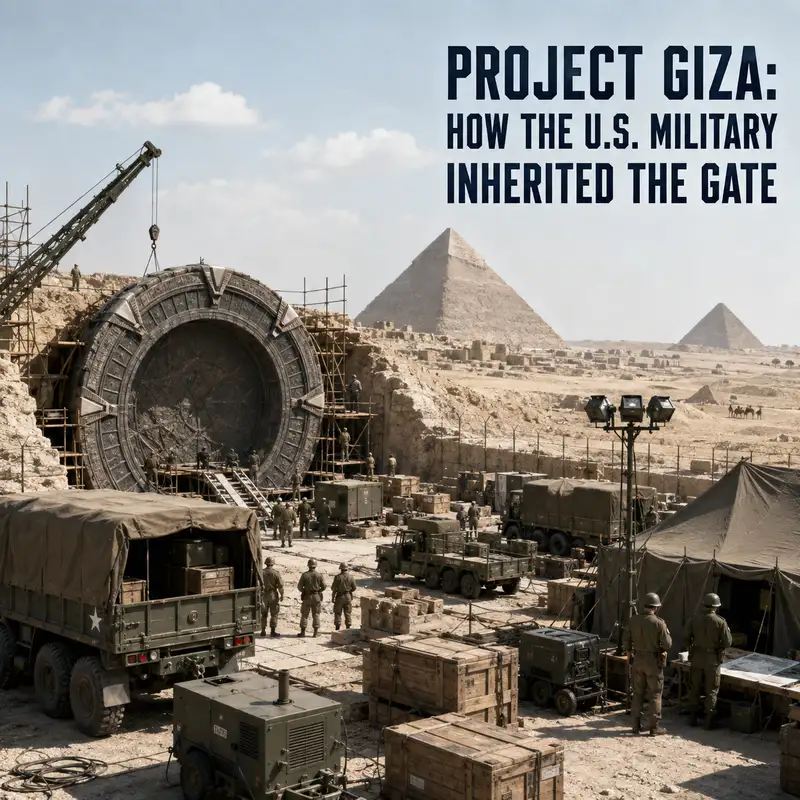
In nineteen thirty-nine, the most important cargo aboard the merchant vessel Achilles was not listed in terms its crew could fully understand. Inside a secured crate was the metal ring recovered near Giza eleven years earlier. American authorities believed the device might be a weapon, and Europe was moving toward war. The immediate mission was therefore simple. Move the artifact from Africa to the United States before Nazi Germany could obtain it. No one aboard needed to know how the machine worked. They needed only to keep the ship afloat and the crate out of enemy hands.
Much later, a Goa’uld named Ba’al would prove how much depended on that voyage. He traveled into the past and attacked the Achilles because preventing the Stargate from reaching America would prevent the modern Stargate Program from existing. A time-displaced Cameron Mitchell stopped him and restored the known timeline. The crew of nineteen thirty-nine could not have understood that their cargo was the hinge of a future interstellar war. From their perspective, it was an unidentified strategic object moving under wartime security. That was already enough to justify secrecy.
The United States did not inherit a functioning transportation system. It inherited a machine, an incomplete archaeological record, a warning no one understood, and a collection of institutional assumptions. Project Giza emerged from those fragments over decades. Its history was not a clean transfer from archaeologists to scientists and then to the Air Force. It was a sequence of custody decisions, classified experiments, abandoned files, revived funding, and increasing military control. The gate became an American strategic asset long before the United States knew what kind of asset it possessed.
Professor Langford’s expedition uncovered the ring and its cover stones at Giza in nineteen twenty-eight. The discovery established where the device had been buried, but the surviving screen record does not show the legal instrument by which an artifact excavated in Egypt became United States government property. It does not identify a purchase, treaty, loan, or formal transfer. The history jumps from discovery to American-directed shipment. That gap should remain a gap. We can describe physical custody with confidence. We cannot claim that the continuity provides a complete legal title.
This distinction matters because possession and ownership are not the same thing, especially when the object is older than every modern state involved. The Ancients built the Stargate. Ra used it during his occupation of Earth. Egyptian rebels buried it. Langford’s team excavated it. American authorities moved it. Each stage created a different claim based on creation, use, recovery, or control. Project Giza proceeded from the practical rule that the government guarding the ring could decide who studied it. That was effective security policy. It was not a settled answer to every diplomatic question surrounding the artifact.
The cover stones traveled into the American system with the ring, but they were handled as archaeological evidence rather than an operating manual. Their inscriptions preserved the connection to Ra, the deliberate burial, and the symbol sequence later used for Abydos. They did not explain wormhole physics, the network, or the missing control pedestal. This was the intelligence package Project Giza truly inherited: one machine, one partial address, and a historical warning translated through assumptions that proved wrong. The hardware suggested immense capability. The surviving text suggested danger. Neither told the custodians what procedures were required to use the device without repeating the disaster its burial had been intended to prevent.
The American inheritance was incomplete in a more immediate technical sense. The Giza Stargate had originally been paired with a dial-home device, the pedestal designed to provide power, select symbols, manage calculations, and enforce safety functions. That controller was missing from the nineteen twenty-eight excavation. Later records revealed that Germans had recovered it separately and that Soviet forces confiscated it after the Second World War. The United States held the doorway. Another great power held the proper control system. Neither government initially understood that together they possessed a complete installation.
That separation shaped the American program from the beginning. Without the dial-home device, the ring offered no obvious interface. Researchers had to build external power systems, rotate the inner track mechanically, detect chevron engagement, and guess which sequence might produce a useful result. Every successful function had to be recreated from observation. Every hidden safeguard remained unknown. The United States did not reverse-engineer the Stargate so much as construct an elaborate substitute for the missing control pedestal. It was a remarkable achievement built on an avoidable information failure no participant knew existed.
President Franklin Roosevelt supported wartime investigation because the device might have military value. That framing was understandable. The ring was made from an unknown material, absorbed large amounts of energy, and had been deliberately concealed beneath inscriptions associated with a powerful ancient ruler. In a global war, an unexplained machine with unusual energy behavior does not remain a museum piece for long. The first intelligence requirement was not whether it could transport explorers. It was whether it could be used as a weapon, copied by an enemy, or turned against the United States.
The nineteen forty-five experiments reflected that urgency. Professor Langford’s team combined civilian scholarship with military security, electrical equipment, cameras, generators, and personnel willing to turn a many-ton alien mechanism by hand. Ernest Littlefield recognized that the symbols could represent destinations rather than a single combination. The team established a wormhole, and Ernest crossed in a diving suit connected by an air line and rope. When the gate closed, the lines were severed. The laboratory had demonstrated interstellar transportation and lost the only person who could report what lay beyond it.
Institutionally, the experiment was treated as a fatal failure rather than a breakthrough. The program lacked a return method, an unmanned reconnaissance capability, a communications plan, and a theory explaining what had happened. Professor Langford told Catherine that Ernest had died in an explosion. The research stopped. Film and documents were sealed in Pentagon storage, while the Stargate itself was placed in an old Washington armory. The United States retained the hardware but abandoned the organizational memory required to understand its most important test.
That decision created two separate archives. One was physical and heavily guarded. The other was informational and badly fragmented. The gate could not be misplaced easily. The explanation of what had been done to it could. Decades later, senior personnel responsible for the revived program did not know that a wormhole had been opened in nineteen forty-five. Classification had protected the secret from foreign intelligence while also hiding it from the Americans trying to solve the same problem. Security had preserved custody and damaged continuity at the same time.
Catherine Langford began renewed research in the late nineteen sixties. A time-displaced S G One encountered her in nineteen sixty-nine and learned that the Stargate was still locked in a Washington armory. Catherine already knew its location even though the military would not acknowledge the object existed. The visitors asked about a second control artifact and may have encouraged her to resume the work that shaped their own future. Project Giza therefore contains one of the program’s quieter temporal loops. The later organization helped prompt the civilian effort that eventually made the later organization possible.
The exact administrative date on which Catherine’s renewed research became Project Giza is not firmly established on screen. The important transition is clearer than the paperwork. A private scholarly campaign regained access to a government-controlled artifact, attracted technical support, and eventually returned the gate to active military study. Over time, the project acquired secure facilities, specialized engineering, classified funding, and Air Force oversight. Catherine remained essential, but the state now controlled the machine, the site, the personnel clearances, and the decision to attempt activation.
The television continuity places the mature project beneath Cheyenne Mountain. The record does not provide a formal basing study, but the operational logic is strong. The site offered depth, controlled access, heavy electrical infrastructure, armed security, and an existing national-defense cover story. It also limited the consequences of an accident or hostile arrival. The location was not perfect. An active Stargate inside a command complex could place an enemy directly beneath a major defense installation. Before the iris existed, the security plan was essentially to guard the room and hope the next experiment behaved.
Project Giza was therefore a hybrid institution with an unequal division of authority. Civilian archaeologists, linguists, and scientists interpreted the evidence and designed the experiments. Military personnel supplied the secure facility, power, communications, engineering support, and command structure. Major General West could authorize access, restrict information, select an expedition commander, and approve the use of a nuclear weapon. Catherine had influence over research. West possessed the authority to convert research into an operation. The project belonged to both communities, but only one controlled force.
The engineering effort was far longer than the final rush that opened the gate. Samantha Carter later summarized the Earth dialing system as the product of fifteen years and three supercomputers. That work included rotating the inner ring, recognizing when chevrons engaged, controlling enormous power flows, and creating software capable of reproducing part of a dial-home device’s behavior. The result was not elegant by Ancient standards. It was a human-built interface attached to machinery no one could manufacture, repair completely, or explain. In defense acquisition terms, the prototype had become indispensable before anyone knew the original specifications.
What the system did not reproduce was equally important. The missing dial-home device normally maintained network updates, handled coordinate corrections, and applied safeguards its users rarely noticed. Earth’s computer imitated the functions researchers could observe. It did not automatically inherit every protection concealed inside Ancient architecture. Later operations would discover that the human system could bypass warnings, accept dangerous conditions, or fail to compensate for changes the original network expected its controllers to manage. Project Giza created access by replacing an unknown operating system with educated improvisation.
The remaining barrier was not power or machinery. It was interpretation. The cover stone displayed six destination symbols and a separate seventh mark. Project researchers treated the symbols as writing and assumed the six formed a code that would activate the ring. They had enough information to build the dialing apparatus but not enough to understand the address. The gate repeatedly accepted part of the sequence and refused to establish a connection. The project was mechanically capable and conceptually stalled.
Compartmentalization made the problem harder. Engineers worked on power and motion. Linguists worked on inscriptions. Military leaders judged whether the program justified continued funding. The nineteen forty-five activation was hidden in another archive. The German and Soviet possession of the dial-home device was unknown. No single team could assemble all of the relevant evidence because no single team knew the evidence existed. Project Giza’s greatest obstacle was not alien physics. It was a familiar intelligence problem in which fragments were protected so effectively that analysis could not connect them.
Captain Samantha Carter represented the Air Force effort to bridge those gaps. She combined theoretical astrophysics, engineering knowledge, and military experience, and she had worked on the project before its first operational expedition. Her expertise helped make the dialing system possible, but she was not given the decisive archaeological insight. She also spent time developing proposals that could justify the project’s continuation. That is another form of logistics. A classified program without visible results still requires money, personnel, computer time, electrical power, and senior officials willing to defend it against cancellation.
Catherine solved the personnel problem by recruiting Daniel Jackson. He was professionally isolated, fluent in ancient languages, and willing to reconsider accepted assumptions. General West noted that Daniel appeared to solve in fourteen days what the existing team had not solved in two years. The comparison was less an indictment of everyone already present than proof that the project had been asking the wrong kind of question. Daniel corrected the translation, recognized constellations rather than words, and identified the seventh symbol as Earth’s point of origin.
His breakthrough did not create the Stargate’s power system or dialing machinery. Project Giza had already built those. Daniel supplied the missing conceptual model that made the hardware useful. Six symbols defined a location in three-dimensional space. The seventh established where the journey began. Once that interpretation was programmed into the computer, the gate locked all seven chevrons and opened a stable wormhole. The project’s decisive advance came from combining archaeology with astronomy, not from one discipline defeating another.
The instant the wormhole formed, the balance of authority shifted. A research artifact had become a route to an unknown destination. General West did not authorize an open-ended scientific expedition. He assigned Colonel Jack O’Neill to lead a military team, placed Daniel with them because he might identify a return address, and provided a nuclear device. The standing logic was containment. If the far side presented a threat, the weapon could destroy the destination gate and prevent hostile use of the route. That plan assumed the threat was local, the gate was the only access point, and a nuclear detonation would end the problem.
Project Giza did perform reconnaissance before sending people. A wheeled probe transmitted images and basic environmental data from the destination. That was an important improvement over Ernest’s mission. It still answered only limited questions. The probe could show a room and measure an atmosphere. It could not explain who controlled the planet, whether the destination gate had a working dial-home device, whether hostile forces were nearby, or whether a ship in orbit could intervene. The first Abydos expedition crossed with better sensors than the nineteen forty-five team and almost the same absence of political intelligence.
The Abydos mission proved both the value and the danger of military custody. O’Neill’s team survived, helped overthrow Ra, and used the nuclear weapon against Ra’s departing ship rather than the Stargate. Daniel remained on Abydos. O’Neill reported that Daniel was dead and that the destination gate had been destroyed, protecting the Abydonians from further American contact. On the basis of that report, the mission appeared complete. Project Giza had reached one world, eliminated one threat, and closed the route. Personnel and attention began to decline.
That near-closure demonstrates how little the United States still understood. The government believed the Stargate connected Earth to one destination. It did not know that thousands of addresses existed, that Goa’uld rulers used the network across the Milky Way, or that an enemy could dial Earth from another gate. The device was guarded, but the guards did not possess the doctrine later considered basic. There was no mature authentication system, no iris, and no expectation that armored troops might arrive uninvited. Physical custody had created confidence before knowledge justified it.
Apophis’s raid ended that confidence. Jaffa entered the Cheyenne Mountain gate room, killed personnel, seized an airwoman, and withdrew through the wormhole. Major General George Hammond, who had replaced West, recalled O’Neilll and reopened the Abydos question. Daniel revealed the larger address archive. Carter applied stellar-drift calculations. The military created S G teams and transformed the declining research effort into Stargate Command. Project Giza did not simply receive a new name. Its mission changed from understanding one artifact to conducting reconnaissance, diplomacy, intelligence collection, and planetary defense across a network.
The military inheritance of the gate was therefore cumulative. The United States first gained physical custody, then experimental access, then computational control, then authority to send personnel, and finally responsibility for defending Earth from whatever came back. At no point did custody equal complete understanding. Each advance solved one problem and exposed another. Moving the ring out of enemy reach created a research burden. Activating it created an extraction problem. Opening it reliably created an invasion route. Sending a team created political obligations on another world.
The missing dial-home device is the clearest symbol of that incomplete inheritance. While Project Giza spent years constructing a substitute, the original controller remained outside American possession and eventually in Soviet hands. The United States appeared to monopolize the Stargate because it controlled the ring and the underground room around it. In reality, another state possessed a critical part of the same installation. The later Russian program would prove that national control of alien infrastructure was contingent, fragmented, and vulnerable to events neither side had planned.
Project Giza also established a political pattern that would persist. Decisions of planetary importance were made inside a highly compartmented American command structure because the United States had the artifact, the facility, and the means to operate it. The public did not know. Most elected officials did not know. Foreign governments did not know that an archaeological discovery from Egypt had become a strategic system under United States military control. Secrecy made rapid action possible. It also postponed every argument about ownership, oversight, international participation, and who had authority to represent Earth beyond the gate.
The United States military inherited the Stargate by moving it, guarding it, funding it, and refusing to abandon it completely. What it inherited was not Ancient mastery. It was responsibility without instructions. Project Giza succeeded because soldiers, scientists, engineers, and scholars eventually combined enough partial knowledge to make the ring work. It failed whenever secrecy kept those fragments apart or when custody was mistaken for comprehension. The crate delivered by the Achilles became a doorway under Cheyenne Mountain. Along the way, the United States acquired control of the room, then discovered that the far side had never belonged to it.