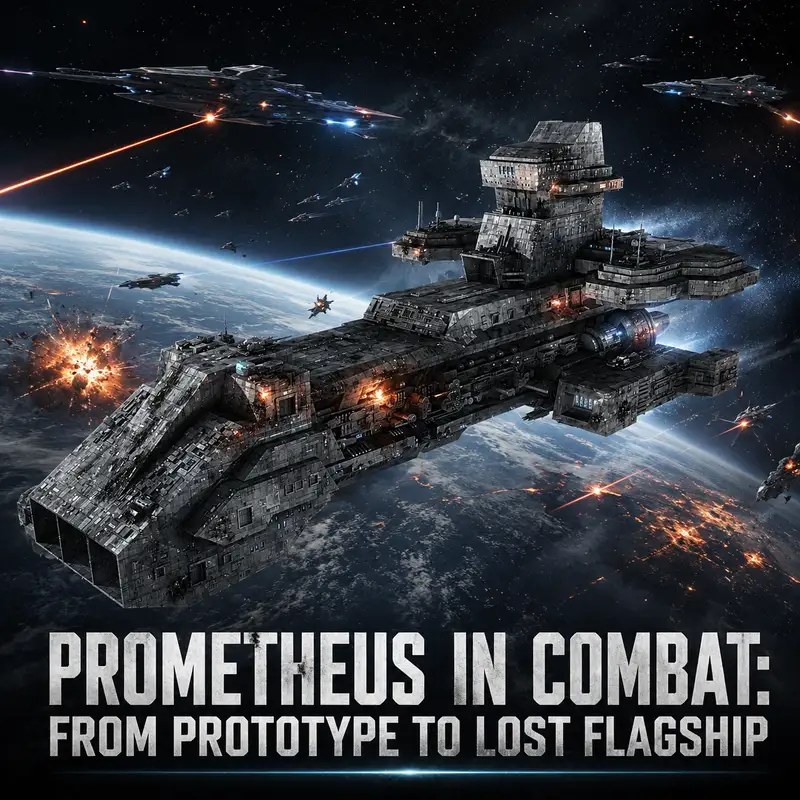
Prometheus in Combat: From Prototype to Lost Flagship
The first beam from the Ori-designed satellite crossed the space above Tegalus and struck Prometheus before its crew had time to redefine the engagement. The Asgard-derived shields failed to stop it. Energy cut through the hull, tore across several decks, and disabled systems that Colonel Lionel Pendergast needed to fight or withdraw. Prometheus had survived Goa’uld attacks, an unstable hyperdrive, a hostile boarding, and the Battle of Antarctica. Now Earth’s first battlecruiser was being dismantled by a weapon built by humans from alien instructions.
Its destruction raises the central question of Prometheus’s service. How did an experimental hybrid become Earth’s de facto flagship, and why did a ship that had survived so many impossible missions die in a battle against a single orbital platform? The answer is not that Prometheus was secretly weak, or that its final crew simply made the wrong decision. The ship became indispensable before Earth possessed a mature fleet, then accumulated missions faster than its design, intelligence support, and defensive systems could evolve.
Prometheus entered service as the X three-oh-three, a prototype assembled from human engineering and alien-derived technology. Its designation later changed to B C three-oh-three as it moved from experimental testing into operational duty. That change did not remove the uncertainties inside the hull. Early propulsion depended on unstable naquadria. Critical systems used control crystals developed from Goa’uld designs. Asgard upgrades improved the ship dramatically, but Earth still lacked the industrial civilization that normally built and maintained those systems. Prometheus was a warship, a laboratory, and a training program occupying the same decks.
Earth also had no comparable vessel to share its burden. The F three-oh-two could defend local airspace and attack targets in orbit, but it lacked the endurance and command facilities of a capital ship. Stargate teams could gather intelligence or sabotage an enemy position, but they could not patrol the Solar System or carry a fighter squadron between stars. For several years, nearly every mission requiring a human starship became a Prometheus mission. Earth had built a flagship before it had built a fleet, which simplified ship assignment considerably.
Its first interstellar operation did not involve a conventional battle. The Asgard needed a vessel able to enter Replicator-controlled space without attracting immediate attention. Prometheus qualified because the Replicators regarded its technology as too primitive to be useful. S G One landed the ship on Hala and reset a time-dilation device intended to trap the machines. The mission succeeded through infiltration and scientific action rather than ship-to-ship firepower. Prometheus’s strategic value was already clear. It could place a team where the Stargate could not and remain available for extraction.
The Asgard later installed improved shields and weapons as recognition for Earth’s assistance. Those systems made Prometheus more survivable, but they did not turn it into an Asgard vessel. Human crews still operated a hybrid architecture with limited redundancy and an incomplete understanding of some components. Its shakedown cruise under Colonel William Ronson ended when the naquadria-powered hyperdrive failed far from Earth. The reactor had to be jettisoned, and the ship landed on Tagrea while S G One searched for the planet’s buried Stargate.
That episode mattered to the ship’s combat history because it established the conditions under which Prometheus would fight. Strategic mobility depended on propulsion that could fail beyond rescue range. Repairs depended on parts sent through a Stargate that might be buried or politically inaccessible. A battlecruiser could dominate the sky above a less advanced world and still be stranded there by one unstable power system. Prometheus was powerful at the tactical level, but its ability to remain in the theater depended on a very narrow logistical chain.
The return voyage provided its first sustained encounter with an unknown hostile ship. Prometheus was using a hyperdrive adapted from an Al’kesh, a vessel much smaller than the Earth battlecruiser, and had to stop periodically for the engine to cool. During one of those pauses, an unidentified craft attacked. Ronson ordered Prometheus into a corrosive gas cloud for concealment. The enemy transported most of the crew away, leaving Major Samantha Carter injured aboard a damaged ship whose sublight engines no longer functioned.
Carter survived by treating the ship itself as an engineering problem. She created a partial hyperspace shift that reduced the cloud’s effect long enough to restore propulsion, then negotiated the return of the crew by offering to tow both vessels to safety. Prometheus did not defeat the attacker with missiles. It escaped through technical improvisation and a limited agreement with an adversary whose motives remained uncertain. The encounter reinforced a pattern that would define the ship. Its most decisive weapon was often the expertise of the people keeping it operational.
The Battle of Antarctica transformed Prometheus from an experimental vessel into a national symbol. Anubis arrived with a fleet large enough to impose surrender on Earth. S G One had located an Ancient outpost beneath the Antarctic ice, but reaching it required crossing airspace controlled by death gliders and Al’kesh bombers. President Henry Hayes ordered Prometheus launched under General George Hammond, with F three-oh-two fighters supporting the operation. The ship’s task was not to destroy the entire invasion force. It was to keep the route to the outpost open.
That distinction shaped the engagement. Prometheus protected the modified Tel’tak carrying S G One while fighters intercepted attacking craft. Once the team reached the outpost, Hammond took the battlecruiser toward orbit and engaged Anubis’s larger ships. Prometheus’s shields deteriorated under fire. Its weapons could contest the approach and impose costs, but they could not defeat the fleet before the ship was destroyed. Hammond prepared to place Prometheus on a collision course with Anubis’s flagship when conventional options ran out.
The ramming attack was never completed. O’Neill activated the Ancient control chair beneath the ice, and drone weapons annihilated the Goa’uld fleet. Prometheus survived because another system won the battle. That does not make its contribution secondary. The battlecruiser and its fighters created the time, space, and protection needed for S G One to reach the decisive weapon. Prometheus performed the role that would define much of Earth’s early space doctrine. It held a stronger enemy long enough for a small team to attack the enemy’s real vulnerability.
Antarctica also created the ship’s reputation as Earth’s flagship. Prometheus had fought above the homeworld under a senior commander, survived the largest attack Earth had yet faced, and remained the only operational human capital ship. Afterward, Colonel Lionel Pendergast assumed command, and the vessel served as an orbital first line of defense. Its presence gave Washington a response to unidentified ships that did not begin with waiting for an alien ally. The deterrent value was partly real and partly reputational. Potential enemies remembered what had happened to Anubis, even if Prometheus had not fired the Ancient drones.
The ship’s commanders reflected that transition. Ronson treated Prometheus as a test platform whose limits had to be identified before they killed the crew. Hammond used it as a strategic reserve during an existential attack, accepting the possibility that the ship itself might have to be sacrificed. Pendergast commanded it as a standing warship, responsible for orbital patrol, rapid response, and the lives of a permanent crew. The hull changed through refits, but the larger change was institutional. Prometheus stopped being a project flown by specialists and became a unit expected to answer an alert on short notice.
The ship’s combat record under Pendergast was less theatrical and more representative of actual planetary defense. When the Trust stole Earth’s Stargate and used a cloaked Al’kesh to conduct attacks with symbiote poison, Prometheus was called into orbit before its new Asgard hyperdrive installation was complete. Daniel Jackson disabled the Al’kesh’s cloak, allowing the battlecruiser to target it. Pendergast was prepared to fire, but S G One and the stolen gate remained aboard the hostile vessel.
The decision became one of fire control rather than firepower. Pendergast held his shot while General Jack O’Neill allowed the team a few more seconds. Prometheus then used its newly installed Asgard transporter to recover S G One and the Stargate before the Al’kesh escaped into hyperspace. The mission was only a partial success. Earth recovered its gate and personnel, but the Trust retained the ship, poison, and freedom of movement. Prometheus had the weapons to destroy the target and lacked the operational conditions to use them safely.
The same Al’kesh later returned with Goa’uld-controlled Trust operatives and became part of an attempt to provoke nuclear war between the United States and Russia. Prometheus transported Daniel and former vice president Robert Kinsey from Moscow, then came under attack when the cloaked vessel revealed itself. The battlecruiser’s shields absorbed the Al’kesh’s fire. When the enemy prepared another attack, Pendergast ordered Prometheus to fire first and destroy it.
This was one of the ship’s clearest independent combat victories. It was also a limited one. An Al’kesh was a dangerous bomber and transport, not a Ha’tak mothership. Prometheus could defeat it in near-Earth space once the target became visible and the rules of engagement were clear. The larger crisis was resolved through counterintelligence and cooperation with Russian officials, not naval fire. The battlecruiser removed one enemy platform. It could not determine which political leaders had become hosts or stop nuclear forces from acting on false information.
Prometheus’s attempted mission to Atlantis revealed another vulnerability. General Hammond took command for an intergalactic rescue after contact with the expedition was lost. A distress signal drew the ship toward a damaged Al’kesh, where Vala Mal Doran boarded in Kull armor, incapacitated most of the crew, and seized control. Daniel remained aboard and fought her for the ship while Hammond’s personnel repaired the vessel on which they had been abandoned.
Prometheus was recovered after Hammond’s improvised crew arrived in the repaired Al’kesh and destroyed the Goa’uld craft attacking it. The rescue mission had to be abandoned because the battlecruiser was damaged. Once again, the ship had not been defeated by superior fleet tactics. It had been compromised through rescue procedures, transporter access, and internal security. Prometheus carried advanced shields and an intergalactic hyperdrive, but those systems offered limited protection when a hostile individual reached the control spaces.
By the time the Ori began establishing a beachhead in the Milky Way, Prometheus had become a mature operational platform. At Kallana, it transported S G One and a Mark Nine naquadria-enhanced nuclear weapon to a planet where an expanding force field surrounded the Stargate. The mission initially appeared to be a precision strike. Place the weapon near the gate, destroy the Prior’s installation, and prevent the Ori from creating a permanent route into the galaxy.
The intelligence picture was incomplete. The force field absorbed the energy directed against it. The Mark Nine and the bombardment from Free Jaffa Ha’tak vessels strengthened the expanding dome rather than breaking it. Segments of an enormous supergate emerged from the active Stargate and accelerated into orbit. Several pieces struck or destroyed Jaffa ships. Prometheus maneuvered among the moving structures, sustained damage, and remained in the system while Kallana collapsed into the singularity intended to power the new gate.
Prometheus could not stop the process with its own weapons. Vala used a cargo ship to occupy the position of the final supergate segment, destabilizing the structure as the singularity formed. The ring was destroyed, and Prometheus survived the resulting energy release. The mission prevented an immediate Ori fleet transit, but it also exposed the limits of Earth’s strongest Milky Way vessel. Against civilization-level engineering, the battlecruiser functioned as transport, command post, sensor platform, and survivor. It was not the decisive weapon.
That record is important because later accounts can make Prometheus appear unsuccessful in combat. It rarely destroyed capital ships, and many of its missions ended with damage, emergency repair, or assistance from another force. The criticism assumes the ship was designed and fielded inside a mature fleet. It was not. Prometheus was the bridge between Stargate special operations and sustained space warfare. Its primary contribution was giving Earth independent presence, not guaranteeing victory against every advanced opponent.
The ship carried teams beyond the gate network, recovered personnel through Asgard transporters, deployed fighters, monitored Earth’s orbit, and gave commanders a platform from which to coordinate mixed operations. Its shields could withstand attacks that would have destroyed any conventional human vehicle. Its weapons were effective against smaller Goa’uld craft and useful in larger battles. Its shortcomings became visible because Earth repeatedly sent one ship to perform missions that a mature force would assign to a task group with escorts, intelligence support, and reserve capacity.
Tegalus was the mission where those shortcomings converged. The Rand Protectorate and the Caledonian Federation had already fought a destructive war after the public activation of their Stargate. The Ori then offered Rand the design for an orbital satellite weapon in exchange for accepting Origin. Rand threatened Caledonia with destruction. Jared Kane asked Earth to intervene before another war devastated the planet.
Daniel Jackson pursued diplomacy on the surface. Prometheus entered the system as the military alternative, prepared to destroy the satellite if negotiations failed. The arrangement created competing objectives. Earth wanted to prevent mass killing, preserve Daniel’s mission, avoid becoming a participant in the planetary war, and remove a weapon built with Ori assistance. Those goals required time and restraint. The satellite’s operators required only a firing solution.
Earth possessed schematics for the weapon, but the information did not reveal its complete defensive capability. When the satellite powered up, Prometheus launched missiles in a preemptive attack. A shield absorbed the strike. The satellite then fired an energy beam that penetrated the battlecruiser’s defenses and cut through the hull. Engines, weapons, life support, and internal communications began failing across multiple decks. The crew had entered the engagement expecting a brief attack followed by withdrawal. They discovered that the target could survive the first volley and prevent the withdrawal.
Pendergast attempted to save both the mission and his people. He ordered damage control, sought power for the sublight engines, and offered the ship’s surrender after it became clear Prometheus could not continue fighting. Rand’s president rejected the surrender and ordered another attack. Carter and the engineering teams redirected power toward the Asgard transporter. The ship that had once beamed S G One and the Stargate out of an enemy vessel now used the same system to evacuate its own crew.
Pendergast remained aboard to complete the evacuation. Seventy-six of more than one hundred fifteen personnel reached Caledonian territory. Thirty-nine people, including the captain, died when the satellite’s final strike destroyed Prometheus. The surviving crew had no ship, Daniel remained entangled in the planetary crisis, and the weapon was still operational. This was not a tactical withdrawal disguised as success. Earth had lost its first battlecruiser without achieving the assigned military objective.
The loss resulted from several failures acting together. Intelligence underestimated the satellite’s shield and beam weapon. The operation placed one irreplaceable ship inside the weapon’s engagement range without another capital ship available for support. The diplomatic mission delayed a clean preemptive strike, while the military backup encouraged negotiators to believe force remained available if talks failed. Once Prometheus fired and the satellite answered, the battlecruiser lacked the speed, protection, and redundancy to recover from the first hit.
Technological asymmetry was decisive. Prometheus carried Asgard-derived shields, yet the Ori design cut through them with little difficulty. Earth could integrate advanced technology and still encounter an enemy operating at a higher level. The ship’s hybrid nature was not the sole cause of its loss, but it limited how much punishment the crew could absorb after the shields failed. Critical systems crossed shared compartments and power networks. Damage that began as a weapons hit quickly became a propulsion, life-support, and evacuation problem.
The contrast with Antarctica is revealing. In both battles, Prometheus faced a weapon system it could not defeat directly. Above Antarctica, its task was to buy time for S G One to activate an Ancient arsenal. At Tegalus, there was no second decisive capability waiting below. Prometheus itself was expected to become the solution once diplomacy failed. The ship fought as though it were the final layer of force, and the enemy proved that it was not.
Its destruction did not show that the Prometheus program had been a mistake. The ship had preserved Earth at Antarctica, supported operations against the Replicators, contained Trust attacks near the homeworld, survived the Kallana beachhead, and trained the crews and engineers who would operate later battlecruisers. Every repair, upgrade, and emergency became design knowledge. Prometheus’s record was expensive because it performed the work of an entire developing space service while remaining a single hull.
The newer B C three-oh-four class inherited the lessons. Its systems were integrated more cleanly, its Asgard technology was planned into the design, and additional ships reduced the danger of placing every strategic mission on one platform. Prometheus had made that progress possible by revealing what failed outside the laboratory. Its destruction accelerated the transfer from prototype-centered operations to a fleet structure, even though Earth still possessed too few ships for the commitments it had accumulated.
Prometheus became Earth’s flagship because it was available, flexible, and capable of reaching battles no other human platform could reach. It was lost because availability had been mistaken for sufficiency. One ship was asked to deter invasion, police Earth orbit, rescue expeditions, carry strategic weapons, support diplomacy, and defeat technology derived from ascended enemies. Pendergast could not save the hull, but he saved most of the crew. They materialized on Tegalus carrying the experience that Prometheus had purchased mission by mission. The flagship was gone. The fleet it had taught Earth to build remained.