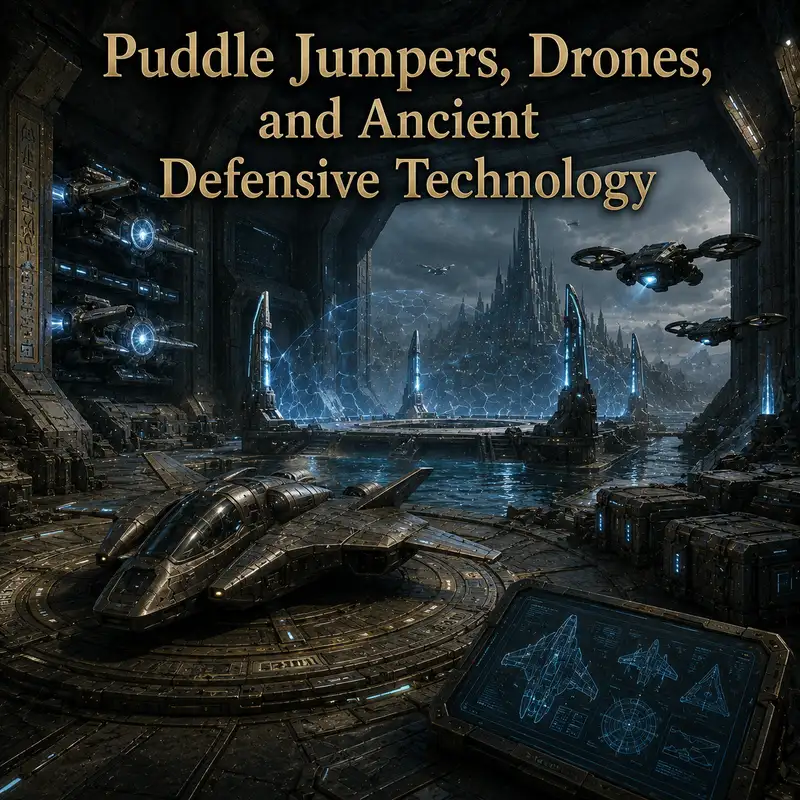
Puddle Jumpers, Drones, and Ancient Defensive Technology
Carson Beckett did not intend to fire on General Jack O’Neill. He had only sat in the Ancient control chair because Rodney McKay insisted that someone with the right genetic marker had to test it. The chair activated, Beckett’s thoughts reached a dormant weapon, and a glowing drone launched from the Antarctic outpost toward the helicopter carrying O’Neill and Major John Sheppard. Beckett stopped it before impact. The Atlantis expedition’s first hands-on demonstration of Ancient defensive technology was therefore both impressive and deeply inconvenient. A weapon could acquire and pursue an aircraft without a conventional targeting console. It could also interpret an operator’s thought before he understood that he had issued a command.
That accident revealed the central problem Earth would face in Atlantis. Ancient defenses were not a collection of independent machines waiting for labels and instruction cards. They were parts of an integrated system built for Lantean bodies, Lantean power supplies, Lantean training, and Lantean command networks. Puddle Jumpers, drone weapons, control chairs, shields, sensors, Stargate barriers, and orbital satellites reinforced one another. Under their builders, the system could defend a city, move personnel through the gate network, and strike ships in orbit. Under the Atlantis expedition, many of the same devices became rare assets operated by people who could activate them more easily than they could explain, repair, or replace them.
The Puddle Jumper was the most useful part of that inheritance because it solved several operational problems at once. It was small enough to pass through a Pegasus Stargate, capable of atmospheric flight and space operations, and designed to deploy directly from Atlantis. Its engine pods retracted so the craft could fit through the ring. Integrated dialing controls allowed the crew to open a gate without landing beside a conventional dial-home device. The Ancient name for the craft was never clearly established. Sheppard rejected the more formal suggestion of Gateship and chose Puddle Jumper, a name that sounded less like a procurement program and more like something a pilot might actually remember while being shot at.
A Jumper was not a dedicated fighter. It was a compact transport, reconnaissance platform, infiltration craft, shuttle, and armed utility vehicle. The forward compartment held the pilot and mission systems. The rear compartment carried personnel, equipment, casualties, prisoners, or whatever discovery had just become too dangerous to leave on another world. The expedition used Jumpers for first contact, medical evacuation, orbital survey, covert insertion, gate rescue, cargo movement, and strikes against Wraith vessels. That flexibility mattered more than raw speed. Atlantis did not need a small craft that performed one mission perfectly. It needed one that could leave as a diplomatic shuttle and return as an emergency ambulance with enemy fire behind it.
The built-in cloak gave the Jumper its greatest tactical advantage. When engaged, the craft could disappear from ordinary sight and evade Wraith scans. That allowed Sheppard’s teams to approach hives, observe cullings, move through defended airspace, and place weapons where an uncloaked aircraft would have been destroyed. The cloak did not make the crew invulnerable. A collision, a known flight path, an open bay door, a compromised landing site, or a brief period of exposure near a Stargate could still reveal the craft. Concealment reduced the enemy’s opportunity to fire. It did not strengthen the hull when the enemy found the target.
Ancient sensors made the Jumper more than an invisible transport. A portable life-signs detector found aboard Atlantis could identify people and Wraith inside structures, while Jumper systems provided navigation, environmental data, and contact with the city. These tools changed reconnaissance by allowing a small team to see beyond the next corridor or tree line. They did not answer the questions intelligence officers care about most. A life-sign remained only a life-sign. The display did not automatically identify loyalty, intent, command status, or whether the person being tracked had already prepared an ambush. Ancient detection improved collection. Analysis still belonged to the crew.
The control interface was equally important. Much of the Jumper responded to thought through the Ancient technology activation gene. Sheppard possessed an unusually strong natural version of that trait and could operate systems with little preparation. Carson Beckett and others also carried the gene, while Beckett’s therapy allowed some personnel without it to activate Ancient equipment. The treatment expanded the pool of possible operators, but it did not give everyone Sheppard’s instinctive control. Genetic access was authorization, not qualification. A pilot still had to learn the craft, understand the mission, and avoid thinking too enthusiastically about the weapons while parked inside the hangar.
The consequences of mechanical failure were severe because the craft’s special design also created special vulnerabilities. During one return to Atlantis, a damaged engine pod failed to retract and left a Jumper trapped partway through a Stargate. The forward section had entered the wormhole while the rear remained in space. The crew could not simply reverse out, and the connection would eventually end. Atlantis technicians had to understand an Ancient mechanism under a fixed deadline while the team treated an injured Sheppard aboard the immobilized craft. The incident demonstrated that extraordinary mobility still depended on maintenance, diagnostic access, and a rescue plan for the moment one moving part refused to move.
Puddle Jumpers gave Atlantis reach, but not occupation power. One craft could place a team behind enemy lines, recover a few prisoners, or inspect a space-based gate. It could not secure a continent, hold an orbit against a hive fleet, or protect every village connected to the gate network. The expedition sometimes used Jumpers as a fighter screen because no better aircraft were available locally. That was improvisation, not proof that the vehicle had become an ideal interceptor. The craft survived by stealth, precision, and selective engagement. Using it as a conventional combat aircraft spent an irreplaceable platform in a role for which Earth already understood the value of armor, redundancy, and mass.
The experimental exceptions make that distinction important. Janus built a Jumper capable of time travel, and the expedition later completed a separate prototype fitted with a hyperdrive. Those craft proved that the basic design could support extraordinary modifications. They did not establish that every Jumper could cross interstellar space without a Stargate or move through time on command. The normal fleet remained dependent on local propulsion and the gate network. In operational terms, Atlantis possessed a hangar of advanced shuttles, one or two unusual prototypes, and no production line. Treating the exceptions as standard capability would have produced a very optimistic flight schedule and a very short campaign.
The Jumper’s principal weapon was the Ancient drone. Despite the name, a drone was not a mechanical soldier or a reusable aircraft. It was a compact guided weapon that could maneuver after launch, seek designated targets, penetrate defenses, and attack from angles conventional missiles could not easily reproduce. Drones appeared in Puddle Jumpers, city arsenals, warships, and Ancient outposts. Their common design allowed the same basic weapon concept to operate from several platforms. The number available, the control method, and the scale of the launch changed with the installation. A Jumper carried a limited combat load. A major outpost could release a swarm.
The control chair turned that swarm into something more dangerous than massed ammunition. Rather than steering each weapon through a bank of switches, a compatible operator could designate targets through a neural interface. The system translated intention into movement, coordinated multiple drones, and allowed them to maneuver around friendly forces. At Antarctica, O’Neill used the outpost chair to launch the buried arsenal against Anubis’s fleet. The weapons passed Earth’s aircraft and ships, tore into Goa’uld vessels whose shields could not stop them, and destroyed the invading force. Earth’s greatest planetary defense victory had been achieved by one operator, one power source, one chair, and a stockpile manufactured before recorded human history.
The battle also created a misleading impression of abundance. The Antarctic outpost released enough drones to destroy a fleet, but Atlantis did not begin its first Wraith siege with an equivalent reserve. By then the city’s arsenal had been heavily depleted during the ancient war. The expedition counted only a few dozen usable drones for the control chair. Those weapons were still formidable, yet every launch reduced a stockpile Earth could not replenish. A drone destroyed a target and then ceased to exist as an available weapon. The expedition had inherited ammunition, not a manufacturing capability, and the distinction became more important with every successful shot.
Puddle Jumper drones were therefore used selectively. They could eliminate a fortified target, disable sections of a hive ship, or clear dangerous debris when Atlantis drifted through an asteroid field. Each mission had to justify spending weapons that might be needed for the next siege. The asteroid operation captured the uncomfortable logic of inherited technology. Drones designed for combat became the safest way to protect the city from collision, but every rock destroyed also consumed part of Atlantis’s defensive reserve. The weapon worked perfectly. The logistical report remained less enthusiastic.
Drone effectiveness depended on the network controlling them. When hostile forces controlled Atlantis, the city’s own drones could be launched against expedition personnel. When the Antarctic chair was later moved to Area Fifty-One and destroyed during a Wraith attack, the surviving drone cache lost its normal command interface at the moment Earth needed it most. The weapon and the controller were separate centers of gravity. Protecting one without the other did not preserve the capability. Ancient design assumed a functioning civilization able to repair command stations and replace operators. Earth usually had one chair, a limited group of compatible personnel, and enemies who were increasingly aware of both facts.
The chairs themselves were not oversized firing buttons. They linked an operator to a wider installation, allowing access to weapons and other systems through thought. Atlantis had a chair similar to the one in Antarctica, but activating it during the first siege required a heavily modified naquadah generator because the city lacked adequate Ancient power. Even then, the generator could support only limited use. The chair simplified control while concentrating risk. A compatible operator had to remain in a fixed location, the power connection had to remain stable, and the city network had to recognize the command. One severed conduit could turn strategic firepower into unusually elegant furniture.
Atlantis’s main shield represented the defensive side of the same design philosophy. At full power it could surround the city, hold back an ocean, resist orbital bombardment, protect the towers during atmospheric flight, and preserve the structure through conditions that would destroy an ordinary base. The shield did not make Atlantis invincible. It converted available energy into time. The more pressure it absorbed, the faster its power reserve fell. During the ancient siege, that allowed the Lanteans to survive inside the city while losing the wider war. During the expedition’s arrival, the same shield nearly failed after ten thousand years beneath the sea.
Power shortages forced the expedition to use the shield in ways its builders had not intended. Engineers sometimes reduced the protected area to the central tower, abandoning outer sections to preserve life support and command functions. During the first modern Wraith siege, McKay and Zelenka modified the field into a citywide cloak. The Daedalus created a nuclear explosion above Atlantis, the cloak concealed the city, and the Wraith concluded that the base had destroyed itself. The solution traded physical protection for deception. Atlantis could hide or absorb fire, but not do both at full effectiveness with the same field. Survival depended on convincing the enemy not to test the distinction.
The Stargate shield was a different defensive system with a narrower mission. It formed a barrier across the Atlantis event horizon and prevented unauthorized matter from entering the gate room. Radio signals and identification codes could be received before the expedition lowered the barrier for an allied team. The shield turned the gate from an open doorway into a controlled checkpoint and performed the same basic role the iris served on Earth. Its value came from routine use. Hive ships were dramatic threats, but one compromised traveler or hostile object arriving through the Stargate could destroy the command center without ever entering orbit.
Gate defense still depended on procedure. Controllers had to recognize the incoming code, confirm the situation, and decide whether the person transmitting it remained in control of the radio. Lowering the shield for a known team could admit an infiltrator traveling beside them. Refusing to lower it could kill allies who had reached the gate under fire. The barrier protected only the event horizon. It did not stop an enemy already inside Atlantis, prevent a cyberattack on city systems, or defend against weapons in space. Ancient technology secured the chokepoint. Human judgment decided when to open it.
The Lanteans had also defended Atlantis beyond the city. Their orbital network included powerful satellites positioned along likely approaches. One surviving platform was found as Wraith hive ships advanced on the modern expedition. McKay and Peter Grodin restored enough power for a single engagement. The satellite fired a sustained beam that cut one hive ship apart. Then the improvised power routing failed. The weapon could not fire again, the remaining Wraith ships destroyed the platform, and Grodin was killed aboard it. One Ancient satellite had the firepower to destroy a capital ship. Without the original network and support system, it was a one-shot ambush.
That loss revealed the difference between a weapon and a defense architecture. The ancient system had likely combined satellites, warships, long-range sensors, city drones, shields, and mobile craft. Each layer forced the enemy to solve another problem. Satellites attacked the approach. Ships contested space. Jumpers moved personnel and struck exposed targets. Drones delivered precision fire. The city shield protected the base. The Stargate barrier denied direct entry. Remove maintenance, power generation, manufacturing, crews, and secure communications, and the same architecture became a set of isolated relics. Each relic remained dangerous. None could cover the gap left by all the others.
Ancient personal shields showed the problem on a smaller scale. After receiving the gene therapy, McKay activated a device that wrapped him in a protective field. It stopped bullets, absorbed impacts, and allowed him to survive a fall that should have been fatal. It also refused to disengage, prevented him from eating or drinking, and responded according to rules he did not understand. The device eventually protected him during a dangerous encounter, but it never became standard expedition equipment. A successful test had demonstrated extraordinary protection and unacceptable control problems. In research terms, that was useful data. In an armory, it was a warning label.
Sensors and automated defenses carried similar uncertainty. Atlantis could detect distant ships, monitor parts of the city, track life signs, and coordinate systems faster than an Earth staff could manage manually. Those capabilities improved warning and command, but they also centralized information inside a network inherited from another civilization. Hostile occupants, Asuran access, damaged control crystals, or corrupted software could turn the city’s automation into a vulnerability. The expedition learned to combine Ancient sensors with Earth radios, human patrols, biometric checks, and ordinary guards. Redundancy was less elegant than the Lantean ideal. It was also easier to understand when the lights went out.
Maintenance became the quiet battlefield behind every mission. Zelenka, McKay, and their teams inspected control crystals, rewired power systems, repaired Jumpers, and kept interfaces operating without a complete industrial base. Some components could be substituted with Earth equipment. Others had to be recovered from unused sections, salvaged from damaged craft, or preserved because no replacement existed. The expedition could operate Ancient technology more often than it could restore it to original condition. Every damaged Jumper reduced the transport pool. Every drone fired reduced the arsenal. Every control device lost narrowed the number of options available to the next commander.
This scarcity changed doctrine. Puddle Jumpers became the preferred tool for reconnaissance, covert movement, and gate access because stealth preserved the craft better than direct combat. Drones were reserved for targets important enough to justify the expenditure. The city shield was raised when concealment, evacuation, or conventional defenses could not manage the threat. The Stargate shield remained active by default because preventing entry cost less than fighting inside the control room. Earth railguns, explosives, fighter aircraft, and battlecruisers filled the gaps Ancient systems could not cover. Atlantis survived through a layered defense assembled from technologies separated by millions of years and several incompatible maintenance manuals.
The expedition also learned that Ancient equipment magnified the judgment of the person using it. Beckett’s accidental launch showed how quickly an untrained thought could become a weapon. O’Neill’s control of the Antarctic drones showed what a prepared operator with Ancient knowledge could accomplish. Sheppard’s skill with Jumpers allowed missions that other pilots could not have attempted as confidently. McKay’s modifications repeatedly turned dormant systems into operational capabilities, sometimes with excellent results and occasionally with a test site no longer available for follow-up inspection. The technology did not remove human error. It gave human error a longer range.
Puddle Jumpers, drones, and Ancient defenses mattered because they gave a small expedition options far beyond its numbers. A team could pass through a space gate, approach a hive unseen, rescue prisoners, and return to Atlantis before a conventional force could cross the system. A control chair could direct weapons against ships in orbit. A shield could preserve a city under bombardment. A satellite could destroy a capital ship. These were real military advantages. They were also temporary advantages whenever they depended on a finite stockpile, a rare gene, a failing power source, or one surviving machine.
Atlantis was never protected by one invincible Ancient weapon. It survived through the interaction of mobility, concealment, detection, denial, precision fire, and endurance. The expedition’s achievement was not simply learning how to activate the system. It learned when not to activate it, which irreplaceable platform could be risked, and how to combine Ancient capability with Earth procedure and Pegasus intelligence. The Lanteans had built defenses for a civilization able to sustain them. Earth inherited the remnants and turned them into a forward base. Every successful mission still carried the same warning first demonstrated over Antarctica: the machine might understand the command before the operator understands the cost.