Quarantine, Contamination, and Biological Defense
At eight hundred hours, the President ordered the borders of the United States closed. More than eight thousand people in thirteen states were already infected, hospitals were receiving patients faster than the source could be traced, and one civilian airline passenger had carried the disease beyond the first quarantine zone. The outbreak had begun with a lieutenant from S G Six who returned through the Stargate, passed his medical screening, and left Cheyenne Mountain. No weapon crossed the iris. No enemy unit seized the gate room. One sick man carried an interstellar war into the civilian transportation system.
That crisis answered a question Stargate Command had been confronting from its first days. How do you defend a planet against organisms no laboratory has catalogued, carried by people whose identification codes are perfectly valid? The Stargate compressed interstellar travel into a few seconds, but it also compressed every biological border Earth had ever built. Customs stations, oceans, flight restrictions, and geographic isolation meant very little when a patrol could move directly from an alien ecosystem into a military hospital beneath Colorado.
Biological defense therefore became one of the program’s permanent missions. It included quarantine, medical screening, decontamination, remote research, epidemiology, armed containment, intelligence analysis, and the authority to close the mountain with everyone still inside. It also included a more difficult requirement. Commanders had to decide when an unknown condition was dangerous enough to stop all gate operations, even when stranded teams and allied populations might depend on the same doorway.
The first warning arrived inside Major Charles Kawalsky. During the withdrawal from Chulak, a larval Goa’uld entered his body without being detected. Kawalsky returned as an authenticated American officer, walked into Stargate Command, and initially displayed symptoms that could be mistaken for fatigue, headache, or the ordinary effects of combat. The hostile organism did not need to defeat the iris because the iris had been opened for its host.
Kawalsky’s infection was not a contagious disease, but it established the central problem of biological security. A returning person could be both casualty and infiltrator. The symbiote possessed access to his memories, security procedures, and personal relationships. Medical personnel eventually identified the organism, yet attempted surgery did not remove its effective control. Part of it had fused into the nervous system. Containment failed when Kawalsky escaped, entered security codes, and tried to reach the Stargate. The threat was stopped in the gate room rather than the infirmary.
The incident forced Stargate Command to consider medical clearance as a counterintelligence function. A normal physical examination could not prove that the individual controlling a body was the person named on the chart. Alien parasites, implanted commands, copied memories, and technologies capable of altering behavior all complicated the meaning of identity. The lesson was severe. Authentication had to continue after a traveler crossed the event horizon.
The first true outbreak followed soon afterward. S G One and S G Three returned from P three X seven nine seven after encountering two related human populations. One lived in a settled society on the planet’s illuminated side. The other had been driven into the darkness after developing aggressive behavior, altered appearance, and reduced reasoning. The local population called the condition a curse. The Earth teams treated the division as an anthropological mystery and returned home before recognizing that exposure had already occurred.
Symptoms appeared inside the mountain. Personnel became violent, impulsive, and increasingly difficult to control. Medical rooms filled, temporary quarters became isolation spaces, and armed professionals turned on colleagues. General George Hammond was infected. Captain Samantha Carter and Colonel Jack O’Neill deteriorated. The command structure responsible for controlling the Stargate was being disabled from within by an organism no one had screened for because no one knew it existed.
The base entered a Code Five lockdown. That action protected the surface, but it also concentrated infected personnel, limited access to outside supplies, and placed medical staff inside the same closed system. Doctor Janet Fraiser had little time and no existing diagnostic test. Her most useful evidence came from the pattern of who remained healthy. Teal’c was protected by his symbiote. Fraiser and Daniel Jackson had both been taking strong antihistamines for severe allergies.
A blood sample from an uninfected resident of the planet revealed unusually low histamine levels. Fraiser concluded that the microbe fed on histamine and that a naturally occurring part of the local diet acted as an antihistamine. She tested a massive dose of chlorpheniramine maleate on O’Neill. The treatment starved the organism and reversed the condition. Stargate Command then returned with tranquilizer darts carrying the medicine, recovered Daniel, and helped treat the affected population.
The cure was a scientific success and an uncomfortable warning. Earth had not contained the pathogen through prepared doctrine. It had survived because one physician noticed an accidental immunity and because a field team obtained the correct blood sample before the base collapsed into violence. The episode established the value of isolation rooms, medical observation, symptom reporting, and rapid field collection. It also established that a cure discovered for Earth created an obligation to the people from whom the disease had come.
The next major biological disaster arrived disguised as a rescue. On Hanka, S G One found S G Seven and the local population dead from a bacterial plague. The team used full protective equipment, decontaminated the temporary facility, and recovered one surviving child named Cassandra. Medical evacuation appeared to be both humane and safe. The disease did not follow her to Earth.
Something else did. The Goa’uld Nirrti had used the planetary deaths to conceal a Trojan horse operation. Biological and metallic components inside Cassandra were assembling into a weapon intended to destroy Earth’s Stargate. The lone survivor was not infected in the conventional sense. She had been engineered as a delivery system, and the expectation that Stargate Command would rescue a child formed part of the enemy plan.
Hanka expanded the definition of contamination. A survivor could carry an organism, an implant, a programmed biological process, or evidence deliberately shaped to manipulate the rescuers. Medical teams had to protect the patient without assuming that compassion and security pointed toward different actions. Cassandra survived because the device deactivated when she was moved far enough from the Stargate. The command did not receive a repeatable diagnostic method. It received another category of threat.
Recovered artifacts created the same problem without a living carrier. S G One brought a spherical device from a dead world after judging that its scientific value outweighed the apparent risk. The object entered the base under level three precautions and was kept near the Stargate in case it had to be returned. That was sensible planning. It did not prevent the device from activating, pinning O’Neill to the gate-room wall, and releasing a microscopic life-form into the facility.
The organism spread through living tissue, clothing, concrete, and electrical wiring. It infected computers and communications as readily as people. Antibiotics slowed its growth inside O’Neill and protected some personnel, but they did not eradicate it. The mountain entered a level-four quarantine under the Wildfire directive. Nothing was permitted in or out. When Doctor Fraiser requested additional medication for an infected officer who could not tolerate the available antibiotic, Hammond refused. The point of Wildfire was that even medically necessary movement could carry the organism beyond containment.
Evacuation through the Stargate was considered and rejected. Most personnel had already been exposed, and no one could guarantee that the organism would not accompany them. Sending survivors to another inhabited world would export the disaster. Sending them to an uninhabited planet might preserve some lives for a few days, until medicine and supplies ran out. The self-destruct became the final containment measure, although analysis showed that a nuclear blast might spread the organism rather than destroy it. The standard last resort had encountered a biological exception.
The crisis ended only when Daniel recognized that the organism was attempting to communicate. It had been preserved inside the sphere after its world died, and Earth’s investigations had awakened it. The solution was not extermination but relocation to an uninhabited world where it could survive without consuming an inhabited planet. The incident demonstrated why biological defense at Stargate Command could never belong to medicine alone. Engineers, linguists, scientists, security personnel, and commanders all held part of the answer.
Another contamination event exposed the danger of diagnostic certainty. On an abandoned Goa’uld site, Daniel brushed against an unseen organism created by Ma’chello as a weapon against the Goa’uld. He later experienced voices, visions, and behavior consistent with severe psychiatric illness. Medical personnel considered the cumulative effects of gate travel, recalled off-world teams for examination, and prepared to limit future missions. Daniel was committed to a secure mental-health facility while insisting that something had entered his body.
The organism eventually left Daniel and moved into Teal’c, where it attacked the larval symbiote. That transfer proved Daniel had been infected, but only after his testimony had been classified as a symptom. Carter’s prior blending with Jolinar left a protein marker that caused the organisms to withdraw from her. Stargate Command used that reaction to develop a treatment, but the process involved deliberate exposure of O’Neill, Carter, and Fraiser inside a controlled setting. The experiment worked. It also relied on a level of personal risk that would make an ordinary institutional review board reach for a larger red pen.
The larger lesson concerned analytic bias. Alien disease could resemble psychiatric illness, possession, radiation injury, or ordinary stress. A correct diagnosis required field history, biological analysis, intelligence about the creator, and respect for what the patient had actually observed. Quarantine could prevent transmission while still failing the person inside it. Containment without curiosity becomes storage.
Remote research sites offered distance from the Stargate but not immunity from contamination. In Antarctica, scientists recovered a woman preserved in the ice near the older Earth gate. She was handled in a quarantine laboratory with masks, gloves, and controlled warming. The team believed it was reviving a human ancestor. The woman, later identified as an Ancient named Ayiana, was also carrying the same general plague associated with the collapse of Ancient civilization in the Milky Way.
Researchers and members of S G One became ill. The Antarctic location limited immediate exposure to the broader population, but it also reduced medical support and complicated evacuation. Ayiana possessed healing abilities and cured the infected personnel one by one, exhausting herself in the process. She died after saving them. Earth recovered extraordinary evidence about its ancient past, but not a vaccine, a production method, or a reliable way to repeat her treatment. Geographic separation had contained the incident. An individual sacrifice resolved it.
The Atlantis expedition inherited the same problem in a more isolated theater. When personnel exploring flooded sections of the city began hallucinating and dying from brain hemorrhages, Rodney McKay and Radek Zelenka recommended a level-four quarantine. Elizabeth Weir suspended gate activity and ordered people to remain where they were. The response depended on voluntary compliance because the expedition did not yet control every Ancient system in the city.
One frightened man broke quarantine and used a transporter. Atlantis then detected the pathogen and imposed its own automatic lockdown, sealing sections and locking the expedition out of much of the main computer. The infection proved to be a manufactured nanovirus designed to kill humans. It could not be treated like an ordinary bacterium. The team disabled it with an electromagnetic pulse, a technical solution that required accepting risks to the city’s electronic systems.
Atlantis showed both the strength and weakness of automated containment. The city could detect a threat, restrict movement, and preserve uninfected sections even when human discipline failed. Damaged sensors delayed that response, and the automatic system did not explain its decisions to the people trapped behind the doors. A quarantine architecture can enforce separation. It cannot supply trust, medical judgment, or a clear chain of command when civilian and military leaders disagree about who is allowed to move.
Biological defense could also become biological warfare. In the Pegasus galaxy, the Hoffans developed a drug intended to prevent Wraith feeding. Atlantis medical support accelerated the work. The treatment made a human difficult to feed upon and poisoned the Wraith attempting it. It also killed roughly half of the people who received it. Hoffan leaders accepted that mortality because periodic Wraith cullings threatened the survival of their civilization.
The drug created a strategic deterrent through the bodies of civilians. If enough people carried it, feeding became dangerous. The same condition could provoke the Wraith to destroy the population rather than harvest it. Atlantis refused to support wider distribution once the human cost became clear, but the research did not disappear. Michael later used a refined form among human populations as part of his own campaign. A medical defense became a weapon whose battlefield was the civilian bloodstream.
Earth confronted the largest test of its biological defenses when the Ori used plague as an instrument of conversion. Stargate Command had already seen a Prior infect an off-world population and had increased precautions. S G Six nevertheless returned from P two X eight eight five carrying a different and rapidly mutating strain. Lieutenant Fisher passed medical clearance because the tests were built around what the doctors already knew. A laboratory cannot detect an unknown virus by determination alone.
Fisher left the base before symptoms identified him. Contact at a gas station infected a civilian attendant and others using the same equipment. One exposed traveler boarded an aircraft, connecting the outbreak to Denver, Chicago, New York, and the wider transportation network. Inside Cheyenne Mountain, some infected personnel had no direct contact with S G Six. Doctor Carolyn Lam concluded that the virus was airborne and persistent.
The Centers for Disease Control mobilized, hospitals received alerts, hazmat teams traced contacts, and officials announced a new influenza as the public explanation. Secrecy protected the Stargate Program but denied the public an accurate account of the source. The cover story still had to be medically useful enough to encourage reporting and isolation. International partners also demanded answers because a classified American mission had created a global emergency.
The infection spread beyond the United States. Other nations grounded aircraft, closed ports, and mobilized the World Health Organization. The pandemic eventually killed a little more than three thousand people worldwide. That number could have been far higher. The response depended on civilian public-health systems that knew almost nothing about the Stargate but understood surveillance, isolation, contact tracing, clinical care, and vaccine distribution.
A cure required resources outside normal Earth medicine. Orlin returned to human form carrying Ancient knowledge and attempted to design a treatment with Earth technology. He needed genetic material from the Prior responsible for the original strain because the contagion was mutating too rapidly. S G One captured a Prior and obtained the sample, but the work still stalled as Orlin’s human brain failed under the burden of his retained knowledge.
Gerak, transformed into a Prior by the Ori, finally entered Stargate Command and cured the infected personnel in the base. The Ori’s safeguards killed him for turning against them. From the recovered patients, medical teams isolated an antibody and used Orlin’s work to manufacture a vaccine. The victory depended on an ascended being surrendering his powers, an enemy commander changing sides, a captured Prior, Earth laboratories, and a global distribution network. It was effective. It was not a capability anyone could assume would assemble itself during the next outbreak.
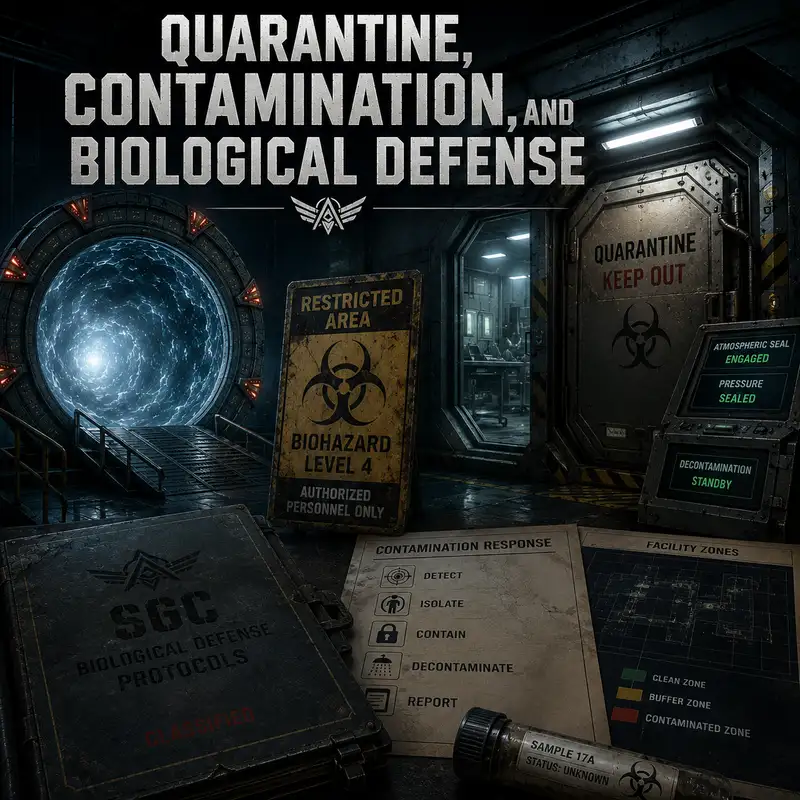
By then, Stargate biological defense had become a layered system. Probes and environmental readings reduced exposure before transit. Teams used protective equipment when encountering bodies, unusual atmospheres, or suspected agents. Returning personnel underwent medical clearance and decontamination. Isolation rooms separated symptoms from the larger base. Gate activity could be suspended, teams diverted to off-world sites, and the mountain sealed under Wildfire. Remote laboratories kept some hazards away from Earth, while civilian agencies supplied scale when an outbreak escaped the military perimeter.
Every layer had limits. A probe could not identify a pathogen it was not designed to sample. Protective equipment was useless after an unnoticed exposure. Medical screening could miss an incubation period or an altered genome. An iris code authenticated equipment, not health. Isolation depended on early recognition and human compliance. A remote base could become another infected population. A cure might require alien knowledge Earth could use once but not reproduce independently.
Secrecy created its own biological vulnerability. Outside laboratories possessed expertise and manufacturing capacity that Stargate Command could not maintain inside one mountain. Bringing them into a response required cover stories, restricted information, and coordination through officials who might not know the true source. Too much disclosure risked exposing the program during a crisis. Too little could prevent doctors from asking the right questions. The pathogen had no clearance level and displayed limited respect for compartmentalization.
Quarantine also carried a moral cost. Closing the mountain protected the surface while trapping healthy and infected personnel together. Refusing evacuation protected another world while denying people a possible escape. Suspending gate activity could strand teams that had no other route home. Isolation could protect a patient or turn that patient into a prisoner whose testimony no one believed. Biological defense was therefore never a purely technical calculation. It was command authority applied to uncertain science and human lives.
The mature doctrine did not promise that nothing dangerous would cross the Stargate. That promise would have required burying the gate and ending the program. Instead, the doctrine tried to detect danger early, slow its movement, preserve options, and prevent one compromised mission from becoming a planetary catastrophe. It treated medicine as part of base defense, public health as part of strategy, and every return from another world as an intelligence event.
The defining image is not a scientist holding a cure. It is an S G team stepping down the ramp after the iris opens, while armed security watches the gate and medical personnel wait beyond the doors. The identification code is valid. The atmosphere on the far side tested safe. Every member appears healthy. None of those facts can prove that the team came home alone. Earth’s biological defense began with quarantine, but its real foundation was the acceptance that an open Stargate is also an open border for life no one yet knows how to name.