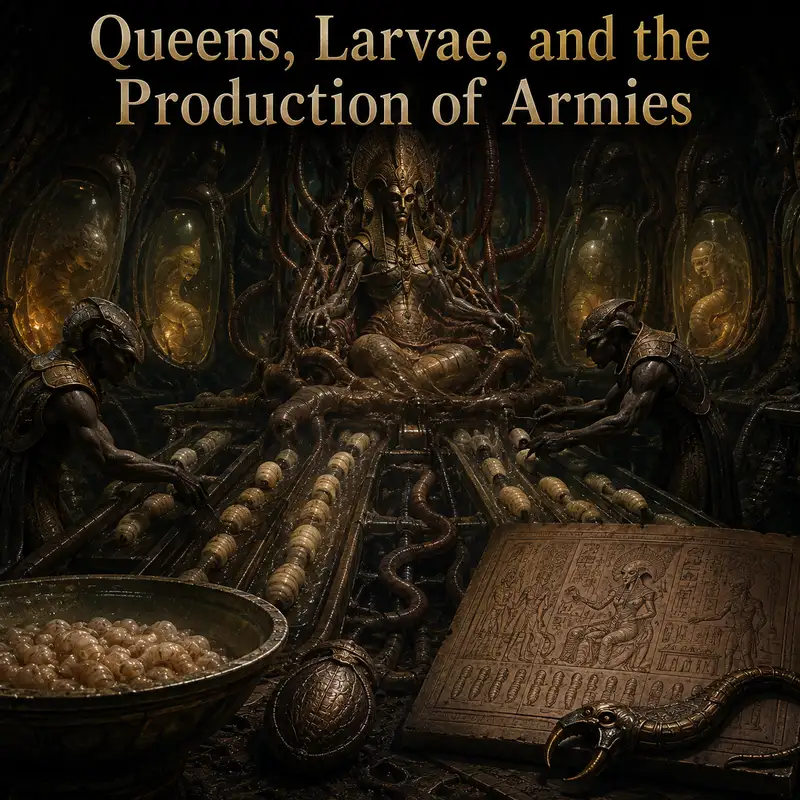
Queens, Larvae, and the Production of Armies
A dying Jaffa lay in the grass while Ishta’s warriors searched his armor. They did not take a weapon first. They opened the abdominal pouch, removed the larval symbiote, and sealed it inside a transport canister. To S G One, the act looked uncomfortably close to battlefield harvesting. To the women of Hak’tyl, it was medical resupply. Somewhere in their hidden settlement, a girl was approaching the age when her engineered immune system would fail. Without a symbiote, she would die. The captured larva was therefore three things at once: a living prisoner, a future Goa’uld, and the biological component required to keep a Jaffa child alive.
That single recovery operation reveals how the Goa’uld produced armies. Queens generated the larvae. Jaffa communities produced and trained the soldiers. The prim’ta ceremony joined the two, giving the warrior greater strength and healing while making continued survival dependent on access to more symbiotes. Religion presented the process as a sacred elevation. Military administration treated it as force generation. Reproduction, medicine, recruitment, and political control were folded into one system, allowing a relatively small parasitic species to field armies drawn from human populations across the Milky Way.
A Goa’uld queen was not simply a female ruler with a ceremonial title. Queens were a specialized reproductive class capable of spawning large numbers of young. They could fertilize their own eggs, but reproduction still required biological information from the species intended to serve as hosts. Hathor described this as obtaining the code of life. In practical terms, she used human genetic material to make her offspring compatible with human bodies. The queen did not need another Goa’uld parent to begin a brood. She needed suitable conditions, host material, and a population whose bodies could be turned into infrastructure.
Hathor’s arrival on Earth provided the clearest compressed demonstration. She entered Stargate Command without an army, a fleet, or a functioning territorial government. Through chemical influence and manipulation, she acquired human genetic material, produced larvae in a tank, and began converting selected men into followers. She also attempted to alter Jack O’Neill so that he could carry a symbiote as a Jaffa. Her method was crude by imperial standards, but the sequence mattered. A queen with access to humans could begin rebuilding the biological foundation of power even after centuries of isolation.
The larvae themselves were not blank animals under normal circumstances. A queen could pass the genetic memory of her maternal line into her offspring. That inheritance carried language, technical knowledge, political assumptions, and the accumulated experience of earlier Goa’uld. A new symbiote could therefore mature with much of the intellectual preparation needed to take a host and function inside the empire. The system shortened the distance between birth and useful service. Human armies require schools, records, instructors, and years of professional development. Goa’uld civilization placed a substantial portion of that institutional memory inside the recruit before the recruit possessed a host.
The queen also controlled what was transmitted. Egeria used genetic memory to give her offspring the principles that defined the Tok’ra resistance. Much later, while imprisoned on Pangar and forced to produce young for medical experimentation, she withheld normal inherited knowledge and deliberately passed on a damaging flaw. Anubis exploited the same biological control for the opposite purpose. A queen working with him suppressed her brain-wave pattern during spawning, producing symbiotes that were effectively blank slates and could be conditioned as obedient soldiers. The brood was not merely numerous. It could be programmed at the point of origin.
After spawning, young symbiotes required an aquatic environment and protected holding tanks. At the proper stage of development, a larva could be placed inside a Jaffa. The Jaffa then carried it until maturity, shielding it from threats while providing the physiological environment it needed. Once mature, the symbiote could leave the Jaffa and take a human host. The lifecycle therefore linked three populations: queens produced the young, Jaffa incubated them, and human subjects supplied the bodies through which adult Goa’uld exercised political and military authority.
The Jaffa did not volunteer for this system as fully informed adults. Goa’uld genetic engineering altered their physiology so that, as children approached the age of the prim’ta, they became dependent on a larval symbiote. The symbiote replaced the natural immune function the Jaffa could no longer rely upon. Removing it without an alternative caused fever, organ failure, and death. A ruler who controlled access to larvae therefore controlled not only military promotion but survival. The arrangement was presented as a gift from the gods. It was closer to a hereditary medical monopoly enforced at spear point.
The prim’ta was the ceremony of implantation, not the name of the animal itself. It marked a Jaffa child’s entry into religious and military adulthood. Priests opened or prepared the abdominal pouch, implanted the larva, and declared the child a true Jaffa. That ritual converted biological coercion into social honor. The child received strength, healing, longevity, and membership in the warrior class. The ruler received another incubator, another potential soldier, and another family whose loyalty was tied to the continued supply of symbiotes.
The benefits were substantial enough to make the bargain persuasive. A carried symbiote could help a Jaffa resist disease, recover from injuries, endure hardship, and remain physically capable far longer than an ordinary human. This produced veteran warriors with decades of experience and bodies able to survive wounds that would remove other soldiers from the field. It did not make them invulnerable. Staff blasts, gunfire, blood loss, severe trauma, and damage to the symbiote could still kill them. The larva improved force durability. It did not eliminate casualty evacuation, replacement, or medical risk.
The relationship inside a Jaffa was also different from possession of a host. The larva did not normally control the Jaffa’s body or speak through the Jaffa’s mouth. It functioned more like an internal organ, exchanging hormones and electrical impulses while remaining mentally isolated. Shan’auc discovered that deep meditation could create limited communication with the symbiote she carried. The Goa’uld had taught the Jaffa that such contact was impossible, because communication created the possibility that a Jaffa might influence a developing symbiote. The empire wanted its young protected by soldiers, not educated by them.
That concern exposed a contradiction in the production model. The Goa’uld needed Jaffa close enough to nurture their offspring but politically distant enough not to shape them. They entrusted the next generation of their species to the people they enslaved, armed, trained, and repeatedly sent into battle. Religious indoctrination was supposed to close the gap. So were strict hierarchies, sacred taboos, and the authority of priests and First Primes. The system worked for thousands of years, but it depended on the incubator never recognizing that the god inside the pouch was as vulnerable as any other dependent child.
Queens alone did not create combat-ready formations. A vat of larvae was not an infantry battalion. Jaffa armies still required births, families, food, shelter, training grounds, instructors, weapons, armor, communications, transport, and a command structure. They required communities willing or compelled to raise children for service. They also required time. A System Lord could order a queen to begin a spawn cycle, but the resulting larvae needed care, and the Jaffa who carried them needed years of training before they became reliable soldiers. Biological output was only the first stage of force generation.
The Goa’uld therefore built military society around the reproductive pipeline. Jaffa settlements produced families and recruits. Temples legitimized implantation. Priests managed ritual and access. Veteran warriors trained the young. First Primes connected the army directly to the ruler. Marks of service identified allegiance to a particular god and turned military identity into visible ownership. The army was not separate from the society that sustained it. Jaffa culture had been engineered so that raising the next generation of soldiers also raised the next generation of Goa’uld.
Control of larvae became a form of patronage. A favored household could receive timely implantation and replacement symbiotes. A disgraced family could be expelled from the community and left without access. A Jaffa whose symbiote matured needed another, because the immune dependence did not end when the larva departed. Drey’auc, Teal’c’s wife, died after her symbiote matured and she could not obtain a replacement. Her death was not an unusual battlefield loss. It was the predictable result of a supply system in which medicine was distributed according to political loyalty.
This changed the meaning of logistics. For a human army, medical supplies and replacement personnel normally travel in different channels. For a Jaffa army, the symbiote was both medicine and a developing member of the ruling species. A transport carrying larvae moved strategic biological assets. A holding tank was part hospital, nursery, and mobilization depot. A priest capable of implantation performed a medical procedure with political consequences. Losing a shipment could kill Jaffa who needed replacements and delay the maturation of future Goa’uld.
Chulak’s abundance of larvae made it strategically important. When Stargate Command attempted to study Teal’c’s symbiote, removing it nearly killed him. Teal’c pointed out that Chulak held hundreds of larvae, an unusual concentration within the empire. For Earth, that suggested an intelligence target and a possible source of medical research. For the Goa’uld, it represented protected reproductive stock. The same facility that supported Jaffa health also sustained the long-term continuity of the imperial species.
Battlefield casualties had equally complicated costs. When a Jaffa died, the empire could lose an experienced soldier and the immature symbiote he or she carried. Recovering the larva preserved a future Goa’uld and allowed it to be implanted elsewhere. Leaving the body surrendered both assets. This helps explain why the Hak’tyl removed symbiotes from fallen enemies and why the act was so morally difficult. They were saving children by taking the biological dependency from other Jaffa, some of whom were still alive. The logistics of liberation forced them to reproduce the coercion they opposed.
The host stage completed the cycle. A mature symbiote could leave its Jaffa incubator and enter a human body, gaining speech, hands, memory, appearance, and access to society. Some became rulers, administrators, scientists, officers, spies, or subordinate Goa’uld serving more powerful masters. Not every adult became a System Lord. The empire needed layers of lesser Goa’uld to govern territory and operate complex institutions. The Jaffa army defended that political class while physically carrying its replacements. Few imperial systems have ever made the infantry responsible for gestating the officer corps.
This arrangement also limited the ruler’s freedom to waste troops. Goa’uld commanders often treated Jaffa as expendable, but every dead warrior represented more than a rifle removed from the line. The casualty could also contain a developing symbiote and decades of military experience. A ruler with plentiful larvae and large subject populations could absorb the loss. A minor Goa’uld with few worlds could not. Force size was therefore shaped by access to queens, Jaffa population, symbiote stocks, training institutions, and the resources required to equip and transport the result.
Hathor’s attempt on Earth failed partly because reproduction was not the same as mobilization. She could produce larvae and chemically dominate personnel, but she lacked a mature Jaffa society, secure hatcheries, reliable logistics, weapons production, and time. Stargate Command was a useful command post only while its defenders remained compromised. Once the women in the facility organized resistance and O’Neill was restored, Hathor’s improvised army collapsed. The episode demonstrated the queen’s potential, but also the infrastructure normally concealed behind Goa’uld claims of effortless divine creation.
Egeria’s captivity showed the same system under industrial pressure. The Pangarans discovered her in confinement and forced her to spawn repeatedly. They processed her offspring into tretonin, a drug that provided powerful protection against disease but eventually suppressed the user’s natural immunity and created dependence. The program treated a sentient queen and her young as raw material. Egeria responded by sabotaging the offspring genetically, hoping the resulting flaw would force the Pangarans to stop. Instead, they expanded production and deepened the medical crisis.
For the Tok’ra, Egeria’s discovery exposed a strategic disaster. She was the mother of their movement and their only known source of new Tok’ra symbiotes. Her long imprisonment meant that the resistance could not replace losses. Experienced operatives might survive for centuries, but every death reduced the total force. Intelligence services can compensate for small numbers through secrecy and access, but they cannot evade demography forever. Egeria’s death preserved the Tok’ra’s moral identity while confirming that their population would continue to decline.
Anubis approached the production problem with fewer moral restraints and greater technical ambition. He wanted soldiers more powerful than Jaffa and less capable of rebellion. His Kull warriors combined artificially created host bodies, life-sustaining technology, protective armor, and Goa’uld symbiotes produced without inherited personalities. The queen at Tartarus was preparing to spawn thousands. By suppressing genetic memory, she created young that Anubis could condition for obedience. He had taken the traditional queen-to-Jaffa-to-host pipeline and redesigned it as centralized weapons manufacturing.
The result solved one weakness and created others. Kull warriors were deadly, fearless, and difficult to stop with conventional weapons. They did not require Jaffa families to raise them or priests to persuade them that service was sacred. Their engineered bodies were barely viable, however, and the symbiotes sustaining them were consumed by the burden. The force depended on specialized laboratories, a cooperative queen, advanced energy technology, armor production, and centralized conditioning. It was tactically formidable and logistically narrow. Destroying the queen and production base could cripple replacement at its source.
The Jaffa rebellion attacked the older system from the opposite direction. It did not initially possess the ability to eliminate every queen or capture every hatchery. Instead, it worked to break the political relationship between warrior and god. Each Jaffa who rejected divine authority weakened the network that protected larvae, trained recruits, guarded temples, and enforced access to replacements. The revolt was not only a mutiny in the field. It was a strike by the workforce responsible for reproducing the empire.
Tretonin eventually created a biological alternative. Properly adapted for Jaffa physiology, it could replace the immune function provided by a larval symbiote. That did not make the transition easy. Dosage varied, treatment could fail, and the user traded dependence on Goa’uld larvae for dependence on a manufactured drug. Early supplies and medical knowledge came through Earth and Tok’ra cooperation, creating new logistical and political relationships. Freedom required pharmacies, laboratories, transport, training, and regular distribution. The gods could be removed from the supply chain, but the supply chain did not disappear.
The Hak’tyl confronted that reality more directly than most. Moloc had ordered newborn girls killed because he believed only male Jaffa would strengthen his armies. Ishta and her followers rescued the children, raised them in hiding, and raided patrols for the symbiotes needed to keep them alive. Moloc’s policy reduced people to projected military utility, while also damaging the population required to sustain his future forces. The Hak’tyl answered by building their own warrior community, but every successful rescue increased their need for food, shelter, medicine, and captured larvae.
Their dilemma showed why the Goa’uld system was so difficult to escape. A rebel could reject the god in one moment and still die years later without the god’s biological property. A liberated settlement could possess weapons and courage yet remain dependent on raids against other Jaffa. A queen could oppose imperial rule and still watch her children exploited by another civilization. The production model bound enemies together through shared physiology. It turned every attempt at freedom into a medical and logistical campaign.
Queens were therefore strategic assets of the highest order. Protecting one preserved reproductive capacity and institutional memory. Capturing one offered the possibility of intelligence, medical exploitation, or forced production. Killing one could prevent the creation of thousands of symbiotes, but it also destroyed a sentient being whose offspring might not share the policies of a System Lord. The queen at Tartarus was a legitimate military target because she was actively supplying Anubis’s drone army. Egeria was a prisoner who required rescue. Biology did not erase the need to distinguish between combatant, captive, ally, and coerced participant.
For Stargate Command, the intelligence problem extended beyond counting troops. Analysts needed to identify where larvae were stored, which worlds held queens, how often symbiotes were moved, which Jaffa populations lacked replacements, and whether an apparent religious ceremony concealed mobilization. A hatchery could be more important than a weapons depot. A raid that destroyed tanks might reduce future enemy strength while killing immature sentient life. A captured canister might save an ally, expose a laboratory to infiltration, or mature into a hostile Goa’uld if mishandled. There were no harmless biological samples in this war.
The Goa’uld production system was resilient because it was distributed across bodies and communities. Destroying one palace did not end it. Jaffa families continued to raise children, priests continued to perform the prim’ta, larvae continued to mature, and adult symbiotes continued to take hosts. It was brittle because every stage depended on coercion. Queens could withhold memory. Jaffa could rebel. Hosts could resist. Tretonin could break immune dependence. A chain designed to make every participant indispensable also gave every participant a point at which to refuse.
The Goa’uld did not manufacture armies in a single facility. They manufactured dependence across generations. The queen produced the larva. The Jaffa child received it as a sacred gift. The warrior carried it through years of service. The mature symbiote took a host and joined the ruling class that demanded another child undergo the same ceremony. That cycle built an empire, but it also placed the future of the Goa’uld inside the people they treated as tools. On the battlefield, the larva in the canister looked small and defenseless. Strategically, it contained the entire system, and the possibility that the system could be broken.