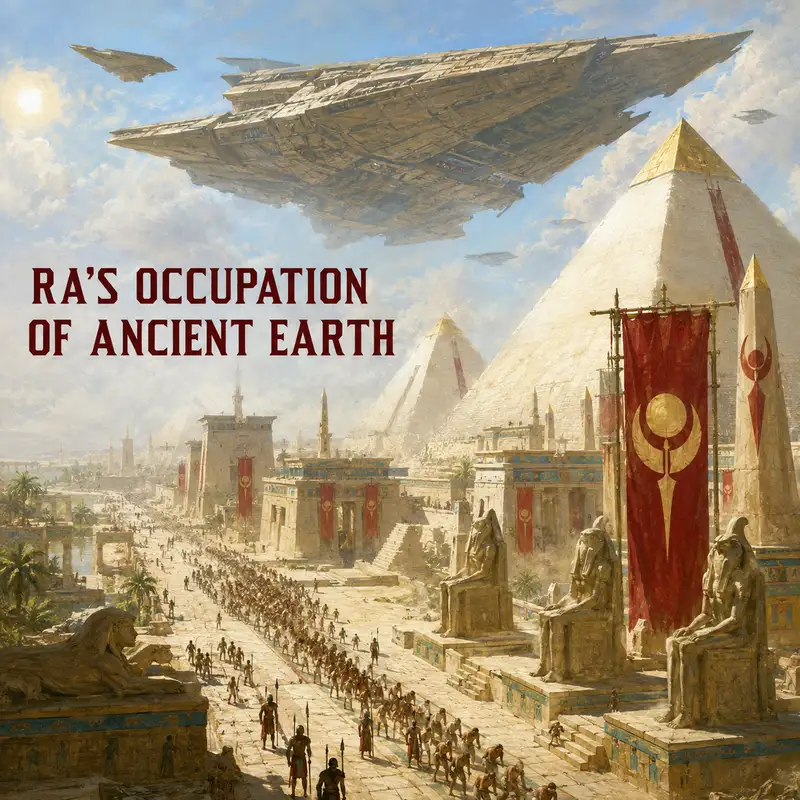
Ra’s Occupation of Ancient Earth
The decisive act was not the uprising itself. It was what the rebels did after Ra’s ship began to leave Earth. They seized the Stargate near Giza, denied it to the retreating Goa’uld, and buried the ring beneath stone and sand. Ra still possessed vessels capable of crossing interstellar space. He still ruled other worlds. His technology remained overwhelming by ancient human standards. Yet the people he had treated as property had taken control of the one piece of infrastructure that made Earth easy to reach, easy to exploit, and easy to punish. An occupation that had lasted for millennia ended with a transportation node disappearing underground.
Ra’s rule raises a question larger than the familiar image of an alien posing as the Egyptian sun god. How did one ruler establish control over part of ancient Earth, turn the planet into the source of a galactic human diaspora, and preserve that system for thousands of years? The answer was not raw firepower alone. Ra combined biological possession, technological monopoly, religious authority, selective terror, and control of the Stargate. His occupation was formidable because those elements reinforced one another. It failed when enough people discovered that every part of the system, including the supposed god at its center, could be resisted.
The earliest account available to modern Earth came from the ruins and oral traditions of Abydos. It described Ra as a member of a dying alien race who found a young human body and used it to extend his own life. Later intelligence corrected the species identification. Ra was a Goa’uld symbiote, part of a parasitic species that had evolved on another world and had first used the native Unas as hosts. The chronology is imprecise, but Ra may have established his Earth power base as much as ten thousand years before the modern Stargate program. The original account had misunderstood the biology, but it preserved the essential event. Ra found humans, recognized the advantages of the human body, and transformed that discovery into a new foundation for Goa’uld power.
A human host offered more than physical survival. Humans were adaptable, numerous, and outwardly familiar to one another. A Goa’uld inside a human body could stand before a population as a ruler rather than appear as an obvious parasite. The symbiote increased strength and healing. Sarcophagus technology could repair the host and prolong life far beyond a normal human span. Ra later explained that human bodies were unusually easy to restore. For a ruler obsessed with survival, that was a medical breakthrough. For the people whose bodies could be taken without consent, it was the beginning of an imperial labor and host system.
Ra’s discovery also changed Goa’uld politics. Human hosts became markers of status, practical vessels for long-lived rulers, and the visible faces of a ruling class that claimed divine identity. Ra rose as the Supreme System Lord, the dominant figure within a feudal order of rival Goa’uld. His supremacy did not create a unified empire. System Lords still competed, formed temporary alliances, and killed one another when opportunity allowed. What Ra possessed was preeminence: territory, prestige, military power, and control over the world from which the Goa’uld obtained the human populations that would spread across the Milky Way.
Earth was valuable because it contained a large and renewable population, not because the entire planet had to be occupied in the modern sense. The surviving record places Ra’s principal power base in the Nile region near Giza. It does not provide a reliable map of his authority over every continent or every community. Other Goa’uld were present on Earth at different times, and later discoveries connected names such as Hathor, Seth, Osiris, and Isis to hidden or abandoned Goa’uld activity. Ra’s title and position indicate supremacy, but the exact division of territory and responsibility among these rulers remains uncertain.
That uncertainty is important. To say Ra occupied Earth does not mean that a single administrative service governed every village from one planetary capital. His control appears to have been strategic, extractive, and concentrated around populations, monuments, transportation routes, and local authorities useful to him. Ancient communities did not need to understand the full Goa’uld order. They needed to understand that Ra’s servants possessed weapons they could not match, that his ships came from the sky, and that disobedience could bring immediate punishment. An empire can exercise decisive power without maintaining a guard at every doorway.
The Giza Stargate was the center of that system. Earth already possessed an older Ancient gate in Antarctica, but it had become inaccessible beneath the ice. The gate used by Ra in Egypt appears to have been installed or repositioned for his own network access. Through it, personnel, guards, captives, administrators, and manageable cargo could move between worlds in seconds. The gate did not eliminate logistics, but it made a distant planet function like a secured border crossing. Whoever held the ring could import force, remove prisoners, and redirect labor without maintaining a continuous convoy across space.
Ra’s ships supplied what the gate could not. A pyramid vessel could carry heavier forces, operate independently of a fixed destination, dominate the sky, and provide an extraction route if the gate was lost. Goa’uld death gliders added atmospheric surveillance and attack capability. Pyramidal structures associated with Ra’s rule also served a practical function in Goa’uld flight operations, allowing the architecture of divine kingship to double as military infrastructure. To an ancient observer, temple, palace, airfield, and command post could appear to be the same place because, under Ra, they often were.
His weapons were designed as much for intimidation as for combat. Staff weapons could kill at range with an energy discharge no human shield or armor could reliably stop. Armored guards used animal-headed helmets that transformed soldiers into walking representations of divine power. Ring transporters moved personnel without visible roads or stairs. The sarcophagus reversed injuries that should have been fatal. None of these systems required the population to understand advanced physics. They required the population to witness an impossible act and accept Ra’s explanation for it.
By the final period of the occupation, Jaffa served Ra as trained military personnel rather than simple palace guards. Their larval symbiotes improved health, strength, and recovery, while their culture linked military service to religious duty. That combination reduced Ra’s need for a large Goa’uld presence on Earth. Jaffa could command checkpoints, protect compounds, collect tribute, and punish resistance while believing they served a divine order. It also created a hidden vulnerability. Their effectiveness depended on discipline and faith as well as weapons. When a mass uprising demonstrated that Ra could retreat and his guards could be surrounded, some Jaffa chose surrender over a hopeless defense.
That explanation was political theology. Ra did not merely claim to have superior machines. He claimed to be a god, and he organized obedience around that identity. Within the fictional history preserved by the Stargate record, religious imagery became a command-and-control system. Ritual marked hierarchy. Offerings became tribute. Temples became access-controlled spaces. Priests and local leaders could translate distant alien authority into daily rules. The arrangement reduced the number of Goa’uld personnel required to govern a much larger human population. It was efficient, durable, and morally grotesque.
The system also made intelligence difficult for the occupied population. Ra controlled the visible evidence of his origins, the movement of people through the gate, and access to the machines that sustained him. Most humans could not compare reports from other planets or examine a captured symbiote. They knew what local tradition, authority, and punishment allowed them to know. A ruler who controls transportation, education, ritual, and the consequences of doubt does not need every subject to believe with equal sincerity. He needs believers, collaborators, frightened neutrals, and enough armed servants to isolate the rest.
Ra’s Earth was therefore not simply a source of slaves. It was the demographic foundation of the later Goa’uld order. Humans were taken through the Stargate and planted on other worlds as laborers, worshippers, soldiers, and potential hosts. Some communities were assigned to mining. Others supported estates, temples, or military systems. Over long periods, transported populations developed separate cultures while preserving fragments of languages and traditions from Earth. The great human distribution across the Milky Way was not a voluntary age of exploration. It was forced migration conducted by an empire that regarded people as strategic material.
The numbers involved are not established, and the Stargate’s limited diameter would have constrained movement at any one moment. That did not prevent enormous demographic consequences over centuries. A few hundred captives moved repeatedly, entire families taken over generations, and populations expanded on destination worlds could produce millions of descendants. The gate’s true power was not that it could move an army all at once. It was that it could support a persistent flow with almost no travel time, provided the occupier held both ends and retained the addresses.
Abydos became the clearest surviving example of this system. Ra transported humans there to mine naquadah, the dense energy-rich material used throughout Goa’uld technology. The population lived under a religious order centered on Ra, while armed overseers and a visiting ship enforced his will. Earth supplied the people. Abydos supplied the strategic mineral. The gate connected the two. Ra had created an imperial circuit linking biology, labor, resources, and military power. It was sophisticated in design even when its public language consisted of gods, offerings, and fear.
The occupation endured because the technological imbalance was extreme. Ancient human weapons could not challenge a spacecraft in the air or reliably defeat armored Jaffa in open battle. No rival Earth government possessed comparable transport. No outside ally arrived with intelligence on the Goa’uld. Populations were politically fragmented, communications were slow, and resistance in one community could be isolated before it spread. Ra did not need to win a global conventional war. He needed to prevent separate acts of defiance from becoming a coordinated political movement.
His method had a weakness that advanced technology could not remove. The system depended on a small ruling and military elite maintaining the appearance of absolute power. Every captured weapon, exposed guard, failed punishment, and surviving rebel threatened that appearance. A staff weapon was terrifying until someone learned that its operator could be ambushed. A ship looked divine until people understood it had to land, load, and depart. A god appeared immortal until his servants bled and his orders were disobeyed. Ra’s authority was broad, but it was not deep enough to survive unlimited scrutiny.
The surviving chronology places the successful rebellion around two thousand nine hundred ninety-five B C. Later time travel complicated the record. S G One traveled to roughly three thousand B C to recover a zero-point module from Ra’s possession. Their mission altered history, and a second group drawn from the resulting timeline had to return and repair the damage. The final version of events therefore includes modern personnel living and fighting in ancient Egypt. That is not a minor footnote, but it should not erase the agency of the Egyptians who supplied the movement’s numbers, purpose, and willingness to accept the risk.
The rebels did not need to destroy Ra’s entire empire. Their operational objective was narrower and more achievable: break local control, overwhelm or isolate his guards, deny him the Stargate, and make continued occupation more expensive than withdrawal. In the repaired timeline, versions of Daniel Jackson, Jack O’Neill, Samantha Carter, and Teal’c helped coordinate the uprising and used an Ancient craft to secure the gate. Thousands of Egyptians joined the revolt, many carrying captured Goa’uld weapons. Faced with a mass rebellion and a compromised transportation node, Ra departed Earth by ship.
This was a tactical victory with strategic consequences far beyond the battlefield. The rebels could not pursue Ra across space. They could not liberate Abydos or the other human colonies. They could not dismantle the System Lord hierarchy. What they could do was deny Ra routine access to Earth. Burying the Giza gate removed the cheapest and fastest route back into the occupied region. The older Antarctic gate still existed, but it was inaccessible and unknown to the people who had fought the uprising. In practical terms, Earth had cut the road.
The burial itself was a remarkably effective act of infrastructure denial. The rebels did not need to understand the Stargate’s internal mechanisms. They understood that Ra’s forces used the ring, that open space was required for it to function safely, and that concealing it would prevent immediate reuse. Stone, sand, and secrecy accomplished what no ancient weapon could. The gate remained buried until its excavation in nineteen twenty-eight. An advanced device capable of crossing interstellar distance had been defeated for almost five thousand years by denying it a clear room.
Why Ra did not return in force by ship is not settled by the surviving record. Several explanations are plausible, but none should be mistaken for confirmed policy. Earth may have become less valuable once large human populations had already been established elsewhere. A renewed occupation would have required forces, time, and attention that Ra preferred to use against rival System Lords. Returning after being expelled may also have carried political costs for a ruler whose authority depended on the appearance of invincibility. The simplest explanation may be that Ra considered the rebellion contained and Earth strategically dormant.
That judgment was understandable and disastrous. Earth possessed no interstellar fleet, no working gate program, and no knowledge of the wider Goa’uld political order. For thousands of years, it presented no visible military threat. From Ra’s perspective, the source world had been closed while its transplanted populations continued to labor throughout his domain. An intelligence service can classify such a problem as resolved. History has a habit of reopening the file without asking permission.
Ra did learn from the uprising. On Abydos, he prohibited reading and writing, apparently to prevent the population from preserving information and organizing as Earth’s rebels had done. The policy reveals what he believed had defeated him. It was not merely the loss of a battle. It was the spread of knowledge. Literate people could compare symbols, preserve accounts, recognize contradictions, and coordinate beyond oral control. Ra responded by narrowing the intellectual space in which resistance could form.
The same response exposed the limits of his strategy. Suppression could delay organized rebellion, but it could not make an occupied population loyal. On Abydos, Ra still relied on isolation, controlled history, visible punishment, and a small guard force. When the first modern expedition arrived, Daniel Jackson reconstructed the buried account of Ra’s origin and Earth’s revolt. Colonel O’Neil and his surviving personnel supplied weapons and military experience. Skaara and the Abydonians supplied the mass participation. Once again, the critical political moment came when ordinary people saw that Ra’s armored servants were not supernatural beings.
Ra died above Abydos when the nuclear weapon intended for Earth was transported onto his departing ship. That later battle repeated the structure of his earlier defeat. A local population rebelled. Outsiders provided specialized knowledge and weapons. Ra lost control of the ground around his infrastructure and attempted to escape by air. The difference was that this time the departing ship did not survive. The ruler who had treated human beings as replaceable bodies and labor units was killed by an alliance between those same humans.
The occupation left Earth with a dangerous archaeological inheritance. Buried technology, preserved symbiotes, hidden spacecraft, and surviving Goa’uld created threats that reappeared in the modern era. Ancient myths and artifacts became intelligence sources because some had been shaped by real contact with alien rulers. Stargate Command could not treat every legend as a literal report, but it also could not dismiss the possibility that a ceremonial object was a control device, a tomb was a stasis chamber, or a forgotten cult preserved the security practices of an enemy operative.
More important was the political inheritance beyond Earth. The Goa’uld continued to define humans as hosts and slaves long after Ra lost the source world. Entire civilizations remained trapped inside institutions built from Earth’s stolen population. Jaffa armies enforced the authority of rulers who wore human faces. System Lords competed for territories populated by descendants of abducted people. Ra’s occupation ended locally, but the imperial order it helped create survived for millennia. Earth had escaped the system without freeing the people taken from it.
That separation explains why Earth developed differently from most human worlds later encountered through the gate. The buried Stargate ended routine intervention. No Goa’uld governor controlled technological progress. No Jaffa garrison enforced divine rule. No System Lord selected hosts from the population under an openly alien state. Human history remained violent, divided, and often oppressive for entirely human reasons, but it was no longer directed by Ra. When Earth reopened the gate, it entered the Milky Way as the lost source world rather than another surviving colony.
Militarily, Ra’s occupation demonstrates the advantage and danger of technological monopoly. His forces could dominate almost any direct confrontation, yet they could not be everywhere. His network offered extraordinary mobility, yet one buried gate could sever the principal route. His religious system multiplied the effect of a small garrison, yet it also made every visible failure a political crisis. His long life supported continuity of command, yet it encouraged a ruler to confuse endurance with permanence. The occupation lasted because resistance was fragmented. It ended when political defiance, captured technology, and control of terrain converged around the gate.
The Egyptian rebellion did not defeat the Goa’uld as a civilization. It did something more limited and, for Earth, more important. It forced the most powerful System Lord to abandon his original human base and denied him easy return. The people who buried the Stargate could not know that their descendants would uncover it, travel to Abydos, kill Ra, and eventually help break the wider System Lord order. They knew only that the ring was the road by which their occupier moved people, soldiers, and fear. They covered that road with stone. For nearly five thousand years, it held.