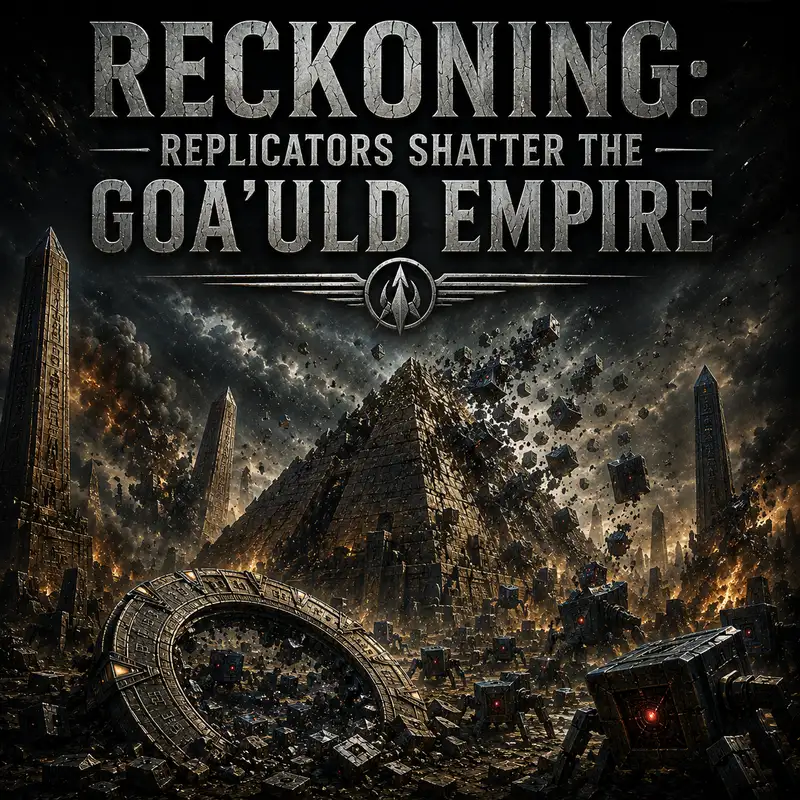
Reckoning: Replicators Shatter the Goa’uld Empire
One dot vanished from the Tok’ra tracking display. Then another. Each point represented a beacon hidden aboard a Goa’uld mothership, and each lost signal meant that a Ha’tak had either been destroyed or taken over. The distinction mattered. A destroyed ship reduced the Goa’uld fleet by one. A captured ship reduced it by one and added its hull, weapons, engines, power systems, and raw material to the Replicators. Across the map, the Goa’uld were not simply losing battles. Their military strength was changing sides.
The Replicator offensive shattered the Goa’uld empire because it attacked the structure that had kept the System Lords powerful for thousands of years. Goa’uld rule depended on personal fleets, fortified territories, Jaffa armies, and control of advanced technology. The Replicators treated fleets as resources, territory as access, and technology as material for growth. Their attack also arrived while the System Lords were divided and the Jaffa rebellion was reaching a political breaking point. The empire faced an enemy that became stronger with every conventional attempt to stop it.
The old order was already under strain. Ba’al had reduced the surviving System Lords to a weakened coalition and demanded their submission under his authority. Yu and the remaining rulers still possessed ships and armies, but their political system offered no unified command capable of responding quickly to a galaxy-wide emergency. Each ruler defended personal territory, protected private resources, and suspected every rival of using the crisis for advantage. That arrangement had survived civil wars because no competitor could consume the entire system at once. The Replicators could.
Their campaign was led by the human-form machine built in Samantha Carter’s image. Fifth had created her from Carter’s memories and emotional patterns, expecting loyalty. She instead deceived Fifth and Stargate Command, studied the Ancient-derived disruptor designed to destroy Replicators, developed an immunity to it, and used the weapon to eliminate her own creator. She then shared the protective cipher with the Replicator collective. The enemy entering the Goa’uld war therefore possessed Carter’s face, access to her knowledge, and none of her loyalty to the people whose memories had helped shape it.
Replicator Carter opened the campaign with political decapitation. She entered a meeting where Ba’al’s representative was pressuring Yu and other System Lords to surrender. Kull warriors escorted her as though she were a captured Tau’ri officer. Once inside, she killed Yu and advanced on the remaining Goa’uld as a Replicator vessel closed on the station. The attack combined disguise, infiltration, and fleet action. It removed senior leaders while demonstrating that the most secure gathering the surviving System Lords could arrange had already been penetrated.
The larger offensive followed the same logic. Mechanical Replicators boarded Ha’taks, overran corridors, consumed control systems, and converted captured ships into extensions of the collective. Human-form Replicators supplied planning, deception, and access to memories taken from their victims. The machines did not require Jaffa loyalty, host populations, conventional food, or the political rituals that held a Goa’uld domain together. A captured Ha’tak came with transportation, weapons, shielding, and enough advanced material to support further replication. That is an unusually generous package to deliver to an enemy.
Tok’ra intelligence made the scale visible. Operatives had placed tracking beacons aboard more than one hundred Goa’uld motherships, feeding locations through an encoded subspace network. At Stargate Command, Jacob Carter and Selmak watched signals disappear as battles spread across the galaxy. Entire Goa’uld territories fell into Replicator hands. Five regions belonging to Ba’al were lost in one twenty-four-hour period. The Tok’ra estimated that the Goa’uld could be wiped out within weeks if the rate continued.
The intelligence picture was unusually strong, but it did not provide an immediate military answer. The Tok’ra could track the collapse without fielding a fleet capable of stopping it. Earth possessed disruptor technology, but not a dependable weapon against the modified machines. The Asgard understood the Replicators better than anyone, yet they had spent years fighting them and were still searching for a lasting solution. Knowing precisely how fast an empire is being dismantled is valuable. It is not the same thing as being able to slow the dismantling.
Ba’al responded as a System Lord would respond to another Goa’uld. He defended territory across a broad front and committed ships wherever his domains were threatened. Jacob recognized the mistake. Replicators often advanced more slowly when they were not being engaged. Pulling back could preserve ships, reduce the supply of captured technology, and buy time for a counterweapon. Ba’al instead fed formations into battles where every lost vessel could join the next attack. The more aggressively he defended the empire, the faster the enemy armada grew.
Anubis made the strategic failure worse. Ba’al was nominally commanding the remaining Goa’uld forces, but he was serving Anubis while waiting for a chance to betray him. Ba’al advised concentrating the fleet and building a coherent defense. Anubis rejected the warning and treated the Replicators as a nuisance he could eliminate when convenient. His confidence came partly from knowledge of the Ancient device hidden on Dakara. He believed he possessed a final answer, which allowed him to ignore the immediate evidence that his conventional fleet was being taken apart.
The Kull warriors offered no solution. Anubis had engineered them to defeat humans and Jaffa, not a machine collective that consumed ships from within. Their armor could absorb staff fire and conventional bullets, but battlefield durability did not protect navigation systems, power conduits, or command networks. Many Kull were killed during the Replicator campaign, and those who survived could not hold an empire whose fleets were disappearing. A perfect infantryman remains of limited assistance when the enemy has taken the bridge and rewritten the engines.
The offensive produced a political effect that appeared contradictory. Thousands of Jaffa began returning to Goa’uld service even while their masters were losing. Many interpreted the Replicators as punishment for rebellion, a plague released because warriors had abandoned the gods. If the Goa’uld somehow defeated the machines, the rulers would claim that victory as proof of divinity. If they failed, fear could still drive Jaffa toward the only authority they had known. The Replicators were destroying the empire’s military strength while temporarily reinforcing its religious narrative.
Teal’c and Bra’tac understood that the rebellion could not wait for the military crisis to resolve. Their answer was to seize Dakara, the sacred world associated with the first Prim’ta ceremony and the beginning of Jaffa dependence on Goa’uld symbiotes. Ba’al’s fleets were dispersed against the Replicators, leaving the system far more lightly defended than normal. The machines created the operational opening. The rebels intended to use it before the Goa’uld could claim credit for any eventual victory.
Earth and the Asgard were pursuing a separate line of effort. Carter and Thor reactivated pieces of Replicator Carter’s severed arm and opened microsecond subspace links to the wider collective. After processing repeated bursts of data, they isolated the cipher that made the Replicators immune to the disruptor and altered the weapon. The method was dangerous because reconnecting the cells could also expose the Asgard ship to the enemy network. It produced a working modification, which in this war meant that it worked during the first test.
The first Replicator-controlled Ha’tak struck by the revised disruptor shut down. A second ship arrived, absorbed the same attack, and continued firing. The collective had adapted after one exposure. Replicators soon boarded Thor’s ship and began taking control of its systems. Carter was transported back to Earth while Thor tried to move the compromised vessel away from the planet. The test proved the central technical problem. Any weapon used sequentially allowed surviving Replicators time to learn, distribute the adjustment, and make the next shot ineffective.
Replicator Carter was looking for the same conclusion from the opposite direction. She captured Daniel Jackson because he had once ascended and might retain Ancient knowledge beneath his conscious memory. She did not need him to volunteer information he could recall. She entered his mind, created a false encounter with Oma Desala, and pushed him toward memories he could not normally reach. Her intelligence requirement was precise. She wanted the location of any Ancient technology capable of threatening the collective.
Daniel eventually recognized the deception, but not before Replicator Carter found Dakara. The monument there contained the one known device in the Milky Way capable of destroying her. She also discovered that Daniel’s buried knowledge extended far beyond one weapon and continued probing. The decision gave her access to extraordinary information. It also opened a connection in both directions. While she searched Daniel, Daniel began reading the Replicator network through her.
Ba’al approached Stargate Command for help before the Dakara device was fully understood. He knew that Earth and the Asgard had defeated Replicators before and asked for the means to fight them. Jacob favored providing strategic guidance, particularly the recommendation to stop defending every threatened region. Jack O’Neill refused because a Goa’uld withdrawal would free Ba’al’s fleet to crush Teal’c and the rebellion. Earth could prolong Goa’uld resistance and slow the Replicators, or preserve the narrow opportunity for Jaffa liberation. There was no option that protected every objective.
The refusal demonstrated why a common enemy did not create an automatic alliance. Ba’al wanted Earth’s weapon while retaining his empire. The Tok’ra wanted the Replicators slowed because a machine victory would replace one oppressive system with something even less negotiable. O’Neill wanted to avoid saving the fleet that would attack Dakara. Each position was strategically rational from a different scale. The machines were winning because their opponents could not separate immediate survival from the political order that might follow it.
The rebels captured Dakara while Ba’al remained engaged elsewhere. The garrison surrendered, and Bra’tac spared the prisoners rather than convert a sacred victory into a massacre of fellow Jaffa. The occupation was militarily fragile but politically explosive. Anubis ordered Ba’al to disengage from the Replicators and retake the planet, expecting the concentrated rebel force to provide an opportunity for annihilation. He also wanted the Ancient device beneath the temple. The fleet war and the Jaffa uprising were now converging on the same location.
Ba’al warned Earth that Anubis intended to use the device to destroy all life in the galaxy and then rebuild according to his own design. Ba’al would die in such an attack. Anubis, existing without a normal corporeal form, expected to survive. Samantha Carter and Jacob traveled to Dakara to locate the system before Ba’al’s fleet arrived. Their first mission was destruction. They could not risk leaving Anubis a machine with galaxy-wide reach merely because its operating instructions were inconveniently absent.
The hidden chamber revealed a different possibility. The Ancient device disassembled matter by transmitting a controlled energy wave. Its operating principle resembled the disruptor, which broke Replicators into their component blocks. Carter and Jacob concluded that the output might be tuned to affect Replicators while leaving organic life intact. The problem was adaptation. Firing at one planet, one ship, or one region would only educate the surviving collective. The strike had to reach every Replicator before any of them could change.
The Stargate network supplied the delivery system. The Dakara wave could pass through an active wormhole, but normal gate operations connect one point of origin with one destination. Carter needed the device linked to every Stargate in the Milky Way at nearly the same time. That required knowledge she and Selmak did not possess. Ba’al had previously manipulated the gate network’s automatic update process and distributed a dialing program through it. The System Lord whose empire the Replicators were destroying became the specialist required to eliminate them.
Ba’al assisted by holographic link while his fleet approached Dakara. Carter and Jacob adjusted the Ancient controls until the device’s output approached the disruptor frequency. Ba’al helped reprogram the dial-home system to use the network update mechanism on a scale never intended for ordinary travel. This was not a capability Stargate Command could thereafter select from a menu. It was a one-time combination of an Ancient installation, Ba’al’s prior interference with the network, Tok’ra knowledge, and Earth engineering under active attack.
The battle around Dakara became a three-sided contest. Ba’al’s ships attacked the small rebel fleet. Replicator-controlled vessels then entered the system and struck Ba’al. Teal’c ordered the Jaffa to engage the Replicators rather than wait for the two enemies to destroy each other. If the machines gained the temple, they would seize or destroy the only weapon capable of stopping them. The rebels therefore defended an Ancient device with ships that had once served the empire the device might help overthrow.
Replicators also attacked the temple and Stargate Command. On Earth, they entered through the gate, spread into the mountain, and cut personnel away from the self-destruct controls. O’Neill ordered evacuation and prepared to destroy the base with a nuclear weapon rather than allow the machines to reach the surface and Earth’s industrial resources. Security teams fought through corridors while ammunition declined and escape routes disappeared. The enemy dismantling the Goa’uld empire was now inside the headquarters responsible for defending Earth.
At Dakara, Carter and Jacob continued calibrating while mechanical Replicators advanced through the temple. In orbit, the rebel fleet was taking damage it could not sustain. Ba’al’s ships were under attack from a growing Replicator force. The Ancient device was close to the required frequency but not close enough. A difference measured in less than one percent separated a selective anti-Replicator wave from either failure or an effect no one could safely predict.
Daniel created the missing time. By using the connection Replicator Carter had opened, he reached into the collective and stopped the machines across the battlefield. Replicators froze in Stargate Command, on Dakara, and aboard the surrounding ships. The control demanded more processing than a human mind could sustain, and Replicator Carter broke free. She stabbed Daniel, apparently killing him, and the collective resumed movement. His intervention lasted only moments. Those moments were the operational reserve no commander had been able to provide.
Jacob and Selmak brought the output within point seven six percent of the required disruptor frequency and activated the device. The structure opened above Dakara and released the wave. Stargates across the Milky Way established connections, carrying the energy into systems throughout the network. Replicators disintegrated on the planet, aboard captured ships, inside Cheyenne Mountain, and within Replicator Carter’s command vessel. The collective had adapted to every sequential weapon. It had no surviving group left long enough to adapt to this one.
The immediate military effect was enormous. Replicator-controlled ships went dormant across the galaxy. Ba’al ordered boarding parties to reclaim them, assuming that the end of the machines restored the old chain of command. It did not. Free Jaffa had already penetrated his fleet. Bra’tac and rebel warriors seized Ba’al’s bridge, destroyed his Kull guards, and disarmed the crew. Ba’al escaped by transport beam, preserving his life while abandoning the ship from which he claimed divine authority.
The Replicators had not liberated the Jaffa, but they had made the old system visibly unable to protect itself. They killed System Lords, consumed fleets, overran territories, and forced Ba’al to request help from Earth. They also dispersed Goa’uld defenses long enough for Dakara to fall. When the machines were destroyed, the surviving Jaffa did not see their gods delivering salvation. They saw Earth, the Tok’ra, rebel Jaffa, and even a frightened Ba’al cooperating around an Ancient device. The political explanation that sustained the empire no longer matched the battlefield.
The Goa’uld empire did not collapse like a modern nation losing a capital. It was a network of personal domains held together by Jaffa service, military intimidation, religious legitimacy, and access to ships. The Replicator offensive broke several of those supports simultaneously. Senior rulers died. Fleets were destroyed or captured. Garrisons were isolated. Jaffa watched supposedly divine commanders fail against an enemy they did not understand. Once warriors began transferring their allegiance with the ships they crewed, the empire lost the institution that made its technology usable.
The civilian consequences remain difficult to measure. Tok’ra reports described entire territories falling into Replicator hands, but no complete casualty count survived. Human populations on Goa’uld worlds faced destroyed garrisons, collapsing transport networks, and machines interested in resources rather than government. Liberation was not automatic. Some worlds moved from Goa’uld control into power vacuums, local wars, or occupation by new factions. The end of imperial command changed the political map faster than it changed daily life for the people beneath it.
The victory at Dakara also did not create a repeatable Earth weapon. Stargate Command could not manufacture the Ancient device, reproduce its power system, or routinely connect every gate in the Milky Way. The successful calibration depended on Jacob, Selmak, Carter, Ba’al, Daniel’s mental access, and a narrow period in which the Replicators were frozen. It worked once under conditions that could not be scheduled again. In a laboratory, that is a breakthrough. In planetary defense, it remains a maintenance concern.
Ba’al survived. Anubis survived. Goa’uld remnants retained ships, bases, hosts, and ambitions. The Replicators were destroyed before they could inherit the territory they had conquered. The result was therefore not a clean transfer from empire to freedom. It was the removal of the dominant military structure at the same moment the Free Jaffa were trying to build a replacement political order. The strategic vacuum would outlast the battle and create opportunities for Ba’al, local warlords, and organizations that had previously lived beneath Goa’uld control.
The Replicators shattered the Goa’uld empire because they turned its strengths into liabilities. Advanced ships became raw material. Territorial defense became a method of delivering more ships. Centralized personal command made the death or flight of a ruler politically catastrophic. Jaffa dependence could compel service, but it could not preserve belief after the gods repeatedly failed in public. Dakara destroyed the machines. The empire had already been broken by the time the wave reached it.
The final image is not the Ancient energy crossing the galaxy. It is Ba’al standing on a bridge he believed he still commanded while Jaffa weapons turned toward him. The Replicators had consumed the fleet that protected the old order, and the weapon built to stop them removed the last excuse for obedience. Ba’al escaped. The empire did not. Its rulers survived in fragments, but the machinery that made their claims enforceable had been shattered from the inside out.