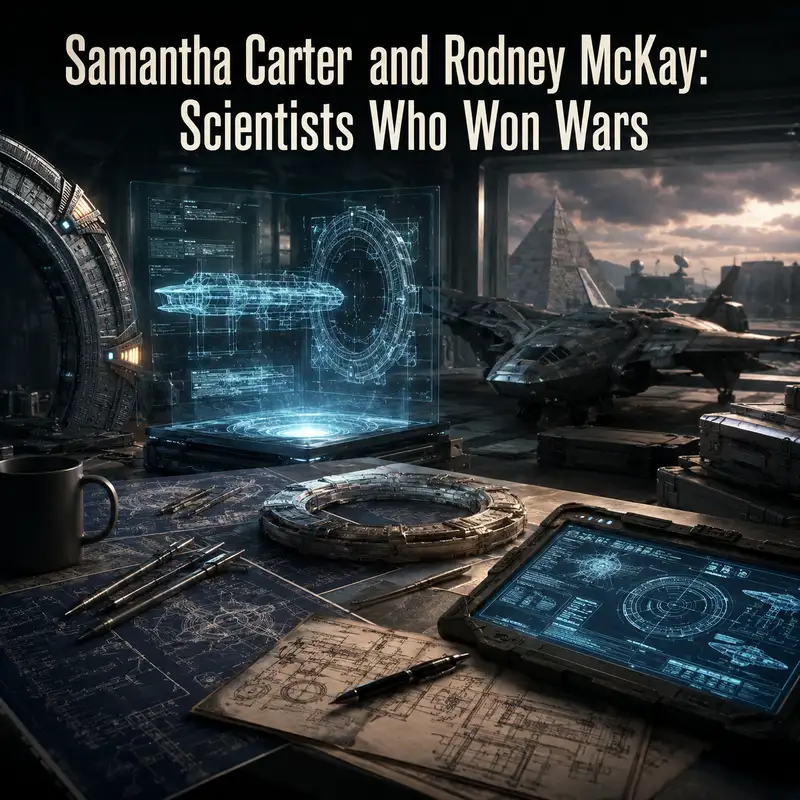
Samantha Carter and Rodney McKay: Scientists Who Won Wars
The plan to destroy Asuras failed at the moment it appeared to be working. Rodney McKay’s artificial Replicator had drawn the Asuran nanites out of their bodies, buildings, and warships, combining them into one growing mass on the planet below. The allied fleet was holding nearly thirty Asuran ships in orbit while McKay prepared to overload several zero-point modules around the mass. Then its weight crushed the subterranean power grid. The modules could no longer be detonated. Colonel Samantha Carter, commanding the Atlantis expedition and monitoring the battle from the Daedalus, noticed that the ground around the mass was rich in neutronium. McKay understood the implication at once. Increase the attraction, pull more of the dense material into the mass, and let the planet’s own pressure finish the weapon. Minutes later, Asuras was breaking apart. A war had been decided by two scientists recognizing that a failed plan had accidentally created a better one.
Carter and McKay are often remembered as rival geniuses, one disciplined and understated, the other argumentative enough to treat a briefing as a competitive event. That contrast is real, but it is not the main reason they mattered. They became strategic figures because both could translate alien science into military options while a crisis was already underway. Earth and Atlantis rarely possessed the time, industrial base, or complete technical understanding needed for conventional development. They usually had a damaged device, incomplete data, an enemy approaching, and a commander asking whether the idea would work before the next weapons impact. Carter and McKay did not win wars by inventing one permanent superweapon. They won by changing the conditions of a battle long enough for soldiers, pilots, allies, and resistance movements to exploit the opening.
Samantha Carter entered the Stargate Program as both an Air Force officer and a theoretical astrophysicist. Before joining S G One, she had worked on the gate project and spent years trying to understand a machine built by a civilization far beyond Earth’s science. She also arrived with operational experience. She had flown in hostile airspace during the Gulf War and understood that a technically elegant answer had little value if it could not survive contact with a mission schedule, a chain of command, and enemy fire. That combination became her defining advantage. Carter could move from a laboratory console to a gate room, a fighter cockpit, an alien ship, or a firefight without treating the scientific and military problems as separate worlds. She knew what commanders needed from a scientist because she was one of the officers responsible for acting on the answer.
Rodney McKay came from a different institution and a different temperament. He was a Canadian civilian scientist associated with Area Fifty-One and the Pentagon’s Stargate research structure, recognized as one of Earth’s leading experts on the gate after Carter. He entered Stargate Command as an outside specialist, not as a member of the team whose lives depended on the result. His first instinct was to identify the technical limit, state it bluntly, and assume everyone else would eventually appreciate that he had been correct. This could make him abrasive, but it also made him valuable. McKay challenged comforting assumptions. He noticed failure modes others preferred not to discuss, and he was willing to say that a plan was impossible even when senior officers needed it to be possible. The difficulty was that he sometimes treated uncertainty as proof that only his model deserved consideration.
Their first major confrontation involved Teal’c trapped inside a Stargate’s energy buffer. McKay calculated that the stored pattern would degrade within forty-eight hours, and his estimate quickly became an institutional deadline. Carter resisted the certainty of that conclusion and kept searching for a recovery method. Teal’c was eventually rematerialized, but the episode established the difference between them. McKay’s skepticism protected the command from wishful thinking. Carter’s refusal to accept a model as the final word protected a teammate. Neither approach was sufficient alone. A military science program needed people willing to identify hard limits and people willing to test whether those limits had been misunderstood.
That lesson became more important when Anubis attacked Earth through the Stargate itself. An Ancient device at the far end fed energy through an active wormhole, steadily overloading the naquadah in Earth’s gate. If the buildup continued, the resulting explosion would devastate the planet. McKay was recalled to work with Carter and Jonas Quinn. His proposed electromagnetic pulse failed and injured Carter, while the countdown accelerated. The successful answer came from changing the problem. Jonas asked how the gate had been brought into the mountain, prompting Carter to realize it could be removed again. The gate was attached to the experimental X three-oh-two, carried into space, and sent millions of miles from Earth through a brief hyperspace window before it detonated. Teal’c, Bra’tac, and Rya’c destroyed Anubis’s source device. Carter did not neutralize the attack scientifically. She turned a planetary explosion into a disposal and transportation problem that Earth’s emerging aerospace program could solve.
That distinction explains much of Carter’s wartime value. She was rarely given enough time to understand alien technology completely. Instead, she identified which part of a system had to be controlled for the mission to continue. When Stargate Command became connected to a world being consumed by a black hole, normal shutdown procedures failed because gravity distorted the wormhole and time around the base. Carter helped devise a shaped explosive charge that forced the connection to jump to another nearby gate. The method was hazardous and highly specific, not a new standard feature of Stargate operations. Years later, however, the underlying principle became the basis for an operation against the Ori. Carter preserved unusual solutions as usable knowledge rather than treating each crisis as an isolated miracle.
Her most consequential scientific victory came during the Replicator invasion of the Milky Way. By then, the machines had adapted to the disruptor weapon created from Ancient knowledge in Jack O’Neill’s mind. Carter worked with Thor to modify the weapon, but the Replicators adapted again. At the same time, the Jaffa rebellion seized Dakara, the spiritual center of Goa’uld authority, while Ba’al’s fleet and the Replicator force converged on the planet. Beneath the temple, Carter and her father, Jacob, discovered an Ancient device capable of manipulating life at its most fundamental level. It was not designed as a simple battlefield weapon. Its scale made it far more dangerous than anything Earth could manufacture.
Carter and Jacob recalibrated the Dakara device to match the disruptor effect that separated Replicator cells. One local pulse would not be enough because surviving Replicators could adapt. Carter proposed transmitting the effect through the Stargate network and striking the entire galaxy at nearly the same moment. That required Ba’al’s knowledge of the gate system, Jacob and Selmak’s understanding of Goa’uld and Ancient technology, Daniel Jackson’s temporary control over the Replicator network, and Jaffa forces holding the temple while fleets fought overhead. When the device activated, the wave emerged through gates across the Milky Way and destroyed the Replicators before they could adjust. The same action left Ba’al surrounded by victorious rebels and helped turn the capture of Dakara into the political collapse of Goa’uld rule.
Calling that Carter’s victory does not mean she won it alone. Her achievement was systems integration. She recognized that an Ancient device, an anti-Replicator frequency, a galactic transportation network, and enemy technical expertise could be combined into one operation. Each component belonged to a different civilization. None was an ordinary Earth capability. The solution worked because Carter could speak to scientists, officers, allies, and enemies in the language each understood. It also created a severe political danger. The Dakara device remained capable of killing biological life and was later used by Free Jaffa leaders against an Ori-controlled world. A weapon calibrated with precision in one crisis became an instrument of indiscriminate policy in another. Scientific control did not guarantee political restraint.
McKay’s decisive work developed under the harsher logistical conditions of Atlantis. The expedition arrived in the Pegasus galaxy with no assured route home, a city it barely understood, and a power system near exhaustion. McKay diagnosed the failing zero-point modules and the collapsing shield before the city rose to the surface. From that point forward, he was responsible for making Ancient systems perform missions their original operators had never documented for human successors. He and Radek Zelenka diverted the electrical energy of a planetary storm into Atlantis’s shield. They attempted to restore an Ancient defensive satellite before the Wraith siege. They managed damaged hyperdrives, failing power grids, gate systems, sensors, and weapons with limited spare parts. Atlantis possessed technology millions of years ahead of Earth, but owning the control room did not mean possessing the civilization that built the components behind its walls.
McKay’s brilliance did not make him safe. On Doranda, he became convinced that he could complete an abandoned Ancient energy weapon whose original development had ended in catastrophe. He ignored increasingly serious evidence that the system was unstable and pressed the experiment beyond the point his team considered acceptable. The result destroyed the installation and most of the surrounding solar system. The failure damaged his relationship with John Sheppard because it was not simply a bad calculation. It was a command failure by a scientist who had treated his own confidence as a substitute for independent review. McKay survived with his intellect intact and his certainty badly wounded, although not permanently. Atlantis benefited from his willingness to attempt the impossible, but only when someone retained the authority to stop him.
His later work showed a growing ability to build systems rather than chase singular breakthroughs. Carter and McKay developed the intergalactic gate bridge linking the Milky Way and Pegasus without consuming the enormous power required for a direct connection. McKay wrote the forwarding programs that moved a traveler from one gate to the next across the void. The bridge reduced dependence on starships and zero-point modules, shortened travel, and improved strategic communication. It also created a new invasion route and required quarantine, security, and a vulnerable transfer station. The project illustrates their shared style of technological adaptation. They did not reproduce an Ancient intergalactic transportation system. They rearranged existing gates, software, and human infrastructure into a capability that met an operational need.
The Asuran crisis exposed both the power and the cost of McKay’s interventions. The Asurans were artificial beings created by the Ancients as weapons against the Wraith. During the expedition’s first encounter with them, McKay altered their base code in an attempt to remove an aggression directive and help the team escape. Later, Atlantis deliberately restored their drive to attack the Wraith. The plan appeared successful until the Asurans adopted a more efficient strategy. Instead of engaging hive ships directly, they began destroying human worlds to eliminate the Wraith food supply. Settlements that had no role in the programming decision became targets of a machine war. McKay understood that his code had helped open that path, even though the command decision and consequences belonged to the expedition as a whole.
By the time Carter assumed command of Atlantis, she was no longer merely McKay’s scientific rival. She was the officer responsible for deciding how his ideas would be used. Their mature working relationship depended on a productive tension. Carter understood the mathematics well enough to challenge him and the command environment well enough to set a deadline. She also defended him from officers who mistook his poor manner for lack of value. McKay, in turn, could tell Carter when her preferred solution would fail without simplifying the explanation for a commander who already understood the physics. They irritated one another because their knowledge overlapped. They succeeded because their responsibilities did not.
The campaign against the Asurans brought those responsibilities together. McKay first tried to create a program that would permanently deactivate the nanites. When that failed, Carter shifted to a fleet attack because human colonies were being destroyed and the command could not wait for perfect code. McKay then devised another approach. He would create a friendly Replicator, later called Fran, whose internal programming would increase the attractive force among nanites. Once inserted on Asuras, she would become the center of a growing mass, pulling Asuran bodies from the planet and their warships. The mass would then be destroyed by overloading zero-point modules around it. The plan required Carter to authorize a coalition with Wraith hives and Traveler warships, enemies and uncertain partners united only by the Asuran threat.
The battle was not won in the laboratory. Earth’s ships, equipped with Asgard beam weapons, had to keep the Asuran fleet from escaping. Wraith and Traveler crews accepted losses while John Sheppard used Ancient drones from a Traveler vessel. Ronon Dex protected McKay at the Asuran power facility. Fran knowingly served as the focal point of a weapon that would destroy her with the collective. When the power grid collapsed, Carter identified the neutronium and McKay converted the accident into a planetary implosion. Asuras was destroyed, along with the main Asuran force and its industrial base. A small splinter group survived elsewhere, so the victory did not erase every Replicator in Pegasus. It ended the organized campaign that was exterminating human worlds. The coalition dissolved almost immediately, because common danger had produced cooperation, not trust.
Carter and McKay had already demonstrated the same partnership against the Ori supergate. The Ori had sent warships into the Milky Way through a gate too large and powerful for Earth’s normal countermeasures. Carter proposed using an ordinary Pegasus Stargate near a black hole to establish a connection toward a second ordinary gate positioned beside the supergate. A precisely timed explosion would force the wormhole to jump from the smaller gate into the Ori structure, while the black hole supplied enough energy to hold the connection open and deny the enemy access. The concept came from Carter’s earlier black-hole crisis. McKay’s role was to calculate the narrow energy range in which the jump might occur without destroying the gate. His objections were not cowardice. The margins were genuinely severe.
The operation became more complex when a Wraith ship attacked the Odyssey near the black hole and an Ori ship approached the supergate in the Milky Way. Carter turned the Wraith attack into the explosive event the original plan required. The Odyssey drew the hostile ship deeper into the gravity well, where its jamming weakened, then beamed nuclear warheads aboard. The detonation destroyed the Wraith vessel and forced the wormhole jump. Teal’c concealed the smaller gate near the supergate and lured the Ori ship into the unstable vortex as the larger gate activated. One action destroyed enemies in two galaxies and tied up the supergate against reinforcement. It was an extraordinary result, but it remained an improvised operation dependent on black-hole conditions, transported gates, nuclear yields, cloaking, beaming technology, and exceptional timing. It could not be turned into a routine weapon system.
Carter’s final years with S G One showed the same habit at a larger scale. When the Odyssey faced destruction by an Ori beam, she activated an Asgard time-dilation field, giving the crew years of subjective time while the blast remained almost frozen outside. The field saved them from immediate death but trapped them with the problem. Carter spent decades searching the Asgard database before the team found a way to reverse the sequence and restore the ship to the moment before impact. The solution preserved the Odyssey, its crew, and the Asgard legacy entrusted to Earth. It also revealed the burden behind Carter’s calm. Scientific persistence could demand a lifetime even when almost no time passed for the war outside.
McKay’s equivalent strength was his ability to improvise while openly acknowledging panic, irritation, and the possibility of failure. On Atlantis, he kept a city alive during power loss, repaired systems under attack, and repeatedly turned Ancient machinery into tools its new operators could use. His fear did not prevent action. In some cases, it sharpened his attention to risk. His ego remained dangerous when it insulated him from criticism, but it also drove him to keep working after more socially graceful people might have accepted defeat. Carter projected control and translated complexity into command decisions. McKay exposed complexity and forced commanders to confront it. The strongest operations used both habits.
Neither scientist worked alone. Carter depended on Jacob and Selmak, Thor, Bill Lee, Daniel, Teal’c, pilots, engineers, and commanders willing to authorize hazardous plans. McKay depended on Zelenka, Jeannie Miller, the Atlantis science staff, Sheppard’s field teams, Wraith technical knowledge, and military personnel who kept enemies away from the equipment long enough for him to finish. Their reputations can obscure the institutional labor surrounding them. A brilliant equation did not manufacture a zero-point module, repair a battlecruiser, evacuate a colony, or hold a gate room. Their science became strategic only when other people converted it into logistics, security, diplomacy, and combat power.
Their failures are therefore part of the same history as their victories. Carter helped make the Dakara device usable against the Replicators, but later leaders used it against living populations. McKay altered Asuran programming to solve immediate problems and helped unleash a campaign against human worlds. The intergalactic bridge improved mobility and created another route an enemy could exploit. The destruction of Asuras ended a machine offensive through an alliance with the Wraith, who returned to feeding on humans once the battle was over. Scientific success changed what was possible. It did not decide what should be done, who should control the capability, or what political order would follow.
Samantha Carter and Rodney McKay won wars because they could see battlefields hidden inside equations, software, power systems, and wormholes. Carter’s military discipline turned theory into plans commanders could employ. McKay’s relentless skepticism and improvisation uncovered options that orderly processes might never have found. Together, they helped destroy Replicator armies, close an intergalactic invasion route, preserve Earth’s most advanced ship, and end the Asuran campaign. Their real achievement was not proving that science could replace soldiers or strategy. It was proving that, in a war fought through machines no human civilization had built, scientific judgment was itself a form of command. The decisive weapon was often not the device on the table. It was the person who understood what else that device could be made to do.