Sarcophagi: Immortality, Addiction, and Command
Jack O’Neill opened his eyes inside Ba’al’s sarcophagus after being killed during an escape attempt. The machine had repaired the staff-weapon wound that ended his life, but his captor had no intention of releasing him. Ba’al would torture O’Neill, kill him, restore him, and begin again until the memories left by a Tok’ra symbiote finally surfaced. In that fortress, resurrection was not mercy. It was an interrogation schedule.
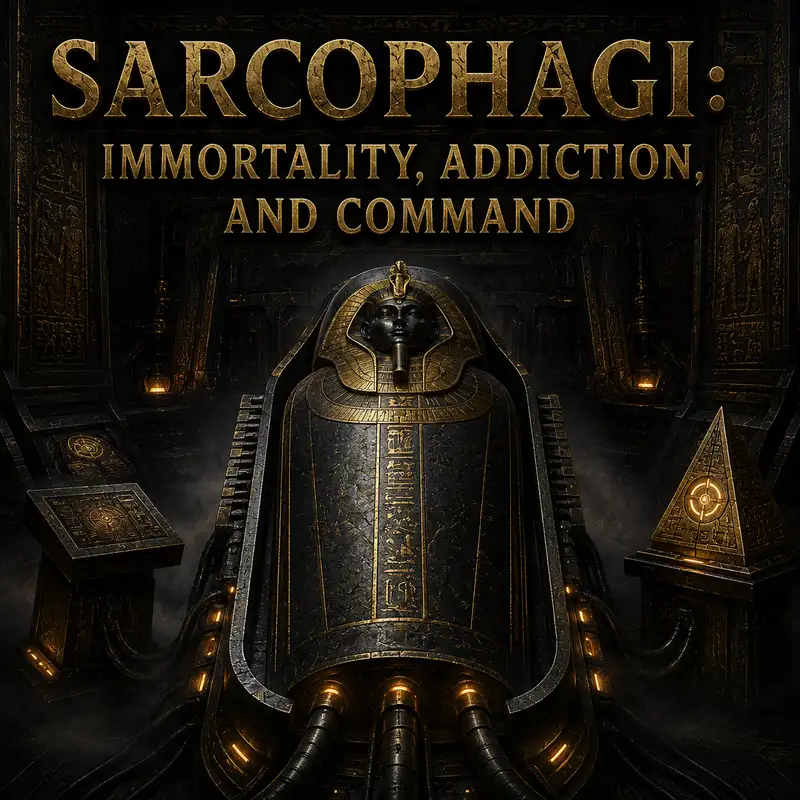
That use exposes the central military importance of the Goa’uld sarcophagus. It healed injuries, reversed aging, preserved bodies, and under the right conditions restored the recently dead. It also created physical dependence, altered judgment, encouraged aggression, and allowed rulers to avoid the political consequences of mortality. The device was simultaneously a hospital, a throne, an intelligence weapon, and a command liability. It made Goa’uld leaders extraordinarily difficult to remove while making some of them progressively less fit to lead.
The sarcophagus was not an original Ancient medical chamber simply placed into Goa’uld service without modification. The surviving record identifies a Goa’uld named Telchak as the figure who derived the first sarcophagus from a far more powerful Ancient life-energy device. That distinction matters. The Goa’uld copied and reduced a capability they did not create, producing a chamber that could be manufactured and installed throughout their domains. The exact engineering remains uncertain, but its effect was repeatable enough to become standard equipment aboard important ships, inside palaces, and at fortified installations.
At a listener-friendly level, the device appears to examine and reconstruct living tissue with an energy field. It can repair massive trauma, restore organ function, reverse deterioration, and rejuvenate both a human host and the symbiote inside. In some cases it can restart life after clinical death. It does not simply close a wound. It restores the body toward a healthier earlier condition, though the amount of time required appears to depend on the severity of the damage.
That restoration has limits. A sarcophagus needs a body to work on, enough remaining structure to reconstruct, access to power, and time. A ruler vaporized with a ship or destroyed in a massive explosion cannot be placed back inside one. Severe damage may require a longer cycle, and repeated use eventually becomes less effective. The chamber is also large, fixed, and difficult to move compared with a field medical kit. It is strategic medical infrastructure, not something a Jaffa patrol carries beside the ammunition.
Earth learned the value of that infrastructure on Abydos. Daniel Jackson was killed by a staff blast while protecting Jack O’Neill. Ra placed him inside a sarcophagus and restored him, turning a fatal casualty into a living witness. Daniel later used a sarcophagus aboard Klorel’s mothership after suffering another near-fatal wound. He reached the chamber alone, recovered, and escaped through the ship’s Stargate before the invasion force was destroyed. Without the device, Earth would have lost one of the people most responsible for understanding the gate network.
Klorel provided the enemy version of the same lesson. O’Neill shot the Goa’uld occupying Skaara’s body to stop an attack on Daniel. Apophis’s Jaffa immediately moved the body into a sarcophagus. Klorel and Skaara returned to life, preserving a dynastic commander and the valuable host imprisoned beneath him. A successful shot had removed the target from the room. It had not removed him from the campaign.
That distinction changes battle-damage assessment. Against an enemy with sarcophagus access, confirming that a leader fell is not the same as confirming that the leader is gone. Recovery of the body becomes an operational objective. Denying the enemy access to the chamber may matter more than winning the firefight around it. A dead prisoner can still become an intelligence source, while a dead ruler can return to command after friendly forces have already reorganized around the assumption of succession.
Apophis demonstrated the strategic consequences. He arrived at Stargate Command physically ruined after prolonged torture by Sokar. Without access to a sarcophagus, both the symbiote and host deteriorated and died. Earth returned the body to prevent Sokar from attacking the planet. The Tok’ra warned that Sokar would revive him. They were correct. Apophis returned, took control of Netu, survived Sokar’s destruction, and seized much of his former captor’s domain. A corpse sent through the gate to end one crisis eventually became a major regional warlord again.
The sarcophagus therefore protected more than individual life. It protected political continuity. Goa’uld government was intensely personal. Fleets, Jaffa, mines, servants, and subordinate rulers owed allegiance to a specific System Lord. The ruler’s death could trigger desertion, rebellion, and predatory attacks by rivals. Restoring that ruler preserved the command signature around which the entire domain had been organized. The device functioned as continuity-of-government technology for a government that consisted largely of one person.
Its effect on claims of divinity was equally valuable. A System Lord could survive wounds that killed ordinary subjects, remain in the same human body for centuries, and occasionally return after apparent death. Priests did not need to invent every miracle. The chamber provided one. Populations denied access to advanced science saw the god emerge young, healed, and confident while everyone else remained subject to ordinary disease and age. Immortality became a political performance supported by machinery hidden behind the throne.
Goa’uld symbiotes were already long-lived, and they could move into new hosts. The sarcophagus added another layer of continuity by preserving a favored body and extending the public identity attached to it. Changing hosts carried political risk. A familiar face, voice, and courtly image could be maintained for generations, allowing subjects to believe they served one unchanging god. The ruler preserved not only life, but branding, which is an undignified word for a very effective imperial practice.
The technology also allowed humans to imitate Goa’uld rule. Pyrus killed the Goa’uld who controlled his world, took the sarcophagus, and lived for approximately seven hundred years. He did not free the miners or abandon the tribute system. He continued forcing his people to extract naquadah and sending shipments through the Stargate so distant System Lords would believe their arrangement remained intact. The liberator became another immortal ruler because the machine preserved both his body and the political habits he had inherited.
Pyrus shows why the sarcophagus cannot be treated as a device that made an otherwise innocent species evil. Human beings could become dependent on it and reproduce the same authoritarian pattern. Goa’uld genetic memory, imperial culture, and voluntary choices existed before any individual entered the chamber. The sarcophagus did not create every cruelty. It amplified traits useful to personal dictatorship, rewarded grandiosity, and weakened the emotional restraints that might otherwise limit violence.
Daniel Jackson’s experience on P three R six thirty-six provided Earth’s clearest medical evidence. He was severely injured during an escape attempt, and Pyrus’s daughter Shyla used the sarcophagus to save him. That emergency treatment worked. She then persuaded him to enter repeatedly while healthy, presenting each cycle as trust, affection, and continued improvement. After roughly nine or ten uses, Daniel no longer behaved like the same member of S G One.
The immediate benefits were real. His injuries disappeared. His eyesight improved enough that he stopped using glasses. He felt stronger, clearer, more confident, and unusually capable. Those effects helped conceal the danger because decline did not feel like decline from inside the patient. Daniel believed he was becoming a better version of himself while everyone around him saw irritability, impulsiveness, inflated confidence, and worsening judgment.
His mission performance deteriorated rapidly. O’Neill, Carter, and Teal’c remained enslaved in a mine while Daniel became increasingly absorbed in Shyla, the sarcophagus, and his imagined ability to control the political situation. He forgot commitments, dismissed warnings, lashed out at friends, and considered abandoning his former life. The machine had not erased his intelligence. It had distorted the priorities governing how that intelligence was used.
Withdrawal revealed that the dependence was physical as well as psychological. Back at Stargate Command, Daniel’s endorphin levels and organ functions became unstable. He suffered muscle deterioration, agitation, collapse, and an overwhelming compulsion to return. Doctor Janet Fraiser could treat symptoms, but she could not instantly reverse the cellular dependence created by repeated exposure. Daniel became violent during an escape attempt from the infirmary before O’Neill reached the person still present beneath the addiction.
He recovered because the exposure had been limited, his team prevented further use, and medical personnel supported him through withdrawal. Shyla later destroyed the sarcophagus rather than allow it to shape her reign as it had shaped her father. That decision was both personal and constitutional. She gave up the machine that could preserve her body because preserving it would eventually threaten her ability to govern as the person she intended to be.
The case also establishes an important qualification. One emergency treatment did not automatically transform Daniel, O’Neill, or every other patient into a tyrant. The most severe effects followed repeated exposure, especially when a healthy person returned for enhancement rather than necessary healing. Even limited cycles could produce withdrawal, as O’Neill later experienced after Ba’al’s repeated resurrections. The danger was cumulative, but the exact threshold varied and was never reduced to a safe dosage table.
The Tok’ra responded by rejecting the technology almost completely. They believed sarcophagus use drained the good from the heart and damaged what humans might call the soul. Their language was moral, but their policy reflected observed neurological consequences. Tok’ra hosts and symbiotes accepted aging and death rather than preserve themselves through a machine that might turn resistance leaders into the kind of rulers they opposed.
That refusal imposed a major strategic cost. Tok’ra numbers were already limited because they would not take hosts by force and had almost no means of producing new symbiotes. Experienced leaders eventually died. Valuable memories disappeared from active service. Selmak required a new voluntary host when the previous one could no longer survive, and even that solution did not create immortality. The Tok’ra traded demographic strength and command continuity for ethical and psychological control.
Their decision also drew the clearest political line between them and the System Lords. Both groups possessed Goa’uld biology, inherited memory, and advanced technology. One accepted mortality as a limit on power. The other treated mortality as an engineering defect. Refusing the sarcophagus prevented the Tok’ra from matching the empire’s numbers, but it also prevented a resistance cell from turning into another immortal court centered on a leader who could never be replaced.
For the System Lords, the chamber removed a natural succession point. A ruler did not retire, age out of office, or transfer authority through a predictable institution. He or she continued until assassination, catastrophic destruction, capture, or biological failure beyond the machine’s ability to repair. Subordinates could accumulate enormous responsibility without legitimate authority to succeed. Rivals therefore prepared for sudden seizure rather than orderly transition.
This made command structures both stable and brittle. A domain could retain the same strategic personality for centuries, preserving long-term plans and relationships. The same ruler could also continue issuing orders after paranoia, addiction, and cognitive decline had compromised judgment. No staff officer could recommend medical retirement to a being publicly worshipped as immortal. The usual performance review involved treason charges and a very brief meeting with the palace guard.
Lord Yu demonstrated the final stage of that problem. As the oldest active System Lord, he had survived rivals, wars, and political transformations that destroyed younger rulers. Eventually, he spent increasing amounts of time inside his sarcophagus and could no longer take another host. The chamber kept his body functioning, but his First Prime, Oshu, observed worsening confusion, paranoia, and senility.
The crisis became operational when Yu was expected to lead the combined System Lord fleet against Anubis. At the decisive moment, he ordered his forces away from the correct battlefield and toward a distant system. Oshu knew the order was irrational but could not openly declare the god incompetent without destroying the authority holding Yu’s fleet together. He and Teal’c quietly transferred practical leadership toward Ba’al while continuing to govern through Yu’s name.
The sarcophagus had preserved the commander and endangered the command. Yu’s experience undermines the assumption that continuous life guarantees continuous competence. His strategic memory had once made him the most cautious member of the old guard. Repeated rejuvenation preserved the office after the person occupying it could no longer reliably exercise judgment. The device delayed succession without solving it.
Ba’al found another command use for resurrection. He converted the sarcophagus into an interrogation instrument. O’Neill had briefly hosted the Tok’ra symbiote Kanan, who used his body to infiltrate Ba’al’s fortress. Ba’al believed residual memories remained. Instead of accepting that O’Neill did not consciously know the answers, he created repeated cycles of pain, death, restoration, and questioning.
This method extended the time available to break a prisoner and removed death as an escape. It also allowed Ba’al to experiment with increasing severity while keeping the subject physically usable. The prisoner could be killed before shock or blood loss ended the session, restored, and returned to the chamber. No conventional detention facility could offer that level of control. Few would advertise it as an advance in professional interrogation practice.
The intelligence value was still limited. Repeated trauma weakened O’Neill’s mind and body. Daniel warned that continued cycles would destroy the identity Ba’al was trying to exploit. A broken memory source does not become more reliable simply because the interrogator can restart his heart. Eventually, the sarcophagus would produce a prisoner less capable of distinguishing memory, suggestion, pain, and the answer expected by the captor.
The rescue required an indirect attack. Stargate Command could not storm Ba’al’s fortress with the forces available. Teal’c helped pass the outpost’s location to Lord Yu, whose motherships struck the rival installation for their own reasons. The attack disrupted power and gave O’Neill the opportunity to escape. The mission succeeded by targeting the political rivalry supporting the fortress rather than trying to defeat the sarcophagus, the guards, and the defenses one room at a time.
O’Neill returned alive but still suffered withdrawal from repeated use. His case showed that entering the chamber only while gravely injured did not eliminate dependency. It also showed that the psychological damage was not always permanent when exposure stopped in time. Ba’al had not created an endlessly reusable prisoner. He had created a narrowing window in which the person he wanted information from still existed.
The threat of revival changed intelligence procedures beyond interrogation rooms. Tok’ra operatives were expected to prevent capture and, if necessary, damage their own brains so completely that a sarcophagus could not restore them for questioning. That policy reflects a grim reality. In a war against the Goa’uld, death did not always protect secrets. Personnel recovery and body denial could become parts of operational security.
Earth never turned the sarcophagus into a routine medical capability. Stargate Command encountered several, used them during emergencies, and understood their value. It did not possess the knowledge or industrial base required to manufacture safe versions. Captured examples were usually aboard hostile ships, inside fortified palaces, or destroyed during the mission that exposed them. Access was episodic, maintenance uncertain, and the side effects severe.
When Daniel suffered lethal radiation exposure, General Hammond considered whether a force could retrieve a sarcophagus from a heavily defended Goa’uld site. He rejected the operation because too many personnel would be risked for a slim chance of returning with a functioning device in time. The decision separated technical possibility from operational capability. Knowing that a machine could save someone did not place the machine in the infirmary.
The original Ancient device recovered from Telchak’s temple appeared to offer another path. Its energy was stronger than that of a normal sarcophagus and helped explain how Anubis gave life to synthetic Kull bodies. Earth and the Tok’ra hoped its effects might be studied, reversed, or refined into a weapon and perhaps a safer healing system. The device did contribute to the development of a countermeasure against Kull warriors. It did not produce a fleet of harmless resurrection chambers for Earth hospitals.
That failure was not simply scientific delay. A reliable sarcophagus would have created profound command and political questions on Earth. Who would receive treatment? Could a President, general, scientist, or intelligence officer remain in office for centuries? Would repeated revival be voluntary after dependency developed? Could a prisoner be restored for interrogation? A device that defeats death for selected people does not remove scarcity. It transfers scarcity into the selection process.
The Goa’uld answered those questions through rank. System Lords, favored hosts, dynastic heirs, and strategically valuable prisoners received resurrection. Miners, ordinary Jaffa, slaves, and civilians generally did not. The sarcophagus did not abolish death across the empire. It made death negotiable for the ruling class and permanent for almost everyone whose labor sustained it.
That inequality strengthened control for thousands of years. Subjects saw rulers survive generations. Jaffa learned that killing a god’s body might not end the god. Rivals had to destroy ships, seize chambers, or deny recovery rather than rely on assassination alone. The machine gave Goa’uld power a persistence that exceeded any one battle and helped turn personal rule into an apparently permanent political order.
The same machine weakened that order from inside. Addiction intensified aggression. Rejuvenation encouraged rulers to preserve themselves rather than build institutions. Commanders could survive beyond the point of competence. Succession remained violent because no one was allowed to prepare openly for the god’s death. The sarcophagus produced continuity without accountability, which is another way of saying it preserved the throne while slowly damaging the person seated on it.
Sarcophagi made the Goa’uld seem immortal because they turned death into a recoverable condition for the people at the top. They also made Goa’uld command more paranoid, more personal, and less capable of renewal. Each opened lid could restore the ruler’s body, preserve a dynasty, or return a prisoner to the torture chamber. It could not restore trust, judgment, or legitimacy. The empire kept bringing its gods back to life and never solved the damage those gods carried out with them.