Sateda, Ronon Dex, and the Wraith Runner Program
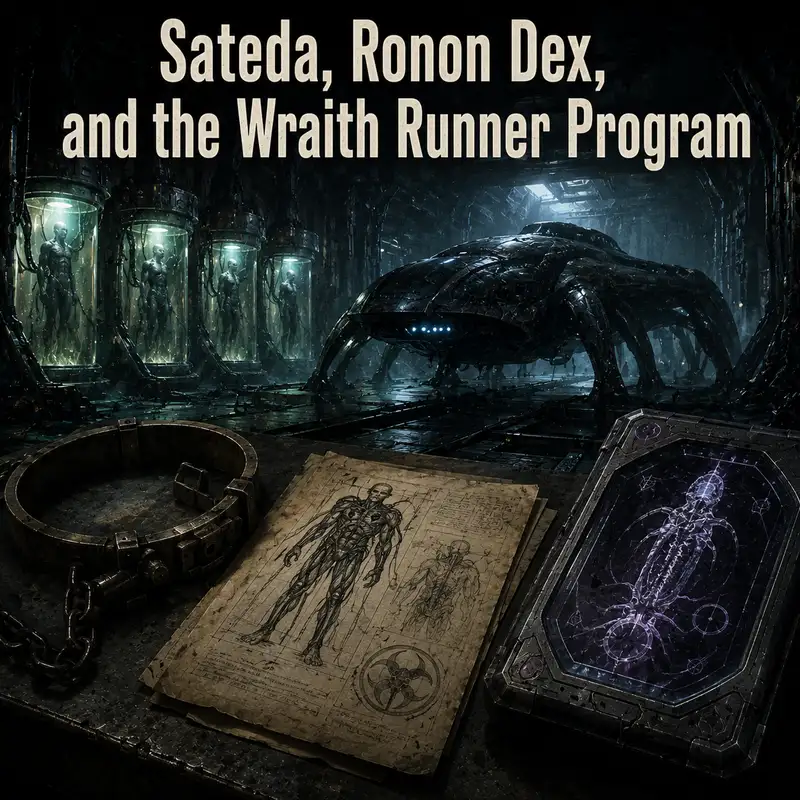
The Wraith did not return Ronon Dex to Sateda as a prisoner. They returned him as quarry. A tracking device had been cut beside his spine, surveillance machines hovered over the ruined streets, and armed hunters were released while a Wraith commander watched from orbit. The city around Ronon was the city he had failed to save. Every collapsed building, empty hospital, and abandoned armory turned memory into terrain. The hunt was not simply an execution. It demonstrated what the runner practice accomplished: isolate a capable human, study how he survived, and make that survival dangerous to everyone he approached.
Ronon was not born as the solitary fighter Atlantis first encountered. He had been Specialist Ronon Dex of the Satedan military, a trained soldier from an urban civilization with radios, hospitals, organized regiments, ammunition depots, shelters, and weapons capable of defeating limited Wraith forces. The title specialist should not be mapped too neatly onto an Earth rank, but Ronon led troops in combat and had been formed by a professional warrior culture. The runner came later. First there was a country, a regiment, a squad, and a defense plan that could hurt the Wraith without being able to stop them.
Sateda’s strategic problem was common in the Pegasus galaxy. A human society could become advanced enough to resist local cullings, yet remain unable to defeat a hive ship in orbit. The Satedans chose resistance rather than concealment or submission. Their forces struck Wraith positions away from the homeworld, launched raids against known strongholds, and fought when enemy craft came through the Stargate. They reportedly destroyed two small vessels during the opening crisis. That success proved Sateda could impose a cost. It did not prove the Wraith would accept the cost and leave.
Ronon’s military formation placed him near the center of that decision. He served in the same regiment as Solen Sincha and trained under a taskmaster named Kell. His comrades included Tyre, Ara, Rakai, and others who conducted raids beyond Sateda. Ronon later took Second Squad back toward the gate during one operation, separating him from friends trapped when a cave entrance collapsed. The details matter because the fighter Atlantis met was not merely strong. He understood patrols, ambushes, weapons, ammunition shortages, and the burden of deciding who could still be extracted when a position failed.
The person Ronon most wanted to extract was Melena, a medical worker who was effectively his partner. As the Wraith attack approached, he traded everything he owned to secure her a place on Kell’s staff because that group was expected to escape through the Stargate. Melena refused to abandon the hospital. She believed resistance might persuade the Wraith that Sateda was too costly to harvest. Ronon understood the military balance more clearly. He had seen what larger Wraith ships could do and believed no one remaining in the city would survive. He stayed because his duty left him no honorable alternative.
The defense collapsed under the difference between local firepower and interstellar power. Wraith Darts crossed the city, ground troops pushed through streets and sewers, and Satedan units ran out of ammunition. Ronon’s squad was used to cover Kell’s escape. One by one, the soldiers around him were killed. Ronon later found their skeletal remains where they had made their final stand, along with weapons and armor the dead no longer needed. Sateda had possessed an army, but its command system fractured. Public speeches called for courage while one senior figure preserved himself by spending the lives of subordinates.
Ronon reached the hospital after his squad was destroyed. The corridors were crowded with casualties, civilians, and medical personnel trying to work while the city came apart. He found Melena and tried to leave with her, even taking responsibility for a child whose parents had been killed. Melena would not abandon the other patients. An explosion struck before Ronon could change her mind. She died in the hospital he later used as a battlefield against the Wraith. The loss of Sateda was not an abstract defeat. It was the death of his unit, the failure of command, and the destruction of the future he had tried to protect.
Sateda was devastated, but its people were not entirely erased. Some soldiers and more than three hundred civilians reached shelters west of the capital. When they emerged, they found nothing worth salvaging and scattered to worlds such as Belkan and Manaria. Ronon did not learn this until much later. For years, he believed he was the only survivor. That belief intensified everything the Wraith did afterward. A refugee can imagine rebuilding with others. A man who believes his people are dead carries the civilization alone, with no one available to share the weight.
Ronon was captured during the culling. A Wraith began feeding on him and then stopped. The record never provides a definitive biological explanation. It should not be described as proven immunity, because Wraith later fed on Ronon under other conditions. What matters is that they saw value in keeping him alive. They operated on him, placed a transmitter beside his upper spine, released him on another world, and followed. The feeding victim had become a marked target. The Wraith took a soldier whose society was gone and converted his continued existence into a recurring hunt.
The tracker was the core of the system. Hunter Wraith carried devices that indicated a runner’s position, allowing them to move through forests, settlements, and ruined cities while the runner remained under pressure. The implant was buried near the second thoracic vertebra, close enough to the spinal column that careless removal could cripple or kill. Ronon tried to cut it out himself with a mirror. Two other attempts left heavy scarring without freeing him. The technology did not need to control his mind. It controlled his choices by ensuring that remaining in one place would eventually bring armed Wraith.
Runner described a category recognized across Pegasus, not a condition unique to Ronon. Teyla had heard stories of runners throughout her life, though she had never met one. Years later, Atlantis encountered another marked survivor named Kiryk. The continuity does not establish a centralized Wraith bureau, standard selection process, or known total number. It is more accurate to describe a recurring practice used by particular hunters or hives. The system was consistent enough to create legends, common enough for Ronon to recognize another runner’s methods, and rare enough that most communities knew it through fear.
Ronon could not say with certainty why the Wraith created runners. He suggested sport, training, learning how humans fought, and measuring the will to survive. Each explanation fits part of the evidence. Hunting an armed and adaptive human gave Wraith warriors a harder target than a normal culling victim. Surveillance revealed tactics, traps, evasion routes, and reactions under stress. The practice also turned domination into ritual. The Wraith did not merely defeat resistance. They selected one resistant human, allowed him room to struggle, and returned to prove that even exceptional prey remained prey.
The larger effect was psychological warfare against human society. A runner carried the Wraith threat into every settlement he entered. Communities that offered food, shelter, or companionship risked attracting hunters. Ronon once stayed in a village for one night and left the next morning. The Wraith destroyed it anyway. On another world, villagers later recognized him as a Wraith bringer and treated his presence as a death sentence. The practice punished solidarity. It taught isolated communities that helping a hunted person could condemn everyone. The most efficient prison did not require walls. It required neighbors too frightened to open a door.
Seven years of running imposed extreme logistical discipline. Ronon could not establish a base, maintain a supply chain, or remain near a friendly population. He moved through the Stargate network, scavenged ammunition and equipment, learned terrain quickly, and built traps from available materials. Food had to be found without creating a pattern. Medical treatment was improvised or postponed. Rest carried risk because the tracker continued transmitting. A conventional unit rotates personnel, evacuates casualties, and receives replacements. Ronon had none of those advantages. He survived by reducing his needs and treating movement as his only reliable defense.
The Wraith expected him to run. Ronon survived because he learned to hunt them back. He used snares, elevated positions, darkness, false trails, close-range ambushes, and captured weapons. His energy pistol could stun or kill, giving him options when ammunition for conventional firearms was uncertain. He carried blades in several locations because disarmament was never assumed complete. None of this made him superhuman. It made him a trained soldier forced through years of live-fire adaptation. His effectiveness came from Satedan military education combined with relentless field experience, not from a mysterious instinct that appeared after capture.
That experience altered his judgment. Ronon treated unfamiliar people as threats, took hostages when he needed leverage, resisted anesthesia, and preferred direct action to debate. Those were survival rules learned where trust could reveal his location and hesitation could let a hunter close the distance. Atlantis personnel sometimes read him as reckless because they possessed a city, medical staff, radios, aircraft, and a chain of command. Ronon had spent seven years with none of them. The remarkable development was not that he distrusted Atlantis. It was that he eventually trusted anyone.
First contact occurred while Sheppard’s team was searching for Aiden Ford. Ronon ambushed Sheppard and Teyla, stripped their equipment, and held them in a cave. Even then, the soldier remained visible. He gave his name and rank, evaluated their weapons, listened to their explanation, and negotiated rather than killing them. Sheppard offered medical removal of the tracker. Ronon offered to help recover Ford. The arrangement was practical and based on a shared enemy. In Pegasus, that is often the first draft of an alliance, although most alliances do not begin with the future member pointing a captured P ninety at the commander.
Carson Beckett performed the operation in the field because the Wraith were approaching. Ronon refused anesthetic and would not surrender his weapon. Beckett cut beside the spinal column while Teyla remained within reach and Sheppard covered the position from above. The procedure succeeded, and Ronon lost consciousness only after the device had been removed. Technically, the intervention was modest compared with the Ancient systems surrounding Atlantis. Strategically, it broke the mechanism governing Ronon’s life for seven years. The expedition did not defeat a hive. It removed one transmitter and gave one man the ability to stop moving.
Atlantis sent a mobile analytic laboratory probe to the gate address Ronon provided for Sateda. The images showed a destroyed city and no obvious survivors. Ronon entered Atlantis as a man without a home and soon accepted a place on Sheppard’s team. Later, on Belkan, he learned about Solen and the civilians who had escaped the shelters. The discovery changed the record without restoring the country. Satedans lived on as refugees, traders, mercenaries, and scattered survivors. Sateda remained a ruin. Ronon could recover people from his past, but not the political and military world that had given him his rank.
His value to Atlantis was often summarized as combat ability, but that is too narrow. Ronon understood Wraith patrol behavior, fieldcraft, intimidation, and the psychology of being hunted. He could track across terrain that defeated ordinary sensors, recognize when an enemy was shaping movement toward an ambush, and continue operating after serious injury. He also understood Pegasus communities as someone who had depended on them and endangered them. He was not merely firepower. He was a human intelligence source on Wraith ground operations, a survival instructor, and a warning about what happened when extraction failed.
The Wraith eventually reactivated the system. A village Ronon had unintentionally exposed during his years as a runner captured Sheppard’s team and offered him for safety. Ronon forced the release of Sheppard and Teyla by threatening to kill himself before the Wraith arrived. The bargain did not save the village. The Wraith killed some residents, culled the rest, and took Ronon aboard a hive. A commander who remembered Sateda implanted another tracker and returned him to his homeworld. The program was restored by surgery, but the target was different. Ronon now had a team that knew he was missing and refused the trade.
Choosing Sateda as the hunting ground was deliberate psychological pressure. The commander could have released Ronon on any forested world. Instead, he placed him among the ruins of his city and used remote cameras to watch him pass the places where his squad and Melena had died. Ronon fought two campaigns at once. One was against hunters closing on the transmitter. The other was against memory. Every supply point offered useful weapons and another reminder of failure. The Wraith expected grief to weaken him. It also gave him detailed knowledge of the terrain.
The rescue created a command problem for Atlantis. The Daedalus was the expedition’s only Earth warship in Pegasus, and approaching the planet risked detection by the hive in orbit. Colonel Steven Caldwell rejected a direct recovery as a poor risk for one man. Sheppard argued that Ronon was a member of his team and deserved the same commitment as any Earth officer. The compromise used the Daedalus for strategic movement and a cloaked Puddle Jumper for the final penetration. Beckett went to remove the tracker again. The plan preserved the capital ship while placing a small recovery force beneath an enemy hive, which qualified as caution by Atlantis standards.
On the ground, Ronon used Sateda’s ruins as an arsenal and a map. He recovered weapons from dead soldiers, moved through sewers, hid above a hunter who trusted the tracker display, and attacked from unexpected positions. Sheppard and Teyla joined him inside the hospital as more hunters converged. Ronon refused evacuation because he wanted the commander responsible for Sateda to come down personally. The decision was emotional and dangerous. It also exploited Wraith pride. By killing the ground force under surveillance, Ronon transformed himself from fleeing prey into an insult the commander could not ignore.
The commander descended and fought Ronon in the street while the hive watched from orbit. Sheppard could have fired, but doing so risked Ronon’s trust and an orbital response. The duel ended when Beckett used a drone from the Puddle Jumper to destroy the Wraith. Ronon had wanted the kill himself, yet accepted the result. The expedition extracted under fire, and Beckett removed the second tracker. The operation killed the commander who had made Ronon a runner, but it did not defeat the hive or eliminate the wider practice. It closed one personal campaign and left the system largely intact.
Kiryk later demonstrated that the system extended beyond Ronon. He was another runner whose arrival brought hunters to a human settlement. During the attack, he rescued a young girl named Celise and took responsibility for her survival. When she developed a dangerous infection, he abducted Doctor Jennifer Keller because he feared she might refuse help. Ronon recognized Kiryk’s traps and movement because they emerged from the same condition. Two men from different worlds had been trained by pursuit into similar patterns of concealment, coercion, and sacrifice. The Wraith had created a curriculum without classrooms and graded every error with casualties.
Keller used a portable defibrillator to disable Kiryk’s transmitter, accepting the chance that the discharge could kill him. The device became inert, but the hunters were still nearby and Celise still needed protection. Kiryk chose to draw the Wraith through the Stargate while Keller, Ronon, McKay, and the child escaped. His action mirrored Ronon’s earlier life. Even after the tracker stopped, he behaved as though his presence endangered everyone around him. The technology could be disabled in a moment. The isolation it created remained embedded in the runner’s decisions.
Ronon and Kiryk show why the program was militarily useful and strategically wasteful. It gave Wraith hunters realistic training against armed resistance. It spread fear and turned fugitives into moving hazards. It required little occupation infrastructure because the tracker and collective punishment did most of the work. Yet it also preserved exceptional opponents, sharpened their fieldcraft, and taught them Wraith habits through repeated contact. Most runners probably did not survive long enough to exploit that education. Ronon did, and Atlantis converted his experience into an enduring advantage.
Sateda’s survivors added one final complication. Survival did not preserve a single identity. Solen remained proud of the old regiment. Kell built a private force after betraying his troops. Tyre, Ara, and Rakai survived operations away from Sateda, only to be captured, repeatedly fed upon, restored, and broken into Wraith worshippers. Ronon found countrymen alive, but some had become enemies serving the power that destroyed their world. The runner program isolated one soldier physically. The wider war isolated Satedans politically and morally, leaving each survivor to decide what loyalty meant after the state disappeared.
The central question is not simply how Ronon survived seven years. He survived because Sateda had made him a soldier, because he adapted faster than the hunters expected, and because he refused to let isolation erase his will to fight. The more revealing question is what the Wraith expected survival to accomplish. They used the tracker to transform resistance into spectacle, intelligence, and terror. Every day Ronon remained alive confirmed their power to find him. Every village destroyed on his trail warned others not to help. The program weaponized the runner against his own species without requiring his cooperation.
Atlantis broke that logic by treating the hunted man as recoverable rather than contagious. Beckett removed the transmitter. Sheppard gave Ronon a place in a team. Teyla understood what it meant to have Wraith pursuit shape an entire culture. None of them restored Sateda or erased seven years of isolation. They changed the operational fact that Ronon had always faced the hunters alone. The Wraith destroyed his city, killed his unit, took Melena, and turned his body into a beacon. Their mistake was leaving the soldier alive long enough to find people willing to follow that beacon back.