Sokar’s Rise and the Campaign for Netu
Sokar’s mothership moved into orbit over Netu as his fleet prepared for war. Below, Apophis had murdered the moon’s governor and seized a few hundred prisoners. Inside the moon, a Tok’ra weapon was descending toward the molten core. Sokar believed he was arriving to restore order before attacking six rival System Lords. In reality, the prison he had designed as a monument to absolute control was about to become the largest demolition charge ever used against him.
Sokar’s rise was dangerous because it threatened to replace the divided politics of the Goa’uld with one dominant ruler. His campaign for Netu mattered because the moon sat at the intersection of that larger war, a Tok’ra intelligence operation, an Earth rescue mission, and Apophis’s attempt to return from political death. The immediate battle involved a few prisoners, one cargo ship, and a weapon aimed at the moon’s core. The strategic stakes involved the future balance of power among the System Lords.
Sokar was an ancient Goa’uld who had once ruled the System Lords before an alliance of rivals defeated him. Ra and Apophis were among those who brought him down. Apophis believed Sokar had been destroyed until the exiled ruler returned strong enough to dismantle his remaining domain. Earth’s historical research connected Sokar with an ancient god of death and with underworld imagery later resembling the Devil. Sokar cultivated that association as political theater.
The performance served a practical purpose. Goa’uld rule depended on superior technology, controlled ritual, and the willingness of subject populations to interpret both as divine power. Sokar chose fear as his principal language. His symbols promised torture, fire, and punishment after death. Netu converted that language into terrain. It was more than a prison where enemies disappeared. It was a place built to prove that Sokar could manufacture hell and decide who entered it.
Earth helped create the conditions for Sokar’s return without intending to do so. The destruction of Apophis’s two Ha’taks above Earth cost Apophis ships, Jaffa, prestige, and the appearance of invulnerability. Once that weakness became visible, rivals moved against him. Sokar defeated him, captured him, and subjected him to torture intended to destroy rather than interrogate. The last loyal Jaffa serving Apophis pulled him from Sokar’s custody and carried him toward a Stargate. Apophis sought sanctuary from the people most responsible for his collapse.
Stargate Command saw a dying enemy and an intelligence opportunity. Apophis saw Earth as a temporary shield and perhaps as a final weapon against Sokar. He warned that Sokar would follow, then offered knowledge in exchange for a new host. Earth refused to sacrifice an innocent host. That decision was morally straightforward and strategically expensive. Sokar knew Earth’s gate address, wanted his prisoner returned, and possessed a method for attacking even a closed iris.
He established repeated incoming wormholes and directed high-energy particles through the minute space between the event horizon and the iris. The particles were small enough to reintegrate and carried enough energy to heat the iris. Sokar could modulate the stream into a crude image and voice. Earth’s gate defense had been designed to stop matter. Sokar demonstrated that a determined enemy could attack the defensive system itself without sending a single Jaffa through it.
The assault forced Stargate Command into a choice between intelligence exploitation and planetary survival. Apophis died in the infirmary after centuries of possession finally gave his human host a few moments of control. Earth returned the body to the world where he had been recovered, hoping Sokar would end the attack. The Tok’ra warned that a sarcophagus might revive him, and Sokar did exactly that. Earth denied Apophis a new victim, but returned an experienced rival to a ruler who preferred punishment to burial.
Sokar restored Apophis, disfigured him, and sent him to Netu under the name Na’onak. The former System Lord became Bynarr’s First Prime, turning defeat into public humiliation. It also preserved a dangerous prisoner inside the command structure of the prison. Sokar’s method reflected the Goa’uld habit of displaying defeated rivals as proof of power. The display worked until the defeated rival found a staff weapon, desperate followers, and a reason to be patient.
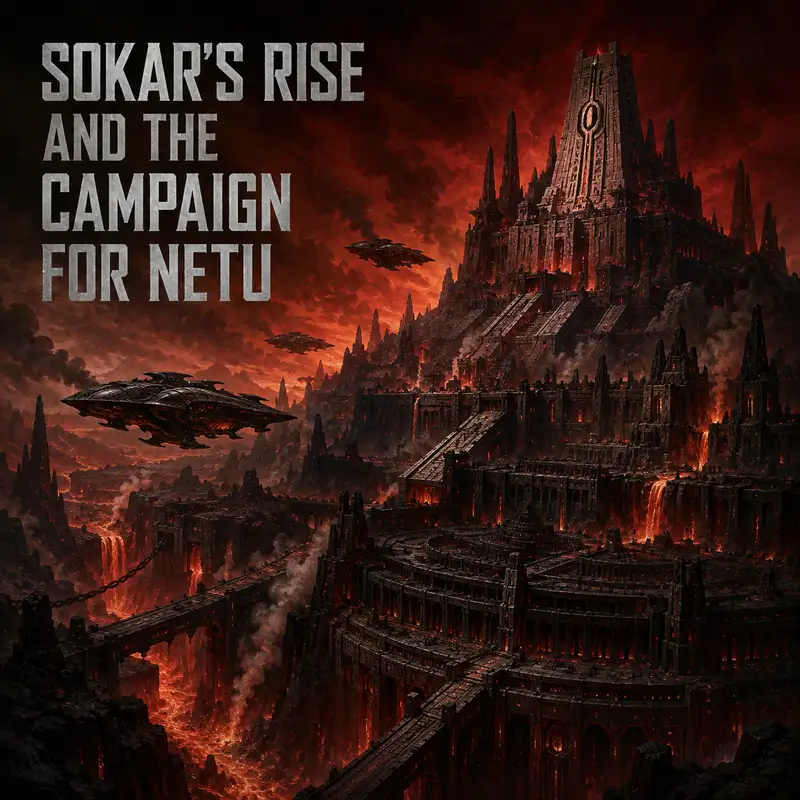
Netu orbited Sokar’s homeworld of Delmak. Before Sokar conquered the system, the moon had been an industrial colony. He transformed it by filling the atmosphere with barely breathable toxins and blasting openings through the surface until the molten interior escaped. Much of the moon became lethal. Survivors and prisoners crowded into the remains of underground structures while fire, heat, and volcanic gases completed Sokar’s chosen image. The engineering was cruel and strategically reckless.
There was no Stargate on Netu. Prisoners arrived from orbit in small descent pods that could survive the toxic atmosphere. Ships could not safely land through the environmental conditions Sokar had created. The absence of a gate reduced escape opportunities and made the moon dependent on orbital access. Any rescue force had to bring a ship, hide near Sokar’s homeworld, and preserve a route through the hostile atmosphere. Netu was difficult to enter by design and even harder to leave.
Bynarr governed the moon for Sokar. He controlled the habitable conditions, suppressed uprisings, and traveled regularly to report on the prisoners’ suffering. Sokar did not run Netu as a conventional penal colony. The suffering was part of the product. Bynarr’s reports reinforced Sokar’s reputation, while the population below remained divided, poorly armed, and dependent on the same official who tormented them. A prison built around one brutal intermediary is efficient until someone kills him.
The Tok’ra learned that Sokar’s theater concealed a serious military buildup. Jacob Carter and Selmak infiltrated his organization to determine the size and purpose of his forces. They discovered that the fleet was approximately ten times larger than Tok’ra estimates and was preparing to strike six key System Lords. The attack was scheduled for roughly two weeks after Jacob’s capture. By the time S G One learned the details, four days had already passed. Sokar was preparing a rapid campaign against the fractured Goa’uld leadership.
The plan exploited the System Lords’ central weakness. They possessed advanced ships and vast Jaffa armies, but cooperated only when a greater threat forced them together. A coordinated attack against several key rulers could prevent them from combining forces in time. Each defeated domain would add ships, troops, and territory to Sokar’s position. If the intelligence was accurate, he would emerge with an army large enough to dominate the remaining Goa’uld. The Tok’ra had spent generations undermining a divided enemy. Sokar could erase that advantage.
Jacob and Selmak were captured before they could escape with the intelligence. Sokar sent them to Netu, where prolonged torture was more useful than immediate execution. Martouf brought the warning to Earth and asked for help. The stated mission was to recover Jacob and Selmak. The larger requirement was to confirm the timing and scale of Sokar’s offensive. A full military incursion was impossible. Netu had no gate, the airspace was watched, and the underground prison could not be seized by a small force. The rescue depended on disguise, memory, and a cargo ship.
S G One and Martouf traveled through the Stargate to Vorash, then boarded a Tel’tak. Teal’c could pilot the Goa’uld cargo vessel, but only four descent pods were available. O’Neill, Samantha Carter, Daniel Jackson, and Martouf would descend as prisoners. Teal’c would remain in orbit with the ship and maintain communications. The arrangement left the surface team without its Jaffa specialist and Teal’c alone against Sokar’s patrols. The equipment, rather than doctrine, determined the force package.
The plan depended on memories Carter had inherited from Jolinar of Malkshur. Jolinar, in her host Rosha, was the only person known to have escaped Netu. She had never explained how. Carter’s brief blending with Jolinar left fragments of experience in her mind, but they were incomplete and emotionally difficult to separate from her own memories. Martouf used a Tok’ra recall device to intensify those fragments. The device reproduced sensory experience with disturbing realism. It might retrieve the route or merely force Carter to relive torture.
The memories revealed enough to guide the descent. The team used prisoner pods, giving their arrival a credible appearance. A coded communicator linked them with Teal’c as long as the Tel’tak remained in orbit. Once underground, Carter followed fragments of Jolinar’s path through the surviving colony. The team reached the caverns and was thrown into the pit. There they found Jacob and Selmak alive, badly injured, and still carrying the intelligence that had justified the mission.
Jacob confirmed the scale of the coming campaign. Sokar’s fleet was ten times larger than expected, six System Lords were in danger, and the attack would likely succeed. That information transformed the mission. Recovering Jacob remained urgent, but preventing Sokar’s offensive now outweighed the fate of any individual team. The Tok’ra needed the report transmitted even if the rescuers never left. This was clandestine war’s cold logic. The operative might be rescued, the campaign stopped, or both might fail. The information still had to survive.
Carter’s recovered memories identified Bynarr as the key to Jolinar’s earlier escape. Jolinar gained access to his quarters, let him believe he controlled her, then stole the ring key while he slept. The rings connected Netu with Sokar’s facilities on Delmak. From there, she stole a cargo ship and fled. Bynarr’s private obsession had created the only known break in the prison system. His shame became hatred, and his desire for revenge kept Carter alive long enough to discover the route.
Before Bynarr could kill her, Na’onak shot him from behind. The prison’s chain of command collapsed immediately. Na’onak was Apophis, revived by Sokar and hidden behind a damaged face and a subordinate identity. He had spent his captivity studying the prison and waiting for an opportunity. The arrival of S G One, Martouf, and Jacob gave him intelligence, bargaining material, and enemies familiar enough to manipulate. Sokar intended Netu to reduce Apophis to an example. Instead, it gave him time, concealment, and access to everyone Sokar had discarded.
Apophis announced his identity, recruited approximately three hundred prisoners, and banished those who refused to the surface. His force had crude weapons and could not defend Netu against a mothership. It did not need to. Apophis intended to trade intelligence for access to Sokar, then kill him at close range. He combined the Tok’ra memory device with the hallucinogenic Blood of Sokar to interrogate the captives through painful memories.
The method targeted emotional vulnerabilities rather than simple resistance to questioning. Carter was pressured for Earth’s iris codes. O’Neill was forced back into memories of his son’s death. Martouf was made to believe Carter was Jolinar and threatened with her execution. Daniel was pushed for the location of the Harsesis child. The victims recognized parts of the deception, but the process injured them and consumed time. Martouf deliberately supplied a false Tok’ra base on Entac, hoping Apophis would accept an answer that sounded genuine.
Above the moon, Sokar’s patrols detected the Tel’tak. Teal’c escaped the death gliders by driving the cargo ship’s hyperdrive at full power and returned to Vorash. He delivered Jacob’s intelligence and requested a rescue force. The Tok’ra High Council chose a different mission. Sokar could not be allowed to launch his offensive, and no available weapon could penetrate his mothership’s shields. Aldwin was ordered to return with Teal’c and destroy Netu while Sokar’s ship was in orbit.
The Tok’ra plan was simple in the way plans involving a moon’s destruction can be called simple. Aldwin would launch a weapon through one of the openings Sokar had blasted into the surface. The device would force the core into a catastrophic chain reaction. Netu would explode, and the blast would destroy Sokar’s shielded ship at close range. The weapon required approximately twelve minutes to destabilize the core. If Sokar recognized the danger early enough, he could escape.
The operation required Sokar to be in the correct position. Apophis’s coup provided the bait. After a cargo ship escaped, Sokar advanced the offensive and demanded the fleet be ready in two days. He then took his mothership to Netu to punish the rebellion before beginning the campaign. Sokar’s decision to cleanse the prison personally placed his command ship over the target the Tok’ra could turn into a weapon. His reputation required a personal answer to defiance. Strategy favored delegation.
Apophis contacted Sokar and claimed to possess the location of the Tok’ra resistance. He offered submission and asked to be appointed the new lord of Netu. His concealed blade was meant for the moment Sokar approached to mark him with a seal of office. The plan depended on false intelligence supplied by Martouf. It failed because Sokar had recently conquered Entac and knew no Tok’ra base existed there. He ordered Apophis killed slowly. For once, a System Lord’s intelligence defeated the deception.
Teal’c and Aldwin reached the system and hid the Tel’tak in the moon’s shadow. Daniel had stolen a coded communicator, allowing the captives to reestablish contact at the last moment. Aldwin launched the weapon anyway. His orders were explicit, and the strategic calculation had not changed. Destroying Sokar, his ship, and Netu was judged preferable to allowing one ruler to seize the System Lords’ combined power. The decision accepted the deaths of S G One, Jacob, Martouf, and every prisoner below. Alliance warfare becomes very clear when another organization selects the people to be sacrificed.
The blast from the weapon’s descent began destabilizing the prison. Carter used the moon’s own volcanic pressure to escape the pit, packing a vent until the force blew open the barrier above it. The group moved toward Bynarr’s ring platform while Teal’c prepared an interception in orbit. The ring path led from Netu toward Sokar’s ship. The Tel’tak would have to fly between the moon and the mothership, stop precisely in the transport path, and capture the matter stream without losing part of it.
The maneuver carried several risks. Sokar’s weapons could destroy the cargo ship before it reached position. If Teal’c failed to stop at the correct point, the rings might transport only part of the group. If the team reached the platform too late, Netu would explode beneath them. Aldwin considered it suicidal and tried to force withdrawal. Teal’c disarmed him, locked him in the cargo compartment, and continued. He also listened when Aldwin explained the technical requirements. Disagreement over the mission did not make the Tok’ra officer’s expertise less valuable.
As Netu’s core became unstable, Sokar’s confidence finally collided with the physical system he had built. His sensors reported that the moon was coming apart. He treated Netu’s fires as an extension of his authority, but the moon was not obedient. It was damaged machinery around molten material. The same ruptures that made the prison terrifying gave the Tok’ra weapon access to the core. Sokar had converted an industrial colony into a theatrical instrument of control and left the critical vulnerability exposed.
The crisis gave Apophis another opening. While Sokar’s guards tortured him, the warning from Netu distracted the command group. Apophis killed the men holding him, fired on Sokar’s personal shield, and escaped through the ship’s ring system. Sokar remained aboard his mothership as it tried to move away. On Netu, S G One, Martouf, and Jacob activated Bynarr’s rings. Teal’c stopped the Tel’tak in the beam and intercepted the matter stream before it reached Sokar’s vessel.
The Tel’tak accelerated away under fire. Netu exploded behind it, and the blast destroyed Sokar’s mothership. Sokar died with the command platform from which he intended to launch his campaign. The six targeted System Lords were spared an offensive they might not have been able to stop. Jacob and Selmak survived. The rescue team survived. The Tok’ra recovered the intelligence and removed the immediate threat. Tactically and operationally, the campaign succeeded beyond reasonable expectation.
The cost was the population of Netu. The number of prisoners is not established, and the campaign record does not provide a casualty count. The moon’s destruction left little possibility of survival. The people below were condemned prisoners whose only shared condition was that Sokar had sent them there. Apophis had already sent dissenters onto the lethal surface. The Tok’ra then destroyed the entire prison to kill the ruler in orbit. The strategic result was defensible, and the human cost remained real.
The political result was also less complete than the explosion suggested. Apophis reached Delmak before Sokar’s ship was destroyed. Later events confirmed that he seized Sokar’s armies. Earth and the Tok’ra had prevented Sokar from becoming the dominant System Lord, but they had delivered his military resources to the rival whose earlier defeat had helped Sokar rise. Apophis emerged from Netu scarred, experienced, and far more powerful than when he entered it. Decapitation removed the commander without securing the succession.
Sokar failed because his power was centralized around fear, spectacle, and personal control. His fleet could defeat several System Lords, but he still answered a prison revolt himself. He built Netu to make escape appear impossible, then preserved transport rings linking the prison to his own seat of power. He turned a former industrial moon into a volcanic underworld, creating the physical conditions for its destruction. He kept Apophis alive to display his humiliation, then placed him close enough to exploit a breakdown in command.
The campaign also showed why the Tok’ra remained dangerous despite limited numbers. They could not challenge Sokar’s fleet in open combat. They infiltrated it, measured it, identified the coming offensive, and used the target’s own geography to destroy the command ship. Earth supplied the rescue team, Teal’c supplied the pilot and the decision to attempt extraction, and Carter’s inherited memories supplied the route. No participant controlled the entire operation. Success emerged from intelligence that survived capture and improvisation that continued after the original plan had failed.
Sokar’s rise ended at the moment he appeared strongest. His fleet was ready, his rivals were divided, and his prison had drawn every enemy into one place. Netu should have been proof that no one escaped his judgment. Instead, the prisoners used its vents, rings, hidden memories, and exposed core against him. The moon destroyed its maker, not the political system that produced him. Sokar died above his manufactured hell, while Apophis walked away with the army intended to conquer the Goa’uld order.