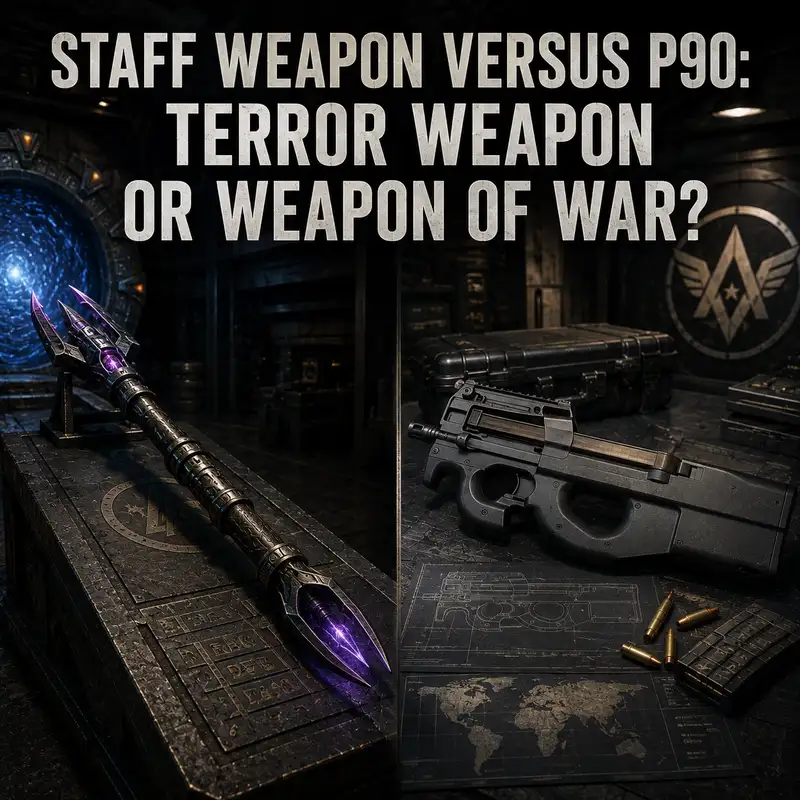
Staff Weapon Versus P90: Terror Weapon or Weapon of War?
Rak’nor was considered one of the rebel Jaffa’s best marksmen. At a training ground, he fired three staff blasts at a stationary log hanging roughly sixty or seventy yards away. Two struck the target. Samantha Carter then raised a P ninety, waited while the log was set swinging, and cut through it with automatic fire. One carefully aimed single shot severed the rope above it. Jack O’Neill delivered the verdict that would define the comparison. The staff was a weapon of terror. The P ninety was a weapon of war. The demonstration was persuasive. It was also incomplete.
O’Neill was not conducting a neutral weapons trial. He was offering Earth’s support to a rebel army, challenging Jaffa assumptions about technological superiority, and testing a charismatic leader he already distrusted. The hanging log measured accuracy, controllability, and volume of fire. It did not measure battlefield endurance, destructive effect per hit, maintenance, ammunition dependence, use in hand-to-hand combat, or the political consequences of accepting foreign weapons. The event proved that Carter and the P ninety could dominate that particular test. It did not prove that the staff weapon had no military value.
The more useful question is not which weapon looks more advanced. It is what kind of war each weapon was designed to fight. The staff weapon served the Goa’uld imperial system. It armed Jaffa soldiers who guarded palaces, occupied villages, crewed ships, enforced tribute, and fought rival Jaffa armies. The P ninety served small, highly trained teams operating through a Stargate with limited personnel and a secure industrial base behind them. One weapon emerged from an empire built on visible power and long-duration control. The other emerged from a military culture built around accuracy, standardized training, fire discipline, and logistical resupply.
The staff weapon was both a ranged weapon and a symbol. Its length, opening head, bright discharge, and distinctive report announced the presence of a Jaffa warrior before the target understood the technical details. That mattered in an empire whose rulers claimed divinity. A weapon carried by the servants of a supposed god was expected to look unlike anything available to the population below them. The Goa’uld did not merely need to defeat resistance. They needed resistance to appear futile. The staff weapon helped turn military occupation into ritual theater, and the Jaffa carrying it became part soldier, part priest, and part warning.
Calling that terror does not make the staff harmless. A direct hit could kill instantly, burn through tissue, and cause severe internal injury. Staff blasts opened locks, damaged equipment, breached light barriers, and punished exposed troops with an energy effect ordinary Earth body armor was not initially designed to stop. A single accurate shot could be more immediately destructive than one cartridge from a P ninety. The weapon’s psychological effect came from real lethality. Empty spectacle rarely controls a population for thousands of years. The staff frightened people because they had seen what happened when it struck someone.
It also gave the Jaffa a close-combat weapon without requiring them to carry a separate polearm. Jaffa trained with staffs as part of a broader warrior tradition, and experienced fighters could shift between ranged fire, blocks, strikes, and thrusts. That dual role made sense for guards, shipboard security, and warriors expected to fight in formal formations or confined ceremonial spaces. A P ninety could be used at close range, but it was not a staff. A Jaffa whose power source failed still held a long striking weapon. An S G team member with an empty magazine held a compact firearm and a rapidly worsening logistics problem.
Endurance was the staff weapon’s clearest operational advantage. Its naquadah-based power source could support extensive service without a soldier carrying boxes of cartridges. The exact number of shots was never established in a reliable technical record, and the weapon should not be treated as literally inexhaustible. Operationally, however, it lasted far longer between replenishment than a magazine-fed firearm. That suited dispersed garrisons spread across worlds connected by gates and ships. A Jaffa patrol could remain armed even when the nearest supply depot belonged to a System Lord several star systems away.
The P ninety carried fifty cartridges in a compact top-mounted magazine. It was lightweight, ambidextrous, controllable in automatic fire, and fitted with an optical sight. Those characteristics made it unusually well suited to Stargate Command. S G teams moved through narrow gate rooms, tunnels, laboratories, ship corridors, and ruined buildings. They also had to carry radios, medical equipment, explosives, scanners, water, and whatever object had just begun glowing after Daniel Jackson translated the warning label. A short weapon that could deliver accurate fire without occupying both the mission and the entire hallway was valuable.
The cartridge was less important than the weapon system built around it. The P ninety allowed rapid follow-up shots, controlled bursts, and single-fire precision from the same platform. A trained operator could engage several targets before a staff weapon completed the same sequence. That gave S G teams fire superiority during the first seconds of an ambush, which were often the only seconds available before the gate became blocked or a prisoner was moved. Against Jaffa infantry, several accurate projectiles arriving quickly could defeat armor and disrupt formation before the Jaffa returned effective fire.
The staff weapon’s low rate of fire was not merely a mechanical inconvenience. It shaped tactics. The weapon had to be brought onto target, armed, discharged, and allowed to cycle before the next shot. Its long body was difficult to maneuver around doorways and cover. The bright energy bolt made the firing line visible, and the interval between blasts gave a moving opponent more opportunity to change position. Skilled Jaffa compensated through training, ambush, massed fire, and use of terrain. The weapon could be effective. It simply demanded more from the shooter while offering fewer immediate chances to correct a miss.
The P ninety reversed that relationship. Its low recoil and sighting system reduced the penalty for rapid fire. The first shot still mattered, but a slight error did not end the engagement. The shooter could adjust, fire again, and place several rounds into the same target area. In practical combat, hit probability is often more important than theoretical power. A staff blast that misses remains impressive scenery. A short burst that hits the armor, joints, and exposed areas of a Jaffa remains a tactical result.
This was what the hanging-log demonstration actually proved. Rak’nor was not shown to be incompetent. He struck twice with a weapon requiring deliberate aim and timing. Carter then demonstrated that the P ninety made accuracy easier to convert into repeated effects on a moving target. She was also a highly trained Air Force officer shooting under controlled conditions. The trial compared an expert Jaffa marksman with an expert Earth operator, which made the result useful. It still favored the characteristics O’Neill wanted to display. Procurement evaluations are usually less theatrical, although they occasionally involve the same amount of salesmanship.
Kytano immediately identified what the demonstration omitted. Earth’s weapon required ammunition. If the rebel Jaffa accepted P nineties, Earth could withhold the cartridges later. The concern was strategically valid even though Kytano was secretly the Goa’uld Imhotep manipulating the rebellion. A weapon supplied from another planet creates influence for the supplier. Fifty-round magazines are impressive until the last one is empty. An alliance based on ammunition delivery remains an alliance with a delivery schedule.
Earth could accept that burden because it possessed factories, transportation, armorers, and standardized training. Stargate Command could move cases of ammunition through the gate, inspect magazines, replace damaged parts, and issue the same weapon to multiple teams. The P ninety was not self-sustaining in the field. It was supported by an industrial system the Jaffa rebellion did not possess. This was the hidden strength behind O’Neill’s claim. Earth’s advantage was not only the firearm. It was the ability to produce another cartridge, another spring, another optic, and another trained shooter after the first engagement ended.
The staff weapon carried a different dependency. Rebel Jaffa could capture staffs from Goa’uld forces and use them for long periods, but they did not control the full industrial and technical system that produced the weapons and their power sources. The Goa’uld had also distributed staffs widely because the weapon reinforced their rule. This created enormous captured stocks once Jaffa units defected. The rebels could therefore begin a war with weapons already in their hands. Earth ammunition offered better tactical performance, but staff weapons offered immediate availability and familiarity.
That distinction matters when comparing lethality. A P ninety generally offered a better chance of placing rounds on target. A staff weapon generally offered a more destructive individual hit. Those are not the same measure. In a close ambush against several Jaffa, the P ninety’s volume and controllability were decisive. Against a locked door, exposed power conduit, or light barricade, a staff blast might accomplish something cartridges could not. Against a distant moving target, Earth’s sighted firearm held the advantage. Against a patrol that might remain away from supply for months, the staff’s endurance became difficult to dismiss.
Armor further complicated the comparison. Jaffa armor looked formidable and carried immense ceremonial value, but Earth projectiles repeatedly penetrated or bypassed it in combat. The armor had developed inside a military system where many opponents used similar energy weapons, primitive arms, or no meaningful weapons at all. It was not necessarily optimized against concentrated automatic fire from a compact high-velocity firearm. Earth personnel faced the opposite problem. Standard protective equipment offered limited protection from a direct staff blast, forcing Stargate Command to improve inserts and rely heavily on cover, movement, and first-shot advantage.
The staff weapon also belonged to a larger family of Goa’uld arms. Fixed or tripod-mounted staff cannons delivered heavier fire. Death gliders attacked from the air. Al’kesh and Ha’taks provided bombardment, transport, and orbital dominance. A Jaffa formation was not supposed to defeat every opponent through handheld staffs alone. The weapon served as the standard arm inside a combined system whose heavier platforms usually faced technologically weaker enemies. When S G teams isolated Jaffa from those supporting assets, the comparison changed sharply. A P ninety could dominate a corridor. It could not shoot down a mothership.
The same principle applies to gate operations. A Stargate is a narrow, predictable entry point. Personnel emerge within a limited area and need several moments to orient themselves. In that environment, high-capacity automatic weapons, prepared firing positions, and overlapping fields of fire are brutally effective. A staff weapon’s size and slower engagement cycle are disadvantages in a doorway fight. This helps explain why small Earth teams could defeat larger Jaffa groups near gates, especially when surprise and cover favored the defenders. It does not mean four people could defeat an entire planetary garrison once the enemy brought aircraft, reinforcements, and control of the surrounding terrain.
Jaffa performance also reflected command culture. Goa’uld armies often emphasized obedience, personal loyalty to the ruler, and visible displays of dominance. Officers held authority through rank, religious status, and proximity to the supposed god. Initiative could be dangerous if it contradicted the master’s expectations. Earth special-operations teams relied more heavily on decentralized judgment, mutual support, and rapid adaptation. The P ninety fitted that doctrine because it supported movement, precise engagement, and immediate concentration of fire. The staff fitted an imperial doctrine in which the soldier’s appearance and obedience were almost as important as efficiency.
That does not make the Jaffa poor warriors. Teal’c, Bra’tac, Rak’nor, and many others demonstrated discipline, courage, and tactical intelligence. Skilled Jaffa used staffs effectively because they understood their timing, balance, and destructive effect. The problem was institutional. A talented warrior could master the staff. The weapon still imposed limitations that did not disappear through courage. Teal’c’s own career became the strongest evidence. He continued to use the staff when its endurance or power made sense, but he also adopted Earth firearms when accuracy, volume, and compactness offered the better answer.
The rebel Jaffa therefore did not need to choose one weapon for all time. They needed a mixed inventory and a doctrine capable of selecting the right tool. Staff weapons were already available, culturally familiar, and sustainable during long operations. Earth firearms improved close combat, ambushes, gate seizures, and defense against some enemies. Heavy Goa’uld weapons remained necessary against vehicles and fortified positions. The Free Jaffa struggle was not won by replacing every staff with a P ninety. It was won by breaking the belief that Goa’uld equipment, Goa’uld doctrine, and Goa’uld authority were inseparable.
The P ninety also proved more adaptable as a platform. When Anubis fielded Kull warriors protected by armor that ordinary fire could not defeat, Stargate Command and the Tok’ra developed a specialized nullifier attachment used with Earth weapons. The cartridge itself had not suddenly become powerful enough. The firearm provided a familiar, controllable delivery system for a new countermeasure. Against early mechanical Replicators, projectile weapons also produced useful physical disruption where several energy weapons performed poorly. The P ninety’s advantage was not universal lethality. It was compatibility with an organization that kept modifying tactics and equipment.
The staff weapon changed far less. That may reflect Goa’uld technological stagnation, but the political explanation is just as important. The weapon already did what the empire needed. It armed Jaffa armies across many worlds, intimidated subject populations, functioned for long periods, and reinforced a warrior culture tied to service. Improving sights, shortening the frame, or increasing the rate of fire might have produced a better battlefield instrument. It might also have weakened the ceremonial identity that made the staff valuable to the regime. Empires do not always optimize weapons for combat when the weapon is also part of the uniform, the hierarchy, and the mythology.
This exposes the weakness in treating terror and war as opposites. Terror is often a method of war. A weapon can intimidate, kill, suppress, punish, and communicate authority at the same time. The staff weapon was clearly used in warfare. It killed trained soldiers, defended ships, guarded gates, and supported campaigns across the Milky Way. Calling it only a terror device understates its battlefield record. The more precise judgment is that it was a weapon of war optimized partly for terror because the Goa’uld system treated fear as a primary form of control.
The P ninety could also intimidate. Carter cutting apart a moving log before a crowd of rebel Jaffa was a psychological operation as much as a technical demonstration. O’Neill wanted the audience to doubt the weapons they had trusted since childhood and to associate Earth with practical victory. The difference was not that one side used fear and the other did not. The difference was what each institution wanted the fear to accomplish. Goa’uld terror reinforced submission. Earth’s display was intended to win an alliance and redirect Jaffa confidence toward rebellion.
In a ship corridor, gate room, rescue operation, or short firefight, the P ninety was usually the superior individual weapon. It was easier to maneuver, faster to engage, more accurate in repeated fire, and supported by magazines that allowed a small team to create immediate fire superiority. In a long patrol without resupply, a remote garrison, or a mission requiring powerful blasts and close-combat reach, the staff retained real advantages. In a ceremonial occupation where the weapon had to represent divine authority, the staff performed a political role the compact Earth firearm was never designed to fill.
The comparison therefore cannot be separated from logistics. A P ninety without ammunition becomes inert quickly. A staff weapon with a functioning power source may remain dangerous for years. Yet Earth could manufacture ammunition by the case, while the Jaffa rebellion inherited alien technology it did not fully control. One system depended on frequent resupply from a productive industrial base. The other depended on long-lived advanced components created within an imperial economy. Tactical endurance favored the staff. Strategic replaceability favored the P ninety and the civilization behind it.
Nor can the comparison be separated from training. Carter’s performance came from skill, not merely hardware. A poorly trained operator could waste fifty rounds and achieve less than Rak’nor achieved with three blasts. The P ninety expanded what training could produce by giving the shooter a stable, sighted, controllable weapon. The staff rewarded years of specialized practice and integrated naturally with Jaffa martial culture. The question for a commander was not which weapon looked superior on a table. It was which soldiers could be trained, supplied, and organized to use it under the expected conditions.
O’Neill was right in the argument that mattered most. The Goa’uld had mistaken spectacle, tradition, and technological prestige for proof that their infantry weapon was tactically superior. Against disciplined Earth teams, that assumption repeatedly failed. The P ninety put more accurate fire into the decisive space before the staff weapon could answer. It matched the reconnaissance, rescue, and close-quarters missions Stargate Command actually conducted. It also represented a military willing to modify equipment when the enemy changed.
He was wrong only if his verdict is treated as an absolute technical law. The staff weapon was not a useless prop, and the P ninety was not the correct answer to every battlefield problem. The staff’s endurance, destructive blast, melee function, and cultural authority made it effective inside the system that fielded it. Its greatest weakness was not simply poor accuracy. It had been shaped by an empire that valued obedience and intimidation more than the survival and initiative of the individual soldier.
The P ninety and the staff weapon were both weapons of war. One was designed for trained small teams backed by factories, ammunition, and a doctrine of precise, concentrated fire. The other was designed for an imperial warrior caste backed by long-lived power cells, ritual authority, and the expectation that most enemies would break before the Jaffa had to improve. Carter cut down the log, but the real target was a military idea. The P ninety won the demonstration because Stargate Command had built a better relationship between weapon, soldier, and mission.