Staff Weapons, Zats, Hand Devices, and Goa’uld Ground Combat
On Cal Mah, one of the rebel Jaffa’s best marksmen fired three staff blasts at a suspended log. Two struck the target, but neither concentrated enough damage to destroy it. Samantha Carter then raised a compact Earth weapon and cut a swinging log apart with a controlled burst. The demonstration was not proof that one civilization had discovered courage and the other had not. It exposed two different ideas of ground combat. The staff weapon had been built to project power across an empire of frightened subjects. The P ninety had been built to place repeated rounds accurately on an enemy who was shooting back.
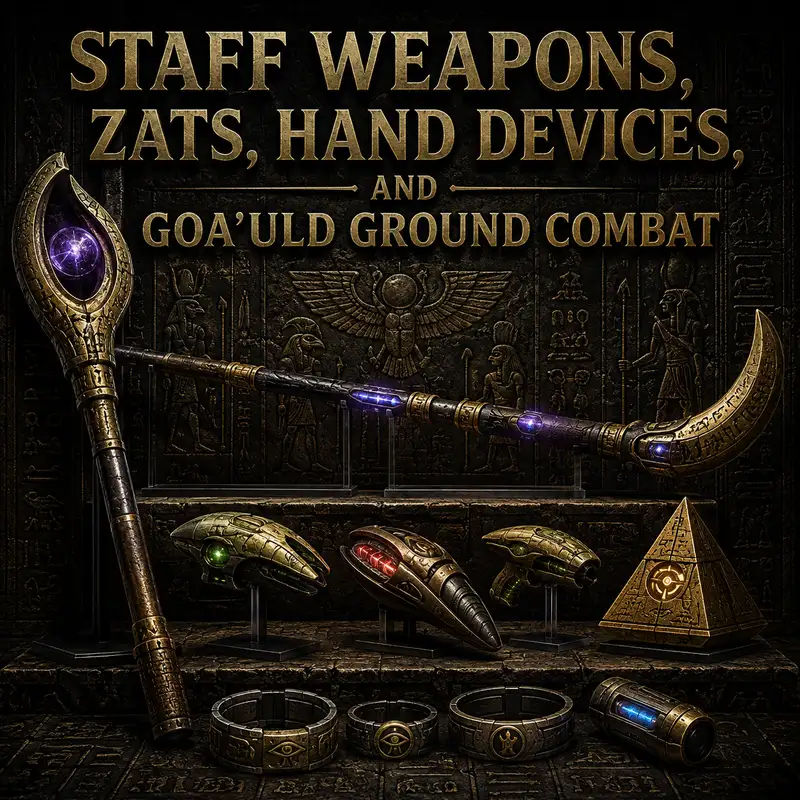
Goa’uld ground warfare depended on three related classes of weapon. The staff weapon armed the Jaffa formations that seized gates, guarded palaces, and occupied villages. The zat’nik’tel gave those forces a compact means of disabling prisoners, controlling ships, and killing without the blast of a staff. The hand device placed a more versatile and intimidating weapon directly on the Goa’uld ruler. Together they formed more than an arsenal. They reflected the political hierarchy of the empire. Warriors received the weapons needed to enforce obedience. Gods reserved the devices that made authority appear personal and supernatural.
The staff weapon was the most visible part of that system. In its closed form, it was a long metal pole suited to ceremonial carry and close control. When activated, the head opened and exposed the firing mechanism. A burst of energy then traveled toward the target with enough force to kill an unprotected human, burn through material, damage equipment, or produce a violent impact around the point of contact. The exact power source and endurance were never fully documented by Earth, but Jaffa used staff weapons through prolonged operations without the frequent ammunition changes required by human firearms.
That logistical advantage mattered. A Jaffa patrol moving through a Stargate did not need to carry magazines, loose rounds, or boxes of linked ammunition for its primary weapons. A garrison could remain on a low-technology world without a local cartridge factory. The staff weapon’s energy reserve appears to have supported many shots before replacement or maintenance became necessary. Earth never received a reliable figure, and there is no evidence that every staff had unlimited power. What the battlefield record shows is a weapon with exceptional endurance and very little visible resupply burden.
The staff was also physically robust. Jaffa used it as a striking weapon, a support while moving, and a symbol of office when no immediate firefight was expected. Its length gave a strong warrior reach in close combat, though the open firing head was less convenient in a confined corridor than a carbine or pistol. Teal’c and Bra’tac demonstrated that an experienced user could fire accurately, move with the weapon, and transition between ranged and hand-to-hand combat. Poor results by ordinary guards should not be mistaken for a mechanical inability to hit anything.
Its limitations became obvious against trained Earth troops. The staff had to be raised, oriented, opened, and aimed before firing. Its length made it difficult to handle from tight cover. The discharge announced the shooter with light and sound, and the practical rate of fire was far below an automatic weapon. A Jaffa who missed usually had to correct and fire again while an opponent with a P ninety could adjust aim during a burst. That difference was especially severe inside ships, tunnels, gate rooms, and forest positions where exposure lasted only seconds.
The staff’s energy bolt could still be devastating. One solid hit might end the engagement, and Jaffa physiology allowed some warriors to survive wounds that would kill ordinary humans. Earth personnel learned to respect every shot, use cover, and avoid presenting stationary targets. The problem was not lethality. It was delivery. A powerful discharge that arrives after the enemy has already fired twenty accurate rounds is an impressive technical achievement with limited comfort for the person carrying it.
Goa’uld doctrine had not been designed primarily for firefights against modern infantry. Staff weapons guarded mines, collected tribute, controlled prisoners, and punished villages whose defenders possessed blades, bows, or nothing at all. Their length and opening mechanism made the threat visible before the shot. The blast could destroy a door, kill a dissident, or ignite part of a settlement in front of witnesses. Against a population being taught that resistance was hopeless, spectacle was part of the weapon’s effect.
This does not mean Jaffa formations were incapable of military operations. They conducted ambushes, defended gates, fought from prepared positions, boarded ships, and operated alongside death gliders and Al’kesh bombers. Senior warriors understood terrain and could coordinate several elements when the commander permitted initiative. The institutional problem was that many missions rewarded obedience and terror more reliably than adaptive small-unit tactics. A guard who frightened a village had succeeded. A guard who questioned the god’s assault plan might not remain employed long enough to improve it.
The P ninety demonstration at Cal Mah therefore addressed doctrine as much as hardware. Carter showed concentration of fire, controllability, and speed. O’Neill argued that the staff was optimized to intimidate while the Earth weapon was optimized to kill an armed enemy efficiently. The statement was intentionally provocative, and it overstated the staff’s uselessness. It was still strategically important. Rebel Jaffa had been trained to see the traditional weapon as part of their identity. Learning another weapon meant accepting that Goa’uld military custom was not the same thing as military truth.
Earth’s advantage came with its own logistical price. A P ninety required magazines, specialized ammunition, cleaning, spare parts, and an industrial system able to manufacture all of them. An S G team could carry enough for a short mission, but it could not sustain a planetary campaign from four sets of load-bearing equipment. Staff weapons could remain useful to Free Jaffa forces because they already existed in large numbers, used familiar maintenance practices, and did not consume conventional ammunition. A better weapon on the firing line is not automatically the easier weapon to support across several worlds.
The zat’nik’tel filled a different role. Shortened to zat by Earth personnel, it was a compact one-handed device that opened into a firing position and released a blue electrical discharge. Teal’c described it as less powerful and less destructive than a staff weapon, but still deadly. A single shot normally caused intense pain and incapacitation. A second shot delivered soon afterward killed most subjects. This gave Jaffa guards a level of force between a command to kneel and a staff blast through the chest.
That distinction was invaluable to an empire that depended on living captives. Potential hosts had to be taken alive. Prisoners needed to be moved through gates, ring rooms, and ship corridors. Interrogators required conscious subjects eventually, even when they preferred the subject unconscious during transport. A zat allowed one guard to disable a person without creating the burns, blast damage, and structural risk associated with a staff weapon. It was a weapon of custody as much as combat.
The effect was not perfectly predictable. Humans sometimes recovered quickly and sometimes remained unconscious for a significant period. Jaffa could survive a first discharge along with the larval symbiote they carried. Certain species were resistant, and Kull armor or Replicator construction could make the weapon ineffective. A second shot was described as fatal to most subjects, not every subject under every condition. The residual effect also faded, which is why people hit on separate occasions did not remain permanently one discharge away from death.
Early encounters established a third-shot effect capable of disintegrating a recently struck body or some objects. That capability appears on screen, but later combat does not apply it consistently, and its limits were never explained. It should be treated as a documented feature with uncertain conditions rather than a dependable answer to every blocked door, body, or piece of battlefield debris. Even Goa’uld technology occasionally produced a rule that looked more useful in the first demonstration than it did in sustained operations.
Zats also affected technology and electrical systems. S G One used them to fuse or damage door controls, open locks, disrupt equipment, and alter an electrical field long enough to solve an immediate survival problem. That versatility made captured zats valuable aboard Goa’uld ships. A compact weapon could neutralize a guard, disable a control panel, and fit inside a uniform without the handling problems of a staff. It was one of the first Goa’uld weapons Earth personnel adopted for repeated field use.
Adoption did not mean mass production. Stargate Command accumulated captured zats and issued them when a mission benefited from a nonlethal option or compatibility with Goa’uld systems. Earth did not establish an independent manufacturing line for them. Every weapon remained a recovered alien device with uncertain service life and limited replacement support. The situation was workable while captures continued. It was not the same as possessing a documented, inspected, and domestically supported sidearm.
The zat’s reputation for nonlethal force also required discipline. One shot caused severe pain, and a second could kill. In a confused firefight, several personnel might fire at the same target without knowing who had already hit it. A weapon that is nonlethal only when everyone counts accurately is not automatically a humane solution. Stargate Command used zats for rescue, containment, and prisoner handling, but the underlying device had been developed by an empire that considered pain an ordinary administrative tool.
The hand device, often called a ribbon device, belonged to another level of the hierarchy. It was worn over the fingers and palm, usually with a central stone positioned to direct or focus its energy. Ordinary Jaffa did not carry it as standard equipment. Operation required concentration and naquadah in the user’s bloodstream. Goa’uld hosts and Tok’ra possessed that biological compatibility. Samantha Carter could use one after Jolinar’s death left naquadah within her body.
That requirement made the hand device a form of authentication. A captured human could pick up a staff weapon or zat and learn the controls. The same person could not normally activate a ribbon device merely by wearing it. The weapon recognized a condition associated with the ruling species and its blended hosts. What appeared to subjects as a divine instrument was also a security system tied to Goa’uld biology.
Its functions varied with the user’s intent. A concentrated attack could inflict pain, disrupt the brain, render a target unconscious, or kill. A broader pulse could throw people backward without the visible penetration of a projectile. The device could also interface with other Goa’uld mechanisms. Some rulers used related personal technology to generate defensive shields capable of stopping bullets and energy fire. Exact configurations varied, so the shield should not be assumed to accompany every hand device in every encounter.
As a battlefield weapon, the ribbon device was powerful but specialized. It demanded focus, a clear line toward the target, and enough time to raise the hand and engage the effect. A rifleman could fire from cover with only part of the body exposed. A Goa’uld using a ribbon device often stood upright and presented the gesture as part of the attack. That posture strengthened the political performance and created a very practical opportunity for anyone unimpressed by it.
Several Goa’uld discovered this limitation at close range. Heru’ur stopped bullets with a personal shield, but a thrown knife reached the hand device slowly enough to damage it. Mot began using his device to kill a subordinate and was shot by a villager before the attack was completed. Thoth raised his hand against an infiltration team and was struck by a zat and automatic fire. The device could dominate an unarmed prisoner. It was less reliable when several armed opponents understood what the raised hand meant.
The hand device’s greatest value may therefore have been command presence. It allowed a System Lord to punish a servant, interrogate a captive, repel an attacker, and operate selected technology without reaching for a soldier’s weapon. The ruler appeared to kill through will alone while Jaffa carried the more ordinary tools of battle. That separation reinforced hierarchy. The staff belonged to the warrior caste. The ribbon device belonged to the being the warriors were told to worship.
Goa’uld ground forces combined these weapons according to mission. Staff-armed Jaffa formed the visible body of a patrol or assault. Zats supported capture, internal security, and prisoner control. The Goa’uld commander or senior operative retained the hand device for personal protection, coercion, and execution. Armor, helmets, fixed energy cannons, grenades, transport rings, and air support added further layers, but the three principal weapons already defined who was expected to fight, who was expected to submit, and who claimed the right to command both.
A typical gate raid favored this arrangement. Jaffa emerged first, opened space around the event horizon, and used staffs to suppress resistance. Zats disabled selected captives whose bodies or knowledge had value. The ruler could arrive after the immediate danger had been reduced, use a hand device to inspect or control a prisoner, and depart with the political message intact. Against an undefended settlement, the sequence was fast, violent, and difficult to resist.
A defended gate changed the calculation. The event horizon forced attackers to emerge through one predictable point with limited awareness of the receiving side. Earth could aim automatic weapons, grenades, mines, and prepared fields of fire at that point. The staff’s slower presentation became a serious liability when Jaffa materialized inside a kill zone. Goa’uld forces could answer by seizing the gate from another direction, bombarding from orbit, using transport rings, or sending specialized devices. Ground weapons alone could not solve the chokepoint.
Shipboard combat created similar problems. Ha’tak corridors restricted the movement of long staffs and provided repeated corners from which compact firearms or zats could be used. Jaffa knew their ships and could reinforce from several compartments, but infiltrators often attacked power controls, shield generators, ring rooms, or command decks rather than attempting to defeat the entire crew. The Goa’uld arsenal was dangerous in those corridors. The architecture and centralized systems gave a small team objectives more valuable than a high body count.
Earth firearms also exploited the limited protective value of common Jaffa armor. The armor offered some physical protection, identified the wearer’s service, and made a Jaffa formation appear imposing. It did not reliably stop sustained modern gunfire at practical combat ranges. P ninety armor-piercing rounds, rifles, shotguns, and explosives repeatedly defeated guards before they could bring staff weapons to bear. Later enemies with Kull armor reversed that advantage and forced Earth to develop a specialized energy-disrupting attachment, proving that the contest was technological rather than cultural destiny.
The Goa’uld could have issued more zats, improved sights, shortened staffs, or changed infantry formations. They did make specialized weapons and training devices when a ruler saw an immediate need. The empire never produced a universal reform because it was not one military organization. Every System Lord controlled private forces, guarded knowledge, and distrusted rivals. A successful improvement might strengthen the Jaffa or spread to an enemy domain. Political fragmentation slowed adaptation even when the battlefield evidence was obvious.
Institutional incentives mattered just as much. The staff weapon performed the missions most rulers assigned most often. It intimidated civilians, armed long-serving Jaffa, required little visible ammunition supply, and worked against rival troops carrying similar equipment. Replacing it across an empire would require production, retraining, new maintenance, and an admission that traditional doctrine had failed. The System Lords were willing to lose warriors more readily than they were willing to weaken the symbols connecting those warriors to divine service.
The Jaffa rebellion changed ownership before it changed every weapon. Free Jaffa continued carrying staffs because the weapons were available, familiar, and tied to generations of martial practice. Some accepted Earth firearms and training, especially when fighting Kull warriors or conducting missions where rate of fire mattered. Liberation did not make every captured arsenal obsolete overnight. It created the freedom to choose equipment according to mission rather than according to what best preserved a Goa’uld ruler’s image.
Zats and hand devices also survived the System Lords. Tok’ra, Trust operatives, smugglers, former servants, and regional powers continued using captured Goa’uld technology. A weapon remains useful after the ideology stamped onto it has collapsed. What changed was context. A zat in the hands of an S G team could support rescue or containment. The same device in a prison corridor could support torture and abduction. Technology supplied capability. Institutions decided whom that capability served.
Goa’uld ground combat was never as simple as inaccurate staffs losing to superior Earth guns. The staff weapon offered lethal power, extraordinary endurance, and political effect. The zat offered compact control over people and machinery. The hand device gave a biologically authorized elite a versatile instrument of violence and command. Each solved a genuine military or security problem. Each also carried assumptions created by an empire accustomed to obedience.
Those assumptions became fatal when the opponent refused the performance. Earth troops used cover, communication, concentrated fire, explosives, and mission-focused raids. Rebel Jaffa supplied local intelligence and the courage to challenge inherited doctrine. The Goa’uld could still win through numbers, air support, orbital fire, or better technology. At ground level, however, their weapons revealed the structure of their power. The staff frightened the population. The zat controlled the captive. The hand device elevated the ruler. Once soldiers and subjects stopped accepting those assigned roles, the arsenal remained dangerous, but it no longer made the empire inevitable.