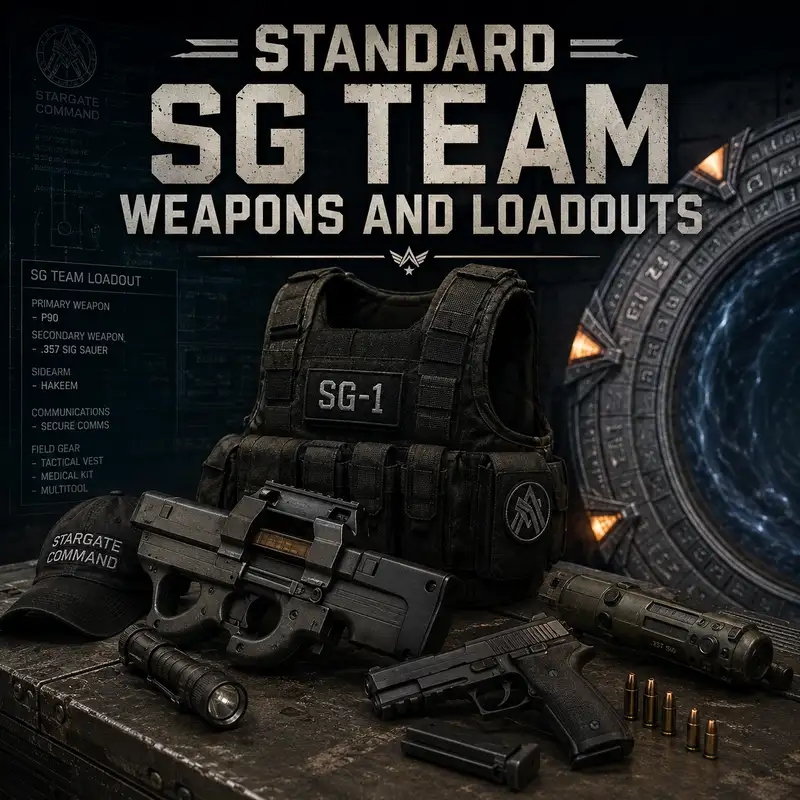
Standard SG Team Weapons and Loadouts
A Kull warrior advanced through concentrated fire without changing pace. P ninety rounds struck the armor. Staff blasts hit with enough force to stagger an ordinary Jaffa. The figure kept moving, protected by a system Earth did not yet understand. In seconds, the standard field weapon of Stargate Command had become inadequate. The answer would require intelligence, captured technology, and a specialized attachment that did not exist when the mission began.
That encounter explains why there was never one perfect S G team loadout. Equipment carried through the Stargate had to support reconnaissance, diplomacy, science, rescue, and combat while remaining light enough for a small team to move without vehicles or immediate resupply. A weapon effective against Jaffa might fail against Replicators, Kull warriors, or Priors. The standard loadout was a baseline, not a promise.
A typical team left Earth with a primary weapon, sidearm, spare magazines, military radio, remote identification transmitter, basic medical supplies, water, field rations, knife, flashlight, and mission-specific tools. Explosives were common, though quantities depended on the objective. Scientists added sensors and sample equipment. Daniel Jackson carried notebooks and cameras. Samantha Carter often carried electronic instruments or tools in addition to the weapons and ammunition expected of military personnel.
Everything had to remain portable after the wormhole closed. A team could cross the galaxy in seconds and then spend hours moving over rough ground with no truck, helicopter, or supply point. Extra ammunition displaced water, batteries, medical gear, explosives, and scientific equipment. A heavier weapon increased firepower but slowed movement and made first contact resemble an invasion. Stargate logistics began with an old infantry fact. A person can carry only so much.
During the program’s early years, the most common primary weapon was the Heckler and Koch M P five. It fired the nine-millimeter pistol cartridge from a compact platform and normally used a thirty-round magazine. The weapon was controllable, accurate at close range, and short enough to maneuver through gate rooms, Goa’uld corridors, village buildings, and pyramid ships. Weapon lights and compact optics also suited the many alien interiors that had apparently been designed before anyone discovered windows.
The M P five’s limitation was the same feature that made it manageable. A nine-millimeter cartridge was not designed for long-range rifle combat or reliable penetration of heavy protection. Against lightly armored Jaffa at close range, disciplined fire worked. Across open terrain, against harder targets, or when the enemy remained behind cover, teams wanted more reach and energy. The early weapon matched the program’s first assumptions. The galaxy quickly developed objections to those assumptions.
By the fourth operational year, the Belgian-built P ninety began replacing the M P five as the weapon most closely associated with S G teams. Its compact bullpup layout placed much of the action behind the trigger. It fired the smaller, high-velocity five point seven by twenty-eight millimeter cartridge and fed from a fifty-round magazine mounted across the top. Its controls were largely ambidextrous, useful for left-handed shooters, firing around cover, and passing weapons between team members.
The P ninety offered a practical compromise. It remained short enough for shipboard and gate-side fighting while providing greater magazine capacity and better performance against body armor than the nine-millimeter M P five. Low recoil supported accurate bursts. A four-person team could produce substantial controlled fire without carrying rifles awkwardly long for the corridors it was clearing. The weapon looked futuristic beside the Stargate, but its real value was ordinary ergonomics.
Compact size mattered during extraction. One member might be entering an address, another transmitting the identification code, and a third moving a casualty toward the event horizon. Weapons had to be brought to bear without striking the dial-home device, another teammate, or the machinery required to get home. The P ninety fit a battlefield built around narrow approaches, short decision times, and one circular exit.
The fifty-round magazine did not eliminate ammunition limits. Automatic fire could empty it quickly, and the unusual magazines consumed space on a tactical vest. The cartridge also required a specialized supply chain inside a command already stocking pistol ammunition, rifle rounds, shotgun shells, grenades, and explosives. Earth could manufacture and maintain the system. An isolated team still had only what it carried. A translucent magazine showing the remaining rounds is useful information, but it does not make the number larger.
O’Neill later contrasted the P ninety with the Jaffa staff weapon while training rebel Jaffa. His point was doctrinal. The staff projected authority and fear as well as energy. The P ninety had sights, controllable fire, a compact stock, and a training system built around repeated hits. Carter demonstrated automatic fire and precise single shots. Earth’s advantage did not come from more advanced physics. It came from treating the firearm as a practical instrument rather than a ceremonial symbol of rule.
That comparison should not be taken too far. A staff weapon could breach doors, kill with one blast, and operate without a vest full of magazines. It offered reach and psychological effect against populations with no comparable arms. Teal’c remained highly effective with one because he had trained for decades. The P ninety was better suited to Earth doctrine, not universally superior in every circumstance.
Stargate Command also used rifles from the M sixteen and M four families when greater range and rifle-cartridge performance mattered. Combat and rescue teams could carry belt-fed light machine guns for sustained fire. Shotguns proved useful in close quarters and against mechanical Replicators whose blocks could be physically scattered. Sniper rifles, grenade launchers, and shoulder-fired weapons appeared when intelligence justified the weight. The correct loadout depended on the target, terrain, and expected duration.
Most S G teams were not identical. A scientific survey among ruins needed different equipment from a Marine team assigned to hold a gate against Jaffa reinforcement. A diplomatic mission might keep firearms visible but slung, while a rescue force carried more ammunition, breaching charges, and medical gear. A contaminated site required protective suits at the expense of mobility. Standardization simplified training and supply. Mission tailoring prevented standardization from becoming a ritual.
The most common early sidearm was a Beretta-pattern nine-millimeter service pistol. It remained available when the primary weapon was empty, damaged, or too awkward for a confined space. It also let a specialist stay armed while using both hands for equipment. A pistol was not expected to win a prolonged fight with Jaffa. It was insurance carried close to the body because emergencies have poor respect for weapon slings.
Alien weapons entered team loadouts selectively. Teal’c’s staff weapon was the most consistent example because it matched his training, identity, and tactical role. It delivered powerful energy blasts and doubled as a striking weapon. It was also long, difficult to conceal, and inconvenient while operating human equipment. Capturing several examples did not provide Stargate Command with a dependable supply of power components, spare parts, instructors, or replacements.
The zat’nik’tel, usually shortened to zat, offered a different advantage. It was compact, carried no conventional magazine, and could incapacitate a person with one discharge. A second could kill. That made it useful for prisoner recovery, stopping a compromised ally, and disabling some devices without immediately using lethal force. Its value was obvious. Its supply, maintenance, and exact operating limits remained outside Earth’s industrial control, so it supplemented the sidearm rather than replacing it.
That distinction between possession and standard issue shaped the entire program. A team might recover a staff weapon, zat, grenade, or energy device and prove that it worked. The armory still might not be able to issue hundreds, repair them after failure, or train operators safely. Earth firearms used understood materials, familiar maintenance, and ammunition that could be produced in quantity. Alien weapons offered capabilities Earth wanted. Conventional weapons offered a system Earth could sustain.
Replicator encounters demonstrated why several damage mechanisms mattered. Goa’uld energy weapons often did little to mechanical Replicator blocks, while automatic firearms and shotguns could break the machines apart through repeated physical impacts. The advantage was temporary. Replicators reassembled, adapted, and later produced human-form bodies ordinary bullets could not defeat. Firearms were not secretly more advanced than energy weapons. They were simply effective against a particular structure until the enemy changed.
The Kull warriors created the opposite problem. Standard projectiles and most captured energy weapons could not defeat their armor and artificial life support. Carter and Jacob Carter, working through the Tok’ra alliance, helped develop a specialized disruptor capable of neutralizing that protection. It could be integrated with Earth weapons and improved for field use. The result was a successful adaptation, not a universal setting marked defeat advanced enemy. Stargate Command had built one answer to one carefully studied vulnerability.
Explosives supplied the second major source of S G team firepower. C four charges could breach doors, destroy control panels, sabotage ships, collapse passages, or deny equipment to the enemy. Hand grenades provided immediate area effects, and claymore mines could strengthen a temporary gate position. These systems were portable, familiar, and powerful enough to damage machinery that small arms could not. They were equally capable of harming civilians, ruins, and the route required for extraction.
C four mattered because early teams rarely had artillery or air support. A few blocks could turn a four-person patrol into a demolition element capable of destroying a shield generator or opening an escape route. The tradeoff was finality. A blast might remove the enemy and the only control crystal needed to dial home. Good demolition planning required intelligence, placement, timing, and the discipline to remember that an Ancient ruin was not merely convenient cover.
Gate defense demanded a different use of firepower. A supporting team could place mines along likely approaches, position automatic weapons to cover the dial-home device, and reserve explosives for pursuit forces. The objective was not to hold the planet. It was to preserve one patch of terrain for the minutes required to open the wormhole and evacuate. Every burst fired too early was ammunition unavailable when the last casualty reached the gate.
The most important device in the loadout was often not a weapon. Each team carried a remote that transmitted its identification code through an active wormhole. Stargate Command could then open the iris before the team entered. The device was commonly called a G D O. Without it, a team could dial Earth and speak by radio, but it could not safely cross unless the control room found another way to verify the travelers. A rifle kept the enemy at distance. The G D O kept home from killing the team by mistake.
The remote had to be protected like cryptographic material. If captured, it could help an enemy imitate a friendly return. If destroyed, it could strand survivors at the event horizon. Codes could be changed or deactivated, and an overdue team might receive greater scrutiny. Personnel who lost their own remote sometimes had to rely on another S G team before returning. The gate reduced interstellar distance to seconds. Authentication remained stubbornly administrative.
Radios completed command and control. Team members needed local communications when terrain, buildings, or combat separated them. While the gate was active, radio could pass through the wormhole for reports, code confirmation, and extraction instructions. Once the connection closed, the patrol was usually alone. No satellite constellation followed it to another planet. Batteries, interference, antenna damage, and terrain could matter as much off-world as they did on Earth.
Clothing and protective gear reflected the same compromise as the weapons. Early teams commonly wore woodland battle dress with load-bearing tactical vests, boots, gloves, and mission patches. The vests carried magazines, radios, grenades, and tools, but did not always equal full heavy body armor. Lead teams often operated without helmets, especially during reconnaissance and diplomacy. The pattern suggests that movement, hearing, visibility, and approachability were prioritized over maximum protection.
Combat teams and high-risk missions could add helmets, heavier armor, or specialized protection. Hazardous environments required sealed suits, respirators, or cold-weather clothing identified by probe data. Prediction remained difficult. A breathable atmosphere could hold an unknown pathogen. A peaceful village could sit beneath Goa’uld surveillance. Protective gear useful against one hazard might slow the team during another. The ideal loadout was usually obvious after the mission, an advantage traditionally enjoyed by historians and accident boards.
Medical supplies were limited by weight and training. Individual dressings, pain control, basic medicines, and emergency equipment could stabilize common injuries, while dedicated medical teams supported larger operations. A four-person patrol could stop bleeding and carry a wounded member toward the gate. It could not reproduce an infirmary or evacuate anyone if the dial-home device was disabled. Medical planning remained inseparable from gate security.
Water, food, and batteries set the real endurance of a mission. A scheduled survey could become a multi-day evasion after the gate was captured. Teams carried field rations and canteens, but prolonged separation forced reliance on local resources. That created medical and diplomatic risks. Drinking from an unknown stream or taking food from a settlement was not merely survival. It was contact with an ecosystem and a population whose rules Earth might not understand.
Scientific equipment competed directly with ammunition for space. Carter carried detectors, electronic tools, computers, and later portable power systems when required. Daniel carried cameras, writing material, references, and containers for records or artifacts. Survey teams added sample kits and environmental sensors. These items looked secondary beside a firearm. They often produced the information that prevented another firefight or revealed how to activate the route home.
The four-person structure distributed those burdens unevenly. O’Neill emphasized command, security, and tactical movement. Carter balanced combat duties with technical analysis. Daniel concentrated on language, culture, and political context while remaining capable of defending himself. Teal’c brought heavy firepower, tracking skill, and direct knowledge of Goa’uld practice. The team carried several kinds of expertise, but losing one person could remove an entire category of capability along with a quarter of the firepower.
Ammunition was therefore a shared resource. A member operating sensors or translating an inscription could not provide continuous security. A wounded person’s magazines might need redistribution. Teal’c could use a staff weapon while the others conserved cartridges, but no one could assume a captured energy weapon was charged or compatible. The person carrying explosives might become the casualty everyone else had to move. Load plans had to survive the loss of the person who made them look balanced.
Mission type changed the package. Reconnaissance favored mobility, optics, cameras, water, and enough ammunition to break contact. Direct action added explosives and breaching tools. Search and rescue added medical supplies, litters, and heavier covering weapons. Diplomatic visits carried records or trade material and demanded a restrained weapons posture. Biological investigations required protective clothing and sample containers. The address identified the destination. The loadout expressed what Earth believed it was going there to do.
That expression had political consequences. On a world with limited technology, four armed strangers in tactical gear could resemble liberators, mercenaries, or the advance party of another empire. Keeping weapons lowered did not erase the imbalance. Neither did describing a visit as peaceful while carrying enough C four to remove the local government’s front door. Daniel’s language skills and willingness to listen reduced the danger, but the equipment communicated intent before translation began.
Enemy forces also learned from captured gear. A lost radio revealed procedures. A G D O threatened the iris. A firearm demonstrated Earth metallurgy and ammunition. Explosives showed how teams sabotaged ships and installations. Stargate Command therefore recovered sensitive equipment when possible and changed codes when it could not. The small loadout was designed to gather intelligence. Every item on it could become intelligence for the other side.
Maintenance made conventional weapons strategically valuable. Armorers at Cheyenne Mountain could inspect, repair, and replace an M P five, P ninety, rifle, or pistol. Training personnel could qualify new operators. Supply officers could obtain ammunition and magazines through classified channels. A zat might function for years or fail without warning. A staff weapon might be powerful but difficult to reproduce. Earth’s armory was less advanced than a Goa’uld arsenal and far more accountable to a parts inventory.
The mix of Belgian, German, Italian, and American weapons created a quiet logistical burden. Different magazines, cartridges, tools, spare parts, and qualifications had to be supported inside a hidden program. Standardizing around the P ninety simplified field operations while creating an ammunition demand unfamiliar to ordinary Air Force units. The weapon fit the Stargate mission better than conventional service practice. Secret programs permit unusual solutions, provided someone can explain the invoices to a very small number of people.
Later technology did not make the basic loadout obsolete. Earth acquired fighters, battlecruisers, transporters, and better sensors, yet S G teams still entered villages, ruins, ships, and gate clearings on foot. Atlantis personnel also depended on compact firearms, pistols, C four, radios, and identification procedures. Ships expanded fire support and extraction. They did not fit through every doorway where a decision had to be made.
Standard equipment failed whenever intelligence failed. A team expecting diplomacy might meet Jaffa. A rescue force might encounter a shield immune to bullets. A scientific survey might awaken a system that treated radio signals as an attack. Carrying every possible weapon and protective suit would immobilize the patrol before it reached the ramp. The answer was reconnaissance, specialized support, alternate extraction, and an armory capable of changing the package when evidence changed.
The most successful loadouts combined familiar weapons with unfamiliar expertise. Earth firearms provided sustainable force. Captured alien weapons added options. Explosives replaced missing artillery in small doses. Radios and the G D O connected the patrol to its secure base. Medical supplies preserved life long enough for the gate to matter. Scientific instruments and notebooks answered the questions bullets could not. Each item covered a weakness created by another.
The defining image is an S G team at the foot of the ramp conducting one last check. Magazines are seated. Sidearms are secure. Radios are working. The identification remote is within reach. Water, medical gear, instruments, and explosives have been divided among four people who do not know whether the destination will require a conversation or a firefight. The standard loadout was never one weapon. It was a compact doctrine: carry enough force to survive first contact, enough knowledge to understand it, and enough communication to get home before the enemy reaches the gate.