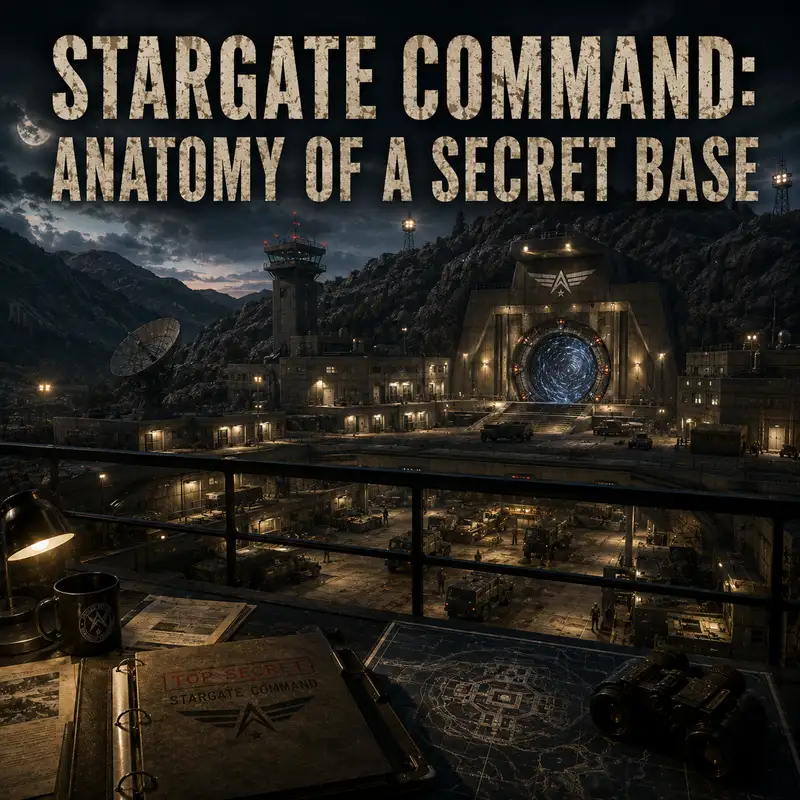
Stargate Command: Anatomy of a Secret Base
The most dangerous moment at Stargate Command was often the interval between an incoming wormhole and a recognized identification code. The iris remained closed. Security teams moved into the embarkation room. Technicians watched the signal monitors while the base commander decided whether the transmission belonged to a returning team, a frightened ally, an enemy using captured equipment, or no one at all. Cheyenne Mountain was built to survive attack from the outside. Stargate Command existed because the greater danger could arrive from inside the mountain, through a doorway that opened in seconds.
The base is usually remembered as a command center with a Stargate in the middle. That description understates the problem its designers had to solve. The facility had to function as a border crossing, special-operations headquarters, scientific laboratory, hospital, intelligence center, diplomatic venue, quarantine station, logistics hub, and last line of planetary defense. Every one of those missions competed for space, authority, power, and attention. The central question is how a Cold War bunker became capable of supporting an interstellar campaign, and why the same concentration of functions that made it effective also made it dangerously vulnerable.
Cheyenne Mountain offered an unusually strong foundation. The real complex in Colorado had been excavated as a hardened command-and-control site for North American aerospace defense. Inside the fictional history of the Stargate Program, its rock, tunnels, security checkpoints, protected communications, and existing military cover made it a natural place to hide an artifact that could not be explained publicly. Personnel and heavy equipment could enter through a guarded installation without attracting the attention that a new purpose-built base would have generated. A secret project could disappear inside another secretive mission.
That cover had strategic value. Electrical demand, armed security, unusual cargo, and round-the-clock operations were less conspicuous inside an already sensitive mountain. Families could be told that personnel worked at a restricted Air Force facility, which was true in the narrow administrative sense and incomplete in nearly every way that mattered. Secrecy did not eliminate evidence. It gave the evidence a plausible place to hide.
The location also imposed a contradiction. Cheyenne Mountain was selected to protect command functions from bombardment, yet Stargate Command placed an active alien transportation system beneath a major national-defense complex. An enemy did not need to penetrate the surface checkpoints, fly through American airspace, or defeat the mountain’s external doors. It needed Earth’s gate address and an unobstructed receiving portal. The mountain could stop many terrestrial attacks. It could not prevent the Stargate from accepting an incoming wormhole.
Access from the surface formed only the first layer of defense. Visitors passed armed checkpoints, identity verification, guarded tunnels, restricted elevators, key-card controls, and additional screening before reaching the lower levels. Movement became more restricted as personnel descended. These measures blocked ordinary intrusion. They were less useful when a person carrying a Goa’uld, alien duplicate, or concealed influence passed every checkpoint with valid credentials.
At the bottom of the operational chain was level twenty-eight, the home of the Stargate and the systems required to use it. The official name for the great chamber was the embarkation room, because teams assembled there before departure. In practical terms, it was a launch bay without a vehicle, a customs station without passports, and a fortified entry point whose far side could be located anywhere in the Milky Way. The ramp provided a clear path for personnel, wheeled probes, equipment cases, and casualties. It also provided an attacker with a direct line into the room.
The Stargate dominated the chamber because every other feature existed in response to it. The room required blast doors, observation windows, cameras, communications, fire suppression, medical access, and open space for the unstable vortex formed during activation. Security personnel needed clear fields of fire without standing where that opening surge would remove them from the duty roster in a particularly final manner. A shaft above the room later allowed the gate to be raised when Earth needed to move it out of the mountain.
The first version of the facility had no effective defense against an incoming force. Apophis demonstrated the weakness when his Jaffa entered the gate room, killed the guards, seized an airwoman, and withdrew before the base could respond. The raid did not defeat Cheyenne Mountain. It showed that the mountain’s depth was irrelevant to an enemy arriving on level twenty-eight. The principal defensive problem was no longer stopping intruders before they reached the bunker. It was stopping them from completing materialization after the wormhole had already formed.
The iris became the answer. The metal barrier closed directly in front of the event horizon, leaving insufficient space for incoming matter to reintegrate. An attacker could establish a connection and transmit radio signals, but soldiers, weapons, and ordinary cargo striking the closed iris would not emerge into the room. This converted the Earth gate from an open access point into a defended border. It was one of the most important technological adaptations in the program, even though Earth had not altered the Stargate itself.
Authentication made the iris usable. Off-world teams carried transmitters that sent identification codes through an active wormhole. Control-room personnel compared the signal with authorized records and opened the barrier only when the code, mission circumstances, and command decision aligned. Codes could be changed or deactivated when equipment was lost. That did not make the system foolproof. A captured transmitter could be used by an enemy, a damaged radio could prevent a friendly team from identifying itself, and a returning officer might already be compromised. The iris answered the question of physical entry. It did not answer the question of identity.
The embarkation room remained a poor place for uncertainty. A friendly team could arrive under fire, carrying wounded civilians, pursued by Jaffa, or contaminated by something no medical officer had encountered. Security forces had seconds to clear the ramp, cover the gate, and separate returnees from the installation. They were expected to welcome their own personnel and prepare to shoot anyone following them.
Above and behind the gate room sat the control room, the facility’s operational nerve center. Its windows overlooked the Stargate, while consoles managed the human-built dialing system, iris controls, communications, probe telemetry, power readings, and warning alarms. Technicians tracked each chevron, announced incoming activations, received identification codes, and connected the base commander with teams on the far side. They did not merely operate a machine. They maintained situational awareness across a border that existed only while the wormhole remained open.
Earth’s dialing system was itself a reminder of technological dependence. The Giza dial-home device was missing, so Project Giza built motors, computers, and power controls to imitate some of its functions. The resulting system could turn the ring and establish connections, but it did not automatically reproduce every Ancient safeguard or network function. Stargate Command therefore relied on equipment its engineers had designed around machinery they could use but not manufacture. A normal day in the control room was proof of human ingenuity. An abnormal day often revealed which part of the original system had never been understood.
The control room’s location supported rapid command, but it also created a concentrated target. An infiltrator who reached those consoles could open the iris, dial an address, disable power, alter security systems, or trap personnel behind blast doors. Kawalsky’s Goa’uld used his memories and credentials to reach the dialing controls. Foothold infiltrators replaced trusted personnel and operated inside the command structure. Anubis later exploited possessed bodies and internal systems while the base tried to isolate him. The most secure console is still vulnerable when the enemy is wearing an authorized face.
Directly above the control room, the briefing room connected operations to policy. Teams received mission orders there, reported what they had found, argued over risks, and placed alien artifacts on tables that had been designed for rather more conventional presentations. The room overlooked the gate, allowing commanders and visitors to watch departures and arrivals while discussing their consequences. A short stairway linked the briefing area to the control floor. That architecture compressed the decision cycle. Intelligence could move from a returning team to the commander and back into a new mission with very little physical distance.
The base commander’s office adjoined this command space. From there, Major General George Hammond and his successors communicated with the Pentagon, the Joint Chiefs, and the President. The office represented the boundary between field judgment and national authority. A decision to open the iris might belong to the duty commander. A decision to expose the program to another government, negotiate with a System Lord, or risk Earth in an off-world operation could reach the highest civilian leadership.
That relationship was strained by time. The Stargate could create a crisis faster than Washington could study it. An incoming traveler might provide only seconds for a decision, and a team in danger might have one brief connection before the wormhole closed. Hammond’s authority mattered because the base could not pause the gate while the interagency process located the correct conference room.
The briefing level also became an improvised diplomatic center. Tok’ra representatives, Jaffa leaders, Asgard visitors, foreign officials, and hostile Goa’uld entered a facility organized around American military secrecy. The same table used for patrol debriefings hosted negotiations with parties possessing greater technology and different political assumptions. Stargate Command was not an embassy, but the gate repeatedly delivered foreign powers directly into the headquarters responsible for dealing with them.
Science occupied much of the base beyond the command floors. Laboratories examined metals, power sources, weapons, biological samples, communications devices, writing systems, and artifacts whose purpose was not obvious. Samantha Carter required engineering and physics support. Daniel Jackson required offices, archives, image analysis, and access to specialists in language and archaeology. Other teams needed technicians who could repair probes, fabricate adapters, and build equipment for conditions no commercial supplier listed in its catalog. The base’s scientific capacity turned off-world discoveries into usable intelligence.
Rapid exploitation came with serious risk. Recovered technology often moved from the Stargate to a laboratory only a few levels away. A device might be damaged, active, deceptive, contaminated, or dependent on an unknown power source. Any discovery might improve Earth’s defenses. It might also affect minds, power systems, biology, or the gate itself. Carrying something home was not the same as bringing it under control.
The medical complex was therefore not a supporting convenience. It was part of the base’s defensive architecture. Returning personnel needed trauma care, surgery, decontamination, quarantine, neurological evaluation, and screening for organisms that did not appear in terrestrial medical texts. The infirmary treated gunshot wounds and staff-weapon burns, but it also confronted symbiotes, alien pathogens, memory changes, radiation, accelerated aging, and injuries produced by unfamiliar physics. Medical officers were asked to protect the patient while determining whether the patient had become a threat to the installation.
Early failures showed how difficult that mission was. Kawalsky returned from Chulak with a Goa’uld inside him and passed into the base before anyone recognized the infection. Other enemies copied personnel, altered behavior, or moved between hosts without producing an obvious external wound. A clean uniform, correct voice, and valid code could not prove that the person inside remained in control. Quarantine procedures improved, but the base never acquired a single test capable of detecting every biological or technological form of infiltration.
Holding cells and isolation rooms supported that mission. They housed enemy prisoners, uncertain allies, compromised personnel, and visitors whose intentions remained unclear. The cells formed part of an intelligence and containment system, allowing interrogation, medical observation, and armed security in one area. The arrangement was efficient. It also meant that some of the galaxy’s most dangerous individuals were occasionally held inside the same mountain as Earth’s operational gate.
The base’s armories, storage rooms, workshops, and vehicle bays supplied the less glamorous half of interstellar operations. S G teams required rifles, ammunition, sidearms, explosives, radios, identification transmitters, protective clothing, food, water, medical kits, batteries, climbing equipment, sample containers, and mission-specific tools. Mobile analytic laboratory probes had to be repaired, recharged, and staged for the next address. Weapons had to be issued, inventoried, cleaned, and returned. Alien equipment needed secure storage until someone decided whether it was a tool, evidence, or an especially creative bomb.
The Stargate reduced travel time to seconds. It did not eliminate logistics. Everything used on the far side had to fit through the ring, survive the transit, and remain supportable without a supply convoy unless another wormhole could be opened. A team could cross the galaxy faster than an elevator could carry its equipment to level twenty-eight, then discover that one missing battery or damaged radio had removed its extraction plan. The base’s elevators, maintenance crews, warehouses, and duty schedules were as essential to the program as the event horizon.
Living and working inside the mountain created another requirement. During alerts or lockdowns, the facility had to feed, house, and medically support people who could not leave. Command staff, security forces, technicians, medical teams, scientists, and S G personnel might remain underground for extended periods. The mess hall and quarters attracted little strategic attention until the doors sealed. A command center can operate without daylight. It cannot operate without meals, sleep, sanitation, and another shift.
Power was equally central. The base needed electricity for life support, communications, computers, blast doors, laboratories, the iris, and the mechanical dialing system. Gate activation imposed a much larger and less predictable load. Emergency generators and isolated circuits provided redundancy, but alien devices sometimes drew power in ways the network had not been designed to tolerate. Engineers such as Sergeant Siler became operational personnel because restoring one breaker or disconnecting one improvised device could determine whether the gate opened, the iris moved, or the complex remained habitable.
Communications extended the base’s reach only while physics allowed it. Radio signals could pass through an active wormhole in both directions, enabling teams to send reports, identification codes, and probe data. Once the connection ended, an off-world patrol was usually isolated until it or Stargate Command dialed again. Mission schedules and return windows therefore mattered. The control room could call a team at an agreed time, but it could not maintain continuous contact across a closed gate. Strategic movement was immediate. Command and control remained intermittent.
The base defended itself through layers. Surface security protected the mountain. Internal checkpoints restricted movement. Armed Air Force personnel covered sensitive corridors and the gate room. Blast doors segmented the lower levels, the iris blocked gate entry, and computer permissions limited access to critical systems. During one possession crisis, command divided the facility into separate zones, disconnected gate power from the normal control room, and required different sections to control access to one another. No single trusted individual could be allowed to open every path.
The final layer was the self-destruct system. If hostile forces took the gate or an uncontrollable event threatened the surface, commanders could initiate a nuclear destruction sequence intended to eliminate the installation and bury or destroy the Stargate. This was not a routine defensive weapon. It was an admission that the base might become more dangerous than the enemy outside it. The device required authorization and provided time for evacuation or cancellation, but emergencies repeatedly showed that codes and controls could be targeted by anyone who gained internal access.
Cheyenne Mountain’s rock could absorb blast and shield the base from many conventional threats. It could not protect Earth from every effect transmitted through the gate. A wormhole connected to a planet near a black hole carried gravitational and time-distortion effects into the complex. Alien organisms, energy forms, computer programs, and psychological influence did not care how much granite surrounded the command floor. The mountain was excellent armor against familiar weapons. The Stargate specialized in delivering unfamiliar ones.
The base also had almost no independent defense against hostile spacecraft during its early years. A Ha’tak in orbit could threaten the planet while Stargate Command remained sealed beneath the mountain with rifles, an iris, and no weapon capable of reaching the ship. The facility could deny gate entry and continue commanding teams, but it could not guarantee control of the air or space above Colorado. This distinction shaped Earth’s later investment in fighters, ships, satellites, off-world sites, and planetary-defense systems. A protected headquarters is not the same thing as a defended planet.
Off-world bases eventually reduced some of the concentration. Alpha Sites provided evacuation points, staging areas, research locations, and alternatives when Earth could not safely receive a team. Other installations separated dangerous experiments from the home world. Yet Cheyenne Mountain remained the institutional center because it linked the gate, command authority, national leadership, science, medicine, and logistics in one place. Dispersal improved survival. Centralization improved decision speed.
That centralization explains both the base’s success and its repeated near-disasters. A returning team could receive medical care within minutes. A captured device could reach experts quickly. A commander could question the team, consult Carter and Daniel, speak with the President, and authorize a response without leaving the secure complex. The same arrangement meant that an infiltrator, plague, power failure, or gate anomaly could threaten nearly every critical function at once. Stargate Command was efficient because the entire program gathered around one doorway. It was vulnerable for exactly the same reason.
The base was never merely a bunker containing a ring. It was the machinery that made the ring militarily and politically usable. The embarkation room controlled movement. The iris controlled access. The control room created situational awareness. The briefing room turned reports into missions. The laboratories turned artifacts into knowledge. The infirmary kept exploration from becoming an uncontrolled biological exchange. The armories, workshops, stores, and living spaces sustained the people sent beyond Earth. The commander connected all of it to civilian authority.
The defining image is the window above level twenty-eight. Below it, the iris is closed against an incoming wormhole. Security personnel hold their positions. Technicians wait for a code. Scientists study the readings, medical teams prepare for casualties, and one commander must decide whether opening the barrier will recover an S G team or admit the threat pursuing it. Cheyenne Mountain provided rock, steel, power, and procedure. Stargate Command existed to make the decision those defenses could never make on their own.