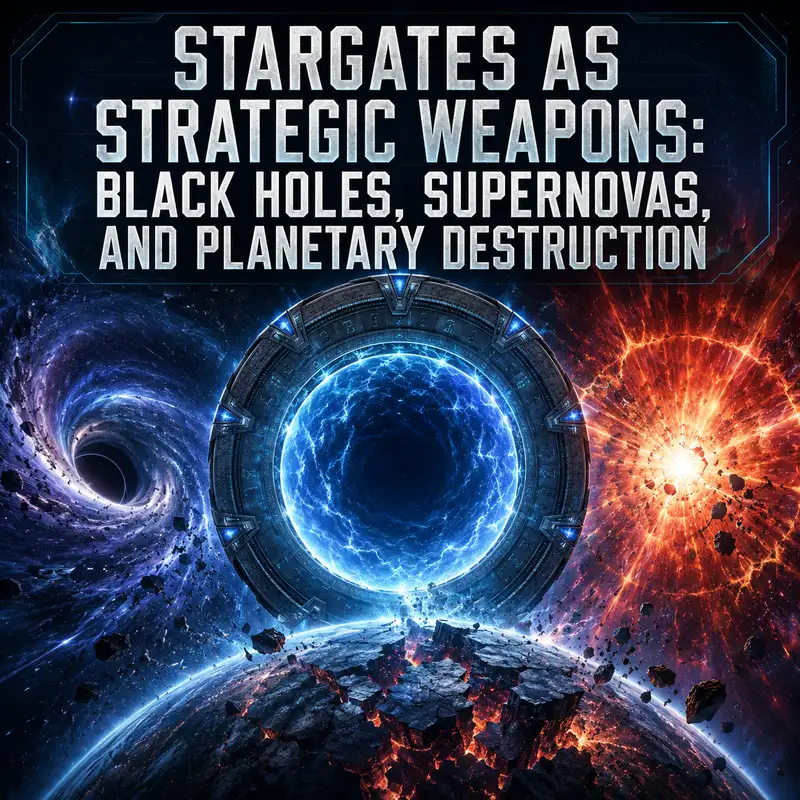
Stargates as Strategic Weapons: Black Holes, Supernovas, and Planetary Destruction
The Stargate had just entered Vorash’s sun when Samantha Carter announced that the system had twenty-seven minutes left. A captured Ha’tak carried the ring close enough to the star for gravity to take over. The gate had been dialed to a world falling into a black hole, then sealed inside a temporary force field and released. When that protection failed, stellar matter began pouring through the wormhole. The sun’s internal balance collapsed. Vorash, the abandoned Tok’ra base, and Apophis’s approaching fleet were about to be consumed by an artificial supernova created with a transportation device.
That operation revealed the strategic danger hidden inside the Stargate network. A gate normally moves people, equipment, and information between fixed points. It does not resemble a battleship, missile, or planetary-defense cannon. Yet the same qualities that make it useful for exploration also make it dangerous in war. A Stargate creates a controlled passage across enormous distance. It connects local terrain to remote energy, gravity, matter, and infrastructure. Once commanders learned to manipulate those connections, a ring built for transportation could become a delivery system, a bomb, a blockade, a network weapon, or the trigger for destroying an entire world.
The gate itself was rarely the complete weapon. Most catastrophic effects required an external condition or another advanced device. A black hole could supply power and gravitational distortion. A naquadah-based attack could overload the ring until its own material amplified the explosion. A computer virus could exploit the dial-home devices that kept the network synchronized. An Ancient machine could use thousands of gates as simultaneous transmission points. Earth never gained a standard procedure for planetary destruction. It accumulated exceptional methods dependent on rare intelligence, precise geometry, dangerous improvisation, and consequences that could not always be recalled.
Normal gate operations contain safeguards against that kind of misuse. Matter travels from the dialing gate toward the receiver, while radio and some other forms of energy can move in either direction. A normal wormhole remains open for only a limited period unless an extraordinary power source sustains it. Dial-home devices verify addresses, compensate for stellar drift, and reject some unsafe connections. Earth’s custom dialing computer reproduced many of those functions, but not all. It also allowed Stargate Command to override conditions the original builders had considered good reasons not to proceed. This was useful in emergencies and dangerous everywhere else.
The first black-hole crisis began as a rescue attempt. S G Ten had reached the planet designated P three W four fifty-one shortly before a nearby star collapsed into a black hole. Their identification transmission returned so slowly that Stargate Command did not initially understand what had happened. Earth dialed the planet again and sent a mobile analytic laboratory probe. The image showed the team trapped under a sky dominated by the growing singularity. Then the gate refused to disengage. The black hole’s gravitational influence and time distortion propagated through the wormhole into Cheyenne Mountain.
The immediate problem was not enemy fire. It was the geometry of space-time extending into a military base beneath Colorado. Time passed more slowly near the gate than it did outside the mountain. Orders, evacuations, and engineering work occurred at different rates depending on distance from the event horizon. The iris deformed. Personnel struggled against increasing gravity. Senior leaders considered destroying the base, only to realize that an explosion might eliminate the mountain without ending the connection. If the effect continued expanding, the danger would no longer be confined to Stargate Command. Earth itself could be torn apart by a black hole located light-years away.
Carter’s solution was to force the wormhole to jump to another receiving gate. Jack O’Neill and Colonel Frank Cromwell lowered a shaped charge into the gate room while gravity pulled everything toward the event horizon. The blast redirected enough energy into the connection to make it arc to a different Stargate. Once the black-hole link was broken, the new connection could be closed normally. Cromwell was pulled through and lost during the operation. Earth survived, but the incident established three facts that changed future planning. A black hole could hold a gate connection open, its gravity could affect the far end, and an energetic disturbance could force a wormhole to change destinations.
Those lessons turned P three W four fifty-one from a disaster site into a strategic resource. The address identified a functioning gate near a black hole, assuming the ring had not crossed the event horizon. Stargate Command and the Tok’ra now possessed more than a location. They possessed a connection to extreme gravity. Under the right conditions, it could provide power, remove matter, or hold another wormhole open beyond normal limits. The network had acquired the equivalent of a remote-access singularity, which is not an item most operations officers expect to find in the address book.
The Tok’ra plan at Vorash used that singularity as the far end of a stellar weapon. Their base was being evacuated when intelligence showed Apophis approaching with a major fleet. Carter and Jacob Carter proposed moving the local Stargate aboard the captured Ha’tak, flying it close to Vorash’s sun, dialing the black-hole world, and jettisoning the active ring. Once the force field around the gate failed inside the star, stellar material would be pulled through the wormhole. Removing enough mass would disrupt the balance between fusion pushing outward and gravity pulling inward. The result would be an artificial supernova.
The operation required more than scientific insight. The Tok’ra had to evacuate their personnel and stores before the weapon was committed. The captured Ha’tak needed to carry the gate, survive close approach to the star, and escape before the predicted detonation. Apophis had to enter the system without understanding that Vorash was already a prepared kill zone. When enemy ships arrived sooner than expected and Teal’c was captured, the plan became a rescue, deception, and fleet-destruction operation at the same time. Unmanned death gliders drew Apophis away from the planet while S G One recovered who it could and raced for hyperspace.
The supernova destroyed Vorash and swept through Apophis’s formation. It was a strategic strike delivered without matching his fleet ship for ship. Yet the blast also struck the escaping Ha’taks while their hyperdrives were active, throwing S G One and Apophis more than four million light-years into another galaxy. The attackers had calculated the star’s destruction better than they had calculated its effect on subspace. The mission eliminated the immediate base and much of the enemy fleet, but it did not kill Apophis, recover Teal’c, or guarantee the survival of the people who triggered it. Planetary destruction had worked. Control of the aftermath had not.
Vorash was selected because the Tok’ra had evacuated and described the system as abandoned and barren. That reduced civilian risk, but it did not make the decision routine. The operation deliberately destroyed a planet, its star, and everything remaining in the system. It depended on a captured capital ship, a movable Stargate, a known black-hole address, a narrow timeline, and calculations never tested at full scale. There was no second shot and no way to reverse the process after the gate entered the sun. The device functioned exactly once, which in a laboratory is a result and in strategic warfare is still a doctrine problem.
A mission to K’Tau showed how easily the same basic mechanism could operate without intent. Stargate Command bypassed dialing safeguards to establish a difficult connection. The wormhole’s path intersected the local sun, and an unstable superheavy element was carried into the star. Its output shifted toward the infrared, turning the sky red and threatening the planet’s agriculture and population. The team had not fired a weapon. It had merely arrived. A technical shortcut in Colorado had created an astronomical emergency around another civilization’s home.
The K’Tau crisis demonstrated why the Ancient safety systems mattered. Earth could power the ring and establish a connection while still lacking the knowledge built into the original dial-home device. Bypassing those protections expanded operational access but also transferred hidden risk to people who had no voice in the decision. Carter developed a plan to introduce a stabilizing element into the sun, while local political and religious conflict complicated delivery. The star was eventually restored, with Asgard intervention strongly implied. The larger conclusion was less comforting. A gate route was not empty space. The path itself could interact with stellar matter, and one successful lock did not prove the connection was safe.
Address intelligence could also become a weapon without modifying the gate. After Earth exposed the Aschen plan to reduce allied populations through engineered infertility, negotiators had already provided them with additional Stargate destinations. O’Neill later noted that the first address led to a black hole and that the remaining entries became progressively worse. Whether the Aschen ever dialed them is not established. The threat revealed a new category of warfare. An address database could contain allies, resources, ambushes, plagues, hostile empires, or gravitational disasters. Giving an enemy the wrong destination could be the interstellar equivalent of marking a minefield as a supply depot.
Anubis later removed even the need for the target to dial the dangerous address. He placed an Ancient device beside a Stargate on a fortified world and used it to transmit an increasing stream of energy into Earth’s active gate. The connection could not be shut down. The naquadah in the ring absorbed and amplified the buildup until Stargate Command estimated a blast in the range of two to three thousand megatons. The exact pattern of planetary damage was uncertain, which was not reassuring. The weapon used Earth’s own Stargate as the explosive material while the attacker remained protected on another world.
This was a distributed attack with two required targets. Teal’c, Bra’tac, and Rya’c moved against the off-world device while Earth tried to remove the armed gate from the planet. The experimental X three-oh-two carried the ring beneath its fuselage, first attempting to reach space and then using its unstable naquadria-powered hyperdrive. A one-second hyperspace window moved the gate more than three million miles from Earth before it detonated. O’Neill ejected and survived. Rya’c destroyed the source device. Earth then installed the second Stargate controlled by Russia, after a negotiation that also involved money and plans for new aerospace programs. Even successful planetary defense had an international invoice.
The Anubis attack changed the security meaning of every Stargate. An iris could stop incoming matter, but not automatically stop hostile energy already moving through an established wormhole. Moving the gate far enough away could save the planet, but only if Earth possessed a vehicle able to lift it, a pilot willing to carry it, and an experimental drive capable of acting before the countdown ended. The Stargate was Earth’s greatest strategic mobility asset and a single point of catastrophic failure beneath its primary command center.
Not every strategic attack required astronomical energy. The Avenger program was designed to disable one enemy Stargate by corrupting the coordinate system in its dial-home device. The target was a major naquadah mining world controlled by Ba’al. Denying its gate would disrupt supply without assaulting the mine directly. Instead, the program triggered the network’s automatic correlative update. Dial-home devices passed the corrupted information from gate to gate until much of the Milky Way network became unusable. Earth’s ring could still dial out because Stargate Command did not use a normal dial-home device. Teams on other worlds could not dial home.
The result was a network-wide logistics crisis created by code intended for one target. S G teams became stranded. Rescue and reinforcement routes closed. Jaffa and Goa’uld movements were disrupted, changing local balances of power in ways Earth could not predict. Evidence indicated that Ba’al had altered the program after recognizing how much advantage a wider collapse would give him. Carter and Jay Felger eventually used the same update mechanism to distribute a correction. Avenger proved that the Stargate network was not only transportation infrastructure. It was a connected information system, and connected systems can spread recovery data, navigation updates, or a mistake at galactic speed.
The weapon on Dakara converted that same network into a broadcast array. The Ancient device beneath the temple could manipulate matter at its most fundamental level. Carter and Jacob recalibrated its energy pattern to disrupt Replicator cells, but one local discharge would leave machines elsewhere alive and able to adapt. Ba’al supplied the knowledge required to reprogram the Dakara dial-home device so the effect could reach Stargates across the galaxy at almost the same time. The wave emerged from the network and destroyed the Replicators before they could adjust.
That victory did not mean Earth had created a permanent galactic weapon. The Dakara machine was unique, Ancient, politically contested, and capable of affecting biological life as well as machines. The Free Jaffa later used it against a world occupied by the Ori, killing the population along with the occupation force. Adria responded by destroying Dakara and the device. The same system that ended the Replicator offensive became an instrument of indiscriminate policy once control passed to leaders facing another existential war. The Stargate network multiplied the reach of the device. It did not supply judgment to the people selecting the target.
The Ori used planetary destruction even more directly at Kallana. A Prior established an expanding force field around the planet’s Stargate. Jaffa weapons and Earth’s Mark nine naquadria-enhanced warhead did not break the field. Their energy strengthened it. The nuclear detonation supplied most of what the system needed to engulf the planet, turning the defenders’ most powerful response into construction material for the enemy. Once the field surrounded Kallana, the planet began collapsing while large segments emerged through the active Stargate and assembled in space.
The completed structure was a supergate large enough for Ori warships. Kallana itself was compressed into a micro-singularity, providing the power needed to support an intergalactic wormhole. A corresponding black hole at the far end would allow the connection to remain open. The Ori had converted an inhabited world into the power plant for an invasion corridor. Vala Mal Doran disrupted the final assembly by placing a cargo ship where the last segment needed to join. The first supergate was destroyed, but Kallana and its population were already gone. Tactical success prevented the immediate beachhead without recovering the world consumed to build it.
A later supergate opened successfully and brought Ori warships into the Milky Way. The allied fleet at P three Y two twenty-nine discovered that stopping a ship-scale gate before activation was far easier than defeating the vessels after transit. Four Ori warships broke the coalition formation, destroyed the Korolev, and began a campaign of occupation and conversion. The supergate was a strategic weapon because it erased the supply distance between galaxies. It delivered fleets, soldiers, Priors, and political authority through one fixed point. Destroying an Ori ship mattered. Denying the corridor mattered more.
Carter and Rodney McKay answered with a plan derived from the earlier black-hole crisis. An ordinary Pegasus Stargate was positioned near a black hole and connected to another small gate concealed near the Ori supergate in the Milky Way. A precisely timed blast was supposed to force the wormhole to jump from the smaller destination into the supergate. The black hole would then hold that connection open, preventing the Ori from dialing their own side. Two attempts failed. The margin between a useful arc and the destruction of both rings was narrow enough to make confidence mostly decorative.
A Wraith hive attack supplied the final opportunity. The Odyssey used the black hole’s gravity to maneuver, placed nuclear warheads aboard the Wraith ship, and detonated it near the Pegasus gate. The explosion forced the wormhole jump. Teal’c kept the Milky Way gate concealed until an Ori ship approached, then allowed the supergate’s unstable vortex to form around the vessel and destroy it. The black-hole-powered connection denied the supergate to further Ori traffic. One operation destroyed a Wraith hive, an Ori warship, and an invasion route between galaxies. It was an elegant result assembled from two failed attempts and no sensible maintenance plan.
Pegasus later supplied a harsher warning through the Attero device. The Ancient weapon disrupted the subspace frequency used by Wraith hyperdrives, destroying ships that tried to enter hyperspace. Its unintended effect caused active Stargates to overload and explode. Janus abandoned the system after early tests showed that human populations near the gates would die. When a rogue Asgard faction reactivated it, Atlantis’s shield contained part of its gate explosion, while a Travelers’ colony was devastated. The device did not target those civilians. It simply treated the network they depended on as acceptable collateral damage. Strategic weapons often acquire that phrase shortly before someone else’s home disappears.
Stargates became weapons because they connected systems that distance normally kept separate. A black hole could reach into Cheyenne Mountain. A star could lose mass into another part of the galaxy. An enemy device could charge Earth’s gate from a fortified world. A virus could move through dial-home devices faster than fleets. An Ancient wave could emerge from thousands of rings. A collapsed planet could power an intergalactic invasion. The decisive feature was not the circular frame. It was the network relationship created when the frame opened.
That power remained difficult to control. Most of the largest effects depended on rare conditions, unique devices, captured ships, advanced calculations, or safety systems deliberately bypassed. The Vorash supernova destroyed its target and displaced the attacking ship across millions of light-years. K’Tau nearly died because Earth forced a connection the network wanted to reject. Avenger paralyzed allies and enemies together. The Dakara weapon saved the galaxy from Replicators and was later used against living people. Kallana’s defenders helped power the mechanism that destroyed their world. Every success expanded the list of ways the next commander could make a larger mistake.
The Stargate was therefore a strategic weapon before anyone fired energy through it. It compressed distance, concentrated movement at predictable points, and made addresses, access, timing, and network control as important as fleets. Black holes and supernovas revealed the upper limit of that principle, but the deeper danger was simpler. A civilization that controlled the connection could decide which battlefield touched which world. Earth became stronger when it learned to use that fact. It never became safe, because the same ring that could bring a team home could also carry gravity, hostile code, an invasion fleet, or enough energy to turn the doorway itself into the bomb.