The Abydos Mission: Humanity’s First Modern Off-World Operation
The mission was already in trouble before the first person crossed the event horizon. General West had authorized a reconnaissance operation to an unknown world, but the only specialist who claimed he could bring the team home had never seen the destination’s dialing system. Colonel Jack O’Neil carried a nuclear device under orders known to almost no one. The soldiers expected a short survey. Daniel Jackson expected to find the information required for a return trip. The command expected the Stargate itself to be destroyed if anything on the far side threatened Earth. Every part of that plan depended on assumptions no one had been able to test.
Ernest Littlefield had passed through the gate decades earlier, but his journey was an experiment conducted by a laboratory. The Abydos mission was different. It had a chain of command, defined objectives, armed personnel, reconnaissance equipment, communications, supplies, a demolition contingency, and an intended extraction. It was humanity’s first modern off-world operation because it attempted to turn one successful transit into organized military activity. It also established a pattern that would follow Earth for years. The technology worked. The plan did not survive contact with the world on the other side.
The operation began after Daniel identified the seventh symbol required to complete the address found at Giza. Project Giza could already rotate the ring, energize its chevrons, and establish the connection. What it lacked was a destination it could use with confidence. Once the wormhole formed, the command sent a tracked probe through. The machine returned images of another Stargate inside a large enclosed structure and transmitted readings indicating breathable air, survivable temperature, and pressure close to Earth conditions. Those results justified human reconnaissance, but they did not answer who controlled the site, whether the local gate could dial Earth, or whether hostile forces were nearby.
The probe also showed that the symbols on the destination gate differed from those used at Giza. General West was prepared to abort because a team that could not establish an outgoing wormhole would be stranded. Daniel claimed he could decipher the local system. His confidence secured his place on the expedition, although it rested on a critical assumption. He expected the far side to contain a record equivalent to the cover stones on Earth. He could read symbols, but he still required the correct sequence and a local point of origin. The distinction was technical in the briefing room and potentially fatal after deployment.
West placed the mission under Colonel Jack O’Neil, an experienced Air Force special-operations officer whose personal condition made the assignment unusually complicated. O’Neil was grieving the accidental death of his son and had withdrawn from ordinary life. The surviving record does not state that he was selected because he expected to die, but his willingness to accept a one-way demolition mission plainly shaped the operation. An officer who did not plan to return could carry out an order others might hesitate to execute. The same detachment that made him useful also made him reluctant to explain the real mission to his own people.
The expedition was larger than the four-person teams Stargate Command would later make familiar. O’Neil led a small armed detachment divided into three elements, with Kawalsky, Ferretti, Brown, Freeman, Reilly, Porro, and other personnel supporting security, reconnaissance, communications, and equipment movement. Daniel was attached as the only linguist and gate specialist. A mechanized rover carried cases, sensors, power equipment, camp supplies, and the concealed nuclear device. The team had rifles, sidearms, radios, protective gear, and field equipment. It had no air support, no medical evacuation route, no reserve force, and no independent spacecraft.
That force structure reflected what the planners thought they were doing. The team would secure the destination chamber, survey the surrounding area, determine whether a threat existed, and return quickly. If the threat justified denial, most of the detachment would withdraw while O’Neil remained behind to destroy the gate. The nuclear weapon was therefore both a contingency and a substitute for understanding. Earth could not control the network, identify every potential enemy, or defend against an advanced civilization. It could attempt to collapse one doorway before that civilization used it. Whether the bomb could actually destroy Ancient machinery had not been established with much rigor.
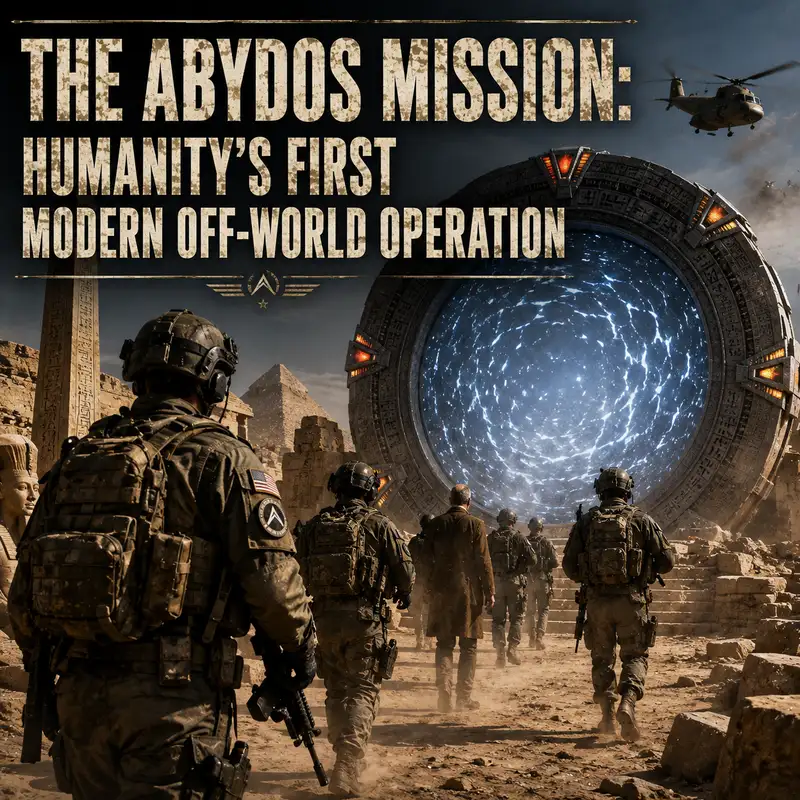
The team crossed behind its equipment rover and emerged inside the Abydos pyramid. The first movements were disciplined. O’Neil divided the detachment, cleared the structure, checked the atmosphere, listened for activity, and pushed a perimeter survey into the desert. The sight of three moons confirmed that Daniel had been correct about traveling to another world. It did not confirm anything else. The pyramid appeared empty, the surrounding desert appeared unoccupied, and there was no immediate hostile contact. For a brief period, the mission looked like the short reconnaissance the command had planned.
The crisis began when O’Neil ordered Daniel to prepare the gate for the return. Daniel admitted that he could identify individual symbols but did not know their correct order. He had assumed the destination would preserve an address tablet near the gate. It did not. The team could not simply wait for Earth to dial them, because matter could not travel back through the existing incoming connection and Earth did not know when a return attempt would be useful. Once the wormhole closed, the expedition possessed no route home. The first modern off-world operation had become an isolated deployment within minutes of arrival.
O’Neil established a camp near the pyramid and secretly prepared the bomb. This decision protected the demolition capability but preserved the compartmentalization that was already damaging the mission. Kawalsky and the others knew they were stranded, but not that their commander intended to remain behind or that a nuclear device sat inside their equipment. Daniel knew the return problem was his fault and began searching for evidence beyond the pyramid. Morale declined quickly. The device had worked exactly as designed, which was scientifically impressive and operationally inconvenient.
Contact with the Abydonians occurred because Daniel encountered a domesticated pack animal and was carried, with limited dignity, toward a mining area. O’Neil, Kawalsky, and Brown followed and found human laborers extracting the same unusual mineral associated with the Stargate. The workers saw Catherine Langford’s Eye of Ra pendant around Daniel’s neck and interpreted the visitors through their own political and religious system. They bowed. The expedition had achieved peaceful contact, but only because the local population initially mistook the newcomers for representatives of its ruler.
That misunderstanding created immediate access and long-term risk. Kasuf and the miners welcomed the team, offered food and water, and led part of the expedition toward their settlement. Daniel could recognize elements of the language, but centuries of separation and Ra’s prohibition against writing had altered it. Communication depended on gestures, fragments of speech, observation, and patience. O’Neil’s force had weapons and sensors, yet the most valuable capability on the ground was the ability to determine why an entire population feared a symbol worn as jewelry.
The movement away from the pyramid divided the detachment. Ferretti and several soldiers remained to secure the gate and equipment while O’Neil, Daniel, Kawalsky, and Brown accompanied the Abydonians. A severe sandstorm then cut radio communications and prevented either group from moving freely. The local population tried to close the city against the weather, while O’Neil initially interpreted the crowd’s behavior as coercive. His men seized civilians, fired warning shots, and came close to turning first contact into a firefight. Skaara finally showed him the approaching storm. Cultural ignorance had nearly created the enemy the mission had been sent to find.
The storm also exposed the expedition’s logistical fragility. Radios became unreliable, batteries were finite, and the two elements could not confirm one another’s status. The team at the pyramid had shelter but no clear intelligence about the city. The group inside the city had local protection but could not secure the gate. Earth’s most advanced transportation achievement had delivered the detachment across interstellar distance, while ordinary weather prevented it from communicating across the desert. Strategic mobility had leapt forward. Field communications remained subject to sand.
During the forced pause, personal relationships began changing the operation. Daniel worked with Sha’uri to reconstruct the local language and learned that writing was forbidden. O’Neil formed an uneasy connection with Skaara, a young Abydonian fascinated by his lighter and equipment. These contacts mattered because the expedition had no intelligence network, no cultural briefing, and no reliable map. Sha’uri could lead Daniel toward concealed records. Skaara could explain local conditions without shared vocabulary. Kasuf could either mobilize the population against the strangers or keep them under protection.
At the pyramid, Ra’s ship descended directly over the structure and physically dominated the gate site. The soldiers left behind possessed rifles and courage, but no way to contest a spacecraft, detect ring transporters, or defend every approach among the columns. Ra’s guards used surprise, close combat, and superior mobility to overwhelm them. Ferretti was wounded and captured. Other personnel were taken or killed. The landing demonstrated the difference between controlling the gate room and controlling the battlespace. Earth had secured the ground around the ring. Ra owned the air, the structure above it, and the technology connecting the two.
O’Neil’s group returned after the storm and saw the ship covering the pyramid. They entered to recover their people and equipment, but Ra’s guards held the interior. Brown was killed. O’Neil and Daniel were captured and transported aboard the vessel. The nuclear device, intended to deny an alien threat access to Earth, was now in the possession of that threat. This was the mission’s most serious failure. A weapon introduced as a safety measure had become an enemy delivery system aimed at the planet it was supposed to protect.
Ra interpreted the bomb correctly as evidence that Earth had become dangerous. For thousands of years, the humans left behind on the source world had possessed no weapon capable of threatening him. The expedition revealed industrial civilization, nuclear technology, and a working Stargate program. Ra planned to send the weapon back to Earth with additional naquadah, increasing the destructive effect far beyond the original device. The command’s contingency had given him both the means to attack and intelligence explaining why an attack was necessary.
Daniel’s capture produced an equally important intelligence breakthrough. Ra’s technology killed him with a staff blast and restored him in a sarcophagus. He learned that the ruler was not a supernatural being, but an alien using a human body and advanced machinery to sustain power. The Abydonian records then placed the local society inside a wider history. Ra had transported humans from Earth to mine naquadah, outlawed writing after the rebellion on Earth, and preserved obedience by preventing the population from recording the truth. The mission had found the threat. It had also discovered the political system holding the local population in bondage.
Ra intended to force Daniel to execute the captured soldiers before the Abydonians, turning the failed expedition into a public demonstration of divine power. Skaara and other young locals disrupted the ceremony with weapons recovered from the American camp. The prisoners escaped, although Freeman was killed during the withdrawal. This was the point at which the mission stopped being a reconnaissance operation with a demolition contingency. The surviving Americans were now allied with an indigenous resistance whose members had chosen to fight because personal contact had broken Ra’s monopoly on information and fear.
O’Neil initially resisted using the Abydonian youths. His objection was partly tactical and partly personal. They lacked training and were handling unfamiliar firearms. Skaara also reminded him of the son he had lost, making their participation difficult to accept. Kawalsky pointed out that the locals had nowhere safe to withdraw and that the Americans needed help. Daniel then exposed the hidden bomb order to the rest of the team. Compartmentalization ended not through orderly declassification, but because the enemy had captured the weapon and everyone needed to understand the new threat.
The revised objective was clear. Recover or intercept the bomb before Ra could send it to Earth, secure the gate, and prevent the ruler from maintaining control of Abydos. The available force consisted of a reduced American detachment, armed local volunteers, captured or recovered weapons, and knowledge of the ceremonial movement into the pyramid. They could not defeat Ra’s ship in direct combat. They could infiltrate the ground installation, exploit the small number of guards, and create enough disorder to reach the weapon. It was a special operation improvised inside a popular uprising.
The attack used a caravan as concealment. O’Neil, Daniel, Sha’uri, and local fighters entered with the workers while Kawalsky, Ferretti, Skaara, and others waited outside. The disguise failed at close range, producing a firefight inside the pyramid. Outside, Ra’s death gliders attacked the assembled resistance. The Abydonians had numbers and motivation but little protection from aircraft. The American survivors provided small-unit leadership and modern rifles, yet even that combined force could not force open every position or prevent casualties. The battle succeeded because Ra’s security apparatus was designed to intimidate a compliant population, not to fight an armed revolt from several directions.
O’Neil reached the bomb and armed it when he believed the original denial mission still had to be completed. Daniel argued that the Abydos gate could be dismantled after the threat was removed, but O’Neil intended to remain and guarantee detonation. The situation changed again when Sha’uri was shot and Daniel used Ra’s ring transporter to carry her body to the ship’s sarcophagus. O’Neil fought Ra’s chief guard beside the weapon while the battle continued outside. The plan had become a sequence of independent emergencies held together by seconds, captured technology, and a refusal to abandon people who were never included in General West’s original orders.
Daniel returned with Sha’uri restored, but Ra’s modifications prevented O’Neil from disarming the bomb. The device could no longer be safely left on Abydos, and the departing ship remained beyond the reach of rifles or local fighters. Daniel and O’Neil solved the problem by using the ring transporter as a delivery system. They sent the bomb aboard Ra’s vessel as it climbed into orbit. The detonation destroyed the ship and killed Ra. Earth’s weapon fulfilled its mission against the threat, but only after the team redirected it away from the gate, the local population, and the people it had been intended to protect.
The tactical result was dramatic. Ra’s guards were defeated, his ship was destroyed, and the Abydonians were freed from direct rule. The surviving American personnel regained the gate and found the local point-of-origin symbol needed to dial Earth. The mission had also suffered serious losses, including Brown, Freeman, and other members of the detachment. Ferretti survived with injuries. Daniel had been killed and restored by alien technology. The operation returned with fewer people than it sent and with intelligence that overturned Earth’s understanding of ancient history, human distribution, and the danger beyond the gate.
Daniel chose to remain on Abydos with Sha’uri and her people. O’Neil returned with the soldiers and gave his superiors an intentionally false account. He reported Daniel dead and allowed the command to believe the Abydos gate had been destroyed. The purpose was protective. If the government knew the gate and population survived, it might send another bomb to close the route permanently. His deception shielded Abydos from Earth, but it also corrupted the official record and left future commanders with a false picture of the first operation’s outcome.
That lie mattered when armed intruders later entered the Earth gate room. The command initially assumed the attack must have come from Abydos and prepared to send a more powerful nuclear weapon through the gate. O’Neil was forced to admit that Ra’s ship had been destroyed above the planet, Daniel was alive, and the Abydos gate remained intact beneath rocks placed to block incoming travel. The original after-action report had prevented one unnecessary strike. It also nearly caused another because the institution could not distinguish what had happened from what its field commander wanted it to believe.
Measured against its original orders, the Abydos mission was an unstable mixture of success and failure. It completed reconnaissance, identified a genuine threat, and destroyed that threat. It failed to maintain extraction, lost control of its nuclear weapon, suffered preventable casualties, and depended on civilians whose existence had not been anticipated. Scientifically, it proved repeatable human transit and discovered advanced alien technology. Politically, it helped liberate an enslaved population. Strategically, it killed a dominant ruler without understanding the wider Goa’uld order or the possibility that other enemies already knew Earth’s address.
The operation succeeded because its participants abandoned the plan before the plan destroyed them. Daniel’s unjustified confidence stranded the team, but his language skills found the intelligence and alliance required to escape. O’Neil’s secret bomb endangered Earth, but his decision to protect the Abydonians turned the device against Ra. The soldiers could secure rooms and win firefights, but local people supplied concealment, numbers, guidance, and the political will to overthrow their ruler. Humanity’s first modern off-world operation was not a clean demonstration of military power. It was a lesson in how quickly reconnaissance becomes diplomacy, occupation terrain becomes an alliance, and a contingency weapon becomes the central threat.
The final image is the surviving detachment standing before an active Stargate while Daniel remains on the far side. Earth had opened the route expecting to send a team out, collect information, and close the danger behind it. Instead, the mission left one civilian among a liberated people, carried home evidence of a galactic human diaspora, and concealed its true result from the chain of command. The Abydos operation began as an attempt to control an unknown doorway. It ended by proving that once the doorway opened, control would depend less on the machine than on the people, enemies, and obligations found beyond it.