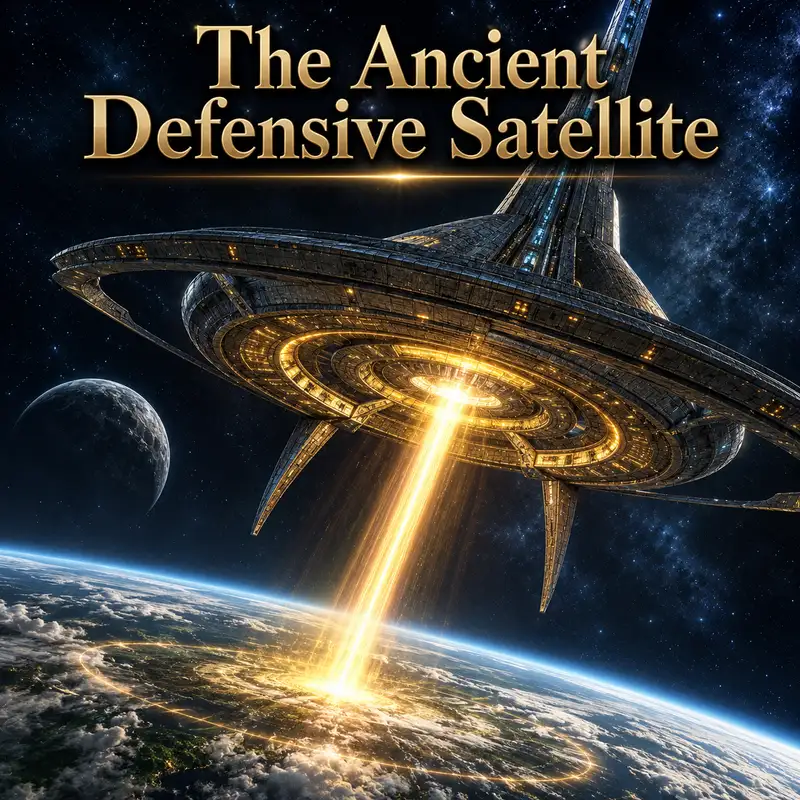
The Ancient Defensive Satellite
Peter Grodin was alone inside a dead Lantean weapons station when three Wraith hive ships dropped out of hyperspace. The satellite had been powerless for ten thousand years. Its docking port no longer worked, its air lock had no pressure, and the repair that restored its weapon had trapped him aboard. A cloaked Puddle Jumper waited at a safe distance while Grodin shifted the system from manual control to automatic fire. If the weapon failed, Atlantis would have no second satellite and Grodin would have no extraction route.
The beam fired once. It crossed the darkness in a straight line, struck the lead hive ship, and cut the enormous vessel apart. Atlantis personnel watching through sensors celebrated because the weapon had done exactly what the Ancient database predicted. Then sparks filled the satellite. The improvised circuit overloaded, the weapon refused to fire again, and the other two hives turned their batteries toward the station. Grodin ordered the Jumper to remain clear. Seconds later, the expedition’s last known Ancient defensive satellite in the Lantean system was gone.
The event created a revealing contradiction. One neglected satellite, powered by an Earth generator and repaired by three expedition members, could destroy a Wraith capital ship almost instantly. It still could not stop the fleet. The reason was not that Ancient technology had been exaggerated. The weapon was as dangerous as expected. The problem was that Atlantis had recovered one broken element of a defensive architecture whose power network, maintenance crews, supporting satellites, warships, and industrial base had disappeared thousands of years earlier.
The expedition believed the station had once been one of dozens positioned around the approaches to Atlantis. That number remained an informed estimate rather than a surviving Lantean inventory, but the strategic logic was clear. A network of orbital weapons could watch likely routes, engage approaching ships before they reached Lantea, and force an enemy to cross several layers of fire. Lantean warships could maneuver against formations damaged or delayed by the satellites, while Atlantis preserved its drones and shield for whatever survived the outer defense.
The surviving record does not establish the exact number of satellites, their full firing range, or whether every platform used the same design. It would be easy to imagine a perfectly synchronized orbital wall, but the evidence supports a more cautious conclusion. The Lanteans deployed multiple defensive satellites, and one surviving station could track an approaching formation and deliver a directed-energy strike. Its demonstrated effect matters more than unsupported specifications. The platform was not powerful because a reference table assigned it impressive numbers. It was powerful because one verified shot destroyed a hive ship.
The surviving station had been positioned near a Lagrange point, a location where the gravitational relationship among major bodies allows a spacecraft to hold a useful position with comparatively modest station keeping. The exact geometry of the Lantean system was not fully explained, but the operational purpose was obvious. The satellite occupied a point the incoming Wraith formation would pass on its route toward Atlantis. It was not chasing the enemy. It was waiting along a predictable avenue of approach.
That geometry made intelligence essential. The satellite was useful only because Teyla Emmagan’s contact with the Wraith revealed that three hives were advancing and because Atlantis sensors projected their route. The ships would pass within firing range in forty-nine hours. The station itself was fifteen hours away by Puddle Jumper. The expedition therefore had a narrow period in which to reach a dead installation, diagnose unfamiliar systems, restore it, and withdraw before the Wraith arrived. There was no time for a second maintenance visit if the first repair failed.
Elizabeth Weir allocated the mission accordingly. Rodney McKay understood Ancient power and weapons systems. Peter Grodin had become one of the expedition’s most reliable control-room and technical specialists. A Jumper pilot provided transport and kept the craft available for recovery. John Sheppard volunteered, but Weir kept him at Atlantis to continue selecting evacuation sites and preparing the base. The decision reflected the wider crisis. The satellite mattered, but so did the Alpha Site, the self-destruct plan, internal security, and the defense of the city if the weapon failed.
The mission also demonstrated the difference between strategic mobility and convenient access. A Stargate could cross interstellar distance in seconds, but no gate delivered the repair team directly into the satellite. The crew spent fifteen hours in a Puddle Jumper, carried all required tools and power with them, and had no larger rescue vessel nearby. Once docked, McKay entered an airless, powerless structure in a space suit. His life-support reserve was finite, and the team had brought no Lantean depot from which to request a replacement crystal.
The satellite appeared completely dead. McKay connected a naquadah generator and restored enough power for life support and diagnostics. This was possible because the weapon did not demand the continuous output of a zero-point module. Atlantis’s major shield and weapons systems had been designed around vastly greater power. The satellite used a lower steady input to build energy over time. That difference allowed one portable Earth generator to awaken a weapon capable of destroying a hive ship.
The internal design worked like a charged battery feeding a single enormous discharge. The naquadah generator sent energy into a buffer, or capacitor, where the charge accumulated. The buffer reached nearly full capacity, proving that the Earth power source was adequate. The failure existed farther along the chain. Energy could reach storage, but not the beam emitter. The repair team therefore faced a distribution problem rather than a generation problem, a distinction that saved the mission and complicated everything that followed.
McKay and Grodin could not simply replace the failed pathway. They did not possess original parts, complete schematics, or a Lantean engineer familiar with the station’s service history. They had an Ancient database, live diagnostics, Earth equipment, and a deadline. Their solution was to reroute energy around the damaged circuit. It was an emergency bypass, not a restoration to factory condition. The satellite could accept power and fire, but the new route had not been built to carry the full discharge repeatedly.
Reaching the necessary connection required McKay to leave the satellite and cross open space from the Jumper to an external panel. The craft moved a short distance away, vented its rear compartment, and disabled artificial gravity. McKay pushed off in a suit and crossed the gap by momentum. The maneuver was modest by the standards of a trained orbital construction crew. For an expedition scientist operating without a dedicated rescue system, it was a reminder that advanced technology often requires very ordinary physical access to the broken part.
The repair succeeded, but its energy routing produced an immediate secondary failure. Power diverted toward the weapon had also been diverted away from the docking station and air lock. The Jumper could no longer dock normally, and Grodin had no suit with which to cross the vacuum manually. McKay offered to return and change the routing. Grodin understood that the Wraith were too close and that another spacewalk could consume the remaining window. Restoring the extraction system might prevent the weapon from firing at all.
Grodin accepted that he would remain aboard. His decision had tactical value beyond accepting personal risk. With a human operator still inside, the satellite could remain powered down until the hives were close enough for an ambush. The Wraith had ignored the station because it had been dead for millennia. Any obvious activation too early might cause them to change course, open fire at long range, or send Darts and cruisers ahead to investigate. Grodin became both operator and deception plan.
The Wraith’s behavior supported that calculation. Their fleet did not initially treat the satellite as an active threat. The station had survived because it was no longer worth destroying, not because the Wraith had forgotten what Ancient orbital weapons could do. The moment it fired, its status changed. Surprise existed for one engagement. After the beam revealed the station’s capability, every surviving ship understood exactly where the danger was and could concentrate on eliminating it.
The station also exposed a basic problem of fixed defenses. A concealed weapon can surprise an approaching force, but firing reveals its position. A network can distribute that risk among several emitters and continue the engagement after one platform is located. The lone satellite had no neighboring station to divide Wraith attention and no mobile escort capable of suppressing return fire. Once the beam identified the source, the remaining hives did not need to understand the repair or duplicate the technology. They only needed to direct enough weapons toward one stationary target.
The weapon’s first shot confirmed the quality of the original design. The beam did not slowly wear down the hive or require a prolonged exchange. It sliced through the vessel and destroyed it. Standard Wraith hives depended on enormous organic hulls, internal redundancy, and the ability to heal damage that was not immediately fatal. The satellite delivered catastrophic energy faster than those advantages could matter. Against a target in range and unaware, the station remained a capital-ship killer after ten thousand years of neglect.
That result does not establish that one pristine satellite could always destroy three hives under every condition. McKay’s estimate came from the Ancient database and assumed the station was fully charged and functioning as designed. The expedition had restored one firing pathway through an improvised bypass. The first discharge proved that the emitter still worked. It did not prove the degraded circuit could handle the second and third shots required by the plan.
The overload appeared immediately. Grodin reported that the rerouted circuit had failed and began searching for another pathway. McKay ordered the Jumper back toward the station, but Grodin stopped him. The Wraith ships were already turning their weapons on the satellite. A cloaked Jumper might avoid detection at a distance. Approaching a target under concentrated fire would place the repair crew inside the blast area and still leave no pressurized route to reach Grodin.
The remaining hives destroyed the station in moments. Whatever protection it may once have possessed, the restored platform could not survive concentrated fire, and the weapon could not fire again before impact. Grodin died with the satellite. McKay returned to Atlantis carrying the result no scientist wants to report. The device had worked, the repair had worked once, the enemy had lost a major warship, and the mission had still failed to accomplish its assigned objective.
At the tactical level, the satellite achieved a clear success. One beam destroyed one hive without exposing an Earth ship or expending Atlantis’s limited drones. At the mission level, it failed because two hives remained. At the operational level, it reduced the first assault formation from three hive ships to two and forced the survivors to slow and reassess. At the strategic level, it did not remove the threat to Atlantis or the route to Earth. The distinction among those levels explains why the celebration lasted only seconds.
The station’s loss returned Weir to the alternatives she had hoped to avoid. Atlantis could not rely on an active city shield, and its drone reserve was inadequate for a full fleet engagement. The expedition had prepared evacuation destinations, a computer virus intended to corrupt the Ancient database, and a self-destruct plan to deny the Wraith the city. The satellite had represented the only option that might destroy the attacking hives before they reached Lantea. Once it failed, survival again depended on evacuation, denial, and reinforcement from a galaxy that had only recently received Atlantis’s warning.
The satellite’s one successful shot still influenced what followed. Two hives were easier to fight than three. The loss demonstrated that Ancient weapons remained dangerous enough to justify caution. The Wraith advance slowed, and Atlantis used the remaining time to prepare. Earth forces later arrived with railguns, nuclear weapons, personnel, and the promise of the Daedalus. None of those later defenses belonged to the satellite, but the station reduced the formation they had to face and improved the odds of a base operating without strategic depth.
Its destruction also clarified what the Lanteans had lost during their own war. A defensive satellite network could impose severe casualties, but static weapons cannot choose every engagement. The Wraith could attack from several routes, concentrate on one section of the network, accept losses, and return with additional ships. Every destroyed satellite created a permanent gap if the Lanteans lacked the time, materials, or secure work crews to replace it. The network became weaker after each battle while the Wraith retained dozens of mobile hives.
Numbers mattered because a satellite defended a position, not a civilization. It could engage ships passing through its field of fire. It could not rescue a culled world, escort a damaged transport, search for a hidden cloning facility, or pursue a Wraith fleet that changed course. Those missions required warships, intelligence, crews, and logistics. Orbital weapons strengthened the defense of Atlantis. They could not substitute for the mobile Lantean fleet whose losses had already isolated the city.
The ancient network also depended on maintenance. Power systems degraded. Control pathways failed. Impacts damaged structure. Ammunition or energy buffers required inspection. Communications had to connect each station to commanders who understood the wider battle. The surviving satellite’s condition showed what happened when those functions disappeared. Its main weapon remained intact, but one failed route between storage and emitter made the entire platform useless until an emergency repair team arrived ten thousand years later.
Redundancy would normally absorb that kind of failure. A functioning network could shift fire to another station, send a repair tender, or replace the damaged component before the next attack. Atlantis had none of those options. The expedition placed its hopes on one platform, one generator, one bypass, one operator, and one firing sequence. The plan was not careless. It was the only plan available. That is often how a last line of defense acquires its title.
The naquadah generator illustrates Earth’s position particularly well. The expedition could supply enough power to charge the satellite because human engineering had already absorbed technology recovered during the Milky Way conflict. Yet Earth had not reproduced the beam weapon, its materials, or its control architecture. A portable power system derived from earlier Stargate discoveries could activate a far older Lantean weapon. It could not turn a relic into a maintainable defense program.
The mission therefore passed through several distinct levels of technological access. Atlantis discovered the satellite in its database and sensors. McKay understood its operating concept. The crew activated life support and charged the buffer. They controlled the weapon long enough to fire it. They could not repair it to original standards, manufacture a replacement circuit, reproduce the station, or field another satellite after its destruction. Possession lasted less than two days. Industrial capability never existed.
The Wraith understood the same difference from the opposite direction. They did not need to match the satellite’s science. They needed to identify the active emitter and destroy the platform before it fired again. Their first hive paid for the intelligence. The next two used it. This was the Wraith way of war in its most efficient form. Advanced technology won the opening exchange. Numerical depth ensured that survivors remained to adapt.
Peter Grodin’s death can disappear inside that strategic explanation if the satellite is treated only as a weapons test. He had been part of the expedition from its arrival, operating consoles, interpreting Ancient systems, and helping turn an abandoned city into a functioning base. On the satellite, his technical judgment became a command decision. He recognized that repairing the air lock would consume the firing window, that his presence could preserve surprise, and that the Jumper crew had to survive even if he did not.
His choice was not made with certainty that the weapon would succeed. The circuit had been improvised, the station had not fired in ten thousand years, and the database estimate assumed a condition the platform no longer possessed. Grodin remained because the probability of success was greater with him aboard than without him. He gave Atlantis the best possible shot, then ordered McKay away when recovery would only add more casualties.
For the expedition, the satellite became an early lesson in the danger of depending on Ancient inheritance. A recovered system might be powerful enough to change a battle and fragile enough to disappear after one use. Its database entry could describe original performance without revealing ten thousand years of corrosion, battle damage, or abandoned maintenance. The fact that the builders once operated dozens did not mean Earth could restore even one safely.
The satellite also changed the meaning of Atlantis’s defenses. The city was not protected by a single miraculous device waiting for the correct command. It had once sat at the center of a layered military system whose outer weapons, fleet, power sources, crews, and supply chain had been destroyed in sequence. The expedition occupied the surviving headquarters after the defense architecture around it had been stripped away. Every recovered component offered capability without depth.
That is why the Ancient defensive satellite mattered long after its wreckage dispersed. It proved that Lantean weapons had not failed because they lacked destructive power. It showed that static firepower without maintenance, redundancy, mobility, and replacement capacity becomes a temporary obstacle rather than a strategy. It also showed what Earth could contribute: portable power, technical improvisation, and personnel willing to operate systems they could not fully restore.
The beam destroyed a hive ship exactly as the Ancient record promised. The station failed because one emergency circuit could not carry the burden once supported by an entire civilization. Atlantis survived the coming siege through additional layers, new allies, and further improvisation, not because the satellite had been enough. Its single shot remains the clearest image of the lost Lantean defense network: overwhelming power crossing the dark, followed almost immediately by silence.