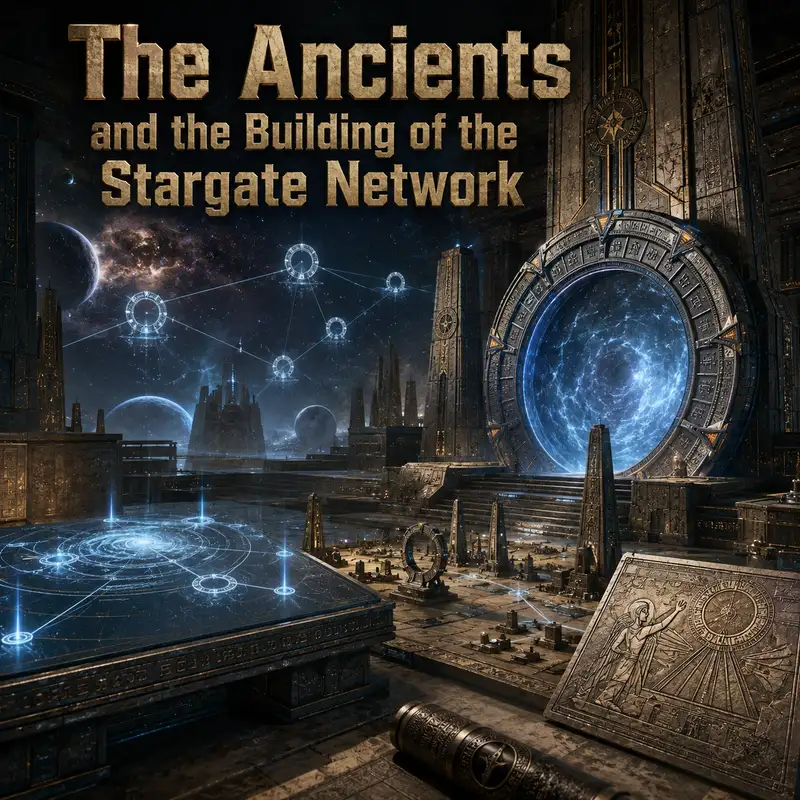
The Ancients and the Building of the Stargate Network
The earliest known Stargate design is not a finished machine. It is a sketch carried by an Alteran named Amelius as his people prepare to leave their home galaxy. The design appears at the moment when the Alterans have rejected the authoritarian path that will produce the Ori and chosen exile instead. That context matters. The Stargate was conceived by refugees who needed distance, access, and a way to rebuild civilization beyond the reach of an enemy. It would become one of the greatest transportation systems ever created. It would also become the road system used by empires, raiders, resistance movements, explorers, and armies whose existence its inventor could not have predicted.
The central military question is not simply how the Ancients made a ring produce a wormhole. It is why they built a network rather than a collection of isolated portals, and what that choice did to the balance of power across several galaxies. A single gate is a remarkable machine. A network is strategic infrastructure. It changes where settlements can survive, how quickly knowledge can move, which planets become valuable, and how an enemy can bypass every frontier that lies between two addresses. The Ancients solved the problem of interstellar distance. They did not solve the older problems of access, security, political authority, or what happens when the road outlives the government that built it.
The builders were originally part of the Alteran civilization. Their break with the Ori was philosophical, political, and eventually existential. The Ori demanded submission to a religious order. The Alterans chose scientific inquiry and departed rather than fight a war they were not prepared to win. After a long migration, they reached the Milky Way and established a civilization so old that later peoples knew them simply as the Ancients. Their achievements included advanced power systems, city-ships, control interfaces, matter manipulation, and research into ascension. Yet the Stargate was different from most of their great devices. It was not valuable because one laboratory possessed it. Its power came from repetition.
At the most basic level, a Stargate creates a stable artificial wormhole between two compatible gates. The traveler does not cross ordinary space. Matter entering the event horizon is converted into an encoded stream, transmitted through the wormhole, and reconstructed at the destination. The system also includes a temporary buffer, error checking, and safety functions that users generally notice only when something goes wrong. Radio and other energy signals can pass in both directions, but physical matter normally travels only from the dialing gate to the receiving gate during that connection. This one-way rule is not a minor technical detail. It determines reinforcement, evacuation, and who controls the initiative at each end.
The mature ring was built around naquadah, a material capable of absorbing, storing, and channeling enormous amounts of energy. The moving symbol track and locking chevrons were not decoration. They formed the physical interface for selecting an address and confirming each part of the connection. When the final chevron locked, the gate attempted to establish the wormhole and produced the unstable opening vortex familiar to later operators. The machine looked simple because most of its complexity was hidden inside the ring. That was one reason less advanced civilizations could use a gate safely without understanding the physics, provided they retained a working dial-home device and did not become too inventive with the safety systems.
The address system turns the sky into a navigable map. In the mature Milky Way network, six symbols identify a destination in space and a seventh establishes the point of origin. The gate does not understand a planet’s name, political allegiance, or current occupant. It understands coordinates. That is efficient engineering and indifferent strategy. A world can be conquered, abandoned, renamed, or repopulated while the address remains useful. Whoever possesses the symbols and a working dialing system can attempt the route. The network therefore preserves access better than it preserves ownership. A government may disappear while its gate address remains operational for thousands of years.
Coordinates create another problem. Stars move. Planets orbit, stellar systems drift, and the galaxy does not hold still simply because an engineer has engraved symbols into a ring. The Ancients solved this with dial-home devices and network updates. A dial-home device provided power, selected the symbols, performed calculations, and enforced safety protocols that a casual user might never realize existed. The devices also helped compensate for stellar drift by exchanging corrections across the network. Earth’s early difficulty with its gate came partly from lacking the original dial-home device and replacing it with a human-built dialing computer. The substitute worked, which was impressive. It also bypassed protections its designers did not yet understand, which was less comforting.
Power was the other limiting factor. A nearby address could be reached with the energy available from a normal dial-home device. A connection across far greater distances demanded much more. Intergalactic dialing required an additional symbol and a power source far beyond ordinary planetary equipment. Atlantis could contact the Milky Way because the city possessed zero-point module technology and a gate designed for that role. Earth reached other galaxies only after acquiring similarly exceptional energy sources or using infrastructure that reduced the distance in stages. A nine-chevron sequence served a still more specialized purpose, locking onto a unique target rather than an ordinary planetary address. The Ancients had not abolished the cost of distance. They had moved much of that cost into the construction of the network and the power required at the moment of connection.
The surviving Ancient record does not establish exactly how every Milky Way gate was manufactured or placed. It does reveal the Ancient solution during an earlier phase of exploration. Long before Atlantis, automated seed ships traveled ahead of the vessel Destiny. Those ships surveyed star systems, identified worlds that might support life, gathered resources, manufactured Stargates, and placed them along the route. Destiny then followed a chain of prepared destinations. This was not a crew landing on each planet with construction equipment. It was industrial reconnaissance conducted by machines across immense distances. The method suggests that the Ancients treated gate building as a repeatable logistical process, not as the creation of a unique monument.
The Destiny-era gates were less capable than the mature networks later encountered in the Milky Way and Pegasus. Their practical range was shorter, their operating system was more limited, and access often depended on the ship’s position along a predetermined route. They formed a corridor of exploration rather than a fully developed galactic web. That distinction matters because the word Stargate can create the false impression that every ring in every era had identical capabilities. Ancient technology changed over time. The early gates prove the concept was already central to their strategy, but they also show that the network was built through generations of engineering rather than appearing fully formed.
The mission behind Destiny reveals the scale of Ancient ambition. The seed ships and Destiny were connected to an effort to investigate a pattern detected in the cosmic background, evidence the Ancients believed might point toward intelligence embedded in the structure of the universe itself. The project required patience measured on a civilizational scale. Gates were deployed not merely to colonize territory, but to provide repeated access to worlds along a journey that might outlast the people who began it. The Ancients later pursued ascension and never boarded Destiny as intended. The machines continued. Their transportation network was durable enough to survive the abandonment of the mission that justified it.
In the Milky Way, the gate system became broader, more mature, and more deeply integrated with settlement. Gates connected worlds that would otherwise have been separated by years of travel or by the absence of any local starship capability. Scientific teams could move between laboratories. Political leaders could visit colonies. Supplies, personnel, and information could pass between planets without maintaining an interstellar fleet for every routine journey. The network reduced the cost of establishing distant communities because a settlement did not need to be completely self-contained. It needed a gate, power, a valid address, and confidence that the destination on the other side was still friendly.
That last requirement was the weakness. The gate itself did not verify political intent. It did not know whether the travelers were diplomats, refugees, infected personnel, Jaffa infantry, or a strike team carrying explosives. Security had to be imposed at the destination. Atlantis eventually used a protective shield over its event horizon. Earth built an iris inside its gate and required incoming teams to transmit authentication codes. Many worlds had neither. For them, an incoming wormhole announced that someone had found the address, not that the arrival had permission. The Ancients built an extraordinarily reliable transportation system without making every endpoint a fortress.
From a military perspective, the network offered strategic mobility but only limited throughput. Troops could bypass space, move without warning, and appear inside a defended star system. Yet the ring’s diameter constrained vehicles and equipment. Only one wormhole could use the gate at a time. A normal connection could not remain open indefinitely and usually ended after a little more than thirty-eight minutes. A team that needed artillery, armored vehicles, extensive medical support, or a sustained flow of supplies still faced a serious logistical problem. The Stargate was closer to a rapid air corridor and a narrow bridge combined than to an unlimited transport system.
The gate also created a chokepoint that could be watched, mined, buried, blocked, moved, or captured. A defending force could establish weapons around the destination. An attacker could wait for the wormhole to close and deny the return route. A buried gate was almost useless until excavated. A damaged dial-home device could strand a team even when the ring itself remained intact. A force controlling the gate did not necessarily control the planet, and a force controlling the planet did not necessarily control orbit. The Ancients had compressed interstellar travel into a room-sized objective. Every later military power learned to fight over that room.
The network’s software was as important as its physical rings. Address tables, safety interlocks, and correlative updates allowed thousands of devices to function as one system. That distributed architecture was resilient because no single central station had to authorize every connection. It was also vulnerable to corrupted information. Much later, a Tau’ri computer program intended to disrupt one enemy’s gate access was modified by Ba’al and spread through the Milky Way network, scrambling dial-home devices across numerous worlds. The incident demonstrated that Ancient infrastructure could be attacked through code as well as explosives. A galactic road system had also become a galactic information system, and both could fail together.
The Ancients eventually faced a catastrophe their transportation network could not solve. A devastating plague spread through the Milky Way. The chronology is ancient and not always precise, but the surviving record is clear that the crisis helped drive the Ancients from the galaxy. Atlantis departed Earth for Pegasus, carrying part of the civilization away from the disease. The Milky Way gates remained behind. At some point in this vast period, Ancient technology centered at Dakara was used to seed or reseed life across the galaxy. The same civilization that built routes between worlds also used a galaxy-spanning device to restore biological possibility after disaster.
Pegasus became the setting for a newer generation of the network. The Lanteans, as the Ancients in Atlantis came to be known, placed gates on planets and in space. Pegasus gates used a more advanced visual interface and could support orbital locations where no convenient planetary surface existed. Space gates expanded the system beyond settlements. They became navigation points, access nodes, and tactical objectives in open space. Puddle Jumpers could dial them directly, allowing small craft to move between worlds without a conventional hyperdrive. The result was a network designed not only for people walking between planets, but for vehicles operating as part of an integrated transportation system.
Pegasus gates could also assert technical priority over older designs when the two operated in the same local area. This was not a political claim. It was a consequence of newer network architecture. The distinction reveals that the Ancients continued refining the system rather than treating the first successful design as final. Faster dialing, improved interfaces, space deployment, and integration with Ancient craft made the Pegasus network more flexible. The underlying strategic principle remained unchanged. Access was open to anyone who possessed a valid address, sufficient power, and compatible equipment. The technology favored knowledge and position, not virtue.
Atlantis functioned as a network hub, command center, and fortified gateway between galaxies. With sufficient power, its gate could reach Earth. Without that power, the same city could be isolated despite possessing the correct address and one of the most advanced gates ever built. Zero-point modules therefore became strategic assets rather than merely impressive batteries. A city might have a functioning gate, a complete database, and trained personnel, yet remain unable to establish the one connection that mattered. The Ancients had made the network dependable. They had not made extreme-range travel cheap.
The war with the Wraith exposed the limit of gate-centered power. Lantean forces possessed better technology, but the Wraith had numbers, biological resilience, industrial depth, and the ability to attack worlds from space. A Stargate could evacuate personnel or move a small force, but it could not shield a population from a hive ship. It could not replace lost warships, defend every settlement, or guarantee that the destination was not already under enemy observation. The network helped the Lanteans maneuver. It did not correct their strategic overconfidence or their failure to destroy the Wraith’s capacity to continue the war.
As Lantean territory contracted, the gates became routes through a battlefield rather than proof of political control. Human communities in Pegasus could remain connected while the civilization that built the system lost the war around them. Atlantis was eventually submerged, protected, and abandoned. The surviving Lanteans returned to Earth through the gate. Many later ascended. Their network remained operational without them. This may be the most important fact in the history of the Stargates. The machinery did not require the continued existence of the state that created it. It became inherited terrain.
In the Milky Way, the Goa’uld turned that inherited terrain into the skeleton of an empire. They did not create the Stargates, but they learned to use them, moved human populations among planets, deployed Jaffa forces, extracted resources, and maintained political control across vast distances. Their ships handled heavy transport, orbital attack, and the movement of large formations. The gates supported administration, raids, punishment, and reinforcement. Ancient infrastructure lowered the cost of imperial reach for rulers who claimed to be gods. The builders had rejected the Ori’s demand for worship, yet their greatest transportation system helped later false gods hold entire populations in submission.
The Goa’uld also moved gates when it served them. A ring could be taken from one world, installed on another, placed aboard a ship, or used to redirect access toward a location of military or economic value. The original network map therefore changed over time. Some gates disappeared beneath ruins or oceans. Others became ceremonial centers, guarded bases, mining routes, or forgotten relics. The network was stable enough to preserve ancient addresses, but physical control of the hardware still mattered. Geography had been compressed, not erased. The nearest gate remained the port, border crossing, and invasion route all at once.
When Earth entered the network, it inherited both the Ancient achievement and its unresolved security problem. Stargate Command added reconnaissance probes, radio procedures, authentication codes, quarantine rules, armed gate-room security, and the iris. None of those systems changed how the wormhole worked. They changed whether Earth could survive using it. The Tau’ri did not initially understand the gate well enough to manufacture a replacement or repair every failure. They built doctrine around a device they could operate but not fully reproduce. That is a familiar military condition: strategic dependence on infrastructure inherited from someone else, with no reliable source of spare parts.
Earth later extended the network in ways the Ancients had not left as standard practice. A chain of gates placed between the Milky Way and Pegasus formed an intergalactic bridge, breaking an impossible journey into manageable segments. The system was ingenious and vulnerable. It required many gates, careful control, and intermediate infrastructure. When the bridge failed or was compromised, the convenience disappeared immediately. The project demonstrated that Ancient technology could be recombined creatively, but not effortlessly. A successful experiment still had to become a guarded, maintained, and politically controlled line of communication.
The Ancients’ greatest engineering success was therefore also an act of strategic surrender. By making the gates durable, decentralized, and widely compatible, they ensured the network would continue serving life long after their own civilization changed, retreated, or ascended. They also surrendered control over who would use it. The Goa’uld used it for empire. The Jaffa used it for rebellion. The Tok’ra used it for clandestine movement. The Wraith and the peoples of Pegasus used it within a very different regional system. Earth used it to transform a secret reconnaissance program into an interstellar power.
The network did not make the Ancients weak. It revealed the difference between technical mastery and political control. They could connect worlds, update coordinates across galactic distances, automate construction, and preserve machinery for millions of years. They could not guarantee wise governments, secure endpoints, stable alliances, adequate power, or competent strategy. The gate could deliver a traveler to the correct planet with extraordinary precision. It could not determine whether that traveler should have been sent, whether anyone would be waiting, or whether the world on the other side still belonged to the people listed in the old records.
That is why the Stargate network mattered more than any single Ancient ship or weapon. Ships can be destroyed, cities abandoned, and power sources exhausted. Infrastructure changes the choices available to every civilization that follows. The Ancients built a system that turned planets into neighboring positions on a strategic map. They solved distance so thoroughly that later powers could concentrate on fighting over access. Their creators vanished from ordinary history, but the gates continued to open, each connection carrying the same unresolved bargain: almost limitless movement through one narrow doorway, and no promise at all about who controls the far side.