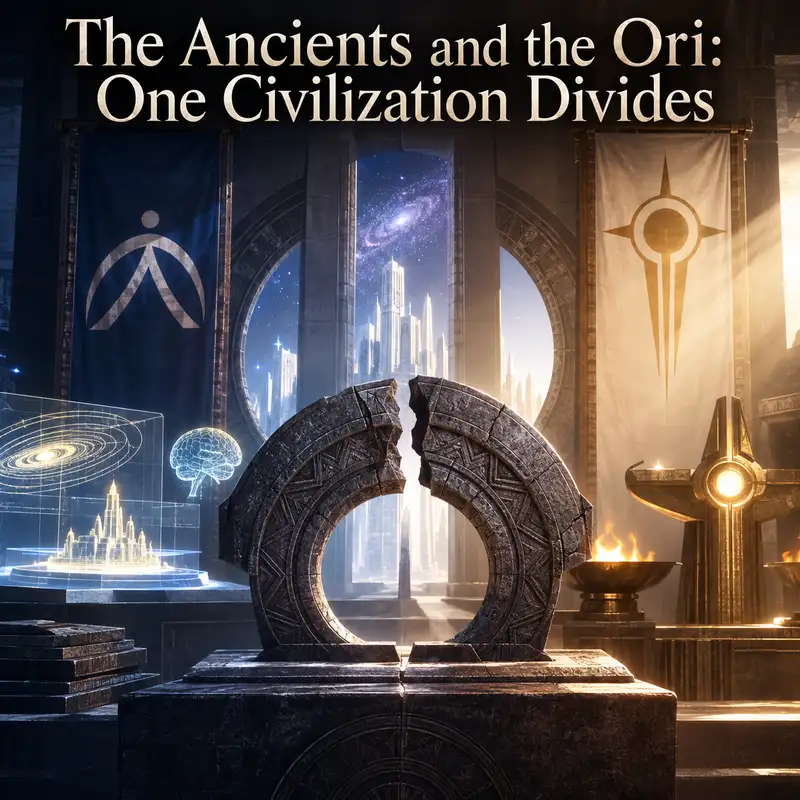
The Ancients and the Ori: One Civilization Divides
Amelius had a device that might have ended the crisis before the first refugee ship launched. The Ark could make anyone who saw it accept a programmed truth. Outside his hidden laboratory, Ori armies were preparing to erase the Alterans. Inside, the last debate was not about whether the weapon would work. It was about whether survival justified taking possession of another person’s mind. The Alterans refused to use it. Amelius closed the Ark, collected a notebook containing the design of a very different machine, and joined the evacuation. One civilization had already become two, and the decision not to compel belief would shape wars millions of years later.
The people in that room were not yet the distant, nearly mythical Ancients known to Earth. They were Alterans, members of a human civilization in a galaxy far from the Milky Way. The surviving record does not provide a complete political history of their society, a precise date for the schism, or a reliable census of either side. It does establish the essential point. The Alterans and the people who became the Ori came from one society, shared an evolutionary path toward ascension, and divided over incompatible ideas about knowledge, authority, and free will.
The usual shorthand describes the dispute as science against religion. That is accurate as far as it goes, but it does not go far enough. The Alterans trusted systematic observation, experimentation, argument, and debate. The Ori faction became increasingly fervent in religious belief. The deeper disagreement concerned who had the right to define truth. For the Alterans, truth had to remain open to examination, and belief had value only when freely chosen. For the Ori, revealed truth carried authority, and opposition was not merely error. It was defiance against the proper order of existence.
That distinction turned philosophy into a security problem. A society can tolerate disagreement while all parties accept debate as legitimate. It becomes much harder when one side believes dissent is evidence of corruption and the other believes enforced agreement destroys the very purpose of knowledge. The Ori did not simply establish a separate school or religious community. Their forces moved against the Alterans, who were badly outnumbered. By the time Amelius presented the Ark, the dispute had passed beyond academic argument. The Alterans faced organized destruction by people who had once been their neighbors.
The Ark exposed the Alterans’ central contradiction. It could have ended resistance by forcing acceptance of a proposition, apparently including the proposition that the Ori were not divine. Militarily, that offered an asymmetric answer to an enemy with superior numbers. Politically, it offered victory without a prolonged war. Morally, it reproduced the Ori method in a more elegant form. The Alterans would preserve freedom by abolishing the freedom to disagree. Their council rejected that bargain, even with extinction approaching. It was a principled decision. It was also a decision whose costs would be paid by generations that never participated in the debate.
Instead of fighting a civil war they might not survive, the Alterans chose strategic withdrawal. They built a vessel, abandoned their home galaxy, and crossed the immense distance to the Milky Way. This was not an orderly transfer between established colonies. It was the evacuation of a threatened intellectual and cultural minority carrying what knowledge, personnel, and technology it could preserve. The Ori kept the original homeland. The Alterans kept continuity. In military terms, they traded territory for survival and exchanged immediate defeat for the possibility of rebuilding beyond the enemy’s reach.
The evacuation solved the immediate survival problem but left the conflict politically unresolved. There was no negotiated separation, no mutual recognition, and no deterrent strong enough to make renewed aggression unprofitable. The Ori retained the homeland, the larger population, and the ability to define the public memory of the schism. The Alterans carried their own records into exile, but abandoned communities could be destroyed and inconvenient history rewritten. Withdrawal preserved lives and principles. It also surrendered the information environment to the faction that had already decided disagreement was evil.
Amelius left with a notebook showing what appears to be an early design for the Stargate. That detail matters because it connects the ethics of the schism to the technology that defined the Alterans’ future. The Ark could impose one answer on every mind that saw it. The Stargate would connect different worlds without requiring them to become the same. One device centralized truth. The other decentralized movement. The Alterans buried the first and developed the second. Their civilization’s most enduring achievement was therefore not a weapon, but an infrastructure for contact, exploration, migration, trade, and, inevitably, invasion.
In the Milky Way, the refugees called their new home Avalon and built the devices they knew as Astria Porta, the Stargates. Dakara became associated with their first arrival in the galaxy. Over time, the Alterans became the people later civilizations called the Ancients. They spread a gate network across the Milky Way and established a technological civilization whose remains would shape nearly every major power that followed. The Goa’uld exploited abandoned systems. Earth eventually learned to use them. Neither inherited the industrial base or scientific maturity of the builders, which explains why possession of Ancient machinery so often produced confidence before comprehension.
The branch that fled did not remain historically simple. A devastating plague struck the Ancient population in the Milky Way and helped drive the survivors toward different paths. Some reached ascension, while others departed for the Pegasus galaxy and became the Lanteans associated with Atlantis. After their long war with the Wraith, surviving Lanteans returned to Earth, and more eventually ascended. These events created different communities, experiences, and opinions among the Ancients. They were never a single mind. What held them together most consistently was not a government but a broad commitment to knowledge and, after ascension, a severe rule against interfering in the affairs of lower forms of life.
The Ori followed a parallel evolutionary road and also ascended. That fact is important because it removes the comforting idea that moral progress automatically accompanies scientific or biological advancement. Both branches reached a higher plane of existence. Both gained extraordinary knowledge and power. They did not become ethically identical. Ascension magnified the original disagreement because it gave each side the capacity to influence entire civilizations. The Alterans’ descendants feared that intervention would turn ascended beings into rulers. The Ori embraced precisely that role and constructed a system in which worship was both political obedience and a source of power.
The religion of Origin promised guidance toward enlightenment and eventual ascension. Its books, rituals, teachers, and moral language gave ordinary followers a complete framework for life. Much of that belief was sincere. The farmers, soldiers, families, and local officials of the Ori galaxy were not all participants in a conscious fraud. Most had been raised inside a civilization where the Ori’s power was visible, Priors performed acts that appeared miraculous, and contrary evidence was suppressed. The system did not need every believer to be cynical. It worked better when almost none of them were.
The central promise, however, was false. The Ori did not intend to help their human followers ascend and join them. Instead, worship produced a real transfer of energy that strengthened the ascended Ori when vast numbers of people surrendered their will. The exact physics were never reduced to a laboratory formula, but the strategic meaning was clear. Believers were not merely subjects. They were a resource. The Ori’s empire rested on a political economy of devotion, with faith collected at population scale and converted into power on the ascended plane.
That arrangement explains why the Ori could not comfortably tolerate pluralism. A conventional empire can sometimes permit local customs as long as taxes arrive and rebellion remains manageable. The Ori required inward submission. A village that paid tribute but rejected Origin still represented lost power and dangerous evidence that another way of life was possible. Heresy therefore became both a theological offense and a strategic threat. Conversion increased the Ori’s strength. Public refusal weakened the credibility of the entire system. Destruction of unbelievers was not an occasional excess. It followed logically from an order that treated belief as military capital.
The Priors made that system operational. They were human followers transformed through advanced knowledge and biology, then sent as missionaries, governors, intelligence collectors, and instruments of coercion. Their abilities allowed them to heal disease, manipulate matter, demonstrate knowledge beyond local science, and inflict plagues or other punishments. To a population with no understanding of ascension or Ancient technology, the distinction between a miracle and a deliberately engineered capability was not easy to establish. The Ori did not merely preach. They controlled the evidence available to the people being asked to believe.
Above the Priors stood the Doci, who served as the principal human voice of the Ori. Below them were local authorities, soldiers, and communities organized around the Book of Origin. This was not only a church and not only a state. It was an integrated command system. Doctrine defined loyalty. Priors transmitted policy. Military forces enforced compliance. Advanced warships carried the system beyond its original galaxy. A believer could experience Origin as faith, law, education, medicine, and government without seeing where one function ended and another began. That institutional depth made the Ori far more dangerous than a small group of ascended tyrants acting alone.
The Ancients responded to the same temptation by moving toward the opposite extreme. Their rule of noninterference prohibited ascended beings from using superior power to direct the lives of those below. The logic was sound. Once an ascended being begins choosing which societies deserve rescue, punishment, technology, or political guidance, there is no obvious stopping point. Protection can become dependency. Teaching can become command. Admiration can become worship. The Ori demonstrated the end state. The Ancients concluded that the safest restraint was a broad prohibition backed by collective enforcement.
They did make one major exception. The ascended Ancients concealed the existence of human life in the Milky Way from the Ori and prevented their rivals from simply acting here through ascended power. That protection delayed discovery and probably prevented an earlier campaign of conversion. It did not extend to every action taken by humans on the lower plane. If a Prior entered through a Stargate, if a population accepted Origin, or if an Ori army crossed in ships, the Ancients treated those events as choices and conflicts among corporeal beings. The distinction was philosophically consistent. To the people facing a Prior’s plague, it was also painfully abstract.
This became the strategic seam the Ori exploited. Direct ascended intervention risked opposition from the Ancients. Human agents, engineered missionaries, warships, and armies could operate below that threshold. The result resembled a proxy conflict governed by rules understood by the most powerful participants and suffered by everyone else. The Ancients blocked one category of attack while permitting another. The Ori designed their campaign around the gap. A policy can be internally coherent and still leave the evacuation, medical response, and casualty reports to someone else.
The Milky Way remained hidden until Daniel Jackson and Vala Mal Doran activated an Ancient communication device and found their consciousnesses connected to two people in the Ori galaxy. The experiment had been authorized as an attempt to contact possible descendants of the Alterans, but its full range and political consequences were not understood. Instead of opening a diplomatic channel to a friendly advanced civilization, it exposed the existence of the Milky Way to a hostile ascended power. That description covers a surprising portion of Stargate Command’s institutional history, although usually the resulting enemy did not draw strength from worship.
Daniel’s attempt to question Origin gave the Ori something they had lacked: confirmation that human civilization existed in the galaxy their ancient opponents had occupied. The Ori interpreted concealment as another crime committed by the Ancients and the Milky Way as a vast population denied their truth. From their perspective, conversion was both a sacred duty and preparation for the final destruction of the Ancients. From a military perspective, the discovery opened a new theater containing vast populations of potential worshippers, established gate infrastructure, divided political powers, and no unified defense.
The first Ori offensive used Priors because Priors could move through existing Stargates and begin conversion before a fleet arrived. They offered cures, demonstrations of power, and apparent certainty. When persuasion failed, they used disease, environmental destruction, political subversion, and the threat of annihilation. Their approach targeted legitimacy before territory. A world that accepted Origin could be controlled without occupation forces. A world that resisted became an example. The strategy reduced the need for enormous garrisons, but it depended on fear, information control, and the willingness to destroy populations that could not be converted.
The later construction of a supergate and the arrival of Ori warships transformed the campaign into an interstellar invasion. These vessels outclassed much of the Milky Way’s conventional fleet, but their purpose was not simple conquest. They carried a religious command structure, troops, Priors, and the means to extend Origin from planet to planet. Space superiority protected the missionaries and punished resistance. Ground conversion supplied political control. The campaign joined theology to combined operations. The ship, the sermon, and the plague were parts of the same weapons system.
The Ancients still refused general intervention. Their position was not unanimous, and that matters. Orlin surrendered ascended existence to warn Earth and help counter a Prior plague. Merlin, known among the Ancients as Moros, concluded that the Ori threatened both lower life and the ascended Ancients themselves. He returned to human form and worked on a weapon capable of destroying ascended beings. Morgan le Fay opposed the Ori as well, though Ancient enforcement limited how openly she could assist. These dissenters show that noninterference was a rule maintained by power, not an instinct shared without question.
Merlin’s weapon, the Sangraal, represented a different answer from the Ark. The Ark attacked belief. The Sangraal targeted ascended beings within its range while leaving ordinary humans alive. It was designed to remove the exploiters rather than rewrite the minds of the exploited. Daniel, temporarily carrying Merlin’s knowledge, completed the device, and it was sent through the Ori supergate to their home galaxy. The available evidence indicates that it destroyed the ascended Ori. Yet armies, Priors, institutions, and believers remained. Killing the leadership did not automatically transmit the news through a system built to prevent independent verification.
Adria, the Orici created to lead the crusade in human form, later ascended and continued the threat. Her existence showed how effectively the Ori adapted to the Ancients’ restrictions. If ascended beings could not intervene directly, they could create a human commander carrying their knowledge and purpose. When that commander ascended, the old conflict returned in a concentrated form. The death of the Ori collective had removed the original rulers, but it had not resolved the underlying relationship among power, worship, and coercion.
The final answer returned to the device the Alterans had refused to use before their exile. The Ark of Truth was recovered in the Ori galaxy and activated in the presence of the Doci. It established that the Ori were not gods and carried that conclusion through the linked Prior hierarchy. The crusade lost its theological foundation almost at once. Ori warships stopped attacking. Priors confronted evidence their system had been designed to exclude. Morgan le Fay engaged the ascended Adria and removed her from the immediate struggle. The war ended not because every Ori soldier was defeated, but because the command structure’s claim to sacred legitimacy collapsed.
Using the Ark did not erase its ethical danger. It compelled belief through technology, even when the proposition it conveyed was true. The original Alterans had rejected that power because they feared becoming indistinguishable from the Ori. Millions of years later, their descendants and allies used it because conventional war could not efficiently liberate populations whose entire information environment was controlled. The choice may have prevented enormous bloodshed. It also confirmed that the Alterans had identified a real moral hazard. A machine capable of forcing acceptance remains dangerous after it has delivered the correct answer once.
The Ancients and the Ori were therefore not simple opposites. Both emerged from the same advanced society. Both pursued ascension. Both possessed knowledge that made them appear divine to less developed humans. Their division came from what they believed power permitted. The Ori treated superior knowledge as authority to rule, convert, and destroy. The Ancients treated the danger of such rule as justification for withdrawal and strict restraint. One side denied free will in the name of enlightenment. The other protected free will so absolutely that it often refused aid while coercion spread through human agents.
Each doctrine created its own strategic weakness. The Ori’s dependence on worship made every unbeliever a threat and drove an empire that had to keep expanding, policing thought, and destroying contradictory evidence. The Ancients’ refusal to intervene preserved a boundary against tyranny but transferred the burden of resistance to civilizations with fewer ships, less knowledge, and no seat in the original debate. The Ori could not stop commanding. The Ancients could barely permit themselves to act. Between those extremes, ordinary people endured plagues, crusades, occupation, and wars whose first cause lay millions of years in the past.
The most revealing image remains Amelius leaving the buried laboratory. He carried the design that would become the Stargate and left behind the Ark that could force a civilization to accept one truth. The gate allowed peoples to meet without guaranteeing peace, wisdom, or equality. The Ark promised certainty at the cost of choice. The Alterans chose the open road and fled rather than become what they opposed. That decision preserved their civilization, but it did not end the conflict. It merely moved the battlefield across galaxies and postponed the day when someone else would have to open the Ark.