The Antarctic Outpost and Earth’s Ancient Weapons
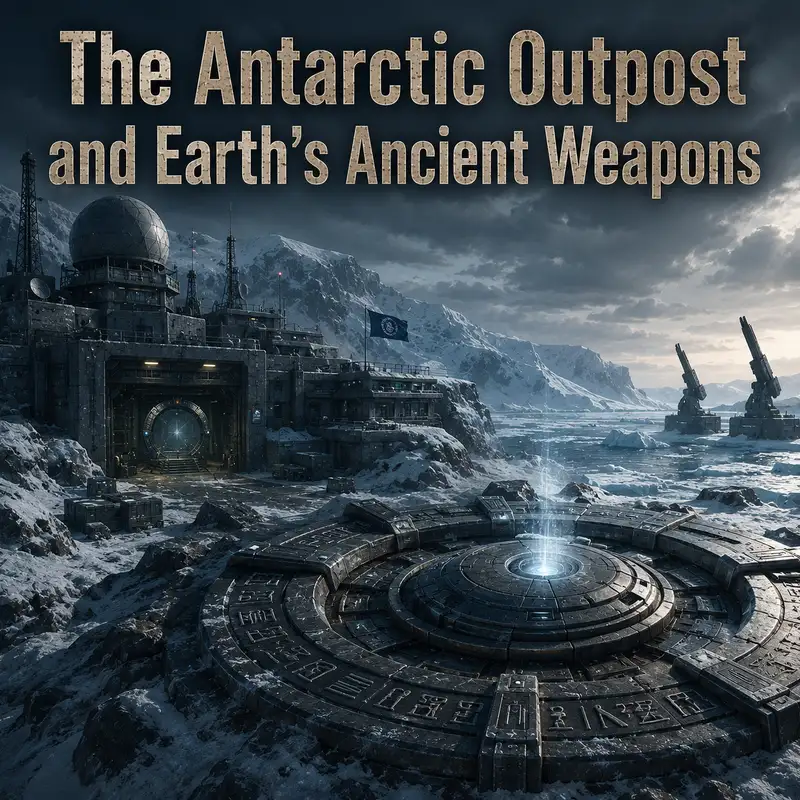
The first Ancient drone cleared the Antarctic ice while Anubis’s fleet was still preparing to finish the battle. It did not climb like a missile or wait for guidance from a radar operator. Hundreds more followed, driven by the intent of one man seated in a chair beneath the glacier. They passed Earth’s fighters, struck Goa’uld vessels in orbit, cut through shields and hulls, and destroyed Kull warriors inside the outpost. In less time than Earth’s commanders needed to explain the weapon, the invasion fleet was gone.
The victory created a dangerous misunderstanding. Earth now appeared to possess an Ancient planetary defense system capable of annihilating a major Goa’uld armada. In reality, the system had been activated by a dying officer carrying knowledge his brain could not survive, powered by a module recovered from another ruined world, and supplied with weapons Earth could neither manufacture nor replace. The Antarctic outpost was the strongest military asset on the planet. For most of its service life, it was also an asset Earth could not reliably use.
Antarctica had already provided evidence that the Ancients once operated on Earth. The second Stargate discovered beneath the ice predated the surrounding glacier, and research at the White Rock station later uncovered Ayiana, an Ancient woman preserved in the frozen landscape. Those discoveries established that the continent was not simply an empty wilderness. It contained remnants from an era when the gate builders still lived in physical form and maintained installations on the planet.
The outpost itself remained hidden until Earth began searching for the Lost City of the Ancients. Anubis was preparing a direct attack, and Stargate Command believed Ancient knowledge might provide the only defense capable of stopping him. On P three X four thirty-nine, Jack O’Neill allowed a repository to download its contents into his mind. He had survived the same process once before, but survival was temporary. The information would eventually overwhelm his brain. Earth had gained access to an Ancient database by turning one officer into a biological storage device with a rapidly approaching expiration date.
Fragments of language and behavior led S G One to Praclarush Taonas, a world whose surface had been consumed by volcanic activity. Beneath the hardened lava, the team found a surviving Ancient outpost containing a control chair and a zero-point module. When O’Neill activated the chair, a holographic display directed them back to Earth and to a location beneath the Antarctic ice. Taonas was not the lost city. It was the key, the power source, and the demonstration model for the weapon Earth was about to find at home.
Getting there remained a military operation. Anubis’s fleet had entered the Solar System, attacked naval forces, disrupted communications, and begun testing Earth’s defenses. O’Neill modified the captured Tel’tak’s hyperdrive and ring transporter while losing the ability to communicate normally. The rings could not penetrate the full depth of the ice, so the ship had to open a route toward the chamber. Prometheus and its F three-oh-two squadrons fought above Antarctica to keep Goa’uld aircraft away from S G One long enough for the team to reach the installation.
The chamber beneath the glacier was not Atlantis. It was a compact Ancient outpost containing a control chair, a storage and deployment system for drone weapons, and a stasis chamber. Later research showed that it also preserved information pointing toward the real city in the Pegasus galaxy. Its exact original mission is never recorded in a surviving Ancient order. The evidence strongly supports a defensive and support role. It protected the region, held strategic weapons, and provided facilities for personnel who understood how to operate them.
The chair was not a conventional firing station. It was a neural interface. Ancient systems sensed the operator’s intentions and translated thought into control inputs. The user normally required the Ancient Technology Activation gene, a genetic marker retained by a small portion of Earth’s population. O’Neill possessed that compatibility, but the gene alone did not explain his performance. The repository had supplied knowledge of the system, the language, and the mental discipline necessary to use it under combat conditions.
That distinction mattered because access was not mastery. A gene-compatible operator could cause the chair to respond without understanding every system connected to it. The interface reduced the distance between thought and action, which made it extraordinarily fast and potentially unforgiving. Human weapons doctrine usually inserts switches, procedures, and confirmation steps between intention and launch. The Ancient chair assumed the person sitting in it already knew what the equipment would do. The Ancients had designed an elegant command system. They had not designed it for nervous researchers learning by trial and error.
The drone weapons were equally unlike Earth’s missiles. Each appeared to be a small physical projectile surrounded by intense energy. Once launched, drones could change direction, pursue moving targets, penetrate advanced defenses, and attack targets in the atmosphere, in orbit, or inside the outpost. Their guidance responded to the operator’s mind rather than to a separate human radar network. During the battle, the swarm distinguished Prometheus and the F three-oh-twos from Goa’uld vessels despite the confusion of close combat.
That discrimination was strategically important. A weapon that powerful would have been difficult to use near friendly forces if it depended on blast radius alone. The drones instead struck individual fighters, Al’kesh bombers, Ha’tak motherships, Anubis’s flagship, and Kull warriors moving through the installation. The system provided both precision and mass. One operator could direct a swarm against targets spread from the chamber floor to Earth orbit without assigning each weapon through a visible console.
The result was not simply a larger explosion. It was the sudden collapse of Anubis’s entire operation. Prometheus and the fighters had been buying time, not winning control of space. Their conventional and alien-derived weapons could damage the attackers, but they could not defeat the fleet before Earth’s defenses failed. The drones changed the tactical balance in seconds. A force that had approached the planet expecting surrender was destroyed by a weapons system Anubis knew existed in principle but did not expect Earth to activate.
The engagement also demonstrated what the outpost could not do by itself. S G One had to locate the site, recover a compatible power source, reach Antarctica, fight through Kull warriors, and place the correct operator in the chair. Prometheus and the fighter squadrons had to protect the approach. President Hayes and Elizabeth Weir had to authorize the mission despite political pressure and incomplete information. The weapon was decisive only after intelligence, special operations, air and space power, political authority, and Ancient knowledge converged at one location.
Power was the first major limitation. The zero-point module recovered from Taonas drew energy from an artificially created region of subspace and supplied output far beyond normal Earth generators. The outpost had a depleted module when S G One arrived. Without a replacement, the chair and drone system could not perform at the required level. The Taonas module powered the defense of Earth, then was itself depleted. Earth had fired the weapon, but it had not acquired the means to recharge or manufacture the battery.
This turned the victory into a form of accidental deterrence. The System Lords knew that Earth had destroyed Anubis with Ancient weapons. They did not initially know that the power source had been exhausted or that O’Neill was in stasis. When Goa’uld representatives later asked Earth to use the weapon against Ba’al, Weir concealed the weakness and allowed them to believe the system remained available. The bluff bought strategic space. For a time, uncertainty about the outpost was almost as useful as the outpost itself.
Deterrence based on secrecy has limits. It works only while the enemy believes the hidden capability exists and while friendly leaders resist the temptation to promise more than they can deliver. Earth could not openly test the system, fire warning shots, or demonstrate readiness without expending irreplaceable drones and revealing the condition of the power source. The outpost was therefore a silent threat whose credibility depended on the memory of one overwhelming battle.
O’Neill’s condition revealed the human cost behind that memory. After directing the drones, he was no longer able to remain conscious safely. The team placed him in the outpost’s stasis chamber, another Ancient system they could activate without fully understanding. The chamber preserved him until the Asgard could remove the Ancient knowledge and revive him. Earth’s greatest victory had depended on an operator who nearly died from the information required to use the weapon and then trusted a second unknown device to keep him alive.
Research began almost immediately. Weir was assigned to supervise the Antarctic site while scientists cataloged its systems and investigated the path to Atlantis. The appointment reflected the installation’s political sensitivity. Antarctica was governed through international agreements intended to preserve scientific cooperation and prohibit military bases and weapons testing. A hidden Ancient arsenal under the ice did not fit comfortably within those rules, especially when the United States military had just used it to destroy a fleet in orbit.
Control of the outpost could not be treated as a routine American property decision. Multiple governments had already been briefed on the Stargate Program, and the site stood in a region subject to shared international interests. Weir’s diplomatic experience was as important as the physicists studying the chair. The outpost had become a weapons facility, an archaeological discovery, a scientific laboratory, and an international legal problem at the same time. Classified programs are often easier to manage before the lawyers learn that the classified object occupies internationally regulated territory.
The research produced a strategic discovery greater than any device removed from the chamber. Information recovered at the outpost identified Atlantis in the Pegasus galaxy and enabled the international expedition that followed. The installation therefore changed Earth’s military position in two ways. Its drones saved the planet in the immediate crisis. Its records opened access to an Ancient city whose technology, database, and regional conflicts would shape Earth’s security for years.
The danger of the chair became clear before the Atlantis expedition even departed. Doctor Carson Beckett possessed the Ancient gene but was reluctant to use the interface. When he sat in the chair during testing, he accidentally activated a drone. The weapon broke out of the outpost and pursued the helicopter carrying O’Neill and Major John Sheppard across the Antarctic landscape. Beckett managed to shut it down before it struck. The incident was brief, nearly fatal, and extremely informative.
Beckett had not intended to attack a friendly aircraft. His fear, concentration, and incomplete understanding had still produced a launch and target selection. Sheppard’s flying kept the helicopter alive while the research team tried to regain control. The event proved that the Ancient gene functioned as an access credential, not a qualification certificate. A person could be biologically authorized and operationally unprepared, a distinction familiar to every military organization that has ever discovered a cleared individual can still press the wrong control.
Earth responded by studying the gene and developing a therapy that could grant compatibility to some people who lacked it naturally. That work expanded the possible pool of operators for Ancient technology, including Puddle Jumpers and control chairs. It did not transfer Ancient education, tactical judgment, or engineering knowledge. Gene therapy solved the problem of getting the system to recognize a user. It did not solve the larger problem of teaching the user what the system expected.
The same limitation applied to maintenance. Earth could power portions of the outpost, inspect the chair, and observe drones in storage. It could not manufacture a replacement chair, build new zero-point modules, or establish a dependable production line for drone weapons. Even repair was constrained by the absence of Ancient industrial tools and technical documentation. The installation was inherited infrastructure. Its components had survived millions of years, which was fortunate because the original warranty department had become unavailable.
Ammunition was another strategic concern. The outpost contained a large cache of drones, but the surviving record never establishes the exact number remaining after the Battle of Antarctica. What mattered was that the supply was finite. Every launch reduced an inventory Earth could not replenish. Commanders therefore faced the same problem as a force holding a limited stock of uniquely effective munitions. The drones were too valuable to waste on routine targets and too important to leave unused during an existential attack.
Power, operator access, and ammunition formed three separate requirements. Possessing any two was insufficient. A charged zero-point module without a compatible chair user did not create a defense. A trained operator without power could not launch the arsenal. A functioning chair and power source without drones produced an impressive command interface connected to an empty magazine. Earth repeatedly encountered Ancient systems in which the missing component was not the most visible one.
The defense of Atlantis made that problem clear on a larger scale. The city possessed its own chair and drone launch system, but lacked enough power and had a limited weapons inventory while Wraith forces approached. Antarctica’s earlier success was not a template the expedition could simply repeat. A zero-point module carried aboard the Daedalus became essential to restoring the city’s shield. Ancient technology remained decisive, but only when the correct power source reached the correct installation before the enemy did.
During the Ori war, the Antarctic system remained a strategic reserve rather than a continuously available shield. Officials considered whether a zero-point module supporting Atlantis should be returned to Earth to power the chair. The debate exposed the cost of scarcity. Strengthening one Ancient installation meant weakening another. Earth could defend the homeworld more effectively, or preserve the city that provided intelligence and influence in Pegasus. It could not assume enough modules existed for every priority.
Earth’s expanding fleet reduced dependence on the outpost but never made it irrelevant. B C three-oh-four battlecruisers, F three-oh-twos, Asgard transport systems, advanced shields, and later Asgard beam weapons created a layered defense. Ships could intercept threats before they reached orbit and could respond to crises far from Earth. The Antarctic weapon remained the last line against an enemy too powerful for the fleet. It was not a patrol system or a substitute for intelligence. It was a fixed strategic battery waiting for the conditions that made it usable.
Its political location eventually became impossible to ignore. By the time a Wraith super-hive approached Earth, the control chair had been relocated from Antarctica to Area Fifty-One because the weapons platform conflicted with international restrictions governing the continent. The move addressed the legal problem by placing the command system at a secure American test facility. It did not change the operational fact that the entire defense still depended on one fixed control node, and a fixed node can be located and targeted.
The Wraith did not repeat Anubis’s mistake. The super-hive had obtained Earth’s location and possessed enough intelligence to understand that the Ancient control chair was the principal threat to its approach. Before the main ship committed to the attack, it launched a large force of darts against Area Fifty-One. Sheppard led F three-oh-twos in an interception, but enough darts broke through to destroy the chair before the drones could be used.
The loss was operationally devastating. Earth had a zero-point module, a remaining drone capability, and experienced gene-compatible personnel, yet the destruction of the control node removed the system from the battle. The precise fate of every supporting component and the surviving power module was not fully established. What was clear was that the Ancient defense could no longer be activated in time. One of the most powerful weapons ever used by Earth was defeated by a preemptive strike against the interface that made it usable.
Earth survived through other layers. Sheppard prepared a nuclear-armed F three-oh-two for an internal attack, personnel boarded the hive through its Stargate, and Atlantis reached Earth in time to engage the vessel. A nuclear weapon detonated inside the super-hive after the boarding party escaped. The outcome did not diminish the importance of the Ancient chair. It demonstrated why Homeworld Command could never build planetary defense around one inherited system, regardless of how spectacularly that system had performed in an earlier war.
The outpost’s history is often remembered as proof of Ancient superiority, and the drones certainly justified that reputation. A single chair-directed swarm destroyed forces that Earth’s fleet could not defeat. The more revealing history concerns dependence. Earth depended on a repository it could not safely use, a power source it could not build, a genetic interface it only partly understood, a stockpile it could not replace, and an operator willing to accept a lethal burden.
The weapon nevertheless changed strategy far beyond the battle itself. It gave Earth the credibility to bluff the System Lords, encouraged the creation of Homeworld Security, intensified international demands for oversight, accelerated research into the Ancient gene, and led directly to the Atlantis expedition. It also taught potential enemies that Earth possessed access to Ancient technology. Every deterrent advertises a capability, and every advertised capability gives an intelligent enemy something to target.
The Antarctic outpost did not make Earth an Ancient power. It made Earth the custodian of an Ancient weapon under conditions the Ancients had never designed for. Human commanders supplied the doctrine. Scientists supplied partial understanding. Diplomats supplied political access. Pilots and SG teams supplied the time needed to use it. The system worked when all of those pieces aligned, and failed when one critical piece was removed.
Beneath the ice, the chair had once waited for an operator whose civilization no longer existed. Earth found it, powered it, and won a battle that should have been impossible. Years later, the same defense was silenced before it fired because the enemy had learned where to strike. That is the real history of Earth’s Ancient weapons. Their power was extraordinary. Their availability was conditional, their ammunition was finite, and the civilization depending on them remained responsible for everything that happened when the chair did not light up.