The Ark of Truth: Defeating an Empire’s Belief System
The Doci was still standing when the Ark opened in front of him. White light crossed his face, passed beyond the chamber in Celestis, and reached Priors throughout the Ori home galaxy through the network carried in their staffs. Four warships that had been firing on the crippled Odyssey stopped. Adria, sustained by the worship of millions, suddenly lost enough power for Morgan Le Fay to confront her. No shield had failed. No engine had been disabled. An empire's military offensive paused because one central figure could no longer believe the authority behind his own orders.
That was the Ark of Truth's strategic achievement. It did not defeat the Ori crusade by destroying its fleets, occupying its worlds, or killing every person who served it. It attacked the belief system that connected ascended rulers, Priors, commanders, and ordinary followers. The device succeeded because Origin was more than a religion practiced beside the state. It was the state's command language, source of legitimacy, intelligence filter, and justification for war. Remove confidence in the Ori's divinity, and the machinery remained physically intact while the reason for operating it collapsed.
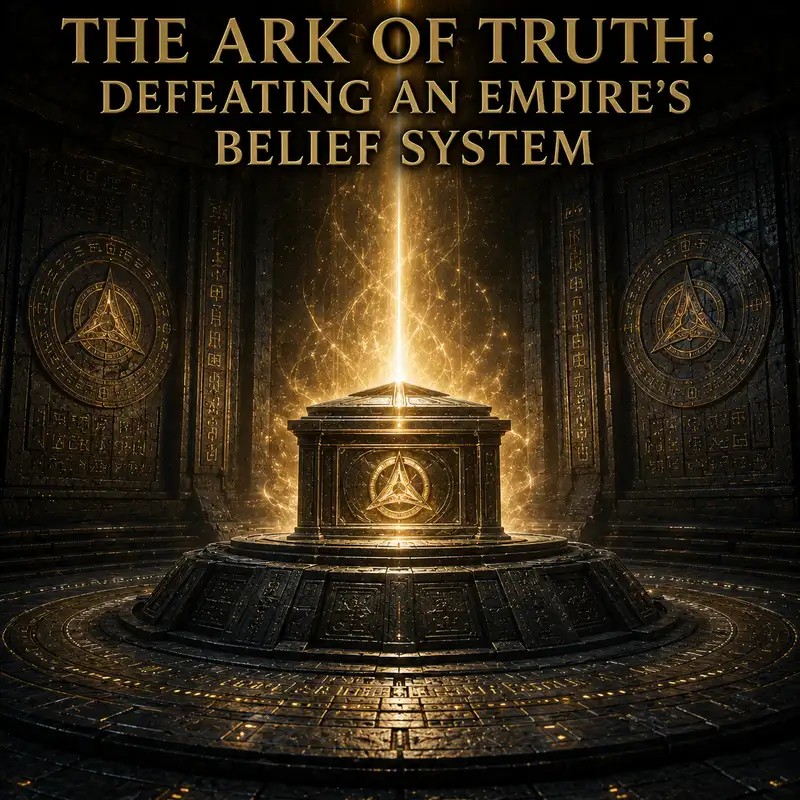
The Ark was an Alteran device known as armeria verimas, loosely translated as the Ark of Truth. The title can be misleading. It was not a neutral instrument that examined competing claims and displayed the objectively correct answer. It was programmed with a proposition and compelled anyone exposed to accept that proposition as true. Daniel Jackson believed it could be configured to make a person believe almost anything. The Ark therefore did not merely reveal evidence. It altered conviction.
Amelius created it millions of years before the modern war, when the Alterans and the people who became the Ori still occupied the same distant galaxy. The two factions had divided over knowledge, authority, and freedom of thought. The Alterans relied on observation, experiment, argument, and debate. The Ori faction treated disagreement as corruption and assembled armies to destroy the smaller community that rejected its doctrine.
The military problem facing Amelius was severe. The Alterans were badly outnumbered, their arguments had failed, and continued concealment was no longer protecting them. The Ark offered an asymmetric answer. One successful exposure could make Ori followers understand that their leaders' path was not the only valid one. It might end the conflict without a prolonged war. It also required the Alterans to preserve freedom by taking control of another person's mind.
The Alteran council rejected that exchange. Its members regarded forced indoctrination as a violation of the same free will they were trying to defend. They accepted the device's extraordinary potential and feared the political power it represented. A government able to install truth by technology would no longer need persuasion, education, courts, elections, or dissent. It would need only custody of the Ark and control of its programming.
Amelius nearly activated the device before the evacuation. He stopped when another Alteran called him away, closed the Ark, collected a notebook containing an early Stargate design, and left Ortus Mallum aboard the departing ship. The settlement was buried when the mountain erupted around the launch. The Alterans carried the concept that would connect worlds and abandoned the machine that could make every connected population think alike.
The decision preserved their principles and surrendered the information environment to their enemies. The Alterans survived by leaving the galaxy. The Ori faction remained, erased opposing history, and transformed its doctrine into Origin. Over immense periods of time, the system joined sincere moral teaching to a central fraud. The ascended Ori promised enlightenment and eventual ascension while using worship to increase their own power. Their followers supplied devotion, labor, soldiers, and legitimacy without knowing the bargain's real terms.
Priors made that system operational. They preached, healed, punished, governed, and directed armies. The Doci stood at the highest visible point of the human hierarchy and could serve as the physical voice of the ascended Ori. Warship commanders and soldiers acted beneath that religious authority. Origin therefore linked strategic leadership to the individual village. A passage from the Book could justify recruitment, occupation, execution, or planetary destruction because the institution controlling interpretation also controlled the miracle and the weapon.
The Sangraal removed the original ascended Ori, but it did not tell their followers what had happened. Priors continued preaching. Shipyards continued producing warships. Adria ascended and inherited the power once distributed among the Ori collective. The crusade survived the death of its founders because institutions can continue issuing orders in the name of absent leaders, especially when independent verification is forbidden.
That was the gap the Ark could fill. Earth did not need to destroy every Ori warship if the people commanding those ships rejected the sacred authority behind the campaign. It did not need to occupy every converted planet if the Priors who enforced doctrine stopped treating conquest as divine law. The required target was not the fleet. It was the shared conviction holding the fleet, priesthood, and political system together.
Finding the Ark required reconstructing history that Origin had deliberately rewritten. Daniel received recurring visions left from his contact with Merlin's consciousness. Tomin recognized the image of a mountain burying a settlement as Ortus Mallum, described in the Book of Origin as the birthplace of evil. The phrase was propaganda preserving a location. The Ori had turned the Alterans' final refuge into a cautionary story, yet the story still carried enough geographic memory to guide their enemies back to it.
The Odyssey crossed the Supergate, and S G One searched the ruins near Celestis with Tomin and assistance from the anti-Ori underground. They recovered the Ark from beneath the buried settlement. The device appeared physically intact after millions of years, but possession did not equal control. Daniel did not initially know the activation sequence, what proposition remained programmed, or whether opening it would affect only the intended target.
That uncertainty had already shaped the search on Dakara, where S G One found a false chest and hesitated to force it open. The caution was justified. A weapon that changes belief should not be treated like an ordinary container merely because the people standing nearby already agree with the expected message. If the programming had been altered, corrupted, or misunderstood, the first test subjects would have been the recovery team.
Morgan Le Fay supplied the critical technical clue in Celestis. Seven symbols on the Ark illuminated while Vala Mal Doran was near it. Daniel first entered the Ancient word for truth and received no response. Adria then invoked the power and glory of Origin. Daniel recognized that the older Alteran form of the word Origin could also mean truth. He entered the seven symbols, and the Ark activated.
The word was an irony built into the system. Origin had become the name of the faith used to conceal Alteran history. In the older language of the people who created the Ark, the same term could open the device that exposed the deception. The empire had preserved the key inside the vocabulary of its own doctrine.
Activation alone was not enough. The Ark needed the correct audience. Exposing one ordinary soldier would have changed one person's conviction and perhaps produced one execution for heresy. The Doci was different. He stood at the center of the Prior hierarchy, beside the Flames of Enlightenment, with authority that reached across the Ori home galaxy. He was both a believer and a communications node.
When the Ark fell open before him, the programmed conclusion entered the most valuable human target available. The Doci understood that the Ori were not gods. His staff and the staffs of other Priors illuminated as that understanding moved through their subspace connection. The screen record establishes that the network operated within the galaxy. It does not show every civilian simultaneously receiving a private revelation. The decisive change occurred among the Priors who interpreted doctrine and gave orders in the Ori's name.
The device did not appear to broadcast independently across open space. Its strategic reach came from combining direct visual exposure with the Prior network. The Doci had to see the interior of the Ark, and the Milky Way Prior had to be shown it separately while holding his staff. The artifact supplied the altered conviction. Ori communications supplied the distribution. Without both elements, the result might have remained confined to one room.
The warships surrounding the Odyssey ceased fire because their command system had lost legitimacy, not because the Ark disabled their weapons. Engines, shields, crews, and soldiers remained in place. A commander could still have chosen to continue the attack for personal ambition or revenge. The Priors instead stopped directing a crusade whose divine foundation they no longer accepted. The political effect traveled faster than any fleet order Earth could have transmitted.
Adria's position changed at the same moment. Worship had strengthened the ascended Ori and later strengthened her after she inherited their followers. Once the Prior network rejected the claim of divinity, the flow of belief sustaining her fell sharply. Morgan Le Fay had been unable to match Adria while that power remained intact. After the Ark, Morgan could engage her as an equal and confine the Orici in an ascended struggle.
The Ark therefore operated at three levels at once. Tactically, it stopped four ships from destroying the Odyssey. Strategically, it broke the religious command network in the Ori home galaxy. On the ascended plane, it weakened Adria enough for Morgan to act. One exposure linked a ship battle, a political revolution, and a conflict among higher beings without firing a conventional weapon.
The first activation did not end the Milky Way campaign automatically. Samantha Carter concluded that the connection among Prior staffs was limited by intergalactic distance. Priors serving with the expeditionary forces had not all received the Doci's new understanding. Seven Ori warships were waiting near Earth while a Prior inside Stargate Command offered one final opportunity to accept Origin.
That Prior was held under the anti-Prior device, which suppressed his enhanced abilities without killing him. The distinction became crucial. A dead prisoner could not carry the Ark's effect through the Milky Way network. Stargate Command returned the Prior's staff, placed the activated Ark before him, and exposed him to the same conclusion. His staff transmitted it to the other Priors in the galaxy. The fleet withdrew without testing Earth's remaining defenses.
Two carefully selected exposures accomplished what years of fleet combat had not. The Ark did not reach every world by transportation. It used the Ori hierarchy's own communications architecture. The Doci reached the home-galaxy network. The captured Prior reached the Milky Way network. The system designed to centralize doctrine became the distribution channel for the fact that invalidated it.
That vulnerability came from the way Origin concentrated authority. Priors shared doctrine, symbols, enhanced biology, and a communications link. Their unity allowed a relatively small number of agents to supervise enormous populations and coordinate distant military forces. It also meant that changing the conviction of one properly connected official could influence the entire hierarchy. Centralization reduced administrative friction right up to the moment it converted one breach into systemic failure.
The Ark attacked what could be described as the crusade's command software. The ships were hardware. The soldiers were manpower. The Supergate was logistics. Origin told all of them why to move, whom to obey, and why resistance deserved punishment. The Ark did not need to destroy the physical components once the operating doctrine no longer loaded.
Calling the result victory without violence would be too comfortable. The Ark itself was coercive. Tomin recognized the moral problem before the mission departed. The Alterans had refused to use the device because it denied the freedom to be wrong. Daniel agreed that using it was troubling and judged it preferable to the bloodshed already underway. The strategic necessity was real. So was the violation.
The proposition programmed into the Ark was accurate. The Ori were not gods, their promise of ascension was false, and their crusade served an exploitative system. Accuracy does not transform compelled belief into free inquiry. A mind changed by the Ark did not evaluate evidence and reach a conclusion through independent judgment. The machine installed certainty.
Ordinary persuasion had failed partly because Origin controlled the conditions under which evidence could be examined. Priors decided which records survived, which miracles were displayed, and which questions became punishable. A villager could not conduct an independent inquiry while a warship waited overhead. The Ark bypassed that closed information system. It did not win an argument on fair terms. It ended a system designed to prevent fair terms from existing.
This creates the central paradox of the weapon. The Ark ended a campaign built on forced conversion by performing a more efficient form of forced conversion against the people directing it. It liberated worlds from Priors who demanded obedience while denying those Priors the freedom to reject the message that defeated them. The difference lay in purpose, scale, and consequence. The resemblance lay in method.
There was also a meaningful difference between using the Ark once to break an active coercive hierarchy and using it continuously to govern. S G One did not program the Priors to obey Earth, surrender their ships, or accept a new ruler. The imposed conclusion removed a false claim of divinity and left later political choices unresolved. That limitation does not make the method voluntary, but it prevented liberation from becoming direct Tau'ri control.
The alternative was not morally clean. Ori fleets were preparing to attack Earth. Priors had spread plague, destroyed worlds, and ordered mass executions. Conventional resistance had already killed soldiers and civilians without breaking the system. Refusing the Ark would not have preserved everyone's freedom in a peaceful environment. It would have allowed a coercive empire to continue using warships and disease while its victims paid for the Alterans' ethical consistency.
The Sangraal and the Ark reveal two different meanings of strategic victory. Merlin's weapon destroyed the ascended leadership but left the institution operating. Amelius's device changed the institution and left its personnel alive. The first removed the rulers above. The second removed their authority below. Neither was sufficient alone.
The anti-Prior device provided the necessary bridge between them. It made Priors physically containable and preserved them as intelligence and communications assets. At Dakara, it exposed the mortality behind a Prior's command and helped Tomin reject an unlawful execution order. At Stargate Command, it kept the final Prior alive until the Ark returned. A temporary neural countermeasure enabled a permanent political effect.
The followers of Origin were not all cynical participants in a known fraud. Many had received genuine comfort, moral instruction, healing, status, or purpose from the faith. Tomin continued to value parts of the Book even after learning the Ori had lied. Ending the crusade therefore did not require erasing every teaching or treating every believer as an enemy. It required separating moral ideas from the ascended rulers who had claimed exclusive ownership of them.
Tomin returned to the Ori home galaxy to help lead that transition. His task was larger than revising a book. Populations that had organized law, education, government, and identity around Origin now had to determine which institutions could survive without divine command. Priors had to confront responsibility for plagues, executions, and forced conversions. Soldiers had to decide whether obedience to a false authority excused what they had done. The Ark stopped the war faster than any reconstruction process could begin.
The device also created a continuing security problem for Earth. Daniel warned that someone might reprogram it or use it to impose another belief. The Ark was sent to Area Fifty-One for study rather than destroyed. General Hank Landry had no final authority over that decision, which had moved into international oversight and classified research. The institution that had just condemned forced belief now possessed the machine capable of performing it.
There is no established evidence that Earth learned to reproduce the Ark or field it as a routine capability. One artifact was recovered, activated with assistance from an ascended Ancient, and retained for analysis. Earth could transport and operate it under exceptional conditions. It had not acquired the Alteran science, production process, or ethical safeguards required to build another.
That distinction limits the military lesson. The Ark was not a standard psychological-operations system that could be deployed against every hostile ideology. It was a unique civilization-level device used against a hierarchy whose communications network made one exposure disproportionately effective. Most political systems do not carry a shared psychic link through the staffs of their senior officials. Procurement officers should be grateful, because the testing requirements would be difficult to explain.
The deeper lesson concerns legitimacy. The Ori empire looked strongest in its warships, Priors, and ascended power. Its decisive vulnerability was the belief connecting those assets. The same doctrine that motivated soldiers and reduced occupation costs made every command dependent on one sacred claim. Once that claim failed, the empire's physical strength could no longer produce coordinated political obedience.
The Ark of Truth defeated the Ori belief system because it struck the point where faith became command. It did not prove that compelled truth is harmless, that every believer was absolved, or that political recovery would be simple. It proved that an empire built on unquestionable authority can survive the death of its gods and still collapse when its servants stop believing the orders are sacred.
The final image is the Doci weeping beside a machine his ancestors had refused to use. Outside, four warships still possessed the power to destroy the Odyssey. Far away, seven more waited near Earth. Their weapons did not fail. The people responsible for firing them saw the authority behind the war differently and chose to stop. The Ark saved two galaxies by taking possession of a few minds at exactly the points where an empire had concentrated its own.