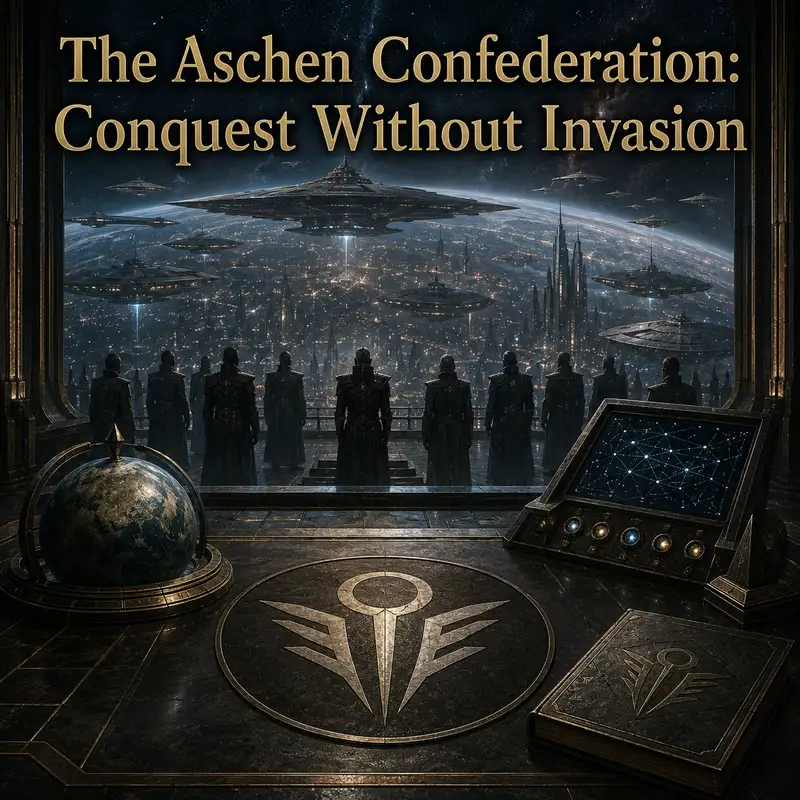
The Aschen Confederation: Conquest Without Invasion
The Volian farmer believed the iron beam in his field was an old obstruction. Daniel Jackson discovered that it was the top of a buried city. Beneath acres of crops and automated harvesters stood the remains of a capital belonging to a civilization that once counted millions. There were no bomb craters, no shattered defensive lines, and no evidence of a final battle. The civilization had not been conquered by an army. It had been reduced so gradually that its descendants no longer remembered the city beneath their feet.
That buried capital was the clearest evidence of Aschen strategy. The Aschen Confederation did not normally expand through occupation fleets, religious rule, or visible terror. It offered medicine, agricultural machinery, transportation, and protection. Those benefits were genuine. They were also the tools through which a target society surrendered its population, economy, political independence, and eventually its history. The Aschen conquered by making resistance appear unnecessary until resistance was no longer possible.
Very little is established about the Aschen homeworld, population, government, or the full size of their Confederation. They appeared human, possessed advanced spaceflight, and could engineer biological weapons with extraordinary precision. Their representatives, including Mollem and Borren, spoke for a larger political system but revealed almost nothing about its internal structure. Even the location of their homeworld was protected as strategic information. What survives is not a complete institutional history. It is a clear record of method.
That method depended on patience. A Goa’uld ruler might seize a world, place Jaffa around the Stargate, demand tribute, and declare divine authority immediately. The Aschen could wait generations. Their ideal conquest preserved productive land, labor, useful infrastructure, and natural resources. It created few martyrs because there was no obvious moment of invasion. By the time the demographic result became undeniable, the institutions capable of opposing it had already become dependent on Aschen systems.
Their own technological development contained an unusual limitation. The Aschen and Volians had discovered buried Stargates, but neither world had recovered a dial-home device. Without that system’s automatic correction for stellar drift, the Aschen could not use the gate network as Earth did. They possessed ships, but their known routes remained concentrated within the Confederation. Earth, by contrast, had hundreds of usable addresses and knowledge of the larger network. The apparently weaker civilization controlled the map the stronger civilization wanted.
This made Earth valuable for reasons extending beyond one planet. Stargate Command had reached advanced allies, hostile empires, abandoned technologies, and worlds the Aschen did not know existed. The Aschen could provide medical and industrial systems Earth could not reproduce. Earth could provide access to an entire strategic environment. The proposed alliance was therefore not charity. It was an exchange between different strengths, with one side concealing its later intentions.
The Volian case showed the mature result. Approximately two centuries before S G One arrived, the Volians had possessed an urban civilization comparable in broad technological terms to Earth in the early twentieth century. A severe epidemic struck their world. The Aschen arrived by ship, supplied a vaccine, and saved the population from the immediate disease. To people facing mass death, they were not invaders. They were the civilization that had come when no one else could help.
The rescue created trust, and trust created access. Over time, the Aschen introduced medicine, power, agricultural machinery, and other forms of technical support. They installed hundreds of floating harvesters across the planet. When crops were ready, the machines gathered them, moved the local Stargate into position, and sent the harvest directly to the Aschen homeworld. The automated system was controlled by the people receiving the food.
The Aschen also ignited a gas giant in the Volian system, creating a secondary star and doubling the growing season. It was an achievement beyond Earth’s engineering capacity and a revealing choice of investment. The Aschen could alter a solar system, yet the principal visible result on Volia was greater agricultural output. Their technology improved the planet while narrowing its purpose. Volia became productive, peaceful, and increasingly specialized as a supplier.
Only a small number of Aschen appeared to be present. The farmers described themselves as free because they were largely left alone. They received medicine, machines, light, and heat. When equipment failed or a field became obstructed, they requested Aschen assistance. That arrangement did not resemble an occupation. It resembled rural prosperity under a distant technical administration. The absence of soldiers made the dependency harder to recognize.
Beneath that prosperity, the original Volian civilization disappeared. The population fell from millions to thousands. Cities were abandoned and covered by farmland. Written records ended after reports that an Aschen vaccine caused a condition Daniel could not initially translate. The people living above the ruins did not know a city had ever existed there. Two centuries had converted demographic collapse into ordinary life.
The missing word was sterility. The Aschen vaccine that had first entered Volian society as medical relief had also prevented future generations from replacing the population. There was no need to kill millions in one campaign. The Aschen allowed time to remove them. Those who remained continued working, aging, and relying on the systems provided by their supposed partners. The conquest advanced through birth records rather than casualty reports.
This was strategically efficient. Biological suppression avoided the cost of planetary bombardment, occupation forces, insurgency, and reconstruction. Agricultural infrastructure remained intact. Local workers continued producing food. The target government could be incorporated gradually, while the visible Aschen presence remained small. Resistance was difficult to organize because the decisive attack occurred through a trusted public-health measure and produced its full effect over decades.
The method was also self-concealing. A population saved from epidemic disease would initially associate the vaccine with survival. Falling fertility could be explained as a side effect, a temporary medical problem, or a social change. Each year’s decline would appear less dramatic than a battlefield disaster. By the time the pattern became clear, scientific expertise, medical records, and critical infrastructure might already be under Aschen influence. The official explanation could always arrive faster than independent verification.
Earth saw the likely endpoint in a future that was later diverted. In that timeline, S G One made direct contact with the Aschen and helped create an alliance. Within ten years, the Stargate had become public, Earth had joined the Confederation, embassies linked multiple worlds, and Aschen technology had transformed daily life. Anti-cancer treatments, tissue-repair machines, advanced transportation, and an anti-aging vaccine made the alliance look like the most successful result in the history of the Stargate Program.
The Aschen also helped Earth defeat the Goa’uld. The exact campaign is not preserved, but the outcome was decisive enough that the old enemy no longer defined Earth’s security planning. That victory gave the alliance political legitimacy no ordinary trade agreement could have produced. A civilization that eliminated disease and helped destroy a galactic empire could ask for enormous trust before its motives were questioned.
The cost appeared first as a private medical problem. Samantha Carter and Ambassador Joseph Faxon had tried unsuccessfully to have children. Aschen doctors assured them that neither partner was responsible and advised patience. Doctor Janet Fraiser conducted an independent examination and discovered that Carter had been rendered incapable of having children. The advanced medical system had not missed the condition. It had concealed it.
Carter and Fraiser entered Aschen medical records and found that the worldwide birth rate had fallen by almost ninety-one percent in only two years. The decline followed the distribution of the anti-aging vaccine. The screen record does not provide a full biochemical explanation, but the evidence strongly links the celebrated treatment to systematic infertility. A medicine that nearly doubled human lifespan was also removing humanity’s ability to continue.
The combination was particularly effective. Longer lives softened the immediate appearance of population loss. Streets remained occupied, experienced workers remained productive, and families did not see mass death. The missing population existed in the future, represented by children who would never be born. The Aschen did not need to hide bodies. They needed to delay recognition of an absence.
Earth’s leaders had not been completely excluded from the policy. Faxon revealed that the Aschen had demanded a major reduction in human population growth as a condition of continued investment. Earth officials had accepted a smaller reduction, believing it necessary for long-term sustainability. The Aschen then imposed a far more severe outcome. Their strategy worked partly because they converted an openly negotiated policy into cover for an undisclosed objective.
This is an important distinction. The Aschen did not rely only on deception. They obtained legitimate consent to part of the program, placed the argument inside familiar concerns about resources and population, and allowed human officials to defend the principle. Once Earth’s leadership had accepted that some demographic control was necessary, disagreement could be framed as a dispute over degree rather than recognition of conquest.
The institutions around the alliance had also changed. Stargate Command no longer controlled the gate. Human science and medicine had become secondary to Aschen expertise. Political leaders celebrated the alliance publicly, while former members of S G One were dispersed, retired, or isolated from direct authority. Fraiser suspected that General Hammond’s earlier death may have involved Aschen action, but the evidence never proved it. The suspicion itself showed how completely trust had collapsed once the demographic program was exposed.
Carter believed the Aschen could manipulate information well enough to conceal the fertility crisis. Exactly how they suppressed worldwide recognition is not established. The scale of the decline should have been difficult to hide. The evidence nevertheless shows that Aschen records contained the truth while public institutions did not act on it. Whether through data control, political cooperation, medical authority, or all three, the alliance had compromised the systems that should have detected the attack.
By then, conventional resistance offered little hope. Earth’s forces had been reorganized after the Goa’uld war, the Aschen possessed superior technology, and humanity no longer controlled its own Stargate. Teal’c judged that even a mobilized Earth military would be defeated. The alliance had first removed the external enemy, then made the protected civilization unable to fight its protector. Security dependence had become strategic disarmament without a formal surrender.
The former members of S G One chose to erase that future. Using Aschen knowledge of solar activity, they timed a Stargate connection so a solar flare would bend the wormhole back toward Earth’s past. O’Neill, Carter, Daniel, and Teal’c died during the effort to place a handwritten warning through the gate. The message reached Stargate Command years earlier and ordered one address, P four C nine-seven-zero, removed from the dialing computer.
The warning prevented the original contact, but it contained almost no explanation. It did not name the Aschen, describe the sterilization program, or identify the Confederation. That limitation mattered when S G One later reached the Volian world designated P three A one-nine-four. The Volians introduced them to their advanced partners, and the dangerous alliance approached Earth by a different route.
The second contact revealed how attractive the Aschen offer remained even with a warning from the future. Earth still faced the Goa’uld, still lacked dependable planetary defenses, and remained frustrated by advanced allies unwilling to transfer weapons. The Aschen offered to end disease, double human lifespan, provide rapid transportation across continents, supply defense technology, and admit Earth into the Confederation. In exchange, they wanted full disclosure of the Stargate network and introductions to Earth’s advanced contacts.
Mollem also displayed a biological weapon described as living, radioactive genetic material that could be designed to attack the specific genetic structure of an enemy. It was presented as a way to destroy the Goa’uld without harming allies. The offer showed that the Aschen possessed the same general class of capability required for demographic conquest. Their medicine and their warfare were not separate technical traditions. Both depended on precise biological control.
The diplomatic situation favored them. The President faced pressure to demonstrate a concrete benefit from the secret Stargate Program. Ambassador Faxon saw the possibility of a historic alliance. Senator Kinsey moved to control the negotiations after senior leaders decided the opportunity was too important to leave entirely with Stargate Command. O’Neill’s distrust carried less political weight than cures, weapons, and membership in an interplanetary organization.
The Aschen understood that pressure. They did not demand immediate submission. They offered more than Earth had requested and allowed human officials to imagine the political victory. Their representatives remained calm, withheld the homeworld’s location, and emphasized mutual benefit. A treaty would apply to all of Earth, not merely the United States. The language sounded inclusive. It also ensured that the Aschen would deal with a planet-wide authority rather than a military command capable of abruptly ending contact.
Intelligence collection exposed what diplomacy missed. Hammond ordered Daniel and Teal’c to ask the Volians how they experienced Aschen rule. The local testimony was positive. The Aschen provided equipment and medicine, interfered little in daily life, and were remembered as benefactors. The source was honest. It was also the product of a society whose population, institutions, and historical memory had already been transformed.
This was the central counterintelligence problem. A conquered population may provide sincere reporting that supports the conqueror when the conquest has removed alternative memory. The Volians were not lying to S G One. They lacked the records needed to recognize their condition. Their peaceful fields were therefore both evidence of Aschen success and camouflage for the operation that had produced them.
Daniel and Teal’c found the hidden city only because a farmer wanted an old metal obstruction removed from his field. The discovery led to abandoned newspapers, reports of epidemic, public gratitude toward the newcomers, later unrest, and the final untranslated warning about the vaccine. Archaeology supplied the intelligence that living sources could not. The decisive evidence had survived because it was buried beneath the economy built over it.
Earth’s leaders still attempted to proceed cautiously. A token package of Stargate addresses was prepared as a gesture of good faith, while Carter and Faxon returned to the Aschen negotiating platform. Carter asked Borren to translate the missing word from the Volian headline. His answer confirmed sterility. Mollem’s response removed any remaining ambiguity. He ordered the humans confined and continued preparing to use the information Earth had delivered.
When Carter escaped, the Aschen dialed Earth and lowered a biological weapon toward the open Stargate. Faxon remained behind to delay them, and his final fate was never established. Carter dropped through the event horizon, ordered the iris closed, and the incoming device struck the barrier before it could rematerialize inside Stargate Command. The defense built against Goa’uld attack stopped a weapon launched by a prospective ally.
Stargate Command had anticipated that the coordinates might be compromised. The first address in the package led to the planet being torn apart by a black hole. The remaining destinations were described only as progressively worse. Whether the Aschen dialed any of them, whether the black-hole connection damaged their world, and whether the Confederation survived are not established. Earth did not defeat the Aschen in a conventional campaign. It denied the alliance, survived the immediate biological attack, and left a dangerous enemy with poisoned navigation data.
The Aschen strategy had several weaknesses. It required secrecy, long timelines, and confidence that the target would accept dependency. It worked best against governments under enough pressure to trade strategic access for immediate relief. Independent medical review, preserved historical records, controlled Stargate defenses, and suspicion of unusually generous agreements could disrupt it. The Aschen were highly advanced, but they were not omniscient. They failed because Earth investigated the client world instead of examining only the promised technology.
Their limited knowledge of the Stargate network was another vulnerability. They wanted addresses because they lacked Earth’s accumulated navigation data. That dependence made deception possible. It also suggests that the Confederation’s reach, while impressive, was not unlimited. The Aschen could transform a solar system and engineer species-specific weapons, yet a missing dial-home device constrained their access to the wider galaxy. Advanced technology had not solved every logistical problem.
The Confederation itself remains poorly documented. The Volians were identified as members, and the altered future showed Earth integrated into a network of planets. No surviving evidence proves that every member world had been depopulated or coerced in the same way. Volia and the planned treatment of Earth nevertheless establish a repeatable pattern. The available evidence suggests that membership could be the administrative phase of conquest rather than a partnership among equals.
The Aschen were dangerous because the benefits they offered were real. Their harvesters increased production. Their medicine cured disease. Their transportation worked. Their weapons could help defeat the Goa’uld. A false gift would have been easier to reject. The Aschen offered genuine progress and attached a cost that became visible only after institutions, infrastructure, and political careers had been built around accepting it.
Their system also avoided the resistance produced by visible oppression. The Goa’uld demanded worship and enforced rule with Jaffa. The Aschen allowed people to keep homes, farms, local customs, and the feeling of private freedom. They did not need to govern every conversation. They needed control over medicine, demographic policy, strategic transportation, and the movement of resources. A population can retain many daily choices while losing every decision that determines its future.
The human cost is best measured on Volia. Farmers lived peacefully above a capital they did not remember, using machines they could not maintain without Aschen help, producing crops for a world they had never visited. Their ancestors had been saved from epidemic disease. Their descendants inherited survival without sovereignty, prosperity without historical memory, and freedom defined as being left alone inside a system they did not control.
Earth’s altered future showed the same process at an earlier stage. The Goa’uld were defeated, disease was disappearing, and the Stargate had become part of public life. Those achievements were not illusions. They were the price used to purchase human consent while the birth rate collapsed. Earth had won the war it understood and was losing the population without recognizing that another war had begun.
The Aschen did not need an invasion fleet because they targeted the functions an invasion is meant to control. They secured access to the Stargate, influenced government policy, redirected scientific dependence, reorganized economic production, and determined who would exist in the next generation. No occupation flag was required. The fields remained green, the harvesters kept moving, and the conquered world thanked them for the medicine while its future quietly disappeared.