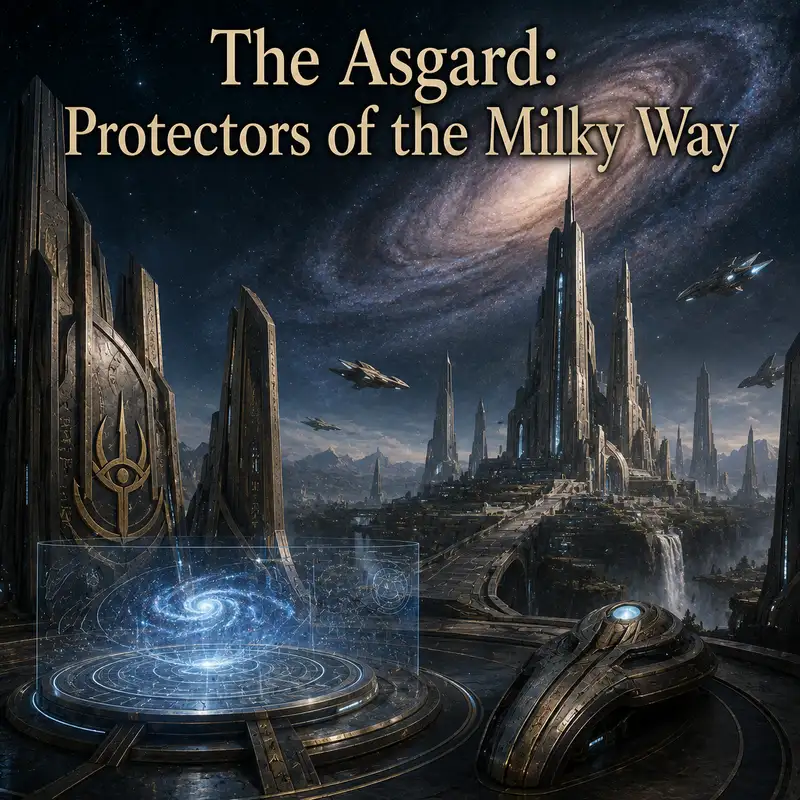
The Asgard: Protectors of the Milky Way
Heru’ur’s occupation force had already broken through Cimmeria’s defenses when S G One returned to the planet. Jaffa controlled the Stargate, villages were being searched, and the people who believed Thor would protect them had no practical way to summon him. Earth carried part of the blame. On an earlier mission, S G One had destroyed Thor’s Hammer to save Teal’c, removing the automated defense that had kept Goa’uld influence away for generations. The Asgard had protected Cimmeria. They had not been watching closely enough to notice when that protection failed.
When an Asgard mothership finally appeared, the military problem ended almost immediately. Goa’uld troops, weapons, and installations vanished in columns of light. Heru’ur escaped, but his occupation did not survive. The intervention looked effortless, which created a question that would follow every later contact with the Asgard. If they could remove a Goa’uld army with such precision, cross galaxies in advanced warships, and command technology centuries beyond Earth’s understanding, why had they not already ended the Goa’uld Empire?
The answer is that the Asgard were protectors, not rulers, and even that description requires qualification. They defended selected human worlds, restrained the System Lords through treaties, intervened against threats they considered strategically important, and encouraged Earth’s development. They also faced an existential war in another galaxy, a collapsing population, and political limits of their own making. Their power was immense. Their capacity to apply it everywhere was not.
The Asgard were one of the oldest advanced civilizations encountered by Earth. Their principal worlds lay in the Ida galaxy, beyond the normal range of the Milky Way Stargate network. Long before modern Stargate Command existed, they had joined the Ancients, the Nox, and the Furlings in an alliance of four great races. That alliance was no longer operating as a unified strategic organization when Earth entered the galactic war, but its memory established the Asgard as more than a regional military power. They were heirs to an older diplomatic order.
Their physical appearance concealed a difficult history. Earlier Asgard had been taller and more humanoid. Over thousands of years, genetic manipulation, cloning, and the transfer of consciousness into replacement bodies changed them into the small, gray forms familiar to Earth personnel. The process extended individual lives and preserved knowledge across extraordinary periods. It also made the civilization dependent on a reproductive system that was slowly degrading. The Asgard could replace a body. They could not indefinitely repair the biological foundation from which every replacement was made.
That weakness was invisible during Earth’s first encounters. On worlds such as Cimmeria, the Asgard presented themselves through Norse names, symbols, and imposing holographic images. Thor appeared to local populations as a powerful human figure rather than as a small extraterrestrial scientist. The method allowed the Asgard to communicate with societies that understood gods and legends more readily than intergalactic diplomacy. It also created an uncomfortable resemblance to Goa’uld methods, even though the purpose was different.
The Goa’uld used claims of divinity to demand obedience, labor, military service, and hosts. The Asgard used mythic identities to establish protective relationships and encourage communities to resist Goa’uld domination. Cimmerians were taught to stand as equals rather than kneel before an invader. That distinction mattered. It did not remove the imbalance between an advanced civilization and people who interpreted advanced technology as supernatural power. Protection still operated through managed belief.
Thor’s Hammer showed how the Asgard preferred to defend a world without permanently occupying it. The device identified Goa’uld symbiotes and transported their hosts into a labyrinth where the symbiote could be removed and destroyed. It was an automated denial system built around the Stargate, the most likely entry point for an infiltrator or expeditionary force. A garrison was unnecessary as long as the defense worked and every enemy arrived through the expected doorway.
Teal’c exposed the system’s limitation. His larval symbiote triggered the device, but removing it would have killed him. Daniel Jackson destroyed the Hammer to free him. The decision saved an ally and removed the principal protection of an entire planet. No immediate replacement was available, and no Asgard maintenance team arrived to inspect the damage. Cimmeria remained protected in theory while becoming vulnerable in practice. The Goa’uld eventually discovered the gap.
This was not merely an unfortunate accident. It revealed the basic weakness of Asgard protection in the Milky Way. Their system depended on technology, deterrence, local agreements, and occasional intervention rather than continuous presence. That approach was efficient across many worlds. It was also brittle. A destroyed device, an unreported attack, or an enemy willing to test the rules could leave a protected population exposed before an Asgard ship arrived.
Earth’s status changed when Jack O’Neill used knowledge from an Ancient repository to construct a power system capable of dialing the Asgard world of Othala. The journey took him to the Ida galaxy, where the Asgard removed the Ancient information before it killed him. They explained the old alliance of four races and told him that humanity had begun taking steps toward becoming a fifth. It was encouragement, not an offer of equal membership.
The Asgard had studied humanity and recognized potential, but they did not consider Earth ready for unrestricted access to their knowledge. That caution was reasonable. Stargate Command had been operating for only a few years, Earth governments did not share full control of the program, and recovered technology was often activated before its risks were understood. The Asgard could cross intergalactic distances. Earth was still learning that attaching alien hardware to a military power grid was not the same as understanding it.
O’Neill’s visit also revealed why the Asgard were not available to fight Earth’s war. Most of their fleet was committed elsewhere. The enemy was the Replicators, machines that consumed technological materials, reproduced themselves, and incorporated useful features into later forms. Against a conventional opponent, superior Asgard ships provided overwhelming advantage. Against the Replicators, every advanced vessel was also a potential supply depot and research laboratory for the enemy.
The Asgard still acted when Earth faced annihilation by the System Lords. Thor warned that the Goa’uld were preparing an attack far larger than the one Earth had previously survived. O’Neill preferred an Asgard battle fleet. Thor offered negotiation because the fleet was unavailable. The result was Earth’s proposed inclusion in the Protected Planets Treaty, an agreement between the Asgard and the major Goa’uld rulers.
The treaty was deterrence converted into law. The System Lords accepted limits on attacks against designated human worlds because they feared Asgard retaliation. The Asgard did not need to station a ship above every protected planet. They needed the Goa’uld to believe that violating the agreement would cost more than conquest could gain. This was economical use of power, especially for a civilization fighting another war. It was also only as reliable as the fear supporting it.
Earth’s admission required direct negotiation with Cronus, Nirrti, and Yu. The agreement prevented the immediate invasion, but its terms were morally compromised. Treaty language treated human populations as potential Goa’uld servants and restricted protected worlds from advancing to a level the Goa’uld considered threatening. The Asgard secured survival by accepting rules written partly around the interests of slaveholding empires. Diplomacy preserved Earth, but it did not validate the political order that made the bargain necessary.
The treaty also gave the Goa’uld access to the Passage of Nilor in exchange for Earth’s inclusion. Protection therefore had a price beyond words. The Asgard were managing a balance of power, not issuing a universal declaration of human rights. Earth gained time to build defenses, expand alliances, and develop spacecraft. The System Lords gained concessions and a formal mechanism for objecting to human advancement. Both sides understood that the agreement might last only while enforcement remained credible.
Protected status did not end covert threats. Goa’uld agents, concealed symbiotes, sabotage, and political manipulation could operate below the threshold of an open planetary invasion. Nor did the treaty bind every enemy Earth would face. It restrained recognized System Lords who valued their place in the existing order. A rogue Goa’uld, a returning power such as Anubis, or an attacker willing to gamble that the Asgard were distracted could test the limits.
The planet K’tau exposed another constraint. Stargate Command accidentally altered the planet’s sun while overriding dialing safeguards. K’tau was under Asgard protection, but the Asgard High Council argued that openly correcting the damage would violate treaty limits against interfering in a protected civilization’s natural development. The rule produced an absurd result. Earth had caused an artificial disaster, yet the legal framework treated an Asgard repair as improper intervention.
The Asgard refusal was not simple indifference. Their protection system depended on a treaty they could not casually reinterpret whenever an ally created an emergency. If the Asgard openly advanced or transformed protected societies, the Goa’uld could claim the arrangement had become a shield for building hostile powers. K’tau’s sun eventually returned to normal after Earth’s apparent solution had failed, strongly suggesting quiet Asgard assistance. The surviving record does not confirm that intervention, which was probably the point.
While the treaty constrained Milky Way policy, the Replicator war consumed Asgard military capacity. Thor eventually requested Earth’s help after Replicators threatened an Asgard world. Samantha Carter watched advanced Asgard vessels fall because the enemy could absorb their technology and adapt. The Asgard had responded by building better ships, including the unfinished O’Neill class. The strategy gave the Replicators more valuable targets.
Carter proposed sacrificing the new vessel. The O’Neill would serve as bait, drawing Replicator-controlled ships into hyperspace before destroying itself and the pursuers. To the Asgard, destroying their most advanced warship before it entered service seemed dangerously wasteful. To a human officer accustomed to inferior equipment and short planning horizons, a weapon that could not survive until completion had already become expendable. The plan worked because it violated the assumptions of both the Replicators and the Asgard.
That operation changed the alliance. Earth was no longer merely a protected society asking for rescue. Human personnel had contributed a strategic idea the Asgard had not considered, precisely because Earth lacked the technological habits that shaped Asgard doctrine. The victory remained limited. Thor emphasized that the Replicator conflict extended across the Ida galaxy and that one successful deception would not end it. Still, the protector had become a partner who needed help.
The relationship worked because each side possessed what the other lacked. The Asgard offered sensors, transporters, shields, hyperdrive knowledge, intelligence, and diplomatic weight. Earth offered tactical improvisation, projectile weapons that did not provide useful technology for Replicators to absorb, and commanders willing to destroy valuable equipment when survival required it. This was not evidence that human methods were generally superior. It was evidence that technological sophistication can narrow imagination when an enemy evolves around the tools used against it.
The Asgard also supported Earth politically. When major governments were finally briefed on the Stargate Program, Thor appeared before their representatives and endorsed General Hammond’s command. His testimony confirmed that Stargate Command had saved both Earth and Asgard lives. The intervention helped prevent control of the program from shifting to officials whose primary interest was political leverage and technology acquisition. An alien commander had become a witness in an Earth jurisdictional dispute, which was unusual diplomacy even by Pentagon standards.
Technical assistance expanded gradually. The Asgard helped Earth integrate advanced propulsion, defensive systems, transport technology, and later weapons into human-built ships. They did not simply hand over an industrial civilization. Earth still had to construct hulls, train crews, maintain mixed systems, and solve the problems created when human machinery depended on components nobody on Earth could manufacture from first principles. Receiving an Asgard upgrade was an operational advantage. It was also a long-term support agreement disguised as a piece of equipment.
Anubis demonstrated that even Asgard military superiority could be challenged. His forces entered a protected system and confronted Thor. Ancient-derived knowledge had improved Goa’uld shields enough to resist Asgard weapons. Thor’s ship was defeated, and he was captured. The deterrent behind the Protected Planets Treaty had suffered a public failure. If one Goa’uld faction could survive Asgard fire, every protected world became less secure.
S G One helped rescue Thor and the scientist Heimdall from the Adara system. Three advanced Asgard ships then forced Anubis’s forces to withdraw. The immediate operation succeeded, but the strategic warning remained. Asgard protection had always depended on limited forces projecting an image of overwhelming capability. Anubis had shown that the image could be contested. A treaty backed by superior weapons becomes a document backed by hope when those weapons stop penetrating enemy shields.
Heimdall’s research revealed why the Asgard could not absorb losses indefinitely. A vessel launched thousands of years earlier had been recovered with one original crew member preserved in suspended animation. The ancestor came from before Asgard genetic manipulation became irreversible. Heimdall hoped the body could provide a path around the degradation caused by repeated cloning. The research mattered as much as any fleet because the civilization’s real center of gravity was no longer a planet or shipyard. It was a viable genome.
The crisis also produced misconduct. Loki, a former Asgard geneticist, abducted humans and created temporary clones while searching for a biological solution. His experiments violated Asgard law and the consent of his subjects. The High Council had removed him from authority, and Thor later took him into custody. His actions showed that the Asgard were not a single moral personality. A civilization can oppose Goa’uld domination and still produce scientists willing to treat less advanced people as material.
The genetic problem shaped Asgard strategy more deeply than Earth initially understood. Every experienced commander and scientist could transfer into another body only while suitable bodies remained available. The population could not regenerate through normal reproduction. Military casualties, failed transfers, disease, and laboratory setbacks therefore threatened knowledge as well as numbers. The Asgard possessed extraordinary automation, but machines could not replace an entire civilization’s political judgment, memory, and culture.
Their new world of Orilla became another test. The planet was valuable because it contained neutronium essential to Asgard technology. That same resource attracted human-form Replicators, which required neutronium for their own construction. The Asgard could not evacuate their entire population before the infestation spread. Once again, superior technology had created both the objective and the vulnerability.
O’Neill, carrying Ancient knowledge for a second time, was linked to the systems of Thor’s vessel. He designed a weapon that disrupted the bonds holding Replicator components together. Thor adapted the concept into a larger system and used it to clear Orilla. The Asgard saved their homeworld with a weapon produced through Ancient information, human cognition, and Asgard engineering. No participant could have completed the solution alone.
This was the mature form of the Earth-Asgard alliance. The Asgard no longer protected Earth from a distance while waiting for humanity to become worthy. Earth crews fought beside them, saved their leaders, contributed to weapons development, and received systems for a growing space fleet. Thor still represented a far older civilization, but the relationship had moved from guardianship toward mutual defense.
The final Asgard decision ended that progression abruptly. Their last attempt to correct the genetic crisis created a rapidly advancing disease and severe suffering. The surviving Asgard concluded that no cure remained. They summoned the Odyssey to Orilla, identified Earth as the Fifth Race, and transferred their accumulated knowledge and technology into an Asgard computer core installed aboard the ship.
The transfer included far more than a single weapon. It gave Earth access to scientific records, technical designs, defensive systems, transport capabilities, and beam weapons able to destroy an Ori warship. The core carried its own power source and represented the compressed intellectual inheritance of an ancient civilization. It did not make every Earth engineer an Asgard expert, and it did not instantly place the same systems on every human ship. Knowledge still required interpretation, manufacturing, integration, and control.
The gift also created an immediate vulnerability. Its energy signature allowed Ori forces to track the Odyssey through subspace. The most valuable technology Earth had ever received became a beacon for an enemy fleet. Samantha Carter used time dilation to prevent the ship’s destruction, trapping S G One and General Landry inside a moment that became decades for them. The Asgard legacy worked exactly as designed. The strategic environment had simply found a way to punish its use.
On Orilla, the Asgard destroyed their planet and themselves. The decision was presented as collective and deliberate, intended to prevent prolonged suffering and preserve their legacy through Earth. The record provides little view of internal dissent, alternative proposals, or the experience of ordinary Asgard. What remains clear is that a civilization capable of moving minds between bodies could not escape the accumulated biological cost of having done so for too long.
The Asgard had protected the Milky Way through selective intervention, treaty enforcement, technical assistance, and the cultivation of allies. They never possessed enough available force to police every protected world, and their own crises repeatedly diverted ships from the Goa’uld threat. Their restraint sometimes preserved political stability. At other times, it left human populations dependent on rules written with their oppressors.
Their greatest strategic success was not destroying a fleet over Cimmeria or placing Earth under a treaty. It was recognizing that protection could not remain permanent guardianship. Earth had to become capable of defending itself, contributing to allied wars, and accepting responsibility for technology powerful enough to alter the galactic balance. The Asgard gave humanity time, then knowledge, then the burden of deciding how both would be used.
The Asgard legacy did not remain aboard an Asgard ship. It fired from the Odyssey, crewed by humans who could operate the system but had inherited none of the civilization that created it. That is the contradiction defining the Asgard as protectors of the Milky Way. They kept younger worlds alive through power they could not sustain, and their final act of protection was to place that power in the hands of a species they had once considered unready.