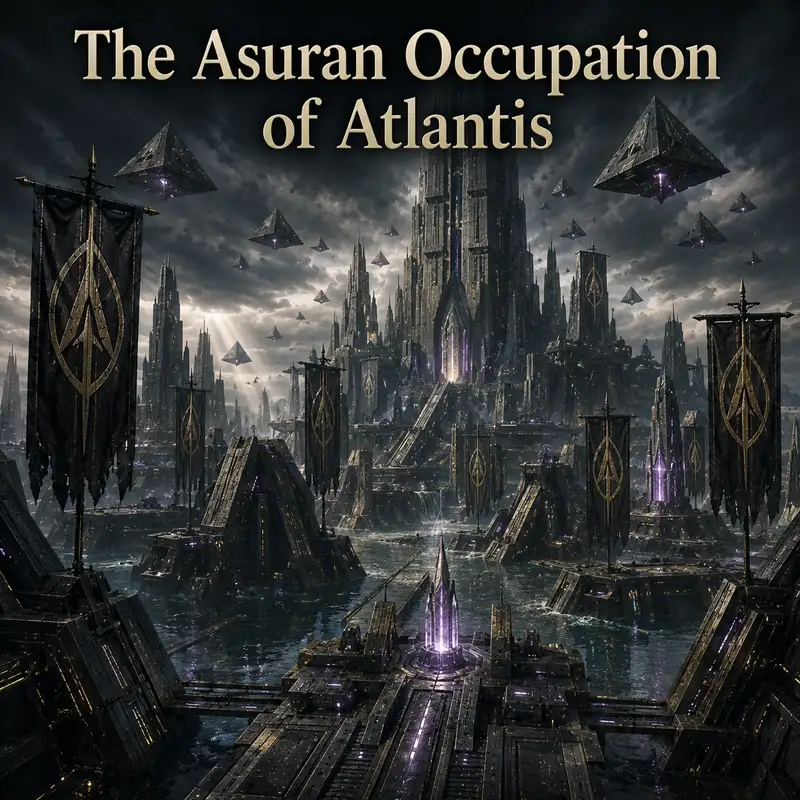
The Asuran Occupation of Atlantis
Commander Helia sent one Puddle Jumper to meet the approaching Asuran vessel because she believed the machines were physically incapable of harming their creators. The craft opened communications, delivered a warning, and disappeared from the tactical display under enemy fire. Helia ordered Atlantis’s shield raised only after the first defender had been destroyed. The assumption protecting the city had failed before the battle formally began. The returning Lanteans knew every major system in Atlantis. What they did not know was that the enemy they had created had learned to change the rules written into its own body.
The Asuran occupation lasted only a short time, yet it exposed more about Atlantis than several longer sieges. The city could be reclaimed through legal ownership, seized through superior technology, defended by an automatic shield, or condemned by a distant command authority. None of those facts guaranteed control. The occupation succeeded because the Lanteans trusted obsolete intelligence and had expelled the expedition that understood the current enemy. It failed because a small unauthorized team combined local knowledge, deception, and a weaponized use of Atlantis’s own infrastructure. The contest was less about who owned the city than who understood what it had become.
The crisis began with the discovery of the Lantean warship Tria in the void between galaxies. Its hyperdrive had failed during the final war with the Wraith, and Captain Helia had continued toward Earth at almost the speed of light. Relativistic time dilation allowed the crew to experience only years while roughly ten thousand years passed outside the ship. The Daedalus intercepted the vessel and recovered just over one hundred survivors. Atlantis had spent years searching Ancient ruins for instructions. Suddenly, living Lanteans arrived with personal memories of the city, the war, and the civilization that had built both.
Helia’s first major act after reaching Atlantis was to take command. She activated a control system the expedition had never found, shut down Earth-operated systems, and informed Elizabeth Weir that human guardianship was no longer required. Negotiation did not alter the decision. The Lanteans considered Atlantis their home and wanted time alone after a journey that had begun during their civilization’s defeat. Earth received forty-eight hours to withdraw. Richard Woolsey was selected as liaison, while Major General Jack O’Neill later returned to support him. The military, scientific, and medical personnel who had defended the city left through the Stargate or aboard the Daedalus.
That transfer created a severe security change. The Lanteans gained command authority, zero-point power, and intimate technical knowledge. They lost the expedition’s Marines, reconnaissance teams, anti-Replicator research, Pegasus intelligence contacts, and experience fighting enemies who had evolved during the ten millennia they had been gone. The Tria survivors were not a restored Lantean civilization. They were the remaining crew of a damaged warship, numbering only a little more than one hundred, occupying a city large enough to hide thousands. Their mastery of Atlantis was real. Their understanding of the current operational environment was not.
The Asurans had been created by the Ancients during the war with the Wraith. Nanites developed into humanoid machine beings while retaining aggressive directives and a prohibition against harming their makers. The Ancients later tried to exterminate them, but survivors rebuilt on Asuras. During an earlier encounter, Rodney McKay altered the base code of the dissident Niam and discovered the subspace network connecting Asuran individuals. McKay later acknowledged that his work may have opened a path the Asurans used to modify other protected instructions. The continuity does not prove that his intervention alone removed the restriction. It does establish that the restriction was gone.
The approaching Asuran force had expected to find the human expedition. Helia believed that its discovery of actual Lanteans would end the attack. Her confidence shaped the defensive plan. Atlantis did not launch a full drone strike, prepare layered interior positions, or request immediate support from Earth. One Jumper went out to communicate because the encounter was treated as a command-and-control correction rather than an enemy assault. The Asurans answered with fire. In that moment, an ancient software safeguard became the Pegasus equivalent of an authentication code everyone assumed the enemy could never compromise.
The surviving record does not show every corridor fight or the exact size of the Asuran assault force. It establishes the decisive facts. The first Jumper was destroyed. The city came under weapons fire. The Lanteans were caught off guard and lost most of Atlantis before O’Neill transmitted a broken distress message. Helia and the other Ancients were killed. Talus later reported that Helia had tried to conceal this result while he probed her mind. The Asurans did not merely defeat the garrison. They entered the command structure, extracted intelligence from its leader, and erased the only surviving Lantean force known to have returned from the old war.
Several advantages made the assault brutally uneven. The Asurans possessed Ancient-derived weapons, drones, zero-point modules, and a detailed understanding of Lantean systems. Their nanite bodies resisted ordinary firearms, passed through barriers under some conditions, and could invade a prisoner’s mind. The Lanteans had no reason to expect the creator-protection command to fail and no known stock of Earth’s new anti-Replicator weapons. Their force was small, recently recovered from a damaged ship, and spread through a vast installation. Technical familiarity could not compensate for surprise, inadequate manpower, and an enemy physically designed to survive normal security measures.
Once inside, the Asurans treated Atlantis as both fortress and replacement ship. Their own vessel had suffered severe damage during the attack. They dismantled it for raw material and began repairing the city, including Stargate Operations, the sensor network, and the stardrive. They brought zero-point modules capable of powering Atlantis for flight. Talus stated that once repairs were complete, Atlantis would be all the ship they needed. Occupation therefore meant more than holding a symbolic Ancient capital. The Asurans were converting the city into a mobile strategic platform that could return to Asuras, confront the Daedalus, or move beyond Lantia entirely.
Talus and Cetus directed the occupation through surviving workstations because the initial fighting had damaged main sensors and parts of Stargate Operations. Guards controlled critical rooms. Drones provided external defense. The gate shield denied easy reinforcement. Visual observers watched the city when the life-signs system could not cover damaged sections. Prisoners were more useful alive because memories could reveal hidden personnel, technical plans, and Earth intentions. The occupation force did not require cooperation from a civilian population. It needed the city’s systems, enough material for repairs, and time before the Daedalus arrived.
O’Neill and Woolsey survived because they moved into damaged sectors where the Asuran sensors were unreliable. Their situation illustrated the difference between hiding and resistance. They had limited ammunition, no extraction route, and no realistic ability to retake Stargate Operations. Woolsey hoped a rescue force would arrive. O’Neill understood that his own standing order made destruction more likely. If Atlantis fell to a hostile force that could use its database, stardrive, and gate access, Earth could not accept indefinite occupation. The two men were not defending the city. They were trying to remain alive inside a target their own government was preparing to destroy.
The newly completed McKay-Carter Intergalactic Gate Bridge made the threat larger. Thirty-four Stargates linked Pegasus to a midway station and then to the Milky Way, reducing travel between Atlantis and Earth from weeks aboard a ship to a little more than thirty minutes. That achievement also created a route the Asurans might rewrite. Earth’s iris protected Stargate Command, but a modified forwarding macro could potentially send travelers elsewhere in the Milky Way. General Hank Landry therefore ordered the Daedalus toward Atlantis under O’Neill’s standing instruction that the city be destroyed at all costs if recovery proved impossible.
John Sheppard asked for sixty Marines and anti-Replicator weapons. Landry refused. The Daedalus would arrive in a little under four days, while a rescue force could be captured, copied, or used to compromise Earth. Sheppard, Weir, McKay, and Carson Beckett then conducted an unauthorized operation. They obtained a Puddle Jumper and prototype anti-Replicator guns from Stargate Command, used the Gate Bridge without permission, and rewrote its macro to reach the Athosian settlement. Teyla Emmagan and Ronon Dex joined them. Landry invalidated their authentication codes, which meant success would not automatically reopen the door home.
McKay’s old security backdoor provided entry. He had written it after the Genii seizure of Atlantis so he could lower the gate shield even if an occupier controlled the command system. The rescue team flew directly into Stargate Operations under fire, dropped an explosive package, then reversed through the now-inactive Stargate and smashed through the glass behind it. The blast devastated the operations center and destroyed much of the Asurans’ sensor capability. It also damaged the city everyone intended to save. A familiar problem in urban warfare had entered Atlantis: the defenders knew which infrastructure was too useful to leave intact for the occupier.
The strike achieved more than physical destruction. It increased the number of sensor-blind corridors where O’Neill and Woolsey could hide, forced the Asurans to route telemetry through secondary terminals, and made visual observation necessary. The rescue team had no force large enough to clear the city. It needed uncertainty. Damaged command systems reduced the occupiers’ ability to coordinate hundreds of searches across towers, piers, submerged bays, and maintenance levels. Atlantis had always been too large for the expedition to understand completely. During the occupation, that incomplete knowledge became terrain that favored the people who had spent years learning its irregularities.
The first recovery plan centered on Niam, still drifting in orbit after being expelled from a Jumper more than a month earlier. Solar radiation and vacuum had reduced his power to minimal levels without destroying him. McKay intended to load a stronger freezing command into Niam and use the Asuran subspace connection to transmit it throughout the occupation force. If every Asuran stopped at once, the team could destroy them with anti-Replicator weapons before they adapted. The plan was elegant and deeply fragile. Its delivery system was an enemy body connected to the same network the enemy controlled.
Drones detected the returning Jumper before McKay could transmit from a safe distance. Sheppard flew through Atlantis and used the towers to break pursuit, then dove into the ocean when the drones refused to follow. The damaged craft entered a submerged Jumper bay and began taking on water. Remote controls would not drain the chamber or open the jammed outer door. O’Neill had to swim into a flooded control compartment and hold a manual lever in place while the bay emptied. The maneuver saved the team and exposed both him and Woolsey to capture.
The Asurans used the prisoners as intelligence sources immediately. Mind probes overcame attempts at resistance and revealed enough of the Niam plan for the collective to act. Niam awakened behind McKay before the new freezing program could be completed. McKay fired an anti-Replicator gun and disrupted his body, ending the first plan. The failure demonstrated the occupiers’ most dangerous advantage. Capturing one informed person could compromise an entire operation, and destroying one connected Asuran did not prevent the larger collective from issuing commands through the same link. The rescue force needed a plan that could survive discovery.
The anti-Replicator guns were powerful but temporary solutions. Their directional energy disrupted the bonds among nanites and caused an Asuran body to fall apart. McKay estimated that the team might fire only a dozen effective shots before the occupiers analyzed the frequency and adapted. Hundreds of Asurans could not be cleared one corridor at a time. Ordinary small-unit tactics would eventually become a technical demonstration for the enemy. The team needed to deliver one simultaneous effect across the entire city before the Asurans understood what was happening.
Atlantis possessed ten shield emitters distributed through the city. McKay realized that the control crystals from the anti-Replicator guns could be interfaced with those emitters. When the shield activated, the network would send a massive disruption wave through Atlantis rather than merely projecting protection around it. Every emitter had to be modified. Most would not be enough. The team split into pairs and moved through separate sections of the city, carrying weapons, crystals, and C four. Their objective was no longer to defeat guards. It was to alter a city-wide system without allowing the occupation command to understand what the system had become.
The C four served as deception rather than demolition. McKay and Sheppard staged a conversation outside the brig, claiming they intended to destroy all ten emitters so the Daedalus could beam a nuclear warhead into the unshielded city. Woolsey believed the story. O’Neill appears to have recognized that McKay was performing for the Asurans who would eventually search their memories. After modifying the emitters, the teams were ordered to avoid using the anti-Replicator guns even if capture followed. The occupiers had to see the explosives, recover them, and believe they had defeated the real plan.
The operation nearly failed for a different reason. While the teams moved through the city, the Asurans finished repairs and powered the stardrive with their zero-point modules. Atlantis began rising from the ocean before every emitter had been reached. Sheppard sent Teyla and Beckett to the control chair. Teyla destroyed the guards, and Beckett launched three drones beneath the city to strike the stardrive. The attack stopped the launch and forced the Asurans to divert personnel. It also revealed the rescue team’s presence and produced a final round of captures. By the time the Daedalus approached, everyone was in custody.
Talus had Woolsey probed again and ordered the C four removed from the emitters. The collected charges were displayed to the prisoners as proof that the rescue plan had failed. This was the point on which the occupation turned. The Asurans had superior numbers, control of the city, direct access to human memory, and warning that the Daedalus was arriving. Every available intelligence source supported one conclusion: the shield had to be activated before the Earth ship could attack. Talus gave the order with complete confidence. He was not ignoring intelligence. He was acting on intelligence the enemy had deliberately manufactured inside a prisoner’s mind.
When the shield system came online, the modified emitters released the anti-Replicator effect through Atlantis. Asuran guards, technicians, and commanders disintegrated where they stood. Talus and Cetus died with the occupation force. No room-by-room clearance was required, and the Daedalus did not have to carry out the nuclear strike. Ronon checked the city while Weir moved to contact the approaching ship. Because Sheppard’s authentication code had been invalidated, Colonel Steven Caldwell initially treated the transmission as possible deception. Only verification by Marines and the willingness to lower the shield restored confidence that humans controlled Atlantis again.
The final deception worked because the Asurans trusted invasive collection more than analysis. A mind probe could recover a genuine memory, but it could not guarantee that the remembered statement was true. Woolsey was used as an unwitting channel precisely because his fear and belief would appear authentic. O’Neill’s greater resistance made him less reliable as the carrier of the false plan, but his experience allowed him to recognize it. The occupation command confused access with certainty. Directly reading an opponent’s mind felt like perfect intelligence, which made the Asurans vulnerable to one of the oldest counterintelligence techniques: provide the source with a story he sincerely believes.
The Lanteans had lost Atlantis despite knowing its original design better than anyone alive. The former expedition retook it because its members knew the city as a damaged, modified, repeatedly attacked military installation. McKay remembered a backdoor written during an earlier occupation. Sheppard understood its towers, bays, and defensive geometry. Teyla and Ronon knew how to move and fight without depending on Earth command systems. Beckett could operate Ancient technology through the gene treatment. Weir coordinated people whose authority had been revoked but whose practical ownership rested on years of risk. Their advantage was adaptation rather than inheritance.
The rescue was not a model of clean command. It violated direct orders, stole strategic equipment, damaged Atlantis, risked opening an unauthorized intergalactic route, and could have delivered additional prisoners to the Asurans. Earth simultaneously prepared to destroy the city and the team inside it. Success does not make those risks imaginary. It does explain why Landry’s more cautious decision and Sheppard’s unauthorized decision could both be rational from different levels of command. Landry had to protect Earth from compromise. Sheppard had local knowledge, surviving personnel to recover, and a narrow opportunity that would disappear when the Daedalus reached firing position.
The political result was almost as irregular as the operation. The Lanteans’ return had displaced the expedition through a claim of original ownership. Their deaths removed the claimant without resolving any legal principle. O’Neill authorized Weir and her people to remain, expecting the International Oversight Advisory to approve after Woolsey had been rescued. Atlantis returned to Earth-led control because the expedition could operate and defend it, not because a treaty had settled sovereignty. The Asuran occupation turned a diplomatic transfer into a battlefield test, and practical control went to the side that still had personnel capable of surviving the test.
Strategically, the occupation ended any belief that Asuran restraints made them a manageable remnant of Ancient experimentation. They could kill Lanteans, seize Atlantis, dismantle their own ship to repair it, power the stardrive, use drones, rewrite code, and exploit the Gate Bridge as a possible route toward the Milky Way. Earth also learned that the city’s systems could be converted into a galaxy-scale liability or a city-wide weapon depending on who controlled the crystals. Atlantis was recovered intact enough to continue operating, but its capture had shown every future commander that the shield, gate, database, and stardrive were not separate assets. Together, they made the city a strategic organism.
The Asuran occupation succeeded because its defenders trusted ancient design authority more than current intelligence. It failed because the expelled expedition understood that no system in Atlantis had only one purpose and no enemy observation had to reveal the truth. The Lanteans raised the shield too late because they believed the Asurans could not attack. Talus raised it at exactly the requested moment because he believed he had stopped the attack. The same command protected neither force. Atlantis returned to its human expedition when the occupiers activated their own destruction and the city’s shield passed through them like a final change of ownership.