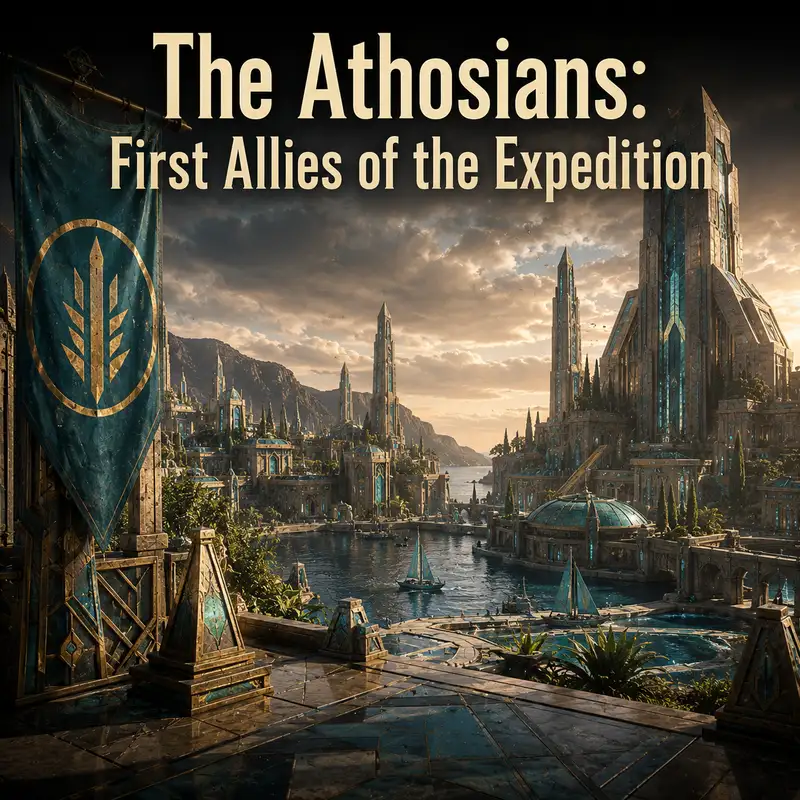
The Athosians: First Allies of the Expedition
By the time Halling sat across from Elizabeth Weir for a security interview, the Athosians had already lost their home, watched relatives taken by the Wraith, and accepted refuge inside Atlantis. They were the expedition’s first allies in Pegasus. They were also the first population Atlantis seriously considered an internal threat. Repeated off-world missions had ended in unexpected Wraith contact, and Sergeant Bates suspected that someone among the Athosians was guiding the enemy. Halling heard the implication clearly. His people had entered the City of the Ancestors as survivors and partners. Within weeks, they were being questioned as possible collaborators.
That contradiction defined the alliance from the beginning. The Athosians needed shelter, weapons, medical support, and a powerful friend. The expedition needed food, gate addresses, regional intelligence, cultural knowledge, and someone who understood how human societies survived under Wraith rule. Neither side possessed what the other required, and neither side had enough information to know whether cooperation was safe. The alliance succeeded because it became personal before it became institutional. It also remained unequal. Atlantis could leave a meeting with new intelligence. The Athosians often left the same meeting carrying the consequences of Earth’s decisions.
Athosian society appeared simple to newcomers because its people lived in small settlements, farmed, hunted, traded, and carried few visible machines. That appearance concealed considerable sophistication. They traveled through the Stargate network, maintained relationships with communities on other worlds, preserved knowledge of safe and unsafe destinations, and understood political conditions that did not appear in the Ancient database. Their survival depended less on industrial concentration than on mobility, memory, and trust. The screen record does not establish every stage of Athosian technological history, but it does show a society adapted to a galaxy where large, visible centers of population invited destruction.
The Wraith shaped nearly every Athosian institution without governing Athos directly. Cullings removed families, leaders, skilled workers, and entire generations. The survivors could not assume that a strong harvest, a growing village, or a prosperous trade route would still exist the following year. Death by age became rare enough to carry special meaning. Knowledge moved through people because archives, workshops, and permanent infrastructure could disappear in one attack. The Athosians were peaceful, but peace did not mean they were unfamiliar with violence. It meant they understood that a village could not defeat a hive ship by pretending to be an army.
Teyla Emmagan served as their most visible leader, but Athosian authority was not presented as a rigid state bureaucracy. Halling spoke with influence, elders such as Charin preserved memory and custom, and major decisions reflected the will of the community rather than one leader issuing orders from a capital. Teyla negotiated, fought, and represented her people, yet she also had to persuade them. Their reverence for the Ancestors gave Atlantis religious and cultural importance before the expedition ever arrived. The city was not merely advanced real estate. It was the surviving work of figures woven into Athosian identity.
The expedition reached Athos because Atlantis was failing. The city’s shield was losing power beneath the ocean, and Weir’s people needed either a new energy source or a place to evacuate. Colonel Marshall Sumner led the first reconnaissance party through the gate with Sheppard, Ford, Bates, and other expedition personnel. They were searching for refuge. The Athosians initially saw armed strangers arriving at the Ring of the Ancestors while the Wraith threat remained quiet. Each side assessed the other through a different emergency. Earth personnel feared drowning in a dead city. The Athosians feared attracting the attention of an enemy that might already be watching.
Halling and two boys, Jinto and Wex, encountered the newcomers first and brought them to Teyla. Her response combined hospitality with warning. She offered food and information, but she also advised the visitors to return home if the Wraith had not yet touched their world. That was not superstition. It was strategic counsel from a leader who understood that contact with Pegasus could not be treated as a controlled scientific expedition. The expedition had no homeward route, so the warning arrived too late. Teyla then did what would become her most valuable service to Atlantis. She began explaining the galaxy as its people actually experienced it.
She led Sheppard to caves containing Athosian records and images of the Wraith. There he found a pendant Teyla had lost years earlier. Neither recognized it as a tracking device. Sheppard’s Ancient genetic trait activated the object, signaling the presence of someone connected to Lantean technology. The Wraith had left it as a detection mechanism, and Earth’s arrival turned an old piece of personal property into a beacon. The mistake was innocent. Its consequences were not. The first meaningful exchange between the expedition and the Athosians included an intelligence compromise neither society possessed the technical knowledge to identify.
Wraith Darts descended on Athos before the contact mission could become an orderly negotiation. People were taken by culling beams, including Teyla, Halling, Sumner, and members of the expedition. The attack destroyed the assumption that Athos might serve as a safe evacuation site. It also placed the Athosians in immediate danger after they had assisted the newcomers. The Wraith would have culled Athos eventually as part of their feeding cycle, but the activated pendant appears to have brought them at that moment. Atlantis had arrived seeking help and unintentionally helped expose the people who offered it.
Sheppard led a rescue using a Puddle Jumper, incomplete intelligence, and a small force. The operation recovered Teyla, Halling, and other prisoners, while Sumner died during Wraith feeding. Sheppard killed the Keeper overseeing the hibernating facility, and her death contributed to the wider awakening of the Wraith. The Athosians were rescued from one chamber while the strategic threat to every human world increased. They could not safely return to Athos. Atlantis therefore accepted them as refugees, and the expedition’s first alliance was sealed not by a treaty, but by shared responsibility for a catastrophe.
Their arrival changed Atlantis immediately. The city had been planned as a scientific and diplomatic expedition with a military guard. It became a refugee center before its personnel had completed a reliable inventory of food, quarters, medical supplies, or safe corridors. The Athosians added pressure to finite stocks, but describing them only as a burden misses the exchange. They brought knowledge of agriculture, local foods, trading partners, gate routes, Wraith behavior, and the political geography of Pegasus. Earth had brought equipment. The Athosians brought context, which was harder to pack and considerably harder to replace.
Teyla’s place on Sheppard’s team converted that context into operational capability. She could identify communities likely to trade, recognize customs that Earth personnel might misread, and warn when a familiar address had become dangerous. She understood that a village’s refusal to cooperate could be a survival measure rather than hostility. She could fight, track, negotiate, and sense changes in the social environment before they appeared on a sensor. The Ancient database listed destinations. Teyla understood who lived there, what they feared, and which old grievance might greet an armed team at the gate.
The alliance never rested on a formal defense treaty with clearly defined obligations. Weir recognized Teyla as a political leader and accepted the Athosians into Atlantis. Sheppard trusted Teyla in the field. Halling and other Athosians expected protection without surrendering their identity. Those relationships created a working arrangement, but they left important questions unresolved. Did Atlantis command Athosian security? Were the Athosians guests, dependents, or equal partners? Could expedition officers restrict their movement? Who decided whether Athosian lives would be risked during an Atlantis operation? The answers changed with each crisis, which is not unusual in coalition warfare and is rarely comforting.
Daily life exposed the difference between welcome and integration. Jinto and Wex explored Atlantis as children rather than as approved archaeological personnel. Jinto used an Ancient transporter, entered a restricted part of the city, and accidentally released an energy entity. The incident frightened the expedition and endangered everyone, but it also revealed that Athosian families were living inside a base designed around adult mission specialists and military controls. Teyla offered Athosian assistance during the emergency. Weir declined it, partly to protect them. The decision was reasonable and paternalistic at the same time. Allies who are always protected from responsibility eventually notice who is making the decisions.
A later gate accident made the cultural divide sharper. Teyla was trapped in a Puddle Jumper that could be destroyed when the wormhole closed. Halling asked that she be allowed to perform an Athosian rite preparing for death. He explained that knowing the time and place of one’s death was rare among people usually taken without warning by the Wraith. Weir resisted because her staff was still trying to save the team and she feared the ritual would concede defeat. Both positions were humane. One treated hope as an operational duty. The other treated preparation as dignity. The alliance had to make room for both.
The security crisis came after Sheppard’s team encountered the Wraith during five of its first nine missions. That pattern was too consistent to dismiss as bad luck. Bates argued that the Athosians were the most likely source of compromise because they knew the destinations and lacked Earth security vetting. Weir suspended normal gate operations, restricted access, and interviewed the refugees. From a counterintelligence perspective, the measures were defensible. From the Athosian perspective, people who had lost their world while helping Atlantis were being asked to prove they had not invited the force that destroyed it.
Halling’s anger was not evidence of guilt. It was the reaction of an ally discovering that gratitude had a short operational half-life. Teyla cooperated because she understood Weir’s responsibility, but she could not ask her people to feel trusted when every interview implied the opposite. McKay eventually identified the real source. The pendant recovered on Athos was transmitting a short-range signal whenever the team carried it into the field. Teyla had never known. She had been turned into an unwitting beacon by Wraith technology and by Sheppard’s accidental activation of it.
The discovery cleared the Athosians and allowed Sheppard to use the device in an attempt to capture a Wraith. It did not undo the political damage. Halling and the community decided to leave Atlantis for the mainland of Lantea. They were not abandoning the alliance. They were restoring autonomy and reducing the daily friction of living inside someone else’s military installation. Weir apologized and supported the move. Teyla remained with Sheppard’s team while continuing to represent her people. The solution created physical distance without ending cooperation, a practical arrangement often more durable than insisting that allies share the same walls.
The mainland settlement gave the Athosians space to rebuild ordinary life while remaining close to Atlantis. Their presence also reminded the expedition that Lantea was not simply a base platform surrounded by empty ocean. Atlantis now had a local civilian population whose security could be affected by storms, Wraith reconnaissance, Ancient technology, and expedition decisions. Medical visits, evacuation planning, transport, and communication became continuing obligations. The Athosians gained greater control over their community, but they still depended on a city whose enemies could threaten the entire planet.
Teyla’s divided residence became one of the alliance’s strongest mechanisms. In Atlantis she served as a field operative, adviser, and eventually a trusted commander. Among the Athosians she remained a leader tied to family, ritual, and collective memory. She translated more than language. She explained Earth’s security concerns to people who had reason to resent them, and explained Athosian choices to officials who might otherwise mistake caution for disloyalty. That position carried influence, but also isolation. Every compromise risked appearing to one side as though she had moved too close to the other.
Athosian culture endured because it was practiced, not stored. When the elder Charin approached death from natural causes, she declined a medical intervention that might prolong her life and asked Teyla to conduct the Ring Ceremony. Among the Athosians, such a death was rare enough to be celebrated as the completion of a full life rather than only mourned as loss. The ceremony placed Charin within a stone ring honoring the Ring of the Ancestors, while Teyla sang of the journey beginning. Atlantis could provide advanced medicine. It could not decide what a completed Athosian life meant.
Charin also preserved the memory that helped explain Teyla’s unusual connection to the Wraith. Some Athosians descended from people who had been taken and later returned, changed in ways their communities did not understand. Investigation of an abandoned Wraith laboratory revealed that one Wraith scientist had secretly experimented on humans, trying to make feeding more efficient by making the food source more biologically compatible. The descendants of some subjects carried small amounts of Wraith genetic material. Teyla was one of them. The discovery transformed an Athosian oral history into intelligence with direct military value.
The so-called gift allowed certain Athosians to sense the Wraith and, under dangerous conditions, enter portions of their telepathic network. It also created another reason for outsiders to fear them. Bates regarded Teyla’s connection as a possible channel through which the enemy might reach Atlantis. His concern was not entirely imaginary, because telepathic contact could expose or influence the person using it. The error was treating risk as identity. Teyla’s genetics did not make the Athosians disloyal. They made some of them survivors of an old Wraith experiment and potential intelligence assets whose use required consent, safeguards, and trust.
During the first siege of Atlantis, Teyla used that connection to help assess the approaching Wraith. The Athosians could not provide a fleet, heavy weapons, or a conventional army. Their contribution was more fundamental. They had warned the expedition what the Wraith were, provided regional knowledge, supported off-world contact, and linked Atlantis to human societies beyond its sensors. They also regarded the city as sacred work of the Ancestors, making plans to destroy it emotionally and politically difficult. The expedition defended Atlantis as a base and a route to Earth. The Athosians also saw a piece of their civilizational inheritance.
That reverence received a painful test when surviving Lanteans returned aboard the warship Tria and reclaimed Atlantis. The Earth expedition accepted the transfer and prepared to leave. The Lanteans did not allow the Athosians to remain on Lantea’s mainland. They found them another suitable world with a Stargate, and the community relocated again. The people who honored the Ancestors were displaced by the Ancestors themselves. The surviving record does not show a prolonged Athosian confrontation, but the decision exposed the hierarchy beneath the rhetoric of heritage. The builders’ legal claim outweighed the residents’ lived one.
The new settlement became known as New Athos. It restored distance from Atlantis while preserving the alliance through Teyla and continuing support. The Athosians chose a familiar pattern of farming, hunting, trade, and community life rather than converting themselves into an auxiliary Earth force. That choice was strategically sensible. Their greatest value had never been massed combat power. It was independence, regional knowledge, and a social network not controlled from Atlantis. A useful ally does not have to become a smaller version of the stronger partner, despite the persistent enthusiasm of military planners for standardized organizational charts.
Atlantis then failed at one of the alliance’s most basic obligations. During a routine visit, Teyla and Doctor Jennifer Keller found New Athos deserted. There were no clear signs of a normal evacuation and no reliable message explaining where the population had gone. Hostile Bola Kai scavengers complicated the search, while a Genii operative supplied a false story that the Athosians had been culled. The community had been missing for months without Atlantis understanding what had happened. The first allies of the expedition had disappeared from a protected relationship without triggering an effective warning system.
Michael was responsible. The former Wraith, transformed and deceived by Atlantis before becoming an independent enemy, had abducted the Athosians for his own biological program. Some were used in experiments. Some were converted into human-Wraith hybrids. Kanaan, an Athosian who shared Teyla’s genetic gift and was the father of her unborn child, was altered and used to draw her into a trap. Michael wanted the child of two people carrying Wraith genetic traits as material for perfecting his hybrid forces. The Athosians were targeted not despite their connection to Atlantis, but partly because knowledge produced through that alliance had made their biology strategically valuable.
Teyla eventually found surviving Athosians in Michael’s custody, including Halling. Atlantis forces helped free those who had not been transformed, while later medical treatment restored Kanaan and other hybrids to human form. The exact number of survivors is not firmly established, and the losses were severe. Rescue did not erase captivity, experimentation, or the destruction of another settlement. It did preserve a community that Michael had treated as a supply of test subjects. Once again, the alliance’s most successful military act was a recovery operation launched after prevention had failed.
The Athosians gave Atlantis its first map of Pegasus that mattered. Not a map of stars and gate symbols, but a map of fear, trade, memory, obligation, and human survival. They showed the expedition that a low-technology village could possess better regional intelligence than an Ancient database, that hospitality could coexist with caution, and that an ally’s culture was not an obstacle to efficient operations. Atlantis offered protection and repeatedly saved Athosian lives. It also brought danger, suspicion, displacement, and enemies whose experiments reached into Athosian bloodlines.
They remained the expedition’s first allies because the relationship survived those failures without becoming submission. The Athosians left Atlantis when trust demanded distance. Teyla stayed when cooperation still served both peoples. They accepted aid without surrendering their customs, and they rebuilt after more than one forced relocation. The alliance endured not because Atlantis always protected them, but because individuals on both sides continued to accept responsibility when protection failed. In Pegasus, that was a stronger bond than ceremony alone could provide.
The final measure of the alliance is not that an Athosian leader joined an Earth team or that Atlantis gained useful gate addresses. It is that the expedition’s mission changed after meeting them. Pegasus was no longer an abandoned Ancient laboratory surrounding one valuable city. It was an inhabited political landscape whose people had already been fighting to survive for generations. The Athosians paid heavily for teaching Atlantis that fact. Their homes were lost, their loyalty questioned, and their bodies exploited. Yet their community endured, and Atlantis became something more than an outpost because its first allies insisted on being treated as a people rather than a resource.