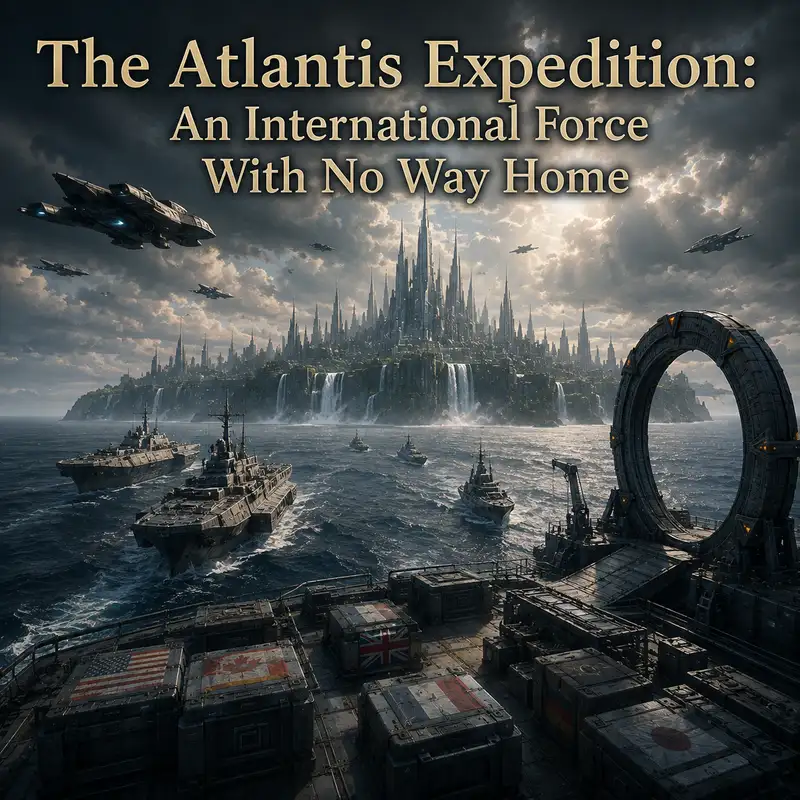
The Atlantis Expedition: An International Force With No Way Home
General Jack O’Neill was asked to spend Earth’s only usable zero-point module on a wormhole that might never open a second time. The device was helping power the Ancient outpost in Antarctica, one of the few defenses capable of stopping another attack from space. Dialing an eighth chevron to the Pegasus galaxy could drain it completely. Even if the connection succeeded, the expedition would not have enough energy to dial home. O’Neill initially rejected the proposal. He approved it only after accepting the strategic gamble: Earth could preserve one dwindling defensive asset, or risk it to reach the civilization that had built the weapon in the first place.
That decision created an organization unlike any Stargate Command had deployed before. The Atlantis expedition was international, civilian-led, scientifically ambitious, and militarily protected. It included personnel from more than a dozen countries and eventually numbered roughly two hundred people, most of them scientists rather than combat troops. They were not an invasion force, a colonial administration, or a normal research detachment. They were expected to locate Atlantis, recover Ancient knowledge, establish a secure base, and survive without knowing whether Earth could ever reinforce, resupply, evacuate, or even confirm that they had arrived.
Doctor Elizabeth Weir commanded the expedition. Her background in diplomacy and international politics made her a deliberate choice. Placing Weir over the expedition gave the multinational scientific mission a civilian center of authority rather than turning it into only another United States military command. Colonel Marshall Sumner of the United States Marine Corps commanded the military contingent and controlled security operations. Rodney McKay led much of the scientific work. Carson Beckett directed medical support. Peter Grodin and other specialists managed operations, translation, power, computing, and the thousand practical tasks hidden inside the phrase, advanced research mission.
The arrangement created overlapping authority from the beginning. Weir was the overall leader, but Sumner was responsible for armed personnel in an environment where nearly every threat was unknown. Scientists required freedom to investigate. Security teams required the power to close corridors, quarantine equipment, and stop experiments. National representatives wore different flags, but they depended on one life-support system, one gate room, and one command decision during an emergency. There was no embassy to arbitrate disagreements and no higher headquarters available by radio. The expedition’s constitution was whatever its leaders could make work before the next alarm sounded.
Major John Sheppard joined almost by accident. He had flown O’Neill to Antarctica and demonstrated an unusually strong natural ability to activate Ancient technology. That genetic compatibility made him valuable enough to add to the mission despite Sumner’s reservations about his record and temperament. Sheppard was an experienced Air Force pilot, but he had not trained with the expedition, helped design its procedures, or expected to become its senior military officer. He walked into the gate room as a late replacement. Within hours, circumstances would promote him by casualty rather than paperwork, which is one of the less desirable methods of career advancement.
The departure itself reflected disciplined planning. Security teams went first, the landing area was cleared, equipment and personnel followed, and Weir crossed beside Sumner to emphasize shared command. Once everyone was through, Earth cut power to the gate. A bottle of champagne rolled across the floor as a farewell gift. The gesture was warm, but the operational reality was severe. The wormhole collapsed behind them, the zero-point module on Earth was nearly exhausted, and the expedition became a self-contained human presence in another galaxy. From that moment, every meal, medical supply, battery, rifle magazine, and qualified technician was a finite asset.
Atlantis did not greet them as an intact base waiting for new occupants. The city had been submerged beneath an ocean for ten thousand years, protected by a failing shield and powered by a nearly depleted zero-point module. The arrival of the expedition awakened systems throughout the city and accelerated the drain. Rooms illuminated, consoles activated, and the Ancient archive began revealing its history. At the same time, sections of the shield failed and water flooded parts of the structure. The expedition had reached its objective and immediately discovered that occupying it might destroy it.
Earth technology could not solve the power problem. Naquadah generators could operate selected systems, laboratories, communications, and life support. They could not sustain a citywide shield holding back an ocean, much less provide enough energy for an intergalactic wormhole. Weir therefore ordered reconnaissance through the Pegasus gate network in search of refuge and a replacement power source. This was the expedition’s first major adaptation. The mission had been to explore Atlantis from a secure base. Within hours, the base itself required evacuation, and the only available escape routes led to worlds whose political conditions were completely unknown.
The first team reached Athos and encountered a human society already living under the Wraith culling cycle. The contact exposed the weaknesses of the expedition’s structure. Sumner approached the Athosians as a military commander seeking immediate information and resources. Sheppard established rapport with Teyla Emmagan, whose knowledge of the region was far more useful than anything in the Ancient database. Neither approach was inherently irrational. The difficulty was that the expedition needed cooperation faster than trust could reasonably develop. Its personnel had arrived with advanced weapons and no understanding of the war that defined local life.
A Wraith attack turned first contact into a refugee and recovery operation. Sumner and several others were captured. Athosian survivors fled through the gate to Atlantis just as the city’s shield was collapsing. An Ancient failsafe lifted Atlantis to the ocean surface, removing the weight of the sea and restoring enough limited power to keep the expedition alive. The city had saved itself, but it remained exposed and virtually defenseless. The mission now included displaced Athosians, missing personnel, an enemy nobody on Earth had briefed them to fight, and no means of reporting any of it.
Weir authorized a rescue despite the possibility that the operation would reveal Atlantis. Sheppard used an Ancient Puddle Jumper to infiltrate the Wraith facility, recovered surviving prisoners, and shot Sumner to end the feeding when the colonel signaled for mercy. The mission also killed the Wraith Keeper whose death triggered the awakening of other hives. The expedition’s first tactical success therefore created its central strategic disaster. It rescued people, established Sheppard as the military leader, and alerted an enemy whose numbers and capabilities were still unknown. The official mission plan had lasted less than a day.
Sheppard’s succession was practical rather than ceremonial. He was the senior surviving officer with the Ancient gene, operational judgment, and the confidence of Weir. Lieutenant Aiden Ford remained an important subordinate, but Sheppard became responsible for reconnaissance teams, base defense, off-world rescue, and the use of the city’s aircraft. His authority still remained beneath Weir’s overall command. That civilian-military balance became the defining arrangement of the early expedition. Weir decided what risks served the mission. Sheppard advised what force could accomplish and sometimes argued that moral obligations required risks the base could barely afford.
The expedition also ceased to be merely international in the Earth sense. Teyla joined Sheppard’s team and became its most important regional adviser. Athosian knowledge supplied gate addresses, trading relationships, cultural warnings, and an understanding of Wraith behavior that the Ancient archive did not provide in operational form. The Athosians were not employees or subjects of Atlantis. They were displaced allies with their own leadership and interests. Their presence made the city more capable while complicating security, sovereignty, and trust. The expedition had crossed one galaxy to discover that its first indispensable intelligence service consisted of people it had met during an evacuation.
Relations deteriorated when repeated Wraith encounters suggested that someone near Atlantis might be revealing expedition movements. Security personnel suspected the Athosians and restricted them while interviews were conducted. The actual cause involved a Wraith tracking device hidden within Teyla, but the damage to trust was real. Many Athosians left the city for the mainland. The incident showed the cost of intelligence uncertainty inside a small isolated force. A false assumption did not remain inside an analytic report. It changed where allied civilians lived, weakened access to local knowledge, and confirmed that Atlantis could reproduce the suspicions of Earth politics without any help from Earth.
The Stargate was the expedition’s lifeline, but it was not a complete logistics system. Teams could move quickly to known addresses, yet every destination remained a potential ambush, biological hazard, or political trap. Many Pegasus gates were positioned in space and required Puddle Jumpers. Those craft depended on Ancient interfaces and a limited number of compatible operators. The gate shield protected Atlantis from unauthorized incoming travel, but identification codes, radio contact, and control-room discipline still mattered. One active wormhole blocked another connection, and the normal time limit made extraction unforgiving. Instantaneous movement did not remove distance. It concentrated distance into one narrow doorway.
A damaged Jumper trapped partway through a space gate demonstrated that point with unusual clarity. The front half had already been dematerialized into the gate’s buffer while the rear remained in orbit, with the vessel physically caught in the event horizon. The team had less than the gate’s maximum connection time to repair the problem and recover an injured commander. Atlantis had medical personnel and technical expertise, but no rescue ship that could simply fly to the scene from the city. The gate had made the mission possible and become the mechanism that might kill everyone aboard. Strategic mobility and single-point failure were built into the same machine.
Isolation made logistics a diplomatic mission. Food stocks declined, forcing Weir to seek trade rather than assume Earth would send another shipment. A mission to obtain agricultural supplies uncovered the Genii, a concealed industrial society preparing for war against the Wraith. The Genii needed intelligence and access to Atlantis technology. The expedition needed food, allies, and eventually nuclear weapons. Cooperation collapsed under mutual deception. The encounter was not merely a failed negotiation. It revealed that Atlantis had entered an existing balance of power and that its supply shortages could be exploited by states with their own plans.
Every category of supply carried similar risk. The expedition had brought ammunition, but it had no demonstrated industrial line for replacing it. Human medicines had expiration dates. Naquadah generators required maintenance and fuel. Computers could interface with only part of the Ancient system. A recovered device might function without providing any way to repair it. Puddle Jumpers were priceless because the expedition could use them but could not build replacements. Atlantis contained the industrial products of a lost civilization, not the functioning industrial civilization itself. Earth had acquired an advanced city. It had not acquired the instruction manuals, factories, spare parts, or customer-support number.
The scientific staff therefore served as infrastructure as much as scholarship. McKay, Radek Zelenka, Grodin, Beckett, and dozens of specialists kept power routed, translated databases, isolated pathogens, inspected flooded sections, and decided which Ancient systems were safe enough to touch. Their work was inseparable from base defense. An energy entity released inside the city became a power emergency. An Ancient nanite infection became a quarantine crisis. A poorly understood control system could open a door, activate a weapon, or shut down life support. Curiosity remained essential, but every experiment occurred inside the expedition’s only home.
Medical support faced the same strategic limits. Beckett had trained personnel and advanced diagnostic equipment, but no evacuation chain leading to a major hospital on Earth. A serious casualty could not be placed on a transport and delivered to a larger theater medical center. Contamination could threaten the entire expedition because everyone shared enclosed spaces and the same gate room. Quarantine decisions therefore carried command authority, not merely clinical advice. The expedition could lose critical expertise to one infection, and in a population of roughly two hundred, the death of a single specialist might remove an irreplaceable capability.
Natural disaster exposed how little depth the expedition possessed. When a massive storm threatened Atlantis, most personnel evacuated through the gate while McKay and Zelenka attempted to use the storm’s electrical energy to power the shield. The Genii exploited the evacuation, seized the city, and tried to take its technology. Sheppard conducted a defense with only a handful of people while Weir and McKay were held. Atlantis survived, but the operation revealed that an adversary did not need a fleet to threaten the expedition. It needed intelligence, timing, and access to the gate during a moment when the base had divided its strength.
The expedition’s diplomatic position grew harder because its arrival changed the war. By killing the Keeper, it helped awaken the Wraith earlier than many human societies expected. The Hoffans accelerated a dangerous medical program because they believed mass culling was approaching. The Genii viewed Atlantis as both a potential ally and a rival center of technology. Other worlds were asked for trade, sanctuary, information, or access without receiving a credible guarantee that Atlantis could protect them. Weir represented Earth’s values, but she could not promise Earth’s power. Her diplomacy was conducted from a city with weak shields and a pantry under review.
This was where the international character of the expedition mattered most. On Earth, multinational operations often rely on negotiated mandates, national caveats, shared funding, and the ability to consult capitals. Atlantis had the personnel but not the consultation. Weir had to make decisions that affected several governments while unable to contact any of them. Military officers served under a civilian expedition leader in a combat theater no government had anticipated. Scientists from different countries controlled discoveries with strategic value to all of Earth. Isolation did not eliminate politics. It forced the people in Atlantis to practice politics without external reinforcement.
Their intelligence picture remained dangerously incomplete. The Ancient database contained thousands of gate addresses and vast historical knowledge, but it did not provide a current order of battle, a reliable political map, or an updated warning about every inhabited world. A valid address proved only that a gate had once been placed there. Teyla could identify trading partners and culling patterns, but even she did not know the location or strength of every hive. The expedition learned through reconnaissance, captured technology, local testimony, and costly mistakes. The audience could see a galaxy. Weir had fragments, and commanders have to make decisions with the fragments they possess.
An apparent route home briefly exploited the expedition’s strongest emotional vulnerability. A form of energy life created a convincing simulation in which personnel believed they had returned to Earth and could later travel back to Pegasus. The illusion succeeded because it offered exactly what isolation had denied them: families, familiar institutions, and the promise that the mission was no longer a one-way choice. Once the deception was exposed, the practical situation remained unchanged. Atlantis still lacked the power to send people home. The incident demonstrated that morale was not an abstract concern. Homesickness could become an intelligence and security vulnerability.
As Wraith forces approached Atlantis, McKay found a way to send a compressed data burst through an intergalactic wormhole without sustaining the connection long enough to transport a person. The expedition used that narrow opportunity to transmit intelligence on the Wraith, reports on the city, and personal messages for families. The recordings were both an operational report and a collective farewell. Earth would finally know that the expedition had survived, but the people recording those messages had no assurance that help could reach them. Communication restored accountability. It did not restore mobility.
The Wraith advance forced Atlantis to prepare an Alpha Site, plan an evacuation, and consider destroying the city to prevent its database from exposing Earth. An Ancient defense satellite destroyed one hive ship before failing. Grodin was killed aboard it, removing an experienced operations specialist at the moment Atlantis could least replace one. The remaining force closed on a base with inadequate shielding and limited heavy weapons. At that point, the expedition’s first year had reduced the original promise of discovery to a denial mission. If Atlantis could not be held, Weir intended to save as many people as possible and destroy what the enemy could exploit. The greatest archaeological discovery in human history had become a classified demolition target.
Earth finally established a wormhole using another recovered zero-point module and sent Colonel Dillon Everett with a Marine contingent, railguns, and nuclear weapons. Everett arrived under orders to assume military command and hold Atlantis until the new battlecruiser Daedalus could reach Pegasus. The reinforcement created an immediate clash with the command culture that isolation had produced. Everett carried formal authority from Earth. Weir and Sheppard carried months of local experience. Both mattered, but the situation allowed little time to reconcile them. The first reliable contact with home therefore arrived as a command dispute in the middle of a siege.
The Daedalus changed the expedition’s strategic condition. It delivered a zero-point module, restored the city shield, provided orbital firepower, and established a physical transport route between galaxies. The journey still took weeks under normal conditions, and routine gate travel to Earth remained dependent on exceptional power. Atlantis had gained a supply line, not proximity. Reinforcements, replacement personnel, mail, equipment, and political oversight could now move between galaxies, but slowly enough that the expedition still had to solve immediate crises with whatever was already present.
The original Atlantis expedition survived because it stopped behaving like a temporary research mission. It became a combined headquarters, reconnaissance command, diplomatic service, medical installation, refugee center, intelligence cell, and isolated community. Its international members could not wait for their governments to settle every jurisdictional question. Its soldiers could not defend the city without scientists. Its scientists could not explore without local allies and armed teams. Its civilian leader could not preserve the mission without accepting military risk, and its military leader could not win by force alone.
Having no way home was therefore more than a transportation problem. It removed the assumption that failure could be evacuated, replaced, or reported later. Every decision had to preserve the only human foothold in Pegasus while accounting for the people already living there. By the time regular contact with Earth was restored, Atlantis was no longer merely an expedition sent from Earth. It had become a distinct strategic command shaped by isolation, local alliances, shared danger, and the knowledge that survival depended on making an unfamiliar city into a home before the galaxy decided it was a target.