The Attero Device: Victory That Could Destroy the Gate Network
Radek Zelenka watched an impossible power spike build inside Atlantis’s active Stargate. The wormhole would not disengage, energy was rising from within the event horizon, and the normal thirty-eight-minute connection limit offered no useful protection. He redirected the city shield around the Gate Room just before the ring reached critical failure. The Stargate exploded like a contained sun. The shield absorbed much of the blast, then failed as energy tore through the control tower. Atlantis survived. Its gate did not. Elsewhere in Pegasus, most worlds had no shield available at all.
The Attero device functioned exactly as intended against the Wraith. Two hive ships attempted to enter hyperspace and disintegrated before completing the transition. The same machine then turned every active Stargate in Pegasus into a potential bomb. It promised a strategic victory the Ancients had failed to achieve through fleets and drones, while threatening the network connecting nearly every human society. The central question was not whether the weapon worked. It was whether defeating the Wraith could still be called victory if the method destroyed the worlds that victory was supposed to protect.
Janus designed the device during the long Lantean war with the Wraith. The Ancients possessed superior science, stronger individual warships, defensive shields, drone weapons, and the city of Atlantis. They still could not impose a lasting decision on an enemy with greater numbers, dispersed hives, and the ability to replace losses. Destroying one ship did not locate the next. Winning one system did not prevent another culling. Janus therefore attacked a common dependency rather than another hull. Every hive might belong to a different faction, but Wraith interstellar movement relied on the same form of hyperdrive technology.
The concept was a galaxy-scale form of technological interdiction. The device generated highly specific turbulence in subspace, focused on the channel used by Wraith hyperdrives. It did not prevent a hive from activating its drive. That was what made it lethal. A Wraith crew could begin the normal transition and discover only after commitment that the relevant region of subspace had become unstable. The ship would be torn apart as it entered. No targeting radar had to find it, no Ancient vessel had to intercept it, and no warning was required beyond the debris left by the first failed jump.
Hyperdrive systems in Stargate continuity shared a broad principle without using identical subspace frequencies. Ancient ships, Asgard-derived Earth vessels, Traveler craft, and Wraith ships could all enter hyperspace through different technical approaches. Janus exploited that variation. The Attero effect was selective enough to leave Lantean hyperdrives operational while making Wraith transitions fatal. An Ancient fleet could continue moving between systems while hive ships either risked destruction or remained at sublight speed. Selectivity at the level of propulsion was the device’s great achievement. Its failure appeared in a different network entirely.
If the Wraith learned what was happening, avoiding hyperspace would preserve their ships but destroy their strategic mobility. A hive stranded between stars could take years or much longer to reach another inhabited system under sublight propulsion. Reinforcement, concentration, territorial defense, and mass culling would become nearly impossible across interstellar distances. The Ancients could isolate individual hives, attack those close to human worlds, and leave others trapped where hunger and internal shortages would do the work. The device did not need to kill every Wraith immediately. It could dismantle the military geography that allowed separate hives to behave like a galactic power.
That made Attero more than a weapon. It temporarily rewrote the theater’s transportation rules. Wraith numbers mattered because those numbers could move. Their reach depended on hives crossing between feeding grounds faster than human populations could organize against them. Remove that movement, and the Wraith became isolated regional threats rather than one distributed strategic problem. The concept resembled a minefield placed not along one road, but inside the act of moving between star systems. The enemy could see the road. It could no longer know whether using it meant arrival or disintegration.
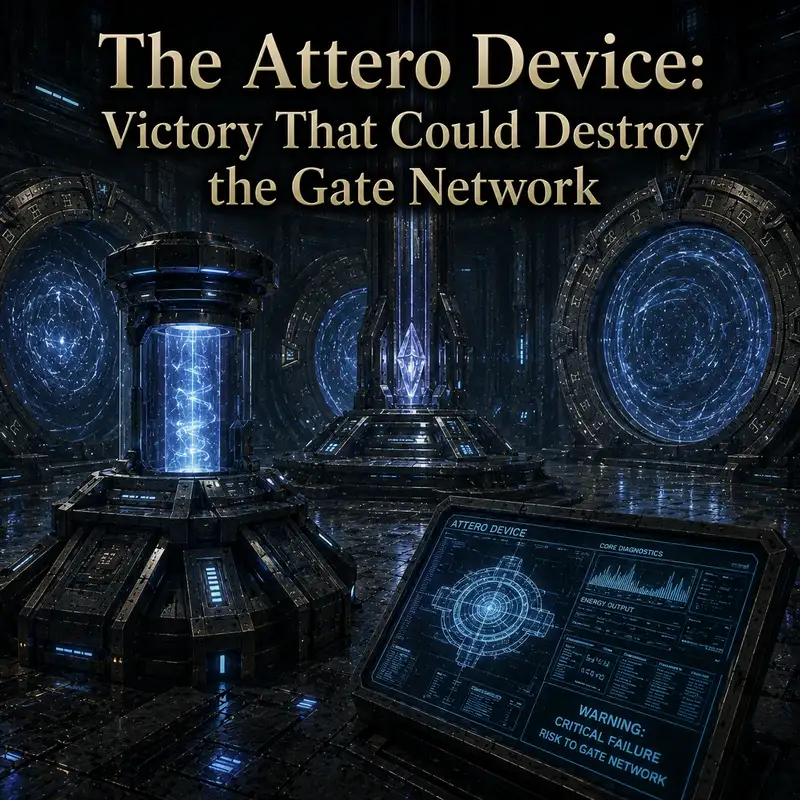
The installation supporting this effect was large, fixed, and heavily specialized. Its central antenna occupied a shielded chamber filled with intense radiation and electrical discharges while active. Control consoles managed the subspace transmission. A separate component, commonly treated as the control key, had been returned to Janus’s hidden laboratory in Atlantis while remaining linked to the remote facility. One part would not operate without the other. The key also required the Ancient gene, adding biological access control to the physical separation. A main control crystal inside the antenna chamber provided another point at which the device could be stopped.
Janus tested the system for three days approximately ten thousand years before the modern expedition found it. He then shut the project down because of what his records called unforeseen side effects. His research was unauthorized, and the key was concealed in a secret laboratory within Atlantis rather than documented openly. The surviving record does not fully explain whether a council order ended the program or Janus acted once the consequences became undeniable. It does establish that he preserved the technology instead of destroying it, allowing someone else to make the decision later.
The side effect came from dangerous radiation generated by the same subspace turbulence that targeted Wraith drives. That radiation interfered with the basic operation of Pegasus Stargates. When a gate was dialed while the Attero device remained active, energy accumulated inside the ring instead of stabilizing through normal wormhole operation. The connection could not be shut down through ordinary controls. Power continued rising until the gate overloaded. Because Stargates were built from naquadah, a material capable of storing and amplifying enormous energy, failure did not resemble a damaged transporter. It resembled the detonation of a strategic weapon in the center of a settlement.
The distinction is important. The Attero device did not cause every dormant Stargate to explode simultaneously. It made activation lethal. A buried gate, an unused gate, or a world that somehow knew not to dial might remain physically intact. The network became a field of armed traps whose triggers were ordinary travel, trade, evacuation, medical assistance, and diplomatic contact. The first worlds to suffer would be the ones still using the system normally because they had no warning. Over time, either more gates would explode or the entire galaxy would have to stop using the network until the device was disabled.
That outcome attacked the foundation of human life in Pegasus. Most human societies did not possess hyperdrive-capable ships. Their gate was the route to neighboring worlds, markets, allies, refugees, medicine, and escape from Wraith attack. Atlantis depended on the network for exploration teams, intelligence collection, emergency evacuation, and contact with communities beyond the reach of its limited ships. Destroying or paralyzing the gates would not merely slow commerce. It would isolate planets politically, eliminate rapid reinforcement, fracture alliances, and leave populations facing local threats without the one strategic mobility advantage ordinary humans possessed.
The Wraith would also lose gate access for Darts and ground forces whenever activation risked an explosion, but they retained hive ships, cruisers, and sublight movement within a system. Human villages generally did not. The side effect therefore imposed unequal costs even though it applied to the same network. Advanced powers could shift some movement to ships. Most civilians could not. A weapon aimed at Wraith hyperdrives would kill human beings through transportation infrastructure because the Wraith and their victims occupied the same strategic environment. Janus had found a technically selective attack whose political and humanitarian effects were indiscriminate.
Atlantis survived its gate explosion only because Zelenka understood the power spike quickly enough to redirect the city shield. Even that defense was incomplete. The gate was destroyed, the Gate Room suffered severe damage, and the blast tore through the central tower after the containment field weakened. A normal settlement would have possessed neither an Ancient shield nor a control room staffed by scientists familiar with improbable emergencies. The device therefore turned the most valuable structure on many worlds into the location most likely to destroy the government, marketplace, garrison, or town built around it.
Stopping all gate traffic before activating Attero sounds simple only from the perspective of someone with a complete map, instantaneous warning, and authority over every world. The screen record does not establish that Janus could remotely disable the Pegasus network or notify every human population before the three-day test. Many societies would not have possessed radios capable of receiving an interstellar alert. Some would have dialed during the warning process, and others would have ignored a message they could not authenticate. The gate network offered enormous reach without one central traffic controller able to close every terminal safely.
The device returned to history when Daniel Jackson and Rodney McKay discovered Janus’s secret laboratory in Atlantis. Their activation of the concealed room awakened the control key and sent a subspace signal to the remote installation. A hidden faction of Asgard exiles had been monitoring that site. They entered Atlantis in armored suits, penetrated the city shield, seized the key, and kidnapped both scientists. The raid was precise because the attackers did not want Atlantis itself. They wanted the missing component and the people capable of operating Ancient systems.
The exiles had located the Attero facility but could not fully reactivate it alone. They needed the key, Janus’s coding knowledge, and access supplied by McKay’s Ancient gene. Under threat that Daniel would be killed, McKay brought the dormant system online. The machine had not been broken. Janus had simply shut it down. Once the correct component and operator returned, ten thousand years of inactivity ended with alarming ease. This was an Ancient strategic weapon without a living command authority, preserved safety review, or functioning institution responsible for deciding whether the original prohibition still applied.
The Asgard exiles accepted the danger because they did not use Stargates. Their refuge was failing, the Wraith had trapped them in Pegasus, and destroying Wraith mobility appeared to offer a route back into the galaxy. Human populations connected by gates were outside their survival calculation. Daniel warned that millions could die. Their leader acknowledged the cost and continued. The weapon’s second deployment was therefore not an accidental laboratory incident. It was a deliberate strategic choice by a faction that understood the side effect and considered everyone dependent on the network expendable.
The first confirmed military result occurred far from the facility. Two hive ships supporting Todd’s faction departed a rendezvous with the Daedalus to answer an attack. Both opened hyperspace windows and broke apart. Todd had witnessed the Ancient test ten thousand years earlier and recognized the effect immediately. He assumed Atlantis had lured his ships into the open to test the weapon. From the information available to him, betrayal was plausible. Earth personnel were experimenting with a Wraith gene therapy aboard the Daedalus, and the destruction had struck his allies at the exact moment they moved.
Todd responded by seizing the Daedalus with concealed stun devices and beaming Wraith troops aboard. He locked out the crew, kept his own hive from entering hyperspace, and demanded the Attero facility’s location. His methods remained those of a hostile commander, but his threat assessment was accurate. Every additional minute placed more hive ships at risk and allowed another human world to activate a gate. Atlantis initially hesitated because Daniel and McKay were probably prisoners at the target. It finally transmitted the coordinates because preserving their rescue opportunity could not justify leaving the entire network armed.
The explosion in Atlantis confirmed that Todd’s warning concerned far more than Wraith survival. Zelenka formed a shield around the gate seconds before overload, limiting a blast that would otherwise have devastated the city. Atlantis lost its main transportation route and could no longer launch the planned Puddle Jumper mission through the network. The command center had to be shifted into an auxiliary space while damage was assessed. A weapon operating on another planet had effectively struck Atlantis without sending a ship, firing a beam, or even knowing that the city’s personnel were dialing at that moment.
The Travelers suffered the cost Atlantis narrowly avoided. Their people had spent a hundred generations living aboard ships to remain difficult for the Wraith to find. They had finally established a new surface colony. When its Stargate was activated, the resulting explosion was visible from orbit. Three thousand people died, and two ships were destroyed, including the recovered Ancient warship that had strengthened the Traveler fleet at Asuras. The Attero device had killed no Wraith at that colony. It destroyed a human settlement created by a civilization whose entire history had been shaped by escaping them.
That disaster produced an unusual alignment of interests. Atlantis needed to rescue McKay and Daniel, stop further gate explosions, and recover from the loss of its own gate. Todd needed the Wraith hyperdrive threat removed and controlled the only nearby Earth battlecruiser. The Travelers wanted the weapon destroyed after losing their colony and possessed a ship able to reach the facility. None of these participants trusted the others. The device made cooperation unavoidable by attacking each of them through a different dependency: Wraith hyperspace, human gate travel, Earth command, and Traveler civilian survival.
Reaching the facility remained difficult because Todd had hijacked the Daedalus and Atlantis could no longer use its Stargate. Katana Labrea brought a Traveler ship, while Sheppard and Zelenka joined her crew. The vessel pushed its improvised hyperdrive beyond normal limits to arrive before Todd could destroy the installation with the prisoners inside. The Travelers engaged the exile ships in orbit. On the Daedalus, Ronon Dex and Jennifer Keller sabotaged key systems while the Earth crew tried to recover control. The rescuers and the Wraith were moving toward the same target with incompatible definitions of acceptable loss.
Todd eventually accepted that a conventional attack might fail. He programmed the Daedalus to collide with the facility, then withdrew his Wraith through the F three-oh-two bay. The maneuver would destroy the weapon and probably kill the Earth crew, McKay, Daniel, and everyone in the installation. It was a coherent answer from a commander who regarded Attero as an extinction threat. The Traveler ship saved the battlecruiser by opening a hyperspace window in its path and carrying both vessels through the planet to the far side. The collision was prevented with very little altitude and less margin.
Inside the Ancient complex, the Asgard removed the control key and tried to escape with it. McKay could no longer shut the system down from the normal consoles. He and Daniel used empty Asgard environmental armor to enter the shielded antenna chamber, where radiation and electrical discharges made ordinary access impossible. McKay located the facility’s main control crystal and pulled it manually. Daniel was struck and seriously injured while helping him complete the operation. The device stopped because two prisoners reached the one component that the remote control architecture could no longer protect.
Removing the crystal ended the immediate effect, but Richard Woolsey judged that disabling the device was not enough. One exile vessel had escaped with the control key, and an intact facility might eventually be repaired or reactivated. The Traveler ship therefore fired on the installation and destroyed it completely after McKay and Daniel were recovered. Earth did not capture the Attero device for research, store it behind another shield, or preserve it as a deterrent. Too many civilizations had already demonstrated that possession of a dormant superweapon eventually becomes an argument for one more test.
Measured tactically, Attero was devastatingly effective. A Wraith ship entering hyperspace had almost no opportunity to detect the danger or defend itself after transition began. Measured operationally, the device could immobilize a dispersed enemy fleet without locating every vessel. Measured strategically, it could break the Wraith ability to reinforce, cull, and govern across interstellar distances. Those achievements explain why Janus built it and why the exiles were willing to use it. They also explain why Todd risked a battlecruiser and hostages to destroy it. Every major participant understood that the weapon could end the existing balance of power.
The failure lay in the relationship between means and political purpose. The Ancients were fighting to preserve their civilization and the human worlds of Pegasus. The Attero device attacked the infrastructure those worlds needed to survive the war. Even a short activation could kill civilians who had no warning. A prolonged campaign would force the galaxy to abandon gate travel, isolating populations while Ancient ships hunted stranded hives. Military victory might still be possible, but the surviving political order would consist of advanced fleets moving among worlds deprived of communication, trade, evacuation, and trust.
The device also demonstrates why technological superiority did not guarantee Ancient strategic wisdom. Janus correctly identified a shared Wraith vulnerability and engineered a way to exploit it at extraordinary scale. He failed to separate the target frequency cleanly from gate operations or to provide a network-wide safety system. The result was not a weapon that malfunctioned. It was a weapon whose primary and secondary effects were both functioning. One destroyed Wraith mobility. The other destroyed the transportation network of nearly everyone else. Better engineering could not be assumed merely because the creator was Ancient.
No operational Attero capability survived the crisis. The control facility was destroyed, the main crystal was removed, and the key departed with a fleeing exile ship whose later actions remain unresolved. Atlantis learned how the weapon worked at a broad level, but understanding a principle did not create the industrial base, specialized antenna, control architecture, or political authority required to reproduce it. The technology remained unique, morally compromised, and physically lost. It never became standard Earth doctrine, an Ancient system held in reserve, or a repeatable way to police Wraith hyperspace.
The Attero device could have delivered victory by transforming the Wraith’s greatest strategic advantage into a fatal vulnerability. It could have trapped every hive within its local region and allowed opposing ships to dismantle their military reach piece by piece. The same effect made ordinary gate use a mass-casualty risk. Janus built a weapon able to win the war while destroying the network that made Pegasus a connected civilization. Atlantis, the Wraith, and the Travelers destroyed it together because each understood the same truth from a different direction. A galaxy of isolated survivors was not the peace anyone was fighting to achieve.