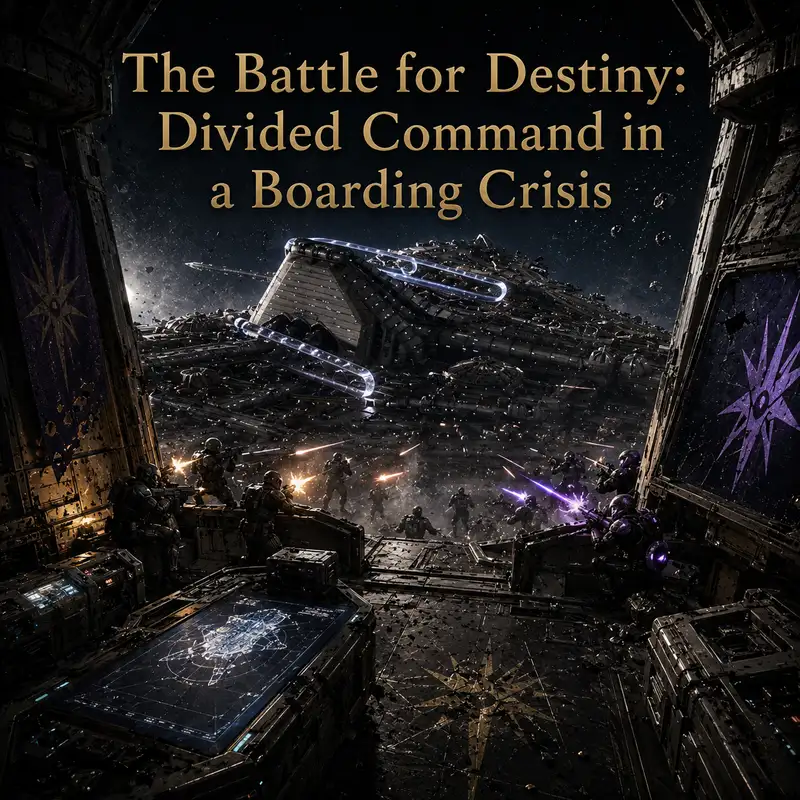
The Battle for Destiny: Divided Command in a Boarding Crisis
Commander Kiva and Colonel David Telford fired at almost the same instant. Both fell in Destiny’s gate room. Outside the hull, Lieutenant Matthew Scott and Master Sergeant Ronald Greer were completing a repair before the next burst from a binary pulsar. Colonel Everett Young had surrendered the ship and was being disarmed. Nicholas Rush and Adam Brody were hiding in an auxiliary control room. Eli Wallace and Chloe Armstrong were isolated in an unexplored section. Lieutenant Tamara Johansen was treating enemy wounded. At the most dangerous moment of the boarding action, no commander on either side controlled enough of Destiny to decide the battle alone.
That fragmentation defined the battle for Destiny. The Lucian Alliance possessed an armed assault force, the gate room, hostages, and eventually access to the ship’s general controls. Young retained loyalty from most of the original crew but repeatedly lost physical control of the compartments they occupied. Rush understood Destiny better than anyone else, yet answered to military authority only when he believed the decision protected the ship. Camile Wray could negotiate but could not enforce an agreement. The battle became a contest over divided command, with weapons, information, technical access, and legitimacy distributed among people who did not fully trust one another.
The Alliance objective was straightforward in strategic terms and difficult in every practical detail. Kiva intended to seize an Ancient vessel carrying intergalactic navigation data, weapons, power systems, and archives gathered across a voyage lasting more than a million years. Her force had crossed from a second naquadria-rich world using a nine-chevron connection that destroyed the launch site behind it. Once aboard, the invaders could not expect reinforcement, resupply, or an easy return. They had projected military power across billions of light-years and converted themselves into a stranded occupation force in the same movement.
Young’s objective was narrower. He had to deny the ship to the boarders, preserve as many lives as possible, and keep Destiny capable of continuing its voyage. Those aims conflicted immediately. Killing everyone who entered the gate room offered the best chance of protecting the vessel. Preserving Rush, Telford, Johansen, and the hostages required restraint. Retaking corridors with rifle fire could also damage systems no one knew how to replace.
Destiny’s internal design favored containment but punished incomplete knowledge. Heavy doors divided corridors into compartments. Atmosphere could be removed from selected areas. Kinos allowed surveillance without exposing personnel. Control consoles could open doors, redirect shields, and transfer access to systems elsewhere in the ship. Yet the original crew did not possess a complete deck plan or a formal damage-control organization. The Alliance arrived with intelligence from Telford and devices capable of forcing Ancient doors, but its people understood even less. Both sides operated inside a fortress whose controls were available in fragments.
The defenders knew that any attack had to enter through the Stargate. Young sealed the gate room and surrounding corridors, positioned armed teams nearby, and prepared to vent the compartment once the invaders arrived. The plan exploited the single predictable point of entry. It did not require a prolonged firefight, and it reduced the danger of stray rounds damaging the ship. In purely tactical terms, it was the strongest defense available. Its weakness was not technology. Its weakness was the identity of one man in the first wave.
Telford and Rush were still linked through the Ancient communication stones when the Alliance dialed Destiny. Rush’s consciousness occupied Telford’s body at the Alliance base, while Telford occupied Rush’s body aboard the ship. Kiva sent the body she believed belonged to Telford through the gate with the advance force. Gate transit broke the connection. The real Telford awakened inside his own body among the boarders, while Rush returned to his body in Destiny’s infirmary. From Young’s camera feed, the important fact was simpler. Telford’s body had entered the kill zone, and Rush might still be inside it.
Young hesitated over the atmosphere control. The delay preserved Telford and avoided the possible loss of Rush, whose knowledge remained essential to Destiny’s survival. It also surrendered the best moment to destroy the boarding force. Kiva’s troops fitted masks, placed devices on the doors, forced the bulkheads open, and used smoke and flash grenades to disrupt the defenders. Young lacked certainty about how the body exchange would react to gate travel or death, and he had only seconds to decide. By the time he ordered the gate room vented, containment had failed.
The first corridor fighting broke the original defensive plan into isolated local actions. Alliance troops pushed through smoke, captured wounded personnel, and expanded away from the gate room. Sergeant Hunter Riley suffered a head wound and was taken. Rush left the infirmary despite orders to remain safe, drawing Johansen into the contested area. Eli and Chloe fled into an elevator as Alliance troops overran the nearby corridors, and Chloe was shot in the leg. The fighting did not produce one continuous front. It produced pockets of control separated by doors, darkness, and incomplete radio reports.
Kiva established a defensible foothold without controlling the ship. She held the gate room, several adjoining corridors, prisoners, and the expedition’s only functioning medic. Young retained the main control area, armed teams, and access to specialists who could manipulate Destiny’s systems. Kiva could threaten hostages. Young could threaten atmosphere and doors. Neither could eliminate the other without risking people or machinery each side needed. The battle therefore shifted from assault to coercive negotiation while gunfire remained close enough to keep every promise provisional.
Command on the defending side was already divided before the first negotiation began. Young held military authority and accepted responsibility for retaking the ship. Wray represented the civilian population and argued that preserving hostages required negotiation. Rush viewed the crew through the logic of acceptable losses and believed Young would eventually have to sacrifice some prisoners to save the remainder. Each position addressed a real problem. None provided a complete solution. Young could not treat civilians as expendable. Wray could not bargain indefinitely with an enemy determined to own the ship. Rush could not be allowed to define acceptable losses without oversight.
Young attempted to regain the initiative by offering medical supplies. Greer carried the bags while posing as another medic, and Scott’s strike team waited beyond a sealed hatch. The plan depended on surprise, precise timing, and stable power. A pulsar-induced blackout interrupted the exchange before the assault could begin. Both sides raised weapons in darkness, Young halted his men, and Kiva withdrew with Johansen. She then killed a hostage named Rivers to prove that further deception would carry an immediate cost. The mechanical failure and the attempted ambush became indistinguishable to the people holding the prisoners.
Wray then arranged a limited prisoner exchange. Kiva received four Alliance personnel, food, and water. The defenders recovered several captives and Rivers’s body, though Kiva did not fully honor the agreed terms and retained Johansen. The exchange did not resolve the battle, but it produced intelligence. The released prisoners confirmed that Eli and Chloe were not in Alliance custody. That meant two civilians remained free somewhere in the forward sections. Their location was unknown, but their freedom represented a surviving command-and-control node outside both formal headquarters.
Eli’s situation illustrated the value of decentralized initiative. He had no rank and no authority over military operations. He did possess a kino interface, knowledge of Ancient consoles, and the determination to keep Chloe alive while carrying her through sections with weakening life support. When they found a powered console, Eli attempted contact in Ancient rather than waiting for rescue. His message eventually allowed Rush to locate them and later helped Scott and Greer find another route inside. The civilians who had been ordered to remain out of the battle became essential because the command system had lost contact with itself.
The same power failures that disrupted the negotiations were not random. Rush, Brody, Dale Volker, and Lisa Park identified a binary pulsar near Destiny. Repeated radiation bursts struck the ship at intervals of roughly forty-six minutes, forcing the shields to draw increasing power and degrading the faster-than-light drive. The Alliance’s wormhole had caused Destiny to stop in the wrong place at the wrong time. If the shield failed, every faction aboard would die. The battle now had a third actor that accepted no surrender and showed little interest in questions of lawful command.
Survival required redirecting shield power toward the pulsar and repairing an external array. Scott and Greer could perform the work, but the nearest exit lay inside Alliance-controlled territory. Kiva understood the leverage immediately. She would permit the two men to pass only if Young transferred control of Destiny’s systems. The demand transformed environmental cooperation into a surrender condition. Young could refuse and preserve nominal command until the radiation killed everyone, or accept and hope that control could later be recovered.
Telford supplied the plan that made surrender tolerable. Kiva believed his conditioning remained intact, giving him freedom inside the occupied area. He proposed that Young transfer the ship while Rush and Brody disappeared into an auxiliary control room. Telford would later reach a gate-room console and return system control to Rush. The plan depended on several people deceiving Kiva at once, on Rush resisting the temptation to seize control too early, and on Telford surviving inside a force that had already discovered him once. It was not a comfortable plan. It was the only plan that addressed the pulsar before the next radiation burst.
Young accepted. The Alliance received control, doors opened, and most of the original crew surrendered their weapons. Kiva’s troops concentrated prisoners in the mess hall and began treating the accessible ship as occupied territory. Rush and Brody withdrew as planned. Eli and Chloe remained concealed. Scott and Greer entered spacesuits and crossed the hull toward the shield mechanism. For a brief period, Kiva possessed the strongest military position of the battle. Her people controlled the gate room and central systems, while Young’s command existed as a promise among prisoners, hidden scientists, one embedded officer, and two men outside the ship.
Telford began transferring control back to Rush, then sabotaged a relay to draw technicians away from the gate room. Kiva found him at the console. Their simultaneous gunfire wounded both and stopped the transfer before it was complete. The Alliance had captured Destiny through centralized leadership, and now that leadership lay bleeding beside the controls. Young was disarmed. Rush remained hidden. Scott and Greer were outside with the radiation clock running. The battle had reached a point where everyone possessed part of a solution and no one possessed the authority or access required to combine them.
Dannic assumed command of the Alliance force. His authority came from proximity to Kiva and from the soldiers willing to obey the most aggressive surviving leader. Varro challenged his judgment, arguing that the expedition still needed cooperation from the original crew and medical help for Kiva. Dannic viewed restraint as weakness and the military prisoners as liabilities. The difference was more than personality. Varro wanted to preserve a force that could survive aboard Destiny. Dannic wanted to preserve possession of the ship, even if the effort consumed the people needed to operate it.
Scott and Greer completed the shield adjustment but found their original airlock closed. Eli guided them toward another entry point, and they sheltered against the radiation long enough to reenter. Once inside, they acquired weapons, linked with Rush’s group, and began moving toward Johansen and the infirmary. Their return gave the defenders a mobile combat element, but not enough force to retake Destiny conventionally. Every firefight risked hostages, medical patients, and irreplaceable systems. Scott and Greer could win corridors. They could not solve the command problem by shooting through the entire ship.
Johansen’s position showed how thoroughly the battle had erased clean categories. She treated Varro because medical duty required it and because Kiva controlled access to other wounded people. When Kiva and Telford were shot, Johansen became essential to both factions. During the confusion, she was shot as well. Earth physicians later reached Destiny through the communication stones, but they could not save Kiva or Johansen’s unborn child. The struggle for command had concentrated armed personnel around the only medical provider and converted the infirmary into contested terrain. Tactical control carried a human cost that no later surrender could reverse.
Dannic reduced his security burden by forcing most of Young’s people through the Stargate to a marginally habitable world under violent storms. Varro’s followers were later sent after them when they refused Dannic’s authority. The action removed prisoners from the ship but also created a mixed group of former enemies under Young’s leadership on the planet. Dannic had simplified occupation aboard Destiny while strengthening the political basis for cooperation against him. Exile became an unintended coalition-building exercise.
Aboard the ship, Rush, Brody, Eli, and Chloe established a protected enclave in the hydroponics compartment. Plants provided a limited local oxygen supply, the doors could be sealed, and the area lay within a section better protected from the pulsar. Scott and Greer attempted to reach Johansen before the next burst. Rush chose a different approach. He began draining shield power from the rest of Destiny while preserving hydroponics. The next radiation wave would kill the Alliance personnel outside and many of the original crew still aboard. It would leave his enclave alive and the ship recoverable.
The ultimatum transformed technical access into strategic command. Rush did not control the armed force, the gate room, or most of the crew. He controlled the one system that determined who would survive the next five minutes. Dannic could surrender, assemble his people where they could be monitored, and allow the shield to be restored. If he refused, Rush claimed he would accept the deaths of Scott, Greer, Johansen, Wray, Telford, and anyone else outside hydroponics as a necessary sacrifice. The scientist who had criticized Young’s hesitation now offered the opposite command philosophy.
Whether Rush would have carried out the threat remained uncertain until the final seconds. His protected position gave him a credible advantage, but his own hesitation revealed the cost. Eli understood that Dannic was not bluffing. Brody reminded Rush that their friends remained outside. Scott, cut off by enemy fire, ordered Eli to seal the compartment and proceed with the plan rather than increase the chance that Dannic would find them. Divided command had produced a terrible form of mutual consent. The people at risk were authorizing a decision the lawful commander was no longer present to make.
Dannic refused because surrender threatened his authority more immediately than radiation threatened his life. Telford warned that the next burst would kill everyone. Ginn confirmed that Rush’s threat was technically possible. Dannic still insisted that possession of Destiny justified the risk and turned his weapon on Telford. Ginn shot him from behind and informed Rush that the remaining Alliance personnel would comply. The invasion ended through mutiny because the Alliance had no trusted procedure for removing a commander who intended to sacrifice the force for his personal control of the ship.
Rush restored the shields. Scott and Greer secured the remaining personnel. Destiny recovered the people Young had taken to the planet, along with Varro and the Alliance members loyal to him. The boarders were disarmed and confined. Kiva died from her wounds, while Telford survived. The ship returned to faster-than-light travel carrying the original expedition, former hostages, and a new population of prisoners whose skills and loyalties would become an immediate logistical and political problem.
The defenders prevailed partly because their own divided command, though dangerous, was resilient. Young could be captured without eliminating Rush’s technical access. Rush could hide without taking Scott and Greer off the battlefield. Wray could negotiate when Young’s credibility with Kiva had collapsed. Eli could restore communications from outside the formal chain. Johansen could preserve lives across faction lines. The arrangement generated conflict and almost lost the ship at several points, but no single capture or shooting removed every essential function.
The Alliance suffered from the opposite design. Kiva concentrated intelligence, political authority, and operational direction in herself. Dannic inherited coercive power without her restraint. Varro’s followers obeyed personal loyalty rather than a common command system. Ginn’s expertise mattered only when she was willing to defy the hierarchy. The force had enough weapons to seize Destiny but lacked the institutional trust needed to operate after losing one commander. It crossed the universe as an army and dissolved into rival constituencies within hours.
The battle also established that controlling Destiny required more than holding the gate room or a bridge. Command depended on armed force, technical knowledge, life support, communications, medicine, and cooperation across the ship. Kiva gained entry, hostages, and temporary system access. She never gained a sustainable crew capable of operating, repairing, and governing the vessel after the shooting stopped.
The victory did not restore the old conditions. Johansen had lost her child. Rivers and others were dead. The Alliance survivors remained aboard as prisoners, intelligence sources, potential recruits, and continuing security risks. Varro and Ginn had shown that some boarders could cooperate, while others remained committed to the organization that sent them. Young now had to govern former enemies inside the closed environment they had tried to conquer.
The battle for Destiny was decided by divided command because divided command shaped every failure and every recovery. Young’s hesitation allowed the breach. Wray’s negotiation preserved hostages and intelligence. Telford’s deception made surrender reversible. Scott and Greer kept a combat force alive outside the occupied corridors. Eli restored links that headquarters had lost. Rush turned the pulsar into leverage. Ginn ended a command that could no longer distinguish mission success from collective death.
No one won by controlling the whole ship. The defenders won because their separate centers of authority eventually aligned long enough to deny it to an enemy whose own command fractured first. Destiny emerged from the crisis under Young’s authority, Rush’s technical control, and the labor of soldiers, civilians, scientists, and former Alliance personnel who would now have to survive together. The final battlefield was not the gate room or the corridor. It was the question of whether divided people could become one crew before the next crisis demanded another impossible decision.