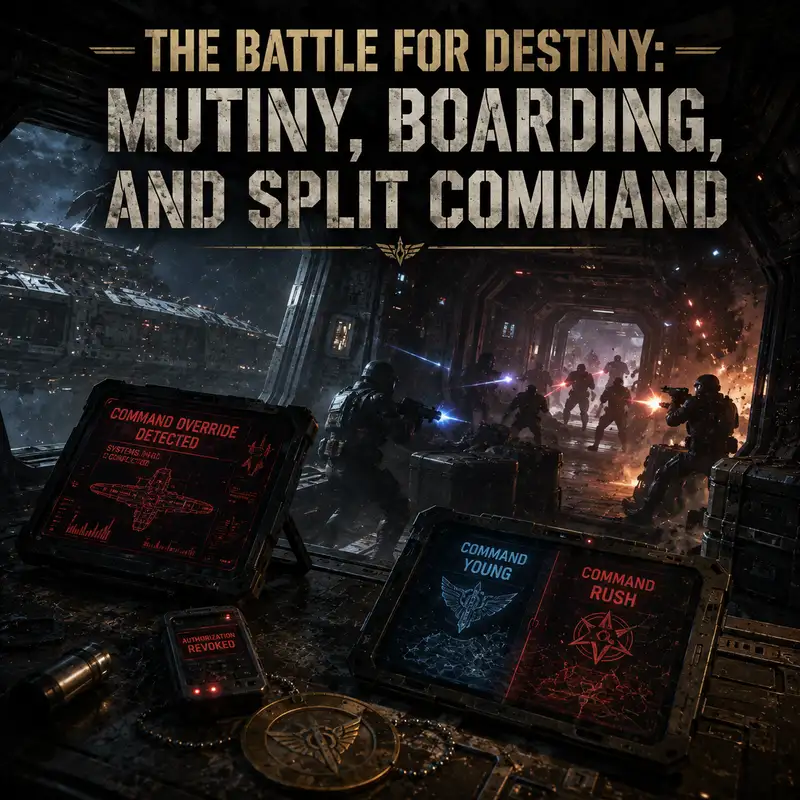
The Battle for Destiny: Mutiny, Boarding, and Split Command
The hand over the atmosphere control was ready to turn a sealed gate room into vacuum. Colonel Everett Young had one clear tactical advantage. The Lucian Alliance could enter Destiny only through a single compartment, and he could remove the air before the boarders opened the doors. Then the first wave came through carrying the body of Colonel David Telford, still believed to contain Nicholas Rush’s consciousness. Young hesitated. Gate transit broke the communication-stone connection, Rush awoke elsewhere on the ship, and Telford regained his own body among the invaders. The moment intended to save one man gave the boarding force time to survive.
The Battle for Destiny was not decided by one firefight or one commander. It became a struggle across sealed compartments, auxiliary control stations, damaged corridors, an exposed hull, and a planet within Stargate range. Military personnel, civilians, scientists, infiltrators, and Lucian Alliance factions each controlled part of the situation. The ancient ship imposed its own schedule while a binary pulsar fired lethal radiation across the battlefield. Destiny was almost lost because command had fractured before the enemy arrived. It was recovered because those same fractures created hidden places from which resistance could continue.
The expedition had never been a normal ship’s company. Most of its people had evacuated Icarus Base without choosing Destiny as their destination. Young held military authority, Camile Wray represented civilian oversight, and Rush possessed technical knowledge nobody else could replace. The ship remained damaged, partly unexplored, and largely automated. Its Stargate offered local reach but no physical supply line to Earth. Communication stones could bring advisers into borrowed bodies. They could not deliver ammunition, food, or a relief battalion when armed intruders reached the gate room.
That command system had already broken once. After Young abandoned Rush on a planet and falsely reported that he could not be recovered, Rush returned and joined Wray in a civilian takeover. They transferred controls into a research room, sealed bulkheads, divided military and civilian sections, and used food, water, and life support as leverage. Young’s troops retook the ship, but the mutiny proved that Destiny’s systems could be redistributed and that one faction could hold essential functions without controlling every corridor. The political dispute remained unresolved. The technical knowledge survived.
The invasion began as an intelligence failure on Earth. Telford had spent months infiltrating the Lucian Alliance before being compromised by Goa’uld conditioning technology. He supplied information on Icarus Base, the ninth-chevron project, and the people assigned to it. The Alliance used that intelligence to attack the original base and later build another installation on a naquadria-rich planet. Rush discovered the betrayal through memories that bled across the communication-stone link after occupying Telford’s body. The expedition knew it had a mole, but not whether the man understood that he had become one.
Young answered with an extreme counterintelligence measure. While Rush’s and Telford’s consciousnesses were linked across the stones, Young depressurized the compartment containing Telford’s mind in Rush’s body. He allowed the body to reach clinical death, restored the atmosphere, and resuscitated it. The interruption broke the conditioning. Telford awoke with his original loyalty restored and warned that the Alliance intended to seize Destiny. The method worked exactly once, which was fortunate because deliberate clinical death is difficult to present as a sustainable personnel-security program.
Telford’s intelligence gave Homeworld Command the location of the launch site. General Jack O’Neill ordered a preemptive strike, and Samantha Carter brought the George Hammond into orbit. The base was shielded against Asgard beaming, forcing Carter to send F three-oh-twos and ground forces. Under attack, Commander Kiva ordered the ninth chevron dialed before the planetary calculations were safe. The Stargate connected, but the naquadria core began to collapse. Carter extracted the forces she could and withdrew before the planet exploded, leaving two fighters that could not return in time.
The strike destroyed the installation and killed much of the assault force before it reached Destiny. It also forced the survivors through the gate with weapons, technical equipment, and Rush as a prisoner. Homeworld Command denied the enemy a permanent launch base but did not stop the boarding. Earth could attack the origin point with a battlecruiser and still remain physically unable to reinforce Destiny at the destination. Once the wormhole closed and the planet was gone, the battle belonged to the stranded expedition.
The Alliance objective was larger than revenge. Destiny represented Ancient technology, intergalactic reach, and a mission whose full purpose remained unknown even to its occupants. Capturing it could give the Alliance scientific advantage and leverage against Earth, the Free Jaffa, and rival leaders within its own network. Kiva did not intend to steal a few devices. She planned to take the ship, retain useful specialists, and leave the remaining expedition on another world.
Young’s defense matched the geometry of the threat. The gate room was sealed. Kino cameras watched the incoming wormhole. Military teams occupied nearby corridors, and civilians moved to safe areas. The plan was to vent the compartment, restore the atmosphere, and secure survivors as prisoners. The enemy had to arrive inside a room whose life support Young controlled. The plan encountered one variable wearing the body of a fellow colonel.
Young’s hesitation was based on information that had been correct seconds earlier. Rush had occupied Telford’s body on the Alliance planet. When that body appeared in the gate room, Young believed venting the compartment would kill Rush. Crossing the gate severed the stone connection and returned each consciousness to its own body, but Young did not receive that update before deciding. Rush was already safe in the infirmary. Telford stood among the boarders. The delay allowed Kiva’s specialists to defeat the door locks and turn a contained incursion into corridor combat.
Smoke, flash devices, and automatic fire disrupted the defenders. Riley suffered a head wound and was captured. Kiva seized hostages and consolidated the gate room with nearby passages rather than scattering her reduced force. Chloe Armstrong was shot while fleeing with Eli Wallace. Eli carried her into an unexplored section where neither side knew their location. Young still held the primary control interface room and many soldiers. Kiva held the gate room, prisoners, and access to terminals that could open more of the ship.
The result was an internal siege. Bulkheads became borders, and atmosphere controls became weapons. Young could vent Alliance sections, but hostages were inside them. Kiva could kill prisoners, but needed the expedition’s knowledge to operate the ship. Wray negotiated exchanges for wounded personnel, food, and water. Kiva killed a hostage when she believed the defenders had violated an understanding. Negotiation preserved lives while confirming that every promise rested on a loaded weapon.
The battle also had too many commanders. Young directed the military defense. Wray handled negotiation. Rush interpreted the ship and challenged both. Scott and Greer controlled tactical teams. Kiva commanded the boarders. Telford had returned to Earth loyalty while trapped inside the Alliance position. Varro favored survival and a controlled transfer. Dannic treated compromise as weakness. Each held authority over something the others needed. Nobody had enough authority to end the battle alone.
Destiny then introduced another combatant. The gate arrival had pulled the ship from faster-than-light travel near a binary pulsar. At regular intervals, the rotating neutron star sent gamma radiation and X-rays across the hull. Shields and structure protected the crew, but the bursts drained power, caused blackouts, and prevented the ship from resuming its course. The Alliance had boarded a strategic prize and found it parked inside a radiation hazard. Ancient navigation had selected the location without consulting either command.
Rush calculated that the shield did not need equal strength around the vessel. Most power could be concentrated toward the pulsar, leaving enough protection elsewhere until the engines recovered. Because Kiva held the core controls, the adjustment required Scott and Greer to go outside between bursts and reconfigure a shield assembly on the hull. The environmental crisis created a reason to cooperate. It also created a way to destroy the enemy without shooting through hostages.
Telford contacted Young and proposed a false surrender. Young would transfer control to Kiva and allow the crew to be disarmed. Rush and Adam Brody would disappear into an auxiliary control room, preserving access to power distribution. Telford would restore more control when an opportunity appeared. The plan was possible because Rush’s earlier mutiny had demonstrated how to create a second command node. An act that nearly broke the expedition now supplied the architecture for resistance.
Young surrendered the visible ship. Alliance personnel opened the bulkheads, disarmed the crew, and concentrated prisoners in the mess hall. Scott and Greer went onto the hull. Rush and Brody moved into the auxiliary station. Telford began transferring systems from the gate room, but Kiva recognized the sabotage and confronted him. They fired at the same moment. Both fell wounded, the transfer stopped, and the boarding force lost its commander as the shield operation reached its most dangerous point.
Scott and Greer completed the adjustment, but the Alliance restored the shield before they returned through the hull opening. The next radiation spike struck while they remained outside. They survived by moving to the underside of the ship, where the hull provided additional protection. Inside, the new Alliance command assumed they were dead or irrelevant. Two of Destiny’s most capable soldiers had disappeared from the tactical map without leaving the battlefield.
Kiva’s death changed the enemy more than the loss of any corridor. Varro wanted to preserve prisoners, stabilize the ship, and keep selected specialists. Dannic wanted retaliation and unquestioned control. Simeon supported the harder line, while Ginn understood enough of Destiny’s systems to recognize the danger. Dannic declared himself commander because nobody challenged him immediately. That was authority by intimidation, and it weakened each time the ship produced another problem he could not solve.
The fighting inflicted costs beyond the command contest. During an attempt to move prisoners, a struggle caused an Alliance weapon to fire through a crowded compartment. People on both sides were killed or wounded. Tamara Johansen was shot in the abdomen while pregnant. Alliance personnel needed her medical skill even as their actions made her a casualty. Chloe remained wounded in an isolated section, though her injuries began healing with unnatural speed because of earlier alien alteration. The battle was producing medical emergencies faster than the infirmary could absorb them.
Dannic separated military and civilian prisoners, then used the Stargate to strand Young and much of the expedition on a planet with breathable air and a severe electrical storm. Destiny could leave them permanently when it returned to faster-than-light travel. Varro objected to mass killing and was sent through with several loyal followers. Young now commanded stranded personnel on the ground, while the people still able to retake his ship operated without him.
That split was not entirely a weakness. Scott and Greer returned through an airlock after the radiation spike and rejoined Eli, Chloe, Rush, and Brody. Their hidden group occupied sections the Alliance did not understand. Kinos provided surveillance. Unexplored corridors provided concealment. Auxiliary controls retained limited access to power. The boarders held the gate room and central stations, but lacked a complete map, a trained crew, and the knowledge to distinguish malfunction from sabotage. Capturing the command console had not made them masters of an Ancient ship.
Rush used the pulsar as leverage. He diverted power away from the shields and stopped the faster-than-light countdown, keeping Destiny near the planet and inside the radiation zone. His group moved into hydroponics, a compartment protected by its depth inside the hull. The next pulse would be survivable there with reduced shielding. Alliance personnel around the control room would not be equally protected. Rush threatened to continue draining power until the boarders surrendered. He made the ship itself the hostage.
Dannic ordered Rush’s group killed and prepared to breach hydroponics with explosives. Scott and Greer ambushed the team sent to execute them. A blast large enough to open the compartment could kill Rush, the scientist Dannic needed to restore the shields. Telford, recovering from his wound, told the Alliance that Rush’s threat was credible. Dannic continued because surrender threatened his authority more immediately than radiation threatened everyone’s lives.
Rush’s leverage worked because the enemy believed he might accept friendly casualties. Young had hesitated to vent the gate room when one man appeared endangered. Rush told Dannic that people still exposed elsewhere would be a necessary sacrifice. Eli, Chloe, and Brody could not know whether he was bluffing. That uncertainty was the weapon. Rush did not need to defeat the boarders in a firefight. He needed them to decide that following Dannic meant dying for Dannic’s possession of a ship none of them knew how to fly.
The final command decision belonged to Ginn. She watched Dannic reject technical warnings, threaten Telford, and insist that his people had been prepared to die from the moment they entered the gate. She shot him before he could kill those opposing him. With Dannic dead, Ginn informed Rush that the surviving boarders would comply. The battle ended through an internal change of command rather than an assault on the gate room. The Alliance surrendered because one of its own specialists recognized that Dannic had made possession of Destiny incompatible with survival.
Rush restored the shields and allowed the ship to continue. The Stargate reopened to the storm planet, and the crew received Young’s people back aboard. Varro and the Alliance members exiled with them also returned as prisoners. This was not a clean expulsion. Destiny had finite food, water, living space, and security personnel, and now carried people who had arrived to seize it. There was no nearby prison, no transport home, and no safe reason to assume every captive shared Dannic’s loyalties.
Tactically, the expedition regained the ship. The Lucian Alliance lost its launch planet and failed to take Destiny. Earth still gained no reliable ninth-chevron supply route. More importantly, the Alliance proved that another human power could reproduce enough of the Icarus project to reach the Ancient vessel and compromise Homeworld Command through conditioned agents. The attack failed, but the method remained possible wherever another suitable naquadria planet could be found.
The victory did not resolve the expedition’s own command crisis. Wray had negotiated effectively for civilians who distrusted military rule. Young’s soldiers had retaken compartments and survived exile. Rush saved the ship through technical control and a threat Young might not have made. Telford supplied the warning and sabotaged the boarders. Scott and Greer completed the shield mission and preserved the resistance. No faction could claim the result without ignoring people it had recently opposed.
Young’s first hesitation remains the defining contradiction. Sparing the man he believed was Rush allowed the invasion to escape the gate room. The choice was tactically costly and morally understandable. Young had been willing to take Telford to clinical death to break conditioning and later accepted that Carter had to abandon two fighters to save the Hammond. He understood sacrifice. What he could not do in that instant was kill a specific person while looking directly at him. Kiva recognized that limit and built her position around hostages.
Rush possessed the opposite form of credibility. His mutiny, secrecy, and willingness to subordinate individuals to Destiny’s mission made the radiation threat believable. Those qualities made him dangerous to live with and decisive during the occupation. He won without formal command because he controlled a system the enemy could not replace and because everyone knew he might let the pulsar settle the argument. The same trait that damaged trust became combat power when directed against an opponent more frightened of death than disobedience.
The Alliance was not defeated by technological inferiority alone. Its people replicated the ninth-chevron method, operated Goa’uld equipment, breached Ancient doors, and captured central sections. Its greater weakness was political. Kiva, Varro, Dannic, Ginn, Simeon, and Telford did not form one stable chain of command. Kiva’s loss exposed rival ideas about the mission. Dannic replaced legitimacy with fear. Ginn ended his command when fear no longer supported survival. The boarding force fractured as the expedition had fractured, but lacked enough shared purpose to recover.
Destiny’s design nearly caused the defeat and made recovery possible. The gate room was a predictable chokepoint, but one delayed decision allowed the enemy to break out. Bulkheads divided the crew, then contained the occupation. Distributed controls enabled mutiny, then resistance. Damaged hull sections created dangerous entry routes, then allowed Scott and Greer to bypass hostile corridors. The shield protected everyone from the pulsar, yet selective control of that shield became the decisive threat. On Destiny, systems became terrain, logistics, and command authority at the same time.
The Battle for Destiny was won because nobody achieved complete control. Young lost the gate room but retained loyal forces. Kiva captured central sections but not hidden systems. Dannic held prisoners but not the technical staff’s consent. Rush controlled power without commanding the crew on the planet. Scott and Greer held a tactical foothold without strategic authority. Ginn controlled the final decision inside the Alliance line. Split command made the battle chaotic and nearly fatal. It also prevented one successful boarding from becoming permanent possession.
When the expedition returned through the gate, the compartment that had admitted the invasion received soldiers, civilians, and enemy prisoners together. Destiny resumed its journey with the original political dispute unresolved, the infirmary filled, Johansen grieving the loss of her child, and Lucian Alliance personnel trapped aboard the ship they had tried to capture. The expedition kept Destiny because its divided parts cooperated just long enough to deny it to another divided force. The ship continued not under one uncontested commander, but under a fragile system in which control had to be earned again after every locked door.