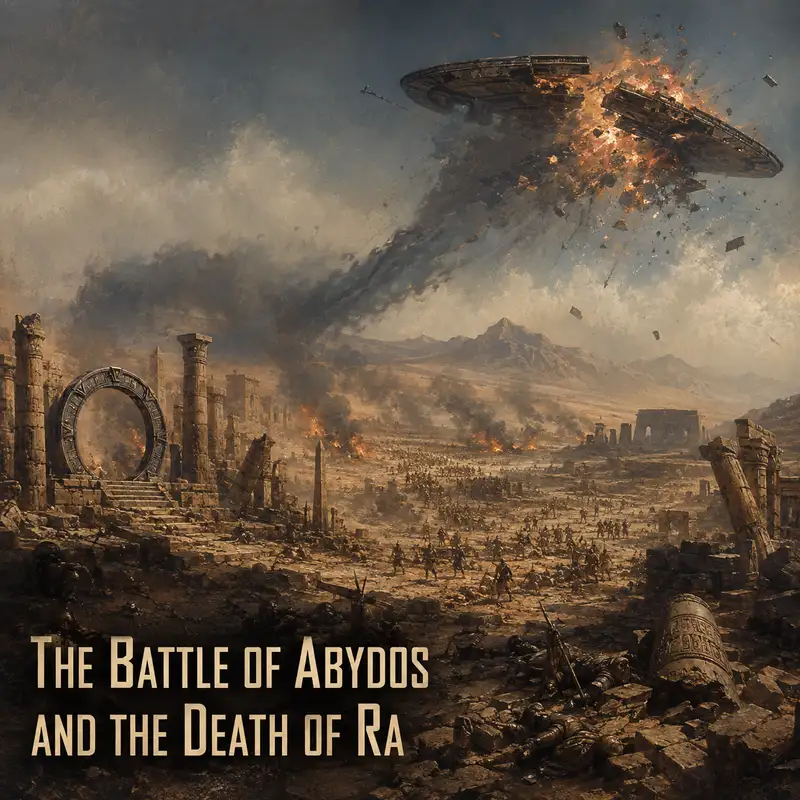
The Battle of Abydos and the Death of Ra
The battle was nearly lost when Ra began to withdraw. Outside the pyramid, the surviving Americans and their Abydonian allies had exhausted most of their ammunition and were surrendering beneath the guns of landed death gliders. Inside, Colonel Jack O’Neil was fighting Ra’s guard captain beside a nuclear bomb that could no longer be disarmed. Daniel Jackson was aboard the enemy ship with Sha’uri’s body, and the ship itself was lifting away from the planet. Every organized part of the resistance had been divided, pinned down, or isolated. Then the population Ra had ruled as slaves appeared across the desert in numbers his guards could not contain.
The Battle of Abydos was not won because Earth brought superior weapons to another world. Ra possessed the stronger technology, air power, orbital mobility, energy weapons, advanced medicine, and control of the Stargate complex. The battle was won because his occupation depended on a political assumption that collapsed faster than his forces could adapt. He expected obedience from the workers, fear from the prisoners, and precision from a small elite guard. Once the Abydonians stopped accepting his divinity, the military advantages supporting that system were no longer enough to preserve it.
The opposing forces were badly mismatched on paper. Ra’s pyramid ship sat directly above the Stargate installation and served as palace, command post, transport, and weapons platform. His armored guards could move between the ship and the pyramid by ring transporter. Staff weapons gave them overwhelming firepower against an unprotected population. Death gliders could strafe formations in the open desert, while the sarcophagus could restore injuries that would have killed any ordinary combatant. Ra also controlled the nuclear weapon brought from Earth and intended to send it back through the gate with naquadah to increase its destructive effect.
The resistance had no comparable system. O’Neil’s original detachment had already suffered deaths, wounds, and capture. The surviving military element centered on O’Neil, Kawalsky, and Ferretti, supported by Daniel, who was an archaeologist rather than a soldier. Skaara, Sha’uri, Nabeh, and several other young Abydonians had acquired American rifles and learned enough to fire them, but they had little training and no secure ammunition supply. Kasuf and the larger population had not yet committed to open revolt. The force that would defeat Ra did not begin the battle as one organized army.
Terrain favored the occupier. The pyramid dominated the flat desert and contained the Stargate, the bomb, and the ring transporter linking the surface to Ra’s ship. Its broad ramp offered a direct approach but little concealment. Heavy doors could separate fighters outside from those who entered. The ship above provided observation and rapid air response. The resistance had no artillery, no antiaircraft weapons, no armored vehicles, and no alternative route into orbit. It had one advantage. Ra had concentrated the political and technical center of his rule in a single place.
The immediate objective was not originally to overthrow an interstellar ruler. The surviving expedition needed to recover the bomb, prevent an attack on Earth, secure the Stargate, and escape. Liberation became inseparable from those tasks because the Abydonians could not be protected while Ra retained the ship and its guards. O’Neil could not simply retrieve the weapon and leave. Ra knew Earth had reopened the gate and developed atomic weapons. Even without the bomb, he now possessed intelligence that made Earth a future target.
The political turning point came before the assault on the pyramid. At the mines, one of Ra’s guards beat a worker while thousands watched. O’Neil and his allies killed the guard and opened the armored helmet. The face beneath it was human. Later television continuity would identify these armored soldiers as Jaffa, but the immediate effect on Abydos required no biological explanation. The supposed servant of a god was a man who could bleed, die, and be exposed in front of the people he had intimidated.
Kasuf initially feared that resistance would bring collective punishment. That was not cowardice. He was responsible for a population with no shelters against air attack and no means of fleeing the planet. Ra had conditioned the Abydonians to understand rebellion as an act that endangered everyone. Skaara and the younger fighters saw the same situation differently. They had watched the Earth team resist, handled weapons that could kill guards, and learned from Sha’uri and Daniel that Ra’s authority rested on deception. The argument between generations was really an argument about whether survival through submission remained possible.
The assault plan relied on deception rather than firepower. Workers approached the pyramid in a caravan carrying an offering, while O’Neil, Daniel, Sha’uri, and local fighters concealed themselves among them. Kawalsky, Ferretti, Skaara, Nabeh, and others remained outside, ready to reinforce the infiltration. The plan used Ra’s own ceremonial system against him. His guards expected tribute, bowed heads, and workers moving toward the pyramid. An occupying force that relies on ritual eventually creates predictable traffic patterns. Predictability is convenient until someone hides a rifle beneath the robe.
The disguise did not survive close inspection. A suspicious guard pulled away the coverings, and the fight began before the infiltrators had reached the bomb. O’Neil and Daniel opened fire at close range. The confined interior reduced some of the guards’ range advantage, but it also exposed the local fighters to lethal staff blasts. One of the young Abydonians was killed during the exchange. Outside, Kawalsky and the others rushed the ramp, only to have the pyramid’s heavy door close before they could enter.
That separation divided the resistance into two battles. O’Neil, Daniel, and Sha’uri were trapped inside with the bomb, the Stargate, and Ra’s guards. Kawalsky, Ferretti, Skaara, Nabeh, and the remaining fighters were stranded outside without access to the primary objective. Ra’s force could now deal with each group using different tools. Guards contested the interior. Death gliders launched against the people outside. The resistance had lost surprise and unity within moments.
The death gliders changed the tactical problem immediately. Rifles could threaten a pilot on the ground, but the resistance had no reliable way to hit fast aircraft making repeated strafing runs. The broad pyramid approach offered almost no natural cover. Kawalsky and the others overturned caravan carts and used them as a makeshift fighting position. It was an improvised shelter rather than a defensible fortification. Energy blasts struck around them, fighters were wounded, and ammunition disappeared faster than any possible resupply.
Nabeh’s death showed the imbalance more clearly than any technical comparison. He ran from the pyramid toward the makeshift position while wearing a recovered military helmet. A death glider passed overhead, and the blast consumed the space around him. The helmet rolled clear. There was no medical evacuation, no protected aid station, and no second line behind the position. The battle was being fought by people who had entered the morning as miners and village youths against aircraft built by a civilization accustomed to treating such populations as defenseless.
Kawalsky’s group kept firing until the magazines were empty. Once they could no longer return effective fire, the gliders landed and the pilots advanced on foot. Kawalsky stepped out with his hands raised, choosing surrender over the immediate destruction of the survivors. Tactically, the decision was sound. The group had no ammunition, no escape route, and wounded people behind its cover. A last burst of defiance would have produced a cleaner target for Ra’s pilots and no advantage for O’Neil inside.
While the ground force was being suppressed, O’Neil reached the Stargate chamber and found the bomb. Ra had ordered it moved into position for delivery to Earth. O’Neil responded by returning to his original mission. He armed the device and intended to remain beside it while Daniel used the recovered address to go home. The seven-minute timer was meant to guarantee destruction of the gate and deny Ra the weapon. It also placed every person near the pyramid under a deadline they did not know existed.
Sha’uri was shot as the timer began. Daniel saw the ring transporter activate and carried her body into it, gambling that Ra’s sarcophagus could restore her as it had restored him. His choice removed the only person besides O’Neil from the Stargate chamber and placed him aboard the enemy ship. It was not part of the assault plan, but it exploited a capability Daniel had observed during captivity. The resistance had no medical system capable of saving Sha’uri. Ra’s technology did, provided Daniel could reach it and survive long enough to return.
The rings delivered Ra’s guard captain, Anubis, to the chamber as Daniel traveled upward. This Anubis was Ra’s senior armored enforcer and should not be confused with the later Goa’uld System Lord of the same name. O’Neil now had to protect the bomb, survive close combat, and watch the countdown at the same time. Anubis’s armor and physical strength gave him an advantage, while the confined room made O’Neil’s rifle less useful once the fight collapsed into grappling distance.
Above them, Daniel placed Sha’uri inside the sarcophagus. Ra discovered him before he could leave and attacked with a hand device that overwhelmed Daniel without a conventional firefight. The two struggles became linked by the ring transporter. O’Neil forced Anubis’s hand onto the control jewel while the guard was positioned inside the transporter’s path. The rings activated, killing Anubis and interrupting Ra’s attack above. Daniel used the moment to enter the return transport with the recovering Sha’uri.
The same system that allowed Ra to move guards instantly between ship and surface had become a vulnerability. Centralized mobility is powerful when one side controls every terminal and authentication procedure. Ra’s ring network appears to have relied on physical access and wearable controls rather than any protection O’Neil could not defeat at close range. Once the resistance reached both ends, the transporter stopped being only an enemy advantage. It became the mechanism that would decide the battle.
Outside, Ra’s pilots appeared to have won. The American survivors and local fighters were disarmed, wounded, and under guard. Then Kasuf arrived on the ridge with the workers from the mines and settlements. More people appeared across the horizon until the guards faced a mass uprising rather than a small raiding party. The exact number is not established with military precision, and it does not need to be. The force was large enough to surround the exposed guards and overwhelm the limited fire they could produce.
This was the true decisive point. O’Neil’s team had demonstrated that Ra’s servants could be killed. Sha’uri and Daniel had explained the history of enslavement. Skaara and his friends had chosen resistance before their elders were ready. None of those actions alone defeated the occupation. Victory came when the wider population interpreted the evidence and acted together. Ra’s weapons could punish a village, execute prisoners, or break a small formation. They could not restore the belief that his authority was divine after thousands of people had seen the machinery behind it.
The guards fired into the advancing crowd, but there were too few of them and no prepared defensive perimeter. Ra’s system had been designed to control laborers, not to defend the pyramid against the labor force of the planet. The uprising surged over the guards and lifted their bodies in a deliberate echo of the ancient Earth rebellion shown in hidden Abydonian records. The symbolism was operational. It told every witness that the old pattern could be repeated and that Ra’s servants no longer controlled the ground.
Air power had suppressed the armed resistance, but it had not secured the population. Once the pilots landed to accept surrender, they gave up mobility and exposed themselves to the mass movement forming beyond their immediate field of view. Ra also appears to have lacked a larger reserve aboard the ship. His occupation depended on a small elite force and the expectation that the workers would police themselves through fear. When that expectation failed, there was no second battalion waiting behind the throne room.
Ra watched the collapse from above and chose to leave. Retreat preserved the ruler, his ship, and whatever authority he still held elsewhere. Remaining over the pyramid meant staying above a hostile population while an American nuclear device sat below. He could no longer trust the ground installation, and his personal guard captain was dead. The withdrawal was rational at the tactical level. It became fatal because the ship remained connected to the pyramid by the same transport system Daniel and O’Neil now controlled.
O’Neil attempted to deactivate the bomb after Daniel and Sha’uri returned, but Ra’s people had altered it. The countdown continued. The pyramid shook as the ship climbed away, leaving the three of them beside a device seconds from detonation. The gate could not be dialed, personnel moved through, and the area cleared in that time. The uprising had won the ground fight and still faced destruction from the weapon brought to protect Earth. Tactical victory had produced a rather severe explosive footnote.
The solution required no new weapon. O’Neil and Daniel used the ring transporter. They sent the bomb upward into Ra’s ship shortly before the timer reached zero. Ra saw the device arrive but had no time to remove it, disarm it, or leave the vessel. The explosion destroyed the ship in orbit and killed him. The sarcophagus could repair a body. It could not restore a ruler whose ship, host, and symbiote had been consumed in a nuclear detonation.
Ra’s death was therefore the product of several independent actions converging within seconds. The Abydonians seized the ground and forced his retreat. O’Neil defeated Anubis and gained control of the ring system. Daniel used the sarcophagus to save Sha’uri and returned through the same system. Ra’s own technicians had made the bomb impossible to disarm, turning it into a threat to whichever side still possessed it. No one had planned that complete sequence. The battle was won through adaptation after the original plan had failed.
The resistance did not defeat the ship with rifles, and the nuclear weapon did not defeat the occupation by itself. The ground uprising denied Ra local control. The ring transporter bridged the otherwise impossible distance to orbit. The bomb destroyed the platform from which he might have rebuilt his authority. Each action solved a different level of the problem. Remove any one of them, and the result changes. Without the uprising, Ra could hold the pyramid. Without the transporter, the bomb destroys Abydos. Without the bomb, Ra escapes with his ship and knowledge of Earth.
The cost cannot be reduced to the loss of Ra’s guards. American personnel had already died during the expedition, and Abydonian fighters were killed during the assault and strafing. Nabeh’s death was visible, but the complete local casualty total was never established. The population also faced the uncertain aftermath of a ruler who had structured labor, religion, and political authority around himself. Liberation removed coercive control. It did not automatically provide institutions, defenses, or protection against another Goa’uld arriving through the gate.
The battle achieved tactical success. Ra’s ground force was destroyed, his ship was lost, the bomb was removed from Abydos, and the surviving expedition regained the Stargate. It achieved operational success by ending Ra’s direct occupation of the planet. Politically, the Abydonians liberated themselves with assistance rather than becoming territory conquered by Earth. Daniel chose to remain with Sha’uri and her people, while O’Neil, Kawalsky, and Ferretti returned home.
The strategic result was far less complete. Later television continuity identified Ra as the Supreme System Lord, the most powerful figure in a divided Goa’uld order. Killing him did not destroy that order. It removed its dominant ruler and opened space for rivals. Earth did not know enough to exploit the resulting power struggle, and it possessed no fleet capable of protecting Abydos from another System Lord. A victory that looked like the end of the threat was, in fact, the first American strike against an interstellar political system whose scale remained hidden.
O’Neil’s false report deepened that misunderstanding. He allowed his superiors to believe Daniel was dead and the Abydos gate had been destroyed. The deception protected the newly freed population from another American attempt to close the route with nuclear force. It also left Earth’s command unaware that the gate remained usable, that an allied human society existed on the far side, and that Ra’s death had not erased the larger danger. The official record converted a complicated victory into a closed mission.
The Battle of Abydos established the pattern that would define many later Stargate conflicts. A technologically weaker force survived by combining local resistance, human intelligence, captured systems, and rapid adaptation. Control of the gate did not equal control of the planet. Air superiority did not equal political obedience. Advanced technology did not compensate for a brittle occupation structure or poor understanding of the population. Earth contributed skills and weapons, but the decisive mass belonged to the people already living under the enemy.
Ra died because he mistook fear for loyalty and technical superiority for permanent control. The Abydonians did not need to match his ship, weapons, or medicine system by system. They needed to expose the people beneath the helmets, overwhelm the small force holding the ground, and deny him the political foundation on which those systems depended. When Ra retreated, O’Neil and Daniel used his own transporter to place Earth’s bomb aboard his ship. The ruler who had moved humanity between worlds as labor was destroyed because the people beneath him finally controlled where one last piece of cargo would go.