The Battle of Antarctica: Ancient Weapons and Planetary Defense
Prometheus had lost its shields, its fighters had expended their missiles, and the next direct hit was expected to destroy the ship. General George Hammond ordered the battlecruiser to hold course for Anubis’s flagship and prepare to ram. Beneath a mile of Antarctic ice, Jack O’Neill sat in an Ancient control chair while Kull warriors closed on S G One. Earth’s first purpose-built starship was seconds from becoming a very expensive projectile when thousands of glowing drones erupted from the buried outpost and climbed toward orbit.
The Battle of Antarctica was the moment Earth first mounted a successful planetary defense against a full Goa’uld invasion fleet. It was not a conventional victory. Prometheus could delay the enemy, but not defeat it. The F three-oh-twos could protect one small cargo ship, but not control the sky indefinitely. The decisive system had been built by the Ancients millions of years earlier, buried beneath the ice, and left without a usable power source. Earth survived because S G One found that power source, O’Neill could operate the weapon, and Hammond’s force bought enough time for both facts to matter.
The crisis began with Anubis’s search for a Repository of Ancient knowledge. He had already combined Goa’uld industry with fragments of Ancient science, fielded Kull warriors resistant to ordinary weapons, and destroyed rivals who once restrained him. Earth knew he was preparing something larger. What Stargate Command lacked was a defense capable of meeting his fleet in orbit. Prometheus was operational, but still a prototype. Its shields and weapons were advanced by human standards and inadequate against dozens of Goa’uld capital ships. Earth had begun building space power. It had not yet built space superiority.
S G One reached the repository first, but Anubis’s forces arrived before the team could remove or study it. O’Neill chose to download the knowledge into his own mind, repeating an experience that had nearly killed him years earlier. The decision denied the repository to Anubis and created a possible route to the Lost City of the Ancients. It also placed a countdown inside O’Neill’s body. Human neurology could not hold the information safely. His speech, memory, and behavior began shifting toward the Ancient language while the knowledge drove him to perform tasks he could not explain.
The military crisis unfolded during a political transition. Henry Hayes had only recently become President. Elizabeth Weir, a civilian specialist in international politics, had been placed in temporary command of Stargate Command while George Hammond was removed for review. Vice President Robert Kinsey expected the change to give him greater influence over the program. Instead, Weir inherited an impending invasion, a team pursuing an uncertain Ancient weapon, and a chain of command in which nearly every normal option had already become obsolete.
Bra’tac provided the strategic warning. Anubis was moving toward Earth with a major force, and the attack would begin within days. The source was credible, but the exact composition and timing remained uncertain. Hayes and his advisers had to decide whether the warning justified exposing Earth’s limited defenses before Anubis committed his main fleet. Launch Prometheus too early, and the enemy would learn that Earth possessed no hidden Ancient weapon. Hold it back too long, and the first attacking ships could strike without opposition.
Anubis tested that uncertainty with three vessels. They emerged near Earth and attacked ships of the Nimitz carrier group from orbit. The carrier and other naval vessels were destroyed by energy fire from a direction their crews could neither see nor answer. Earth’s surface forces possessed immense conventional power, but almost none of it could engage a shielded spacecraft above the atmosphere. Hammond advised the President to keep Prometheus concealed. The decision allowed American ships to die without visible assistance, but preserved the possibility that Anubis still feared a defense he had not located.
The search for that defense depended on O’Neill’s deteriorating mind. Daniel Jackson recognized that the Ancient phrase Praclarush Taonas was both a place name and a spoken Stargate address. The gate at that location would not connect, suggesting it had been buried or destroyed. Samantha Carter could calculate the planet’s position from the address, but the team needed a ship to reach it. Teal’c and Bra’tac returned with a Goa’uld cargo vessel and a young Jaffa pilot. One small ship was now carrying the only people who might find a weapon before the invasion arrived.
The mission faced the familiar difference between access and logistics. A buried Stargate made the normal route useless. The cargo ship had to cross interstellar distance while O’Neill’s condition worsened and Anubis approached Earth. O’Neill modified the engines using Ancient knowledge he could no longer explain in ordinary language. He also transferred field command to Carter when he recognized that he was losing the ability to judge and communicate reliably. The knowledge made him indispensable. The damage it caused made him unsafe as commander.
Praclarush Taonas was a volcanic ruin, not a functioning city. The team found a small Ancient outpost protected beneath hardened lava. Inside, O’Neill activated a control chair and a holographic map. The display identified Ancient sites and directed the team back toward Earth, specifically Antarctica. The lost city they expected to find was not waiting beneath the volcanic dome. What they did recover was more immediately valuable: a zero-point module, an Ancient power source capable of activating the corresponding outpost on Earth.
Even that recovery nearly failed through counterintelligence. The Jaffa pilot accompanying Bra’tac was loyal to Anubis and attacked him while S G One explored the outpost. Bra’tac survived the fight but suffered a serious wound. O’Neill used Ancient knowledge to heal him, then modified the cargo ship again for the return journey. The incident demonstrated how little margin the mission possessed. One infiltrator, one damaged engine, or one delay at the volcanic site could have left Earth without its only viable defense.
Anubis’s main fleet arrived while S G One was still returning. More than thirty ships took position around Earth. Anubis projected himself into the White House and demanded surrender, confident that the reconnaissance strike had exposed no hidden defense. Hayes refused. The refusal carried moral clarity and very little immediate military leverage. Earth had one battlecruiser, a limited number of F three-oh-twos, nuclear weapons that could not reliably reach shielded ships, and a secret command whose best team was still in transit.
Anubis’s objective went beyond punishment. Earth had killed Ra, defeated Apophis’s first invasion, aided the Jaffa rebellion, and repeatedly disrupted the balance among the System Lords. More dangerous still, the Tau’ri had demonstrated access to Ancient knowledge. Anubis could not allow a younger civilization to convert that access into a permanent defense or a rival source of advanced weapons. The assault was therefore both a conquest operation and a counterproliferation strike. He intended to destroy the capability before Earth learned how to reproduce it.
Weir recommended using Prometheus to cover S G One when the cargo ship reached Antarctica. Kinsey objected and tried to assert control. Hayes backed Weir and gave Hammond the combat command. The resulting plan did not require Prometheus to defeat the fleet. It required the ship and its fighters to protect one slow, vulnerable cargo vessel long enough for S G One to reach the ice. This was a holding action built around an intelligence estimate. If the Antarctic location contained nothing useful, the defending force would be destroyed for no strategic return.
The command arrangement was distributed across several locations. Weir remained at Stargate Command, translating operational reports into recommendations for the President. Hammond commanded Prometheus and the fighter force. Carter commanded S G One once O’Neill stepped aside. Bra’tac controlled the cargo ship after the team ringed below the ice. O’Neill alone could operate the Ancient systems, but he was no longer capable of explaining the plan. The battle had no single commander with a complete picture. Coordination depended on each leader understanding a narrow responsibility and trusting that the others would complete theirs.
The cargo ship arrived over Antarctica under immediate attack from death gliders and Al’kesh bombers. Prometheus rose from Earth with its F three-oh-two complement and placed itself between S G One and the incoming aircraft. Hammond ordered the scout ship defended at all costs. The phrase was not ceremonial. Every fighter, missile, railgun burst, and point of shield strength was being spent to preserve the few minutes O’Neill needed. Earth’s entire space combat capability had been concentrated over one patch of ice.
The F three-oh-twos engaged the Goa’uld aircraft at low altitude while Prometheus took fire from heavier attackers. The human fighters offered guided weapons, trained pilots, and better precision than death gliders, but they carried finite ordnance. As the engagement continued, the remaining aircraft exhausted their missiles and had to divert toward McMurdo rather than return to a carrier still under attack. Prometheus suffered outer-hull damage and declining shields. The holding force was doing its job, but it was consuming itself to do it.
The air battle had two different objectives. Goa’uld aircraft were trying to kill the cargo ship and prevent access to the outpost. Earth’s fighters did not need to destroy every attacker. They needed to disrupt bombing runs, draw gliders away, and keep the transport rings over the correct location. Prometheus served as shield, gun platform, and command post while absorbing fire intended for the smaller vessel. This was defense in depth compressed into minutes. Fighters protected the battlecruiser and scout ship. Prometheus protected the insertion. S G One protected the operator. The outpost, if it worked, would protect the planet.
O’Neill had modified the cargo ship’s ring transporter to solve the next obstacle. The Ancient outpost lay roughly a mile beneath the ice, far beyond the normal penetration expected from transport rings. His alterations carved a shaft downward and deposited S G One beside the buried facility. The cargo ship then moved clear under Bra’tac’s control. This was another one-time solution produced by knowledge Earth did not understand. Nobody at Stargate Command could have briefed the modification, reproduced it in advance, or guaranteed that it would not deposit the team inside solid ice.
The Antarctic structure resembled the outpost on Praclarush Taonas, but it remained dormant. O’Neill located the power interface and installed the recovered zero-point module. Anubis had already identified the site and ringed Kull warriors into the chamber. Carter, Daniel, and Teal’c fought to keep the engineered soldiers away from O’Neill while he reached the control chair. Earth had recently developed weapons capable of stopping Kull troops, but every second spent fighting them was another second in which Prometheus faced the fleet without help.
Above the ice, Hammond’s delaying action reached its final stage. The fighters were out of ordnance. Prometheus had expended its weapons, its shields had collapsed, and its crew expected the next strike to destroy the ship. Once the cargo vessel cleared the shaft, Hammond turned toward Anubis’s flagship. A collision could not stop the entire fleet, but it might remove the enemy commander and deny him an intact Earth battlecruiser. It was not a winning maneuver. It was the last useful act available to a force that had completed its covering mission.
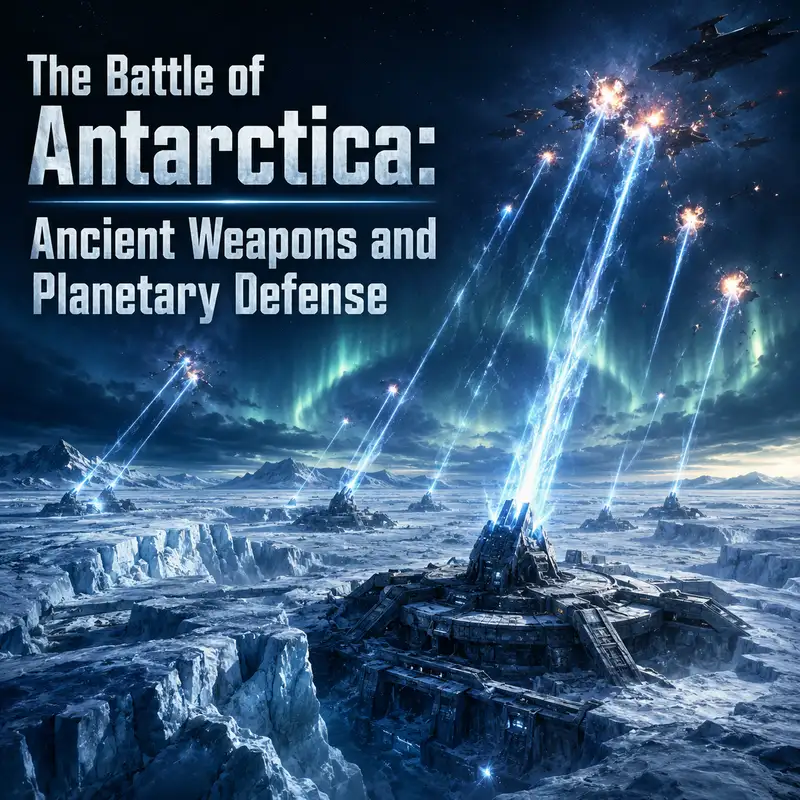
O’Neill activated the chair through the Ancient gene and the knowledge now overwhelming his mind. The outpost opened beneath the chamber, releasing thousands of drone weapons. They passed around S G One, destroyed the Kull warriors, emerged through the Antarctic surface, and accelerated into the atmosphere. The drones then divided among the targets in orbit. They avoided Prometheus and Earth’s aircraft while entering Goa’uld ships through shields that had resisted every human weapon available.
The drones were physical guided weapons rather than a conventional surface-to-orbit beam. Each could maneuver independently, seek a designated target, and penetrate or bypass defenses that stopped ordinary projectiles and energy fire. Their behavior implied sensors, control logic, and propulsion far beyond Earth’s understanding. It also implied a finite magazine. The outpost contained stored drones, not an unlimited stream of energy that could be regenerated after the battle. Earth could count what remained. It could not build replacements, explain their internal guidance, or know how many future attacks the surviving stock could stop.
The fleet’s defensive systems offered no meaningful protection. Drones struck death gliders, Al’kesh, Ha’taks, and Anubis’s flagship with enough speed and precision to overwhelm them almost simultaneously. Hammond broke off the collision course as the weapons tore the flagship apart. In minutes, the invasion force that Earth could not defeat through direct fire ceased to exist as an organized fleet. The tactical outcome was absolute. The defenders had lost ships, aircraft, personnel, and much of their available ordnance, but the enemy force in Earth orbit was destroyed.
At the tactical level, the Antarctic position held and Anubis’s ships were destroyed. At the mission level, S G One activated the defense and saved Earth. At the operational level, Hammond’s force successfully covered the insertion despite being unable to win the fleet action. Strategically, the result was more limited. Anubis survived, the Goa’uld still possessed fleets, and Earth remained dependent on technology it could not sustain. The battle was decisive for that invasion, not for the entire war.
The weapon’s performance explains why the outpost became the foundation of Earth’s planetary-defense planning. It combined global reach, extreme acceleration, autonomous target discrimination, shield penetration, and destructive power in one ground-based system. A fleet could not remain safe merely by holding orbit or attacking from above the atmosphere. The control chair allowed one operator to direct a mass of weapons against targets separated across a vast battlespace. Ancient engineering had turned the planet itself into the launch platform.
That description can make the victory sound more repeatable than it was. The outpost had been hidden for millions of years. Its original power source was exhausted. The recovered zero-point module was depleted by the battle. O’Neill possessed both the Ancient gene and a repository of knowledge that was killing him. Earth could activate parts of the system afterward, but it could not manufacture zero-point modules, replace drones at scale, or guarantee another operator could reproduce the same combat performance. A weapon requiring a rare power source, compatible biology, and knowledge downloaded directly into the commander’s brain is not yet a procurement program.
The battle also imposed a personal cost at the point of victory. O’Neill collapsed after controlling the drones. The Ancient knowledge had progressed too far for human medicine to remove it, and the outpost provided no instructions useful to the team. He indicated a stasis chamber and was placed inside before the information destroyed him. Earth had gained a planetary-defense site and lost access to the person who had made it work. The Asgard would later save him, but nobody beneath the ice could know that when the chamber sealed.
Nor had the drones permanently killed Anubis. His flagship and physical presence were destroyed, along with the fleet and Kull forces committed to the attack. His partially ascended nature allowed him to survive beyond the loss of the vessel. Earth had won the battle while failing to remove the architect of the campaign. This distinction mattered. A tactical annihilation in orbit did not end the war against Anubis, and possession of one Ancient outpost did not erase his wider influence over Goa’uld territory.
The political consequences were almost as important as the military result. Hayes had rejected surrender, restrained Kinsey, trusted Weir’s judgment, and returned Hammond to operational responsibility during the crisis. Weir emerged with the credibility to lead the later expedition to Atlantis. The Ancient site in Antarctica also became an international issue. Russia, China, Britain, France, Canada, and other governments could no longer treat the Stargate as only an American research project when a weapon beneath territory governed by treaty had just defended the entire planet.
The battle accelerated the transition from Stargate Command toward a broader homeworld-defense system. Prometheus had proven that an Earth-built ship could launch, fight, protect another vessel, and keep operating under severe damage. It had also proven that one prototype could not defeat a major fleet. F three-oh-twos had provided effective local air cover but exhausted their ordnance during one engagement. The outpost had produced overwhelming force but lacked a sustainable power source. Earth’s future defense would need ships, fighters, off-world bases, allied technology, intelligence, and political coordination rather than dependence on one buried miracle.
The civilian cost remained largely hidden. Sailors in the Nimitz group died before Prometheus launched. People on the surface saw disrupted communications, unexplained military activity, and distant flashes without being told that hostile ships had entered orbit. The secrecy protecting the Stargate Program prevented panic and concealed Earth’s capabilities from other enemies. It also meant that families could not receive the true account of why their relatives had died. Planetary defense had succeeded without public consent, public warning, or public knowledge that the battle had occurred.
The Battle of Antarctica was won by Ancient weapons, but the weapon alone does not explain the result. Daniel interpreted the route. Carter calculated the destination and took command when O’Neill could no longer do so. Teal’c and Bra’tac provided the ship and fought an infiltrator. Weir and Hayes authorized the covering action. Hammond and the crews of Prometheus and the F three-oh-twos spent Earth’s entire space force to purchase a few minutes. O’Neill turned those minutes into a planetary defense.
Earth left the battle stronger, internationally exposed, and still insecure. It had discovered that a buried Ancient outpost could destroy a fleet, but also that its own ships could barely hold the line long enough for the device to activate. The drones saved the planet because every weaker layer of defense remained in place until the last stronger layer came online. That was the lasting meaning of Antarctica. Planetary defense was not one chair beneath the ice. It was the chain of people, intelligence, ships, aircraft, alliances, and command decisions that kept the enemy from breaking that chair before it could fire.