The Battle of Antarctica: Earth’s First Planetary Victory
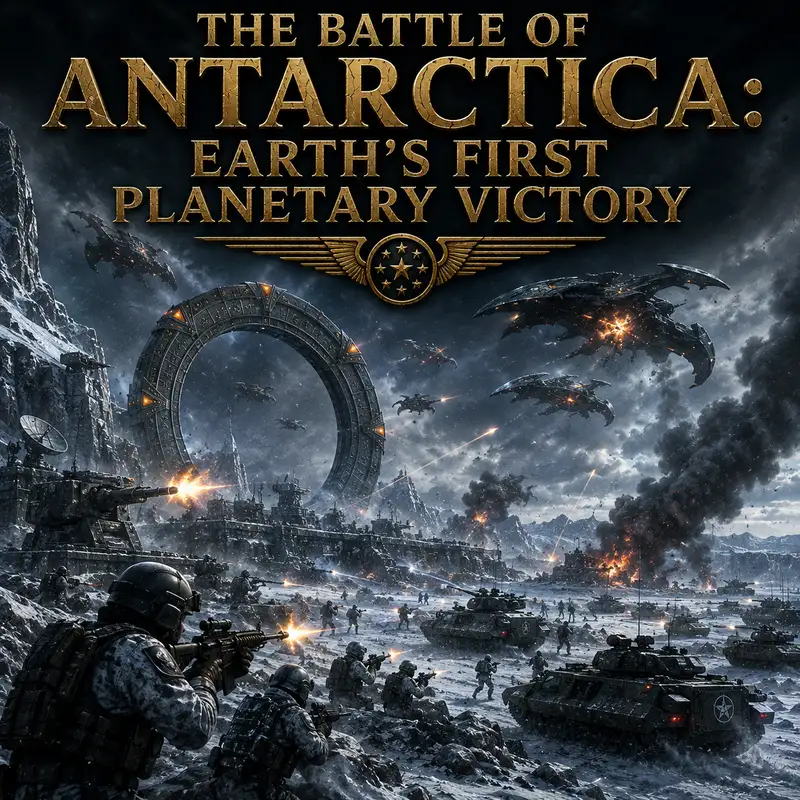
Prometheus had already lost the fighter screen when General George Hammond refused to withdraw. The surviving F three-oh-twos had expended their missiles and could not return to the ship. Goa’uld fire was cutting into the outer hull, the shields needed time to recharge, and the cargo vessel beneath Prometheus was still boring through the Antarctic ice. Hammond ordered the ship to hold. Earth’s only capital vessel was not expected to win the battle. It was expected to remain alive long enough for four people to reach a buried room.
That order explains why the Battle of Antarctica became Earth’s first true planetary victory. The decisive weapons were Ancient, the transport was Goa’uld, and the operator carried knowledge no human mind could safely contain. Yet the defense was an Earth operation. Civilian authority selected the strategy, Stargate Command coordinated the mission, Prometheus and its fighters fought the covering action, and S G One activated a weapons platform on Earth’s territory. The planet did not merely survive because a team was aboard the enemy’s ships. It fought as a planet, however imperfectly.
Anubis attacked because he believed Earth was close to finding Ancient technology capable of defeating him. That belief was accurate enough to be dangerous. S G One had recovered a tablet from Abydos referring to a lost city, and Stargate Command had located another Ancient repository. When Anubis’s forces attacked the repository site, Jack O’Neill accepted the full Ancient download rather than allow the information to be destroyed or captured. The knowledge began overwriting his brain, creating both Earth’s best intelligence source and a medical emergency with a very short clock.
Bra’tac supplied the strategic warning. Anubis was assembling the full strength of his fleet and would reach Earth in three days. The report did not include a complete order of battle, the exact route, or a target list. It did establish intent and timing. Earth could not evacuate billions of people, disperse its population through one Stargate, or build a new fleet in seventy-two hours. The available choices were to find the Ancient defense, prepare continuity sites for a tiny surviving population, or meet Anubis with forces already known to be inadequate.
The political chain of command was changing at the same moment. President Henry Hayes had placed Doctor Elizabeth Weir in charge of Stargate Command for a civilian review, while General Hammond was reassigned to Washington. Vice President Robert Kinsey expected the change to increase his influence. Instead, Weir inherited an invasion warning, a dying officer carrying alien knowledge, and a command whose most experienced leaders had just changed positions. Planetary defense is difficult enough without reorganizing headquarters during the alert.
Anubis first sent three vessels to test Earth’s response. Hammond and Hayes recognized the purpose. If Prometheus launched immediately, Anubis would learn that Earth possessed only one operational capital ship and no hidden Ancient weapon. Holding the ship back preserved uncertainty. The decision exposed conventional forces, but it denied the enemy confirmation while S G One continued the search. This was strategic deception by omission. Earth’s strongest available vessel remained underground because displaying it too early would reveal how weak the rest of the defense actually was.
One Goa’uld ship then attacked the Nimitz carrier battle group. An energy beam destroyed the carrier and struck other vessels before their crews could identify the source or return effective fire. The engagement lasted less than five minutes. Modern naval power remained formidable against threats operating within the atmosphere and on the ocean. It offered almost no answer to a shielded spacecraft firing from beyond conventional reach. Anubis did not need to defeat Earth’s armed forces one service at a time. He could demonstrate that their existing battlespace ended below his firing position.
After the naval strike, Anubis attacked power grids and broadcast networks across the world. The pattern suggests an effort to isolate command structures, suppress public warning, and make coordinated resistance more difficult. Civil authorities described visible effects as a meteor shower, an explanation with a limited service life once alien ships took station over the planet. Secrecy had protected the Stargate Program. It could not conceal orbital occupation indefinitely.
The main fleet arrived with more than thirty vessels and spread around Earth. That deployment gave Anubis surveillance, multiple firing positions, and the ability to respond to launches from several regions. It also signaled that the probing phase was over. President Hayes raised the defense condition to its highest level and prepared for a battle his advisers did not believe conventional forces could win. The fleet was not simply threatening Washington or Cheyenne Mountain. It was establishing control over the planet’s surrounding space.
Anubis also neutralized Earth’s best evacuation route. When Kinsey attempted to dial the Alpha Site, main power failed and an unauthorized incoming wormhole formed. A powerful explosive struck the closed iris. The barrier survived, but the active connection prevented Stargate Command from dialing out. Anubis had blocked the gate without capturing the mountain. Earth could no longer move selected leaders, scientists, or military personnel off world at will. The portal that had made strategic mobility possible became a locked door from the outside.
Weir identified the only viable mission for Prometheus. The ship could not defeat the Goa’uld fleet, but it could protect S G One long enough to reach the Antarctic outpost. This distinction shaped every later order. Prometheus was not committed to seek fleet superiority. It was committed as a covering force for the actual weapon system. The capital ship, its fighter wing, and their crews would absorb enemy attention while a cargo vessel remained stationary over the ice. In military terms, the conventional force supported a special operation whose target lay beneath the battlefield.
Kinsey tried to remove Weir and take command. Hayes rejected the attempt, accepted Kinsey’s resignation, and backed Weir’s recommendation. Hammond was then placed aboard Prometheus, where his knowledge of S G One and the Goa’uld threat mattered more than his formal removal from Stargate Command. The resulting command arrangement was improvised but coherent. Hayes held national authority. Weir directed the underground headquarters. Hammond commanded the space action. Samantha Carter commanded S G One after O’Neill surrendered field authority as the Ancient knowledge consumed his ability to communicate.
The available force was remarkably small. Prometheus was one experimental ship with limited combat experience. The F three-oh-twos could engage death gliders and Al’kesh, but carried finite ordnance and could not defeat an armada. S G One traveled in a Goa’uld cargo vessel obtained through the Jaffa resistance. The presumed strategic weapon was a buried Ancient installation of uncertain condition. Every element had to perform a narrow task because no single platform could solve the battle.
S G One first traveled to Praclarush Taonas, a world consumed by its expanding star and covered in molten terrain. Beneath hardened lava, O’Neill activated an Ancient outpost and identified Earth as the location associated with Terra Atlantus. He also removed a compact power module from the chair system. Earth had found a coordinate and a power source, not a complete instruction manual. The team still had to return through an enemy-controlled solar system, penetrate a mile of ice, locate the installation, and trust O’Neill to operate it before his condition became fatal.
O’Neill’s transfer of command to Carter was critical. He could modify engines, heal Bra’tac, and manipulate systems through knowledge he did not consciously understand. He could no longer reliably explain his intentions or assess them in ordinary language. Carter therefore had to command a mission whose most important technical decisions came from a subordinate acting on instinct. The arrangement worked because the team trusted O’Neill’s access to Ancient knowledge without pretending that access made him medically stable or operationally accountable in the usual sense.
The cargo ship approached Earth by leaving hyperspace close to the atmosphere on the side opposite Anubis’s fleet. Teal’c then fought to decelerate before the vessel struck the surface. The maneuver used the planet as concealment and reduced the enemy’s response time, but left almost no margin for navigation error. Once inside the atmosphere, O’Neill guided the ship toward the coordinates associated with the second Stargate previously found beneath Antarctica. The team had crossed interstellar distance. The last mile was vertical and made of ice.
O’Neill had modified the ring transporter’s matter-stream system into a cutting beam. Instead of moving personnel, the altered equipment bored downward toward the outpost. The solution was ingenious and temporary. Earth did not gain a standard ice-drilling transporter or a repeatable engineering package. More immediately, the cargo ship had to hover motionless while the beam worked. It became a fixed target with modest shields, no useful fighter screen of its own, and the full attention of Anubis’s sensors.
Al’kesh bombers and death gliders converged on the Antarctic position. Their objective was straightforward. Destroy the cargo ship before S G One reached the outpost, or force it to abandon the beam. The defenders had no ground-based air-defense network prepared for Goa’uld craft over the southern continent. The interception therefore came from the F three-oh-twos launched with Prometheus. Earth’s fighters entered a battle for which they had been designed but never tested at this scale.
The F three-oh-twos did not attack the Ha’taks in orbit. They targeted the aircraft threatening the stationary cargo ship. Their missiles and guns broke the first attack, forced enemy craft away from direct firing runs, and created a moving screen over the ice. This was the battle’s most conventional element. Pilots protected a vulnerable objective from bombers and fighters while a larger ship covered them, a mission familiar to air commanders from much earlier wars.
Prometheus then positioned itself above the cargo ship and took the heavier fire. Hammond ordered the scout vessel defended at all costs because its survival mattered more than preserving Earth’s only capital ship. That choice inverted normal force protection. The larger vessel was not the asset being protected. It was armor for the smaller one. Goa’uld fire damaged the outer hull and drained the shields while the ring beam continued below. Every hit Prometheus absorbed was another second purchased for S G One.
The defense could not continue indefinitely. The F three-oh-twos expended their ordnance and lacked a safe opportunity to return aboard Prometheus. Hammond diverted them toward McMurdo rather than risk recovery under fire. Prometheus needed to break contact and recharge its shields, but Hammond ordered it to hold until the cargo ship cleared the opening. Logistics ended the fighter contribution before courage did. Missiles do not become more plentiful because the target is important, and shields do not recover faster because withdrawal would be embarrassing.
Once the shaft was complete, S G One used the rings to reach the buried installation. Bra’tac moved the cargo ship away, removing one target from the surface action. Inside, the team found an Ancient outpost similar to the one on Taonas. O’Neill located the chair and replaced the depleted power unit with the module brought from the lava world. The installation now had energy. It still required an operator biologically compatible with Ancient systems and mentally connected to the knowledge needed to activate them.
Anubis sent Kull warriors through the outpost’s transport rings. Carter, Daniel, and Teal’c engaged them at close range while O’Neill worked at the chair. The Kull armor resisted ordinary weapons, though the disruptors developed by Earth and the Tok’ra gave the team a chance. This ground fight was small compared with the fleets above, but strategically equal to them. If one Kull warrior reached O’Neill before activation, the entire planetary defense would fail regardless of how long Prometheus survived.
The new power module awakened the chair, the control systems, and the weapon network buried beneath the ice. O’Neill did not direct the system through a conventional console. The chair responded to his mind, Ancient knowledge, and biological compatibility. Earth’s technicians could provide the power source and place him in the room. They could not replace him with another trained operator on short notice. The defense was therefore both a planetary system and a single-person dependency.
Above the outpost, the cargo ship finally moved clear. Hammond then ordered Prometheus toward Anubis’s mothership. With the shields failing and the covering mission completed, the ship had little remaining combat value at range. A collision offered the one form of damage Earth could still guarantee. The order was not a sudden act of despair. It was the final branch of the defensive plan after the actual weapon had been reached. Prometheus would either survive because the outpost worked, or strike the enemy command ship if it did not.
The Ancient drones emerged from beneath Antarctica in a vast swarm. They moved through the atmosphere, passed around Prometheus, and divided among hostile targets in orbit. Anubis’s shields were ineffective. The drones penetrated the Ha’taks, struck internal spaces, and destroyed the fleet in rapid succession. Their behavior showed autonomous guidance and target discrimination far beyond Earth’s weapons. O’Neill provided intent through the chair, while the system handled movement and attack geometry at a scale no human pilot could have coordinated manually.
Hammond broke off the collision course as the drones reached Anubis’s mothership. The command ship and the surrounding fleet were destroyed. Earth’s conventional weapons had not battered down the shields or won through an exchange of fire. The outpost invalidated the defense on which Anubis’s operational plan depended. A fleet optimized for controlling orbit had no answer to weapons launched from beneath the planet, guided through its shields, and distributed across multiple targets faster than the formation could disengage.
The victory belonged to more than the outpost. Bra’tac’s warning created time. The repository mission produced the knowledge. Weir recognized the correct use of Prometheus. Hayes protected the command decision from political interference. Hammond and the ship’s crew held the covering position. The fighter pilots kept the cargo vessel alive. Carter, Daniel, and Teal’c defended the chair. O’Neill accepted the Ancient download and activated the system. Remove any one of those contributions, and the drones might never have left the ice.
This is why Antarctica differed from the earlier battle against Apophis over Earth. In that first orbital crisis, Earth’s enhanced missiles failed, S G One destroyed the two Ha’taks from inside, and a space shuttle recovered the survivors. The planet was saved, but its formal defenses had not defeated the attack. At Antarctica, national command, Stargate Command, an Earth-built warship, Earth-built fighters, allied intelligence, and a weapon emplaced on Earth were integrated into one defensive operation. The decisive technology was inherited. The campaign was Earth’s.
The phrase planetary victory requires qualification. Earth could activate the outpost, but it could not manufacture its drones, reproduce the chair, or build another power module. The zero-point module from Taonas was a unique resource, not fuel that industry could replace. O’Neill was the only available operator with the knowledge required. Prometheus and the fighters bought access to a one-time advantage. Earth controlled the battle without controlling the technology that won it.
The outpost also did not create a permanent shield around the planet. It was fixed beneath Antarctica, dependent on stored drones, vulnerable to power depletion, and politically difficult to control in secret once other governments understood what had occurred. A later attacker could approach differently, strike the installation, exhaust the weapons, or arrive when no charged module was available. The battle proved that Earth possessed a defense. It did not prove that Earth could sustain one under repeated attack.
O’Neill paid the immediate human cost. The Ancient knowledge had nearly erased his ability to function, and activating the outpost left his pulse unstable. He directed the team toward a stasis chamber and entered suspension because no one present could remove the knowledge or repair the damage. Earth’s first planetary victory ended with its principal operator frozen beneath the battlefield. The command could report that the enemy fleet was destroyed. It could not report that the officer who made it possible had been recovered.
Other losses remained less visible. Sailors in the Nimitz battle group died before the main fleet arrived. Power and communications attacks affected populations around the world. Fighter pilots were forced to divert after expending their weapons. Prometheus suffered substantial damage while its crew prepared for a collision they did not expect to survive. The continued secrecy of the Stargate Program meant most civilians could not know why the attacks occurred, who had defended them, or how close the planet came to defeat.
The battle changed the political meaning of Antarctica. The outpost lay beneath territory governed through international agreements, while its weapons protected every nation. No single government could plausibly treat it as an ordinary classified installation forever. The victory strengthened the case for wider international participation and a civilian structure able to negotiate among governments that shared the consequences of Stargate operations without sharing equal control.
Strategically, Anubis lost more than ships. He lost the fleet intended to force Earth’s surrender and much of the military concentration supporting his claim to dominance. His command vessel was destroyed, and the System Lords gained time to resist his expansion. Yet his partially ascended nature allowed him to survive the destruction of the platform. Earth had defeated the invasion and broken the immediate force. It had not permanently removed the ruler who ordered it.
The battle established a doctrine Earth would use repeatedly even when the specific weapon could not be repeated. Intelligence identified a narrow vulnerability. Special operations reached the decisive system. Conventional forces accepted risk to protect the access mission. Political leaders preserved unity long enough for the plan to work. Advanced technology supplied the final effect, but only after ordinary organizations delivered the operator to the control point. Earth did not become stronger by matching Anubis ship for ship. It became stronger by connecting capabilities that had been developed separately.
Antarctica was Earth’s first planetary victory because the planet’s institutions, forces, allies, and recovered technology acted together under one defensive purpose. It was not proof that Earth had become secure, technologically independent, or capable of defending every allied world. One capital ship was damaged, one irreplaceable power source was committed, and one officer entered stasis inside a machine no one understood. Above the ice, the enemy fleet vanished. Below it, the cost of victory remained visible in the control chamber, waiting for someone to learn how to bring its operator home.