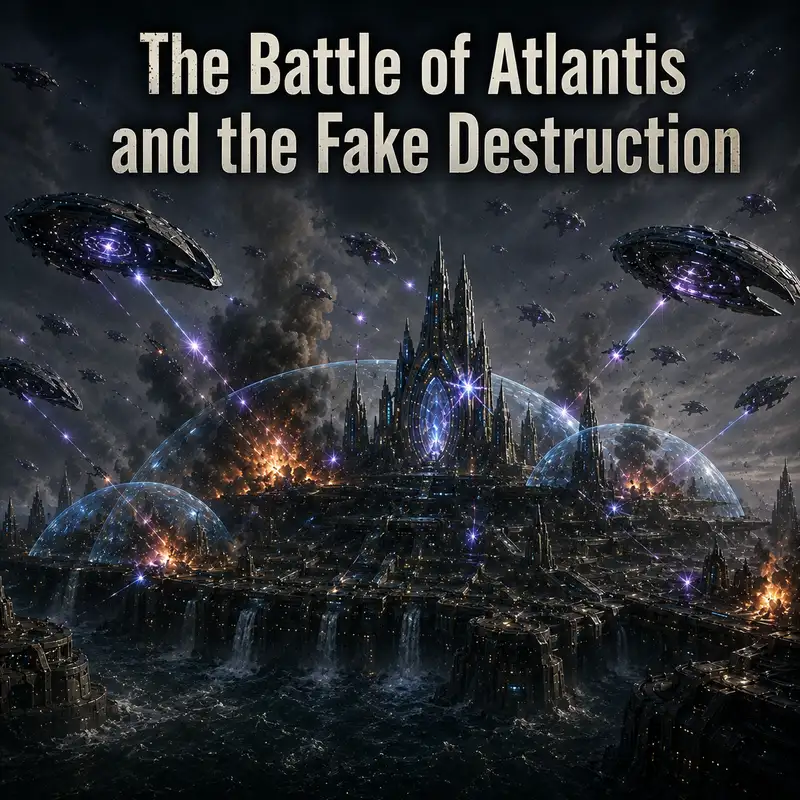
The Battle of Atlantis and the Fake Destruction
The Wraith bombardment stopped before the weapon appeared. For hours, hive ships had poured fire onto the shield above Atlantis, steadily converting the city’s only zero-point module into heat and lost time. Then Teyla Emmagan reached into the Wraith telepathic network and gave them a reason to hesitate. The humans intended to destroy Atlantis rather than surrender it. A nuclear weapon materialized above the shield, the sky became a white fireball, and the city vanished from every enemy scan.
The explosion did not destroy Atlantis. It completed a deception designed to make destruction look more convincing than survival. The Wraith saw the warning, the detonation, the cloud, the radiation, and finally an empty ocean where the city had stood. Beneath that false picture, the expedition waited without a shield. If even one hive commander doubted the story and ordered another strike, there would be nothing between Wraith weapons and the towers.
The fake destruction was the final operation in the first modern Battle of Atlantis, but it can only be understood through the defensive failures that came before it. Earth personnel had tried fixed weapons, mines, drones, railguns, nuclear strikes, and a newly arrived battlecruiser. Each method destroyed Wraith forces. None solved the larger problem. The enemy could send more ships than Atlantis could destroy, and the city’s power supply would fail long before the Wraith ran out of patience.
The first assault formation had originally contained three hive ships. An Ancient defensive satellite destroyed one on the approach before its improvised power circuit failed and the surviving hives eliminated the station. The remaining ships reached Lantea while Atlantis was almost defenseless. The city had no functioning shield, only a small reserve of Ancient drones, and no local fleet. Colonel Dillon Everett’s reinforcements brought Marines, railguns, nuclear devices, and a plan to hold until the Daedalus arrived from Earth.
That plan consumed nearly every available layer. Wraith asteroids triggered the nuclear minefield before the hive ships entered it. The resulting detonations blinded Atlantis sensors. Darts attacked through the confusion, and some pilots used their transport systems to insert warriors into the city before the aircraft crashed. John Sheppard expended the remaining Ancient drones against the incoming craft, preserving the towers while emptying a weapon stockpile Earth could not replace.
The next plan was to guide nuclear-armed Puddle Jumpers remotely through the Ancient control chair. The test worked. The modified naquadah generator powering the chair did not survive long enough to make the system operational. With Wraith forces overrunning defensive positions and no time for another repair, Sheppard took one of the Jumpers himself. He cloaked the craft, approached a hive’s fighter bay, armed the Genii-built weapon, and expected to die inside the detonation.
The Daedalus emerged from hyperspace during his final approach. Colonel Steven Caldwell transmitted a valid Earth authentication code and ordered Sheppard to lower the cloak. Once the Jumper became visible to friendly sensors, an Asgard transporter removed him from the craft. The nuclear device continued into the hive and destroyed it. Atlantis personnel saw Sheppard’s signal disappear in the explosion and believed the sacrifice had occurred. His voice returned moments later from the bridge of Earth’s newest battlecruiser.
Caldwell’s ship brought more than firepower. It carried the zero-point module needed to restore the Atlantis shield. The module had accelerated the Daedalus across intergalactic space, so transferring it to the city weakened the ship at the moment combat began. McKay and two Marines carried the device through corridors still occupied by Wraith warriors. The escort was killed, Teyla cleared the route, and McKay forced the module into its Ancient housing seconds before Darts began a mass ballistic attack on the city.
The shield rose just in time. Darts traveling at extreme speed struck the field and exploded above the towers. In orbit, the Daedalus found that Earth missiles could not penetrate the defensive screen around the final hive. Sheppard suggested using the Asgard transporter as a weapons-delivery system. The technology contained safeguards against exactly that purpose, but the Asgard engineer Hermiod bypassed them under combat pressure. A nuclear warhead appeared inside the hive, and the last capital ship of the initial assault was destroyed.
The surviving cruisers withdrew. Marines and expedition personnel cleared the Wraith still inside Atlantis. Everett survived feeding but was left severely aged and injured. Lieutenant Aiden Ford was recovered from the ocean after a Wraith enzyme kept him alive under conditions that should have killed him. The city had won the immediate battle, restored its shield, and gained an Earth warship in orbit. For a brief period, it looked like the siege had ended.
Then the deep-space sensors returned to service.
Twelve more hive ships were traveling toward Atlantis and would arrive in approximately thirty-six hours. The cruisers that escaped the first engagement had probably carried warning of the defeat and the transporter attack. Expedition research suggested that at least sixty hive ships existed in Pegasus. The number was an estimate rather than a complete register, but it made the strategic problem unmistakable. Destroying two hives had not exhausted the enemy. It had demonstrated that Atlantis was dangerous enough to justify a larger response.
The city shield offered time, not victory. One zero-point module could keep Atlantis protected for an extended period under normal demand, but concentrated bombardment would deplete it within days. The Ancient siege had lasted for years because the Lanteans possessed a larger technological and industrial system. Earth controlled one city, one module, and one battlecruiser. It could operate the shield. It could not replace the power source after the Wraith consumed it.
Sheppard argued against waiting beneath the shield. Wraith hyperdrives were slower than the Asgard drive aboard the Daedalus and required several jumps. McKay calculated that the fleet would make a final stop about fifty light-years from Atlantis. Caldwell could arrive first, wait near the projected point, and attack as the hives emerged. The proposal shifted the expedition from passive defense to operational interception.
The ambush began with extraordinary success. Hermiod placed nuclear weapons directly inside two hives as the fleet left hyperspace. Both targets were destroyed before the remaining commanders understood the method. Caldwell then drove the Daedalus toward the formation, hoping to maintain surprise and continue the sequence. The Wraith responded before a third weapon could be delivered.
They activated a countermeasure that prevented the Asgard transporter from locking onto coordinates inside their ships. The surviving record does not establish how the system was developed so quickly. What matters is that the Wraith recognized the attack mechanism, created interference, and removed Earth’s greatest advantage during the same engagement in which they first experienced it. The nuclear weapons remained available. The delivery method had become unusable.
The Wraith began flanking the Daedalus. Railguns returned fire, but the battlecruiser could not trade conventional weapons with ten hive ships and their escorts. Rear shield emitters weakened, a railgun position failed, and a cruiser moved alongside in what appeared to be preparation for boarding. Caldwell broke contact before the ship was lost. The Daedalus reached Atlantis damaged and landed on a pier, placing itself beneath the city shield while repairs began.
The interception was a tactical success and an operational failure. Earth destroyed two capital ships and survived. Ten hives continued toward the target. More important, every surviving Wraith formation now knew how to block the transporter tactic. The Daedalus had imposed losses without changing the enemy’s objective or its ability to continue the attack.
When the fleet arrived, the hives took position above Atlantis and began sustained bombardment. The shield held, but every impact consumed part of an irreplaceable power reserve. Caldwell estimated that his ship could return to fighting condition within a day, while also acknowledging that another direct engagement would probably end the same way. Even if the repaired Daedalus destroyed another hive, the Wraith could continue firing and summon more ships.
This was the moment the Battle of Atlantis changed from a contest of weapons into a contest of perception. Elizabeth Weir stated the problem plainly. Destroying the ships already in orbit would only delay the next formation. Radek Zelenka identified the enemy’s continuing reason to attack. Atlantis remained the only known route from Pegasus to Earth. As long as the Wraith believed the city existed and could reveal that route, they would keep coming.
Sheppard turned the observation into a military objective. If the Wraith could not be defeated at an acceptable cost, they had to be convinced that the objective was gone. The expedition did not need to hide from a patrol passing through the system. It needed to manufacture a complete explanation for the disappearance of a city the enemy was actively bombarding.
McKay and Zelenka proposed adapting a Puddle Jumper cloak generator to the Atlantis shield network. Puddle Jumpers could become invisible to ordinary sight and Wraith scans, but their cloaks were designed for small craft. Extending the field around an entire city required interfacing the generator with Ancient systems under active fire. The engineering was possible because the shield and cloak manipulated related field architecture. Possible was not the same as tested.
The modification created a severe limitation. The city could maintain the shield or the cloak, not both. Once the cloak activated, Atlantis would become difficult to detect and completely exposed to physical attack. If the Wraith fired on the last known coordinates, sent Darts through the field, or recognized the signature of the modified system, the city could be destroyed before the shield returned.
A simple disappearance would invite investigation. The Wraith already knew Atlantis possessed cloaking technology through its Puddle Jumpers. If the city vanished without explanation, they might continue scanning, probe the ocean, or bombard the area to test the possibility of concealment. The expedition needed the enemy to believe it had witnessed an irreversible event.
The Daedalus supplied that event. Hermiod would transport a nuclear warhead to a point directly above the Atlantis shield. The weapon would detonate while the field still protected the city. The blast would produce light, radiation, heat, and a cloud large enough to overwhelm local sensors. As the dangerous portion of the blast expanded away, McKay would shut down the shield and activate the cloak. When Wraith sensors recovered, they would find open water beneath the apparent remains of a self-destruct.
Nonessential personnel and wounded were moved aboard the Daedalus before execution. That was more than prudent evacuation. It preserved a portion of the expedition, its records, and its specialized knowledge if the city was destroyed. Caldwell intended to break through the Wraith lines and escape using superior speed if the ruse failed. The ship could not save everyone, but it prevented the deception from becoming an all-or-nothing wager on every person Earth had placed in Pegasus.
Timing was the most dangerous technical element. Activating the cloak too early would remove the shield while the nuclear fireball could still incinerate Atlantis. Waiting too long might allow Wraith sensors to observe the city between the collapse of the blast signature and the formation of the cloak. McKay reduced that transition to a matter of seconds, using a calculation that had not been tested at city scale and could not be rehearsed without spoiling the surprise.
The deception depended on a command arrangement that would have been difficult to reproduce in a simpler military hierarchy. Weir authorized the risk to the city and the evacuation of nonessential personnel. Caldwell controlled the warhead, transport system, and escape platform. Sheppard framed the operational problem. McKay and Zelenka converted a small-craft cloak into a city system. Teyla delivered the false intention directly into the enemy’s communications environment. Beckett monitored the biological risk to her. No single participant controlled the complete operation, and failure in any one part could expose everyone else.
The physical signature alone was not enough. Military deception succeeds when the enemy receives a story that explains what its sensors observe. Teyla provided that story. Her inherited Wraith genetic traits allowed her to enter portions of their telepathic network. She would make the fleet believe that Atlantis intended to destroy itself rather than permit capture. The message exploited the enemy’s actual priorities. The Wraith wanted the city, its database, and the route to Earth. They did not want to help the defenders erase the prize.
The plan included one observable test. If the Wraith believed Teyla, they would stop firing to avoid triggering or assisting the self-destruct. If the bombardment continued, the deception had already failed and detonating the weapon would accomplish little beyond adding another explosion to a crowded sky. Teyla entered the network under Carson Beckett’s medical supervision. She delivered the warning. The Wraith guns fell silent.
That pause was the authorization signal.
Weir ordered the Daedalus to deploy the weapon. Personnel aboard Atlantis shut down exposed systems and prepared for the flash. Hermiod transported the armed warhead above the shield, and the detonation filled the sky over Lantea. The field absorbed the immediate energy while the fireball and cloud expanded around the city. To the Wraith, the visual and radiological evidence matched the warning already planted in their command network.
McKay waited while the blast radius diminished. Those seconds were necessary because the cloak offered no protection from the explosion. They were also dangerous because the enemy’s sensors were recovering. Once the calculated interval passed, he transferred the city from shield to cloak. Atlantis disappeared.
No one inside could verify success by looking outside. The expedition’s own systems could detect the field state, but only Wraith behavior could confirm whether the false picture had been accepted. The hives scanned the ocean. The defenders remained silent and unprotected while enemy ships capable of destroying them occupied the sky. The most sophisticated base Earth had ever controlled was relying on the military equivalent of remaining very still and hoping nobody checked the water too carefully.
The operation faced an internal crisis at exactly the wrong time. Ford’s exposure to the Wraith enzyme had changed his strength, judgment, and behavior. He escaped medical custody, took the remaining enzyme, and moved through the city while Sheppard tried to recover him. After the cloak activated, Ford seized a Puddle Jumper and dialed the Stargate.
An active gate could produce energy and subspace effects the Wraith might detect through the cloak. Atlantis personnel could not shut the connection down because the Jumper controlled the dialing sequence. Sheppard ordered Ford to stand down, but he flew through the wormhole and escaped. The expedition had completed a complex deception against a fleet and then risked exposure through an unauthorized departure by one of its own officers.
The hives did not resume fire. Daedalus sensors showed the fleet breaking orbit and entering hyperspace. The gate activation either remained undetected, appeared consistent with surviving evacuees, or was judged insufficient to contradict the evidence of destruction. The exact Wraith assessment is not recorded. Their decision was clear. Searching the empty ocean no longer justified keeping ten hive ships in the system.
The deception succeeded because it attacked the enemy’s decision process rather than only its sensors. Teyla supplied expectation. The bombardment pause showed that the expectation had been accepted. The nuclear blast supplied a signature. The cloak supplied the absence expected after destruction. The Daedalus offered an evacuation platform if the plan failed. Each component supported the same story.
It also succeeded because the story was credible. The Wraith knew Atlantis would be more valuable intact. They had already encountered defenders willing to sacrifice people, weapons, and aircraft rather than permit capture. A self-destruct was consistent with Earth’s interests and with the expedition’s earlier preparations to deny the city. The Wraith did not have to believe humans preferred death. They only had to believe Earth preferred a destroyed Atlantis to an intact route toward Earth.
The operation was not a conventional battlefield victory. The Wraith fleet remained largely intact. The Daedalus had been damaged. The zero-point module was still finite. Ground casualties were serious, Everett’s career was effectively over, and Ford had disappeared into Pegasus. Atlantis had not broken Wraith naval power or removed Earth from their strategic interest.
At the tactical level, Earth forces destroyed the original assault formation and two ships from the reinforcement fleet. At the operational level, they preserved the city and forced the remaining hives to leave without capturing the objective. At the strategic level, they bought time by making the Wraith believe the route to Earth had been erased. Those were different achievements, and only the second depended on the fake destruction.
The battle also changed the expedition’s status. The Daedalus created a recurring intergalactic supply line, carried heavy equipment and personnel, and provided space control unavailable during the first year. The zero-point module restored major defensive options. Atlantis emerged from the siege as a more capable forward base. It also emerged as a base whose continued survival depended on keeping its existence uncertain while Earth expanded the forces available to defend it.
The fake destruction was therefore not an act of theatrical desperation added after the real battle. It was the operation that solved the actual strategic problem. Mines could be triggered. Drones could be exhausted. Nuclear transport could be jammed. Shields could be drained. The Wraith could adapt to every physical defense while continuing to send more ships. What they could not justify was an endless siege against a city they believed had ceased to exist.
When Atlantis reappeared after the fleet departed, its towers were damaged, its people were exhausted, and one member of its first team was gone. The city had survived not by proving it could defeat the Wraith in open battle, but by convincing them there was no battle left to fight. Above the ocean, the nuclear cloud dispersed. Beneath it, Earth’s most important base remained exactly where the enemy had stopped looking.