The Battle of Kallana: Creating the Supergate Beachhead
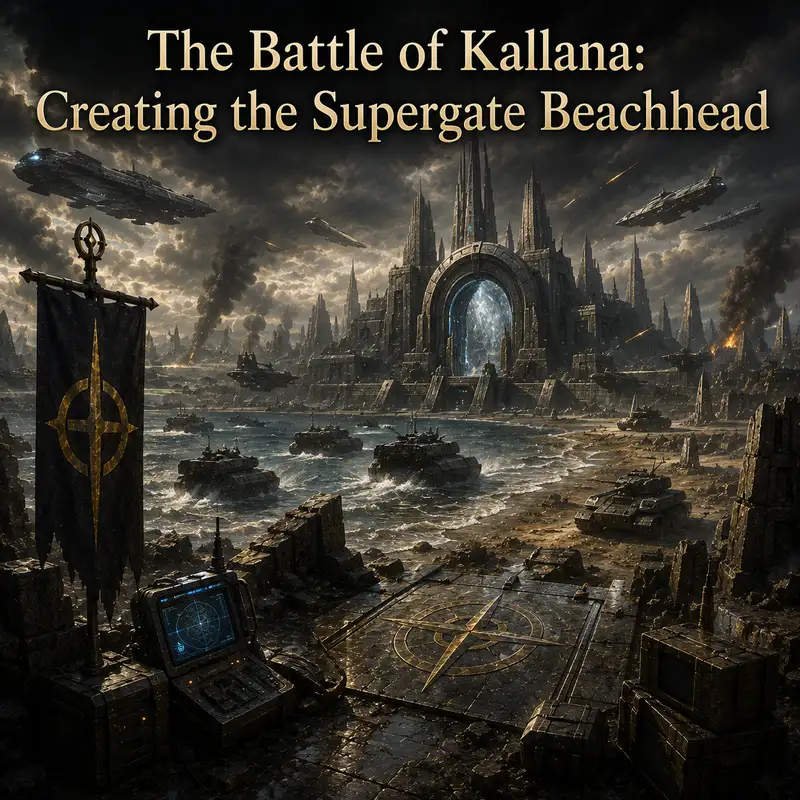
The Mark Nine warhead detonated exactly where Earth intended, beside an active Stargate at the center of Kallana’s expanding force field. It was a multi-gigaton, naquadria-enhanced weapon built to destroy gates and almost everything around them. From orbit, the blast looked decisive. Then the blue field surged outward. The strongest explosive Earth had brought to the battle had not destroyed the Ori position. It had supplied most of the remaining energy needed to complete it.
That reversal defines the Battle of Kallana. The Ori did not open their first attempted invasion corridor by forcing a fleet through defended space. They inserted one Prior through an ordinary Stargate, established a protected lodgment around the gate, and designed the position so that every predictable counterattack strengthened it. Kallana was less a conventional battle than a hostile engineering operation conducted under fire. The defenders believed they were reducing a beachhead. In reality, they were helping build a supergate.
Kallana belonged to the Free Jaffa, a people newly liberated from Goa’uld rule and deeply unwilling to accept another claim of divinity. When the Prior returned after offering the Book of Origin, the local Jaffa had made their decision. They would not replace one false god with another. Their refusal was politically understandable and strategically dangerous, because the Prior had not come merely to secure converts. He had selected their world for a purpose that did not require their survival.
The Prior stood alone before the active gate as the Jaffa approached with staff weapons. He asked whether they spoke for the whole world. Their leader confirmed that they did. The Prior answered that Kallana would serve the Ori one way or another. When the Jaffa opened fire, his personal defenses absorbed the attack. He drove his staff into the ground, threw the defenders back, and raised a dome of energy around the Stargate. In a few moments, the planet’s transportation hub became an enemy-controlled fortress.
A Stargate normally provides access, but it also creates a chokepoint. Control the immediate area around it, and reinforcements arriving on foot must emerge through one predictable position. The Ori improved on that logic. Their field prevented the Jaffa from reaching the gate, protected the Prior, and allowed the incoming wormhole to remain active far beyond the normal limit of thirty-eight minutes. Kallana could no longer be dialed from another world because its gate was already occupied by the hostile connection. The Free Jaffa had lost their fastest route to the battlefield.
The local response was immediate and forceful. Jaffa units fired staff weapons and P nineties into the dome. The field did not fail. It expanded in phases. Energy released around it altered the enclosed environment until the atmosphere became toxic, and orbital sensors later found no life signs beyond the Prior protected near the gate. The exact number of dead was never established. What the surviving record makes clear is that the attempt to defend Kallana devastated the population before allied commanders understood the weapon they were fighting.
The first useful warning reached Stargate Command from Nerus, a minor Goa’uld who had served Ba’al and possessed considerable technical ability. He provided imagery from a surveillance satellite showing the field around Kallana. His report contained critical truths. The dome was expanding. One Prior remained inside. The Stargate had been open for roughly two days. Nerus described the position as an Ori beachhead and urged Earth to destroy it before it could accommodate an army.
The source was almost offensively untrustworthy, and Vala Mal Doran said so. Nerus was known for treachery, ambition, and appetites that made his request for asylum unusually expensive in catering terms. Yet good deception does not require false information. It requires true information arranged to produce the wrong decision. Nerus carefully emphasized the field’s apparent vulnerability during expansion phases and encouraged Earth to use the most powerful weapons available. He was not trying to hide Kallana. He was trying to bring additional energy to it.
Earth could not ignore the warning. Priors were already appearing across the Milky Way, and a permanent Ori foothold threatened every world connected to the gate network. The President authorized any means necessary to stop the operation. Lieutenant Colonel Samantha Carter returned from Area Fifty-One, where she had been working on advanced weapons development. Prometheus was ordered to carry S G One to Kallana, along with the newest and most destructive nuclear device Earth had yet fielded.
The Mark Nine was not a routine bomb with a larger number painted on the casing. It was a naquadria-enhanced weapon developed specifically to destroy a Stargate and everything within a vast radius. Its yield was measured in multiple gigatons. It required controlled arming modes, redundant authorization, and careful handling. Carter considered it their best available option and still doubted it would be enough. That assessment is worth preserving. Earth possessed a prototype capable of extraordinary destruction. It did not possess a reliable understanding of the target.
Because Kallana’s gate could not be reached through the network, S G One traveled by Stargate to a rendezvous point and transferred to Prometheus. This changed the mission from a rapid gate deployment into an interstellar naval operation. It required a ship, hyperdrive transit, orbital sensors, transporter access, and a crew capable of supporting a nuclear strike. The Ori had not merely blocked local reinforcement. They had forced Earth to use one of its few strategic space assets before the battle had properly begun.
The mission therefore carried three different objectives that did not fit comfortably together. Earth wanted to identify the mechanism, give the Prior a chance to withdraw, and destroy the gate if he refused. Intelligence collection required patience. Diplomacy required communication and a credible threat. Demolition required a brief transporter window and a weapon whose safety systems left little room for improvisation. Once Gerak’s fleet arrived, a fourth objective appeared: prevent a confrontation between allies. Kallana compressed reconnaissance, negotiation, nuclear strike planning, and coalition command into one rapidly changing operation.
Prometheus arrived to find the incursion almost nine times larger than the original intelligence showed. No other weapons were detected in the system. No fleet waited in ambush. One life sign remained inside the dome, almost certainly the Prior. The absence of visible enemy forces encouraged the belief that the problem was still localized. Yet the toxic atmosphere, the missing Jaffa, and the uninterrupted wormhole all indicated that the Prior had already achieved effects far beyond what one unarmored missionary should have been able to produce.
The force field weakened briefly whenever it expanded. Carter used those windows to attempt an Asgard transport through the barrier. S G One descended in environmental suits with the Mark Nine, knowing the return window would last only about sixteen seconds. If the transporter failed to retrieve them during that phase, they would remain trapped until the next opening roughly half an hour later. The insertion plan therefore combined a nuclear device, a hostile Prior, a poisoned atmosphere, and a very narrow extraction schedule. It was not the sort of mission improved by losing track of the clock.
Lieutenant Colonel Cameron Mitchell armed the weapon and delivered an ultimatum. The Ori would shut down the gate and withdraw, or Earth would detonate the Mark Nine. Daniel Jackson added the political message. The Milky Way rejected Origin, understood that the Ori were not gods, and would resist similar actions on other worlds. The Prior showed no concern. He claimed knowledge of their identities and confidence that they would fail. Negotiation did not change his behavior because his mission depended on Earth following through.
Before the deadline expired, three Ha’tak vessels under Gerak emerged from hyperspace and immediately opened fire on the dome. Prometheus received no warning. Colonel Lionel Pendergast tried to stop the attack because S G One was still on the surface and the Mark Nine’s armed fuse could react unpredictably to nearby energy. Gerak’s ships ceased fire only after the field entered an early expansion phase. S G One was extracted at the first opportunity, but the allied force had already demonstrated that it lacked a common plan.
The dispute between Earth and Gerak was more than personal irritation. Teal’c had warned the Jaffa High Council, but no response reached Stargate Command before Prometheus departed. Gerak had sent a cloaked cargo ship to observe Earth’s actions and concluded that the Tau’ri were doing nothing. Earth had withheld the identity of its intelligence source. Gerak arrived expecting to command a Jaffa defense of a Jaffa world. Prometheus arrived under presidential authority with a nuclear weapon. Both sides opposed the Ori. Neither trusted the other enough to coordinate before opening fire.
With the team safely aboard, the Mark Nine completed its countdown. The Prior placed a hand on the Stargate as the device detonated. A blast capable of erasing the gate should have ended the operation. Instead, the field entered its largest expansion phase. The environment inside became superheated plasma, preventing reliable sensor readings, while the active wormhole apparently survived. Carter calculated that the Mark Nine alone had provided nearly seventy percent of the energy required for the dome to surround the entire planet.
Gerak interpreted the continued expansion as proof that Earth’s plan had failed. He demanded a renewed attack and warned that Prometheus could become a Jaffa target if it refused. Pendergast faced an ugly command choice. The nuclear detonation had weakened the field even as it expanded, creating the possibility that combined fire might break it. Refusing Gerak risked combat between allies while an Ori position grew below them. Accepting his proposal meant attacking a system whose power source remained unknown. They chose to fire.
Ha’tak weapons, Prometheus railguns, and missiles struck the dome together. At first, the data appeared encouraging because the field’s local strength decreased. Its rate of expansion, however, increased with the intensity of the attack. Carter finally identified the correlation and ordered all fire stopped. By then the pattern was unmistakable. The force field was harvesting the energy directed against it. The Ori had built an enemy position whose defenders supplied the construction power every time they attempted to destroy it.
The field’s phased behavior made the trap harder to recognize. During each expansion, its local strength fell enough to suggest that the defenders were wearing it down. That apparent weakness created a rational reason to increase fire at exactly the moment the system could accept more energy. Sensors were measuring what the barrier looked like in one place, not what the installation was doing as a whole. The Ori had designed the feedback to resemble progress until the planet was nearly enclosed.
The design solved a major logistical problem. The Ori could send a Prior and limited material through an ordinary gate across intergalactic distance, but they could not project enough power through that connection to construct a fleet-sized portal by themselves. Kallana’s Jaffa were known to defend their home. Other Jaffa would reinforce them. Earth could be induced to bring weapons of exceptional yield. The Ori did not need to transport the full energy requirement. They needed to predict how their enemies would react and provide a system capable of collecting the result.
Nerus ensured Earth behaved as expected. His warning was not meant to prevent the beachhead. It was an adversary-controlled intelligence operation designed to accelerate it. He supplied accurate imagery, highlighted a real threat, and recommended the response the Ori needed. Once confronted, he admitted that Earth’s contribution had done more than his own. The incident was a useful reminder that intelligence can be timely, technically accurate, and still operationally poisonous.
The field completed its expansion before Gerak’s force could be fully warned. Objects approximately ten meters long began launching from the active Stargate and accelerating into orbit. They contained no crews and no internal spaces. Prometheus shifted its railguns to defensive fire and prepared fighters as the modules crossed the battlespace at high speed. At least one struck a Ha’tak. Two of Gerak’s ships were ultimately destroyed, his flagship was damaged, and Prometheus suffered a hull breach, lost most of its shield strength, and temporarily lost sensors.
Gerak withdrew after detecting that Kallana itself had begun to collapse. Prometheus also pulled away to survive the debris and recover its systems, then returned for a closer look. Carter found that the planet’s diameter had already decreased significantly and was shrinking faster. The objects launched through the gate were assembling into a ring hundreds of meters across. It resembled a Stargate because that was precisely what it was, only large enough to pass the Ori warships waiting in another galaxy.
The supergate revealed the true purpose of the dome. The field had not been designed primarily to keep an army safe on Kallana’s surface. It had been designed to compress the planet into a micro-singularity. A black hole at the Ori end helped maintain the original long-distance connection. Kallana would become the matching power source for a much larger wormhole. Once the modular ring locked into place, the Ori could maintain a permanent corridor capable of moving an armada directly into the Milky Way.
In military terms, the Ori were creating a beachhead and its strategic line of communication at the same time. The protected Stargate was the initial lodgment. The expanding field secured and powered the construction zone. The planet supplied mass for the singularity. The modular supergate replaced the narrow pedestrian corridor with an intergalactic passage for capital ships. No supply fleet had to cross hostile space to build the position. The target world, the defenders, and the transportation network all became parts of the installation.
By the time Carter understood the mechanism, conventional options had disappeared. More weapons fire would feed the process. The planet was collapsing too quickly for another scientific solution to be developed. The supergate remained incomplete, and its separate modules were held together by an energy linkage. Vala recognized that the unfinished ring was the one vulnerable point left. Her first attempt to explain the idea was lost in the command group’s increasingly urgent discussion, so she stopped requesting permission.
Gerak’s cloaked cargo ship remained nearby with a scout aboard. Vala activated Prometheus’s ring transporter, knowing its signal would seek the nearest compatible ring platform whether the target ship was visible or not. She transferred aboard, stunned the scout, sent him back to Prometheus, and took control of the vessel. The method was improvised, but it used familiar Goa’uld technology rather than asking Earth’s damaged ship to perform another untested miracle.
Vala flew the cargo ship into the empty position reserved for the supergate’s final module. Her intention was to interrupt the energy linkage by becoming the last link in the chain, then return through the rings before the singularity’s shockwave arrived. Carter warned that the cargo ship could not survive. Vala was counting on its destruction. The plan did not require the ship to overpower the supergate. It required the wrong object to occupy the correct space for a few critical seconds.
The cargo ship disrupted the field holding the modules in formation. Kallana completed its collapse, and the resulting shockwave shattered the incomplete supergate along with Vala’s ship. The Ori’s first attempted capital-ship corridor into the Milky Way was destroyed. The planet was not saved. Its population, surface, and Stargate were gone, two Jaffa ships had been lost, Gerak’s flagship and Prometheus were damaged, and the allied force had nearly built the enemy installation through its own fire.
Vala did not rematerialize aboard Prometheus. Telemetry recorded a matter stream leaving the cargo ship just before it was destroyed, creating the possibility that she had been drawn through the singularity toward the Ori home galaxy. For the people on the bridge, the victory arrived with no certainty that the person responsible had survived it. Tactically, the beachhead was destroyed. Operationally, the Ori fleet had been delayed. Strategically, everyone present understood that the enemy could attempt the same method again.
Kallana exposed several weaknesses that could not be repaired with a larger warhead. Earth and the Free Jaffa lacked a unified command structure. Their intelligence sharing was slow and incomplete. Gerak’s distrust encouraged independent action, while Earth’s reliance on a hostile Goa’uld source allowed the enemy to shape the response. The Mark Nine functioned as designed, but the target had been designed to exploit that function. Technical success at the weapon level became operational failure at the battlefield level.
The battle also changed how Stargate Command had to think about Ori logistics. A Prior was not merely a missionary who preceded an army. He could serve as the advance party for strategic construction. An active gate was not merely a route for personnel. It could deliver modular components while denying access to reinforcements. A planetary population was not necessarily a political objective. At Kallana, the Ori treated the entire world as fuel for transportation infrastructure.
The Battle of Kallana was won only in the narrow sense that no Ori armada emerged from the completed ring. The Free Jaffa lost the world they had tried to defend, Earth nearly lost Prometheus, and the coalition learned the enemy’s method by supplying it with energy. The beachhead failed because one person recognized that the last useful weapon was not greater firepower. It was a stolen cargo ship placed where the final piece of the enemy’s gate was supposed to be. Kallana survived only as a warning: when an adversary has designed the battlefield, the most obvious counterattack may already be part of the plan.