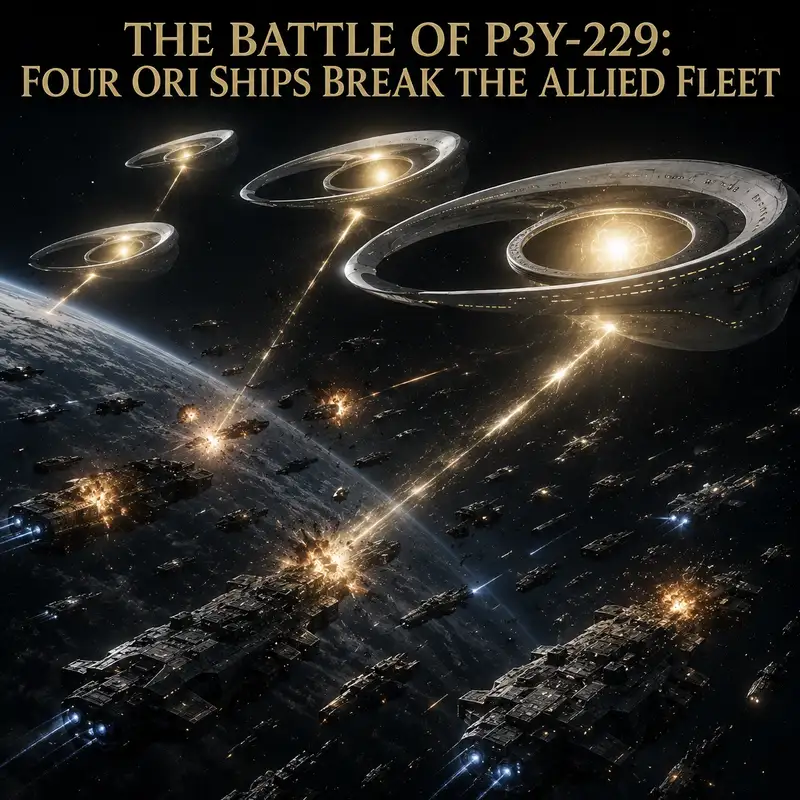
The Battle of P3Y-229: Four Ori Ships Break the Allied Fleet
Samantha Carter was still outside the Supergate when the incoming wormhole threw her clear of its surface. The modified control crystal she had installed was supposed to make the ring dial outward and deny the Ori access. Instead, the enormous event horizon formed in front of her, transport interference cut her off from the Odyssey, and four warships emerged one after another. Below them waited the strongest fleet the Milky Way's divided powers could assemble. Within minutes, that fleet was burning.
The Battle of P three Y two twenty-nine was the first direct fleet engagement of the Ori invasion, and its central fact remains difficult to ignore. Four ships broke a coalition containing Earth battlecruisers, Jaffa and Tok'ra motherships, an Asgard vessel, and later a Lucian Alliance force. The outcome was not produced by numbers alone. It came from technological asymmetry, rushed planning, incompatible command systems, poor intelligence on the enemy, and a battlefield shaped by the Supergate itself.
The battle began with a Jaffa reconnaissance report. A vessel investigating unusual energy readings near P three Y two twenty-nine found a completed Supergate where the planet should have been. Stargate Command could not dial the world's ordinary gate, and Samantha Carter concluded that the planet had probably been consumed while creating the micro-singularity that powered the larger ring. Jaffa ships had already fired on the structure without effect. The enemy's invasion port was operational before the defenders knew where it was.
The allied mission was initially to destroy the Supergate by any means available. Earth dispatched the Odyssey under Colonel Paul Emerson and rushed the newly built Korolev into service under Colonel Chekov. The Daedalus remained in the Pegasus galaxy, while Prometheus had already been lost. That left only two Earth battlecruisers in the Milky Way, and one of them had entered service ahead of schedule because the strategic situation did not permit the courtesy of proper testing.
The rest of the fleet reflected the political map left after the fall of the Goa'uld System Lords. Free Jaffa and Tok'ra forces arrived in captured or inherited Ha'tak motherships. An Asgard vessel joined the formation, and Kvasir transferred aboard the Odyssey to assist Carter. Teal'c went separately to recruit the Lucian Alliance, whose leaders had ships but no strong reason to trust Earth or the Jaffa. This was a coalition of necessity, not a standing alliance with common doctrine, shared communications, or one recognized fleet commander.
The Earth ships were advanced by Milky Way standards, but their capabilities must be placed in the correct era. Odyssey and Korolev possessed Asgard-supported shields, transporters, and hyperdrives, along with human railguns, missiles, and nuclear weapons. They did not yet carry the Asgard plasma beam weapons that later transformed Earth ship combat. Their defenses were superior to those of most Ha'taks. Their offensive systems were still designed for enemies whose shields had been measured in previous wars.
The Ori ships represented a different level of military engineering. Their exact dimensions, crew totals, and power outputs were not established, and assigning precise numbers would create confidence the surviving record does not support. Operationally, each vessel combined heavy shields, powerful beam weapons, fighter capability, troop capacity, and intergalactic strategic mobility through the Supergate. They were not raiders assembled from captured technology. They were purpose-built instruments of a civilization mobilized for conquest.
Carter and Kvasir developed a plan more sophisticated than simply firing at the ring. They located the Supergate's dialing-control crystals and prepared a replacement that would make it establish an outgoing connection. An active Stargate cannot accept a second wormhole. If the allies dialed first, they could deny the Ori entry. If Merlin's weapon had been found, the same connection might have carried it into the Ori home galaxy. When Daniel Jackson and Cameron Mitchell reported that the weapon was not on Camelot, denial of access remained valuable enough to justify the attempt.
Carter transported to one segment in a spacesuit and locked her boots to the structure. She removed the original crystal, installed the replacement, and waited for initialization. The plan failed on timing rather than theory. The Ori dialed inward before the modification took control. Energy passing across the ring disrupted Carter's magnetic lock, while interference prevented the Odyssey from beaming her back. The fleet now had to fight with its leading gate specialist drifting beside the event horizon.
Korolev arrived at almost the same moment. Chekov received the warning, activated shields and weapons, and brought the ship to battle stations. Daniel and Mitchell had only just been collected from Camelot. Teal'c was still negotiating with the Lucian Alliance. The allied force had found the battlefield, but its key personnel and reinforcements were distributed across separate commands. The Ori emerged into a formation that was present, armed, and fundamentally unfinished.
The four ships passed through the Supergate and formed a line facing the defenders. Their opening message was not a tactical demand or an offer to withdraw. It was a passage from the Book of Origin warning that the proud who refused to bow would be reduced to dust. Daniel answered with another passage challenging the search for wickedness in one's neighbors. The exchange clarified the political situation. The Ori were not negotiating for access. They were announcing the moral justification for an attack already decided.
When the Ori ships powered their weapons, Emerson ordered every battery to fire. Odyssey launched missiles and brought its railguns into action. Ha'taks added their energy weapons. The Asgard vessel engaged. The first allied volley represented technology drawn from several civilizations and centuries of conflict. It struck the Ori shields and produced no visible damage. The defenders had concentrated much of the Milky Way's available combat power at one point and still could not establish that the enemy had noticed.
Ori return fire answered the question immediately. Their primary beam weapons cut through smaller vessels and destroyed Ha'taks with a speed that made formation strength almost irrelevant. A ship that had once served as a Goa'uld capital vessel could be removed by one effective strike. The Earth battlecruisers endured longer because of their Asgard-derived shields, but endurance was relative. Odyssey's shield strength fell to half during the opening exchange, and heavy internal damage followed.
Technological superiority changed the meaning of every tactical choice. The allies could mass fire, flank, or close range, but none of those maneuvers mattered unless their weapons could penetrate. The Ori could accept incoming fire while selecting targets at leisure. Their beams did not need prolonged contact to create mission kills. Once a ship lost engines, power, or shields, the next strike could finish it. Numerical superiority becomes decorative when one side's weapons cannot injure and the other side's weapons rarely need a second attempt.
The battlefield geometry made withdrawal harder. The allied ships had gathered near a fixed gate because that was the point they had to defend. The Ori arrived facing them and ready to fire. Odyssey soon lost sub-light engines and could not perform meaningful evasive maneuvers. Korolev lost power while taking repeated hits. The defenders were not only outgunned. Several became stationary targets beside the strategic objective they had been ordered to hold.
The coalition's command problem became visible as damage reports accumulated. Earth, Jaffa, Tok'ra, Asgard, and Lucian units did not share one practiced battle network. No joint commander is shown assigning sectors, concentrating fire on one target, coordinating withdrawal lanes, or establishing a common damage-control plan. Individual captains did what their ships and political authorities allowed. Courage was abundant. Unified control was not.
Teal'c's recruitment of the Lucian Alliance illustrates both the value and weakness of the coalition. Netan initially treated the request for help as madness and had Teal'c restrained. Teal'c persuaded him that the Ori threatened every regional power, including organizations that preferred profit to theology. Three Alliance Ha'taks eventually entered the battle from behind the Ori formation and opened fire at once. Their arrival created a second axis of attack. It did not create a weapon capable of breaching the shields.
By then, Chekov and Mitchell were arguing over the F three-oh-twos. Chekov correctly assessed that fighters could not damage the Ori capital ships. Mitchell was not proposing them as a winning strike. He wanted to draw fire and buy time for Korolev's crew to restore power. It was a desperate use of a system designed for interception and attack against more vulnerable targets. Mitchell reached a fighter bay and launched, gaining an escape craft even if the diversion accomplished little else.
The Earth ships also tried the tactic that had worked against other shielded enemies. They attempted to beam weapons directly aboard. Ori defenses or interference prevented the Odyssey's transporters from establishing a lock. Korolev's sensors detected a small fluctuation in enemy shields when the Ori fired, suggesting a narrow vulnerability. Chekov ordered a neutron bomb prepared for transport. The available opening existed for moments, and the Asgard beam could not exploit it.
Daniel proposed using ring transporters instead. Ori warships carried compatible rings, and a matter stream set to seek the nearest receiving platform might cross where the Asgard beam failed. Chekov ordered Korolev closer to the nearest enemy vessel while crewmen moved the warhead into the ring room. The plan was improvised, technically plausible, and untested under fire. That description covers a substantial portion of Earth weapons development, though usually the laboratory does not explode before the test is complete.
An Ori beam struck Korolev before the bomb could be sent. The blast threw the technicians from the platform and knocked the warhead out of position. Daniel completed the ring sequence and used it to save himself, materializing inside an Ori ship. His escape proved that the ring connection could reach the enemy vessel. It did not prove that the bomb would have detonated as intended or that the method could be repeated after the Ori understood it.
Korolev was then destroyed. Black-box data later showed that six crew members escaped through beaming technology. Mitchell survived in an F three-oh-two, and Daniel survived through the rings. Colonel Chekov was not among the known survivors and was treated as lost with most of the crew. The ship's only known battle had lasted minutes. Russia had received a place in Earth's interstellar fleet and paid for that status with a vessel, a senior officer, and an unknown number of personnel before the fleet had developed procedures for replacing any of them.
The loss had consequences beyond one hull. Korolev had been rushed into service because Earth possessed too few ships to hold one back. Its destruction cut the Milky Way Earth force in half in a single engagement. Shipbuilding could eventually produce another B C three-oh-four, but not during the battle, and not without classified industrial facilities, imported alien systems, trained crews, and political agreements that remained under strain. A ship can be replaced on a chart long before it can be replaced in orbit.
Carter watched much of the destruction from outside the Supergate. She had no shipboard console, no ability to alter the gate, and no transporter lock to bring her home. She could see allied vessels break apart while hearing only fragments over the radio. The person most capable of analyzing the Ori system had been reduced to an observer because the incoming wormhole had isolated her at the decisive moment. It was a precise demonstration of how one failed technical action can remove a specialist from the larger fight.
Vala Mal Doran watched from the other side of the battle line. She was aboard an Ori warship, near the end of a pregnancy the Ori had imposed on her, and saw the allied fleet destroyed through a window. As the battle ended, she went into labor with the child who would become Adria, the Orici and field leader of the crusade. The fleet breakthrough and the creation of its human commander occurred together. The Ori were delivering ships, soldiers, doctrine, and leadership as parts of one campaign.
The battle did not end with a formal surrender. It ended when the allied formation ceased to function as an organized force. Wreckage drifted around the dormant Supergate. Odyssey remained alive but badly damaged. At least one Lucian Alliance mothership also survived in poor condition. Other vessels had been destroyed, disabled, or scattered. The four Ori ships formed up and left for their next objectives without remaining to conduct rescue, occupation, or a systematic search for survivors.
The available evidence suggests that leaving witnesses was deliberate. Origin sought conversion as well as destruction. Survivors could carry news that a mixed fleet, including an Asgard vessel, had failed to damage four Ori ships. That report would reach worlds the invasion force had not yet visited and make future demands for submission more credible. A complete massacre would remove enemies. A visible, overwhelming victory could recruit frightened populations across the galaxy.
Odyssey's survival did not amount to combat effectiveness. Its shields were reduced to a fraction of normal strength, its hyperdrive was offline, long-range communications were destroyed, and life support could sustain the ship for perhaps a day under existing conditions. Kvasir had to rebuild damaged Asgard transport-control software from the beginning. Earth could not send immediate help because it had lost contact and had no other battlecruiser available in the Milky Way.
Recovering Carter showed how far the ship had fallen. The transporter remained unreliable, so Mitchell used the damaged sub-light engines to maneuver Odyssey physically around her position and bring her through the atmospheric shield of a hangar bay. Kvasir controlled the internal gravity to reduce her fall. The rescue required piloting a crippled capital ship close enough to collect one person in a spacesuit. It worked. It was also not a procedure anyone would select while writing the original mission plan.
The political coalition began fracturing before the wreckage cooled. Netan blamed Teal'c for drawing the Lucian Alliance into a disastrous battle, took him prisoner, and later threatened the disabled Odyssey. Shared defeat did not create shared trust. Lucian commanders saw depleted competitors and potential prizes. Earth officers saw an ally becoming a new threat while life support failed. Bra'tac's arrival with Jaffa ships prevented that confrontation from becoming another battle, but the episode exposed how temporary the original alignment had been.
The Ori ships, meanwhile, had already moved to Chulak. That decision turned victory at the Supergate into operational freedom. The fleet had passed the only intergalactic chokepoint, neutralized the force waiting there, and entered hyperspace before another defense could form. The defenders had failed in their strategic objective even though Odyssey survived and several members of S G One escaped. Survival was a tactical result. The invasion corridor had been opened.
The battle also triggered panic at the political level. With the location and destination of the Ori ships unknown, the International Oversight Advisory considered moving Atlantis's zero-point module to Earth for the Antarctic defense system. The proposal could not solve the immediate problem. Transport from Pegasus would take weeks, and no one knew whether Ancient drone weapons would penetrate Ori shields. The discussion revealed the scale of the defeat. Earth's leaders were reaching for a unique power source in another galaxy because the fleet they had sent as its best conventional defense had disappeared.
No single intelligence failure caused the disaster, but several gaps aligned. The defenders knew the Supergate's purpose and had seen Priors use advanced energy systems. They did not possess reliable data on Ori capital-ship shields, beam strength, electronic defenses, fighter doctrine, or damage tolerance. The first engagement therefore became a reconnaissance mission conducted by the entire allied fleet. It produced excellent information. The collection cost was unacceptable.
Industrial asymmetry made that cost worse. Many allied Ha'taks were captured remnants of the Goa'uld order. Earth could build B C three-oh-fours, but slowly and with essential alien components. The Asgard were technologically superior but strategically constrained and unable or unwilling to send a larger force. The Ori had mobilized their home galaxy, built warships for one campaign, and moved them through a gate supported by a stellar-scale power source. The defenders brought what they possessed. The invaders brought what the operation required.
P three Y two twenty-nine forced a change in strategy. Matching Ori ships with existing weapons was no longer credible. Stargate Command and its allies had to focus on asymmetric solutions, including blocking the Supergate, finding Merlin's weapon, neutralizing Priors, capturing enemy technology, and exploiting brief shield vulnerabilities. Earth ships would later gain weapons capable of challenging Ori vessels, but those systems were not available to Emerson, Chekov, or the crews who fought the first wave.
Four Ori ships broke the allied fleet because they arrived as an integrated invasion force against a collection of powers that had assembled faster than they had learned to fight together. Their shields invalidated allied firepower. Their beams punished every exposed ship. The Supergate fixed the battlefield, timing stranded Carter, and fragmented command prevented the defenders from turning numbers into coordinated effect. The coalition had more hulls. The Ori possessed the functioning system.
The most accurate image of the battle is not the first missile launch or the destruction of Korolev. It is Carter drifting beside the Supergate after the enemy had left, calling into a field of wreckage for anyone who could still answer. The allies had found the invasion route and gathered nearly everything they could send. Four ships came through, broke the fleet, and continued toward Chulak. Earth survived the encounter. Its strategy did not.