The Battle of Vorash: Turning a Star Into a Weapon
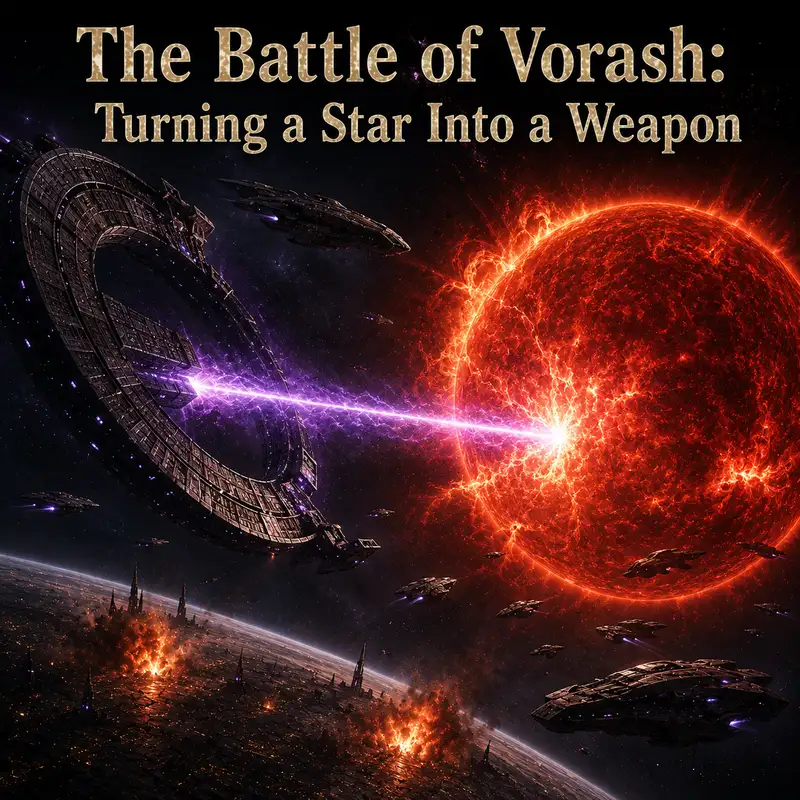
The Stargate left the cargo bay already connected to a black hole. Ahead waited the sun of Vorash. Behind, Apophis approached with what the Tok’ra believed to be the largest Goa’uld fleet yet assembled under one ruler. The plan required the gate to fall into the star, draw stellar matter through the wormhole, and force a premature supernova. The strike package was one captured Ha’tak, one relocated Stargate, and several people who had never destroyed a star before. This was not an established weapon. It was an emergency idea with a solar system for a warhead.
The Battle of Vorash was the moment Earth and the Tok’ra stopped treating the Stargate only as a road and used it as part of a strategic weapon. The operation combined a black hole, a main-sequence star, a stolen Goa’uld capital ship, Tok’ra intelligence, Earth improvisation, and timed deception. It destroyed the main body of Apophis’s fleet. It also cost the Tok’ra their base, left Teal’c in enemy hands, and threw the surviving allied ship more than four million light-years from home. The weapon worked. The extraction plan did not.
Apophis had become dangerous on a scale neither ally could ignore. His assault force over Earth had been destroyed, but he survived Sokar’s imprisonment, escaped Netu, and seized the armies Sokar had assembled. He then eliminated Heru’ur and absorbed much of that rival’s military power. Each victory over a System Lord had opened a succession gap, and Apophis had repeatedly been best positioned to fill it. By the time he turned toward Vorash, he commanded the accumulated strength of defeated empires.
Vorash was the principal Tok’ra base, making it both an intelligence center and a liability. Tok’ra security depended on concealment, underground installations, and evacuation before a Goa’uld fleet arrived. Their tunnels could be collapsed and their personnel dispersed, but the Stargate could not be carried by hand to another hidden world. Moving people was possible through the gate. Moving the gate, stored equipment, and infrastructure for a permanent base required heavy transport the Tok’ra did not possess.
Earth had recently acquired that transport. Cronus had been killed, and his Ha’tak had fallen into Earth hands. At this stage, Earth had no operational interstellar fleet of its own. A captured Goa’uld mothership was therefore a strategic asset, a technical intelligence prize, and a maintenance problem of majestic proportions. General George Hammond ordered it loaned to the Tok’ra for relocation. In return, Earth expected operating instruction and wanted the ship back for study. The arrangement joined alliance support with technology acquisition, which was often how Stargate Command handled equipment no procurement office sold.
The original Vorash mission was an evacuation, not a fleet engagement. The Ha’tak would transport Tok’ra personnel, equipment, and their Stargate to a world absent from Goa’uld maps. The move would create a more secure base and end a counterintelligence operation centered on Tanith. Tanith was a Goa’uld who had entered the willing Jaffa host Hebron and claimed to have joined the Tok’ra. The Tok’ra recognized the deception and let him believe he had penetrated their organization. For months, he passed prepared false information to Apophis.
That channel had real value. While Apophis acted on misinformation, Tok’ra operatives moved through Goa’uld territory, recovered stranded agents, and freed allies. Tanith believed he was weakening the resistance. In practice, he became an unwilling communications system for it. Once the Tok’ra prepared to abandon Vorash, they exposed him. Their plan was to extract the symbiote, save Hebron if possible, and leave Tanith behind. They had little reason to carry an identified enemy agent to their new base.
Tanith escaped before the extraction. He collapsed in his cell, exploiting Tok’ra concern that he might kill Hebron rather than surrender the host. When guards lowered the barrier, he attacked and fled into the desert. He could not reach the guarded Stargate, but he did not need to. A hidden long-range communications device let him contact Apophis and reveal Vorash’s location. The Tok’ra learned that an attack fleet would arrive in less than a day. A planned relocation became a compromised withdrawal under threat of orbital attack.
The first adjustment was straightforward. The Tok’ra would evacuate through the Stargate instead of waiting for the Ha’tak. That protected the population and reduced the load aboard the ship. It also left a captured capital ship, an empty base, a known enemy approach, and a narrow period to prepare the battlefield. Samantha Carter and Jacob Carter, blended with Selmak, proposed using all four. Apophis expected to find the Tok’ra on Vorash. If the system became a kill zone without warning him, his concentration of force became a vulnerability.
The decision was not casual. The Tok’ra council approved the concept, but the Ha’tak remained an Earth asset under O’Neill’s responsibility. Carter emphasized that the solar system was abandoned and barren, and that the Tok’ra would be gone before the strike. No known civilian population was being left beneath the blast. Apophis’s fleet was committed and might never again gather in one predictable location. O’Neill accepted because the target was military, the system was believed empty, and the alternative was overwhelming attack. It was still a field decision to destroy an entire star system.
The scientific explanation used by Carter and Jacob began with a balance inside the star. Fusion in the core pushed outward, while the gravity created by the star’s mass pulled inward. Their plan was to remove enough matter quickly enough to disrupt that equilibrium and trigger an artificial supernova. Within the operation’s model, the sun was healthy, with billions of years of normal life remaining. The allies were not waiting for a natural instability. They intended to create one by using the Stargate as a conduit to something with far stronger gravity.
That destination was P three W four five one, the world whose gate had been caught near a black hole. Stargate Command had connected to it before and discovered that gravitational time distortion could hold a wormhole open far beyond normal limits. The planet had probably been torn apart, but Carter reasoned that matter could take years to spiral through the distorted region. The receiving gate might remain active after the world around it ceased to exist. If the address failed, the mission would abort. If it connected, the black hole would become the far end of a stellar siphon.
The Ha’tak would carry the Vorash Stargate toward the sun, remotely dial the black-hole address, enclose the active gate in a force field, and release it into the star. The field would protect the gate during the initial descent. Once it failed, the black hole’s pull through the wormhole was expected to draw stellar matter from Vorash. The gate would not survive long inside the sun. It only had to remain intact long enough to remove the critical mass. In ordinary operations, one protects the gate. Here, destruction was part of the firing sequence.
The allies needed a ship large enough to carry a Stargate, generate the field, approach the star, and escape through hyperspace. They also needed the black-hole gate to remain dialable and the stellar model to be correct. No one had tested the complete sequence. Earth could not reproduce a Ha’tak, manufacture another Stargate, or create a black hole for scheduled use. The plan was a one-time convergence of captured technology and rare conditions, not the beginning of a solar artillery program.
The human problem inside the operation was Teal’c. Tanith had murdered Shan’auc, the Jaffa priestess who had trusted him and attempted to communicate with the symbiote. Teal’c had twice accepted the Tok’ra decision to preserve Tanith as an intelligence asset rather than take personal revenge. The spy’s escape made that restraint feel wasted. O’Neill reminded him that the deception had saved lives and that destroying Apophis’s fleet mattered more than one prisoner. Teal’c accepted the larger objective, but he also warned that he might not show the same restraint again. The operation carried a private war inside its command team.
Once the Tok’ra evacuation was complete, their Stargate was loaded into the Ha’tak’s cargo bay. Long-range sensors placed Apophis’s fleet about sixty-eight minutes away. The ship accelerated toward the sun, then slowed to roughly five percent of light speed for release. The remote dialing sequence reached P three W four five one. The connection formed, confirming that the receiving gate remained functional near the black hole. The force field engaged, the cargo doors opened, and the clamps released. The active Stargate drifted away on the calculated course. At that moment, the most difficult scientific assumptions appeared to be correct.
The mission should then have become an escape. Instead, a cloaked Al’kesh attacked before the Ha’tak could enter hyperspace. The Goa’uld mid-range bomber had probably been positioned to recover Tanith and was able to reach the area before Apophis’s main fleet. Its surprise attack disabled the Ha’tak’s shields, main power, and hyperdrive, although return fire damaged the bomber as well. The solar weapon was already in motion. The ship meant to outrun it was now sitting near the sun without propulsion sufficient for a safe withdrawal.
O’Neill and Teal’c launched in a death glider because it was the only available craft capable of engaging the damaged Al’kesh. The bomber remained larger and more heavily armed, but the glider offered superior maneuverability. They forced it to break contact, then watched it turn toward Vorash. Teal’c concluded that it was returning for Tanith and pursued. Operationally, the decision increased risk to the entire mission. Personally, it was almost inevitable. The enemy craft was both a threat to the crippled Ha’tak and the probable extraction route for the man who had murdered Shan’auc.
The pursuit ended with both aircraft going down near the abandoned Tok’ra base. O’Neill and Teal’c survived their crash, but their glider’s propulsion and communications were damaged beyond repair. The Al’kesh was destroyed, denying Tanith that escape route. The two men were now stranded on the planet inside a solar system that their own team had scheduled for destruction. Their only possible extraction depended on reaching the known location of the Tok’ra transport rings and trusting the Ha’tak to return before the countdown expired.
Aboard the mothership, Jacob restored main power, shields, and weapons, but the hyperdrive control circuit had burned out. The engines themselves remained intact. Carter began rerouting them through secondary systems while Jacob talked her through the repairs and kept the ship under control. Daniel managed the command deck despite having no reason to consider himself a qualified Goa’uld capital-ship officer before that morning. The division of labor was improvised but rational. Jacob had the piloting knowledge, Carter had the engineering skill, and Daniel could read enough of the displays to recognize when the Goa’uld word for warning began flashing.
Apophis arrived ahead of the original estimate. The crew believed the Al’kesh had warned him and accelerated the fleet’s approach. His ships took attack positions around Vorash, making a direct return to the planet suicidal. The Ha’tak hid behind the sun while repairs continued. The star had become more than a weapon. It was terrain, concealment, a countdown clock, and the boundary of the only safe maneuver space left to the allied ship. Every minute spent hiding improved the hyperdrive repair and reduced the time available to recover O’Neill and Teal’c.
On the surface, Tanith used Apophis’s arriving Jaffa to reverse the hunt. Teal’c was struck by a staff weapon and captured. O’Neill was incapacitated but survived and eventually reached the area of the transport rings. Tanith delivered Teal’c to Apophis as proof of his usefulness. The fleet commander had come expecting the Tok’ra leadership and instead received the former First Prime who had betrayed him. For Apophis, the prisoner was a personal prize. For the allied ship, Teal’c’s disappearance created an extraction problem that sensors and calculations could not solve.
Jacob created the final opening with deception. The captured Ha’tak carried a complement of death gliders. He launched them under remote guidance from behind the sun and sent them racing out of the system as though they carried the evacuating Tok’ra. Apophis ordered his fleet to surround the apparent escape force. The gliders had no life signs, but that became clear only after the pursuing ships had left Vorash. The decoy did not defeat the fleet. It displaced it for the few minutes required to bring the Ha’tak back toward the planet.
Daniel established radio contact with O’Neill near the ring coordinates. There was no visual confirmation and almost no time to correct positioning. The ship entered range, activated the transport system, and recovered him. Teal’c was not there. O’Neill had no reliable information about whether he was dead, wounded, or aboard Apophis’s flagship. The team could either continue searching and be consumed with the system, or escape with one member missing. They engaged the hyperdrive.
The Stargate reached the stellar interior, the siphon removed the required matter, and Vorash’s sun went supernova. The blast consumed the system and destroyed the main body of Apophis’s fleet before it could clear the danger zone. The plan achieved its operational objective. A force too large for Earth or the Tok’ra to challenge ship against ship disappeared in a single event. No allied fleet had to trade fire with it. No planetary defense had to absorb its weapons. The star did the destructive work after intelligence, science, and deception placed the enemy in range.
The result was not clean. The allied Ha’tak entered hyperspace so late that the expanding blast caught the edge of its subspace window. Instead of merely damaging the ship, the interaction threw it more than four million light-years away, outside the Milky Way galaxy. Its navigation system recognized no star patterns. At maximum normal speed, the return journey would take generations. The operation had saved the Tok’ra and broken Apophis’s fleet, but the surviving strike team had become strategically irrelevant unless it could find another route home.
Apophis’s flagship also survived, carried into the same distant region by the blast. Teal’c and Tanith were aboard it. The target commander had lost most of his fleet but retained a capital ship, his prisoner, and the will to continue the fight. The Battle of Vorash therefore did not end with the death of Apophis or the recovery of S G One. It ended with both surviving ships displaced into unknown space and the two sides still close enough to threaten one another. Destroying the formation had not destroyed every command element within it.
Tactically, the allies executed the solar strike and recovered O’Neill. The Al’kesh was destroyed, the black-hole connection worked, and the decoy gliders drew the fleet away from the planet. At the mission level, the Tok’ra population and critical resources escaped, but Teal’c was captured and the Earth-controlled Ha’tak was lost to known space. Operationally, Apophis’s fleet was shattered. Strategically, the victory removed a major concentration of Goa’uld power without establishing a repeatable defense against the next one. Each level produced a different answer to whether the mission succeeded.
The weapon itself was powerful precisely because it was not a conventional weapon. The allies did not build an explosive capable of overcoming Ha’tak shields. They manipulated gravity, gate geometry, and stellar structure so that shielding became irrelevant. Apophis’s ships could survive heavy weapons fire, but they could not remain inside a supernova. The concept resembles the best forms of asymmetric warfare. Do not attack the enemy’s strongest system. Change the environment until that system no longer solves the problem.
The same asymmetry imposed strict limitations. The operation required an expendable Stargate, a specific black-hole destination, a star suitable for the model, a barren system, a capital ship with the right cargo and field capabilities, and an enemy willing to enter the trap. It also destroyed the terrain, the gate, and any possibility of occupying the battlefield afterward. There could be no damage assessment team, salvage operation, or second shot. The Battle of Vorash produced a spectacular effect without creating a weapon Earth could stockpile, maintain, or deploy on routine notice.
The intelligence war mattered as much as the astrophysics. The Tok’ra had manipulated Tanith successfully for months, but their handling of his final detention failed. His escape compromised the base and accelerated the crisis. The allies then exploited the information he gave Apophis by turning the exposed location into bait. Later, unmanned gliders exploited Apophis’s expectation that the Tok’ra would flee. The battle was a chain of intelligence successes and failures, each side repeatedly converting the other’s assumption into an operational opportunity.
Coalition command was equally important. The Tok’ra council approved destroying the system. O’Neill controlled the Earth asset and accepted the risk. Carter and Jacob designed the mechanism across two scientific traditions. Jacob piloted a ship built by the enemy. Daniel interpreted systems outside his professional training. Teal’c supplied combat skill and knowledge of Goa’uld behavior, but personal revenge pulled him away from the safest course. The alliance succeeded because its members combined capabilities. It nearly failed because those same members carried different priorities into the same countdown.
The human cost was concentrated rather than large, which did not make it minor. Teal’c was delivered to the ruler he had betrayed and subjected to an effort to break his identity. O’Neill left the planet without knowing whether his teammate lived. Carter and Jacob escaped the supernova only to discover that home was more than four million light-years away. The Tok’ra survived, but Vorash and everything left beneath its surface ceased to exist. Tanith’s host remained trapped within the symbiote that had started the crisis.
The Battle of Vorash answered a strategic problem with a scientific solution no conventional fleet commander would have considered. Earth and the Tok’ra could not defeat Apophis ship by ship, so they turned the arrival point, the Stargate network, and the local star into one integrated ambush. The victory proved that Earth’s greatest advantage was not superior firepower. It was the willingness to combine technologies their creators had never intended to work together. The final irony was exact. They destroyed a fleet by opening a path across the galaxy, then escaped through hyperspace and found themselves farther from home than the Stargate network could reach.