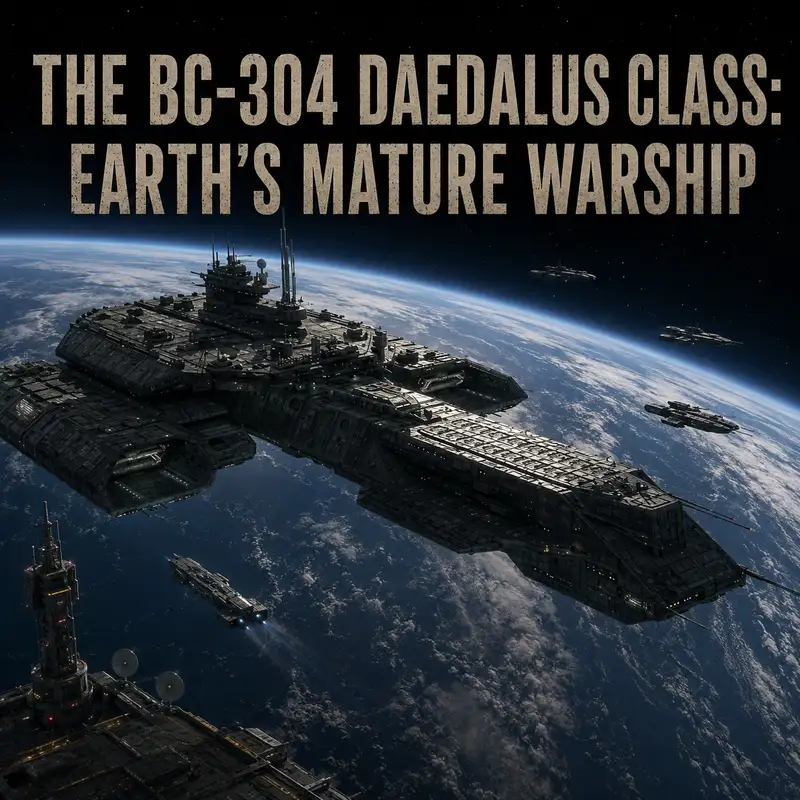
The BC-304 Daedalus Class: Earth’s Mature Warship
Daedalus emerged from hyperspace over Atlantis carrying a zero-point module, a relief force, nuclear warheads, and the first Earth crew trained to operate a warship designed for another galaxy. The city below was under siege. Wraith hive ships controlled the approaches, the expedition’s shield was failing, and the defenders had already prepared to destroy Atlantis rather than let the enemy discover the route to Earth. Daedalus had crossed the intergalactic distance in less than four days because the zero-point module was feeding its Asgard hyperdrive. Its first operational mission was not a shakedown cruise. It was a rescue conducted at the edge of defeat.
The B C three-oh-four represented a different stage of Earth’s military development from Prometheus. Prometheus proved that humans could assemble a starship from recovered principles, imported materials, and a considerable tolerance for unfinished engineering. Daedalus was intended to prove something harder. Earth could design a class, build more than one hull, train permanent crews, support regular deployments, and improve the ships without rebuilding the entire concept after each mission. Maturity did not mean the vessel was fully human in technological origin. It meant the capability had become repeatable.
Prometheus had been a hybrid prototype in the most literal sense. Its systems were added, replaced, and repaired as Earth learned what they did. Early reliance on unstable naquadria made its hyperdrive unreliable. Asgard assistance improved the ship, but many upgrades had been fitted to an architecture never designed to receive them. The B C three-oh-four incorporated those lessons from the start. Human engineers built the hull and command environment around advanced systems that were expected to be there, rather than treating every shield generator or transporter as an emergency modification.
The class combined several military roles. It was a battlecruiser able to fight in orbit and deep space. It was a carrier for F three-oh-two fighters. It was a strategic transport capable of moving personnel and equipment without relying on a destination Stargate. It was also a mobile command post, sensor platform, rescue ship, and logistics vessel. No single label describes every mission well. Earth called the vessels battlecruisers, while their operational record often made them deep-space carriers with enough weapons to discourage an argument about terminology.
The basic design remained human-built. Crews lived and worked in compartments arranged for human physiology. The bridge used familiar military command relationships. Human railguns and missiles provided weapons that Earth could manufacture, load, and replace. Internal hangars supported F three-oh-twos, allowing a B C three-oh-four to carry aerospace power across interstellar or intergalactic distance. A ship could deliver fighters to a world with no friendly runway, maintain them aboard, and recover them after combat. That turned the fighter from a local defense aircraft into part of a deployable force.
The most important high-end systems came from Asgard science. Advanced shields allowed the ships to survive weapons that would have destroyed any conventional human vessel. Asgard sensors extended detection and targeting across enormous distances. Beaming technology moved people, supplies, and weapons without landing or using ring transporters. The intergalactic hyperdrive gave the class a mobility Prometheus had possessed only after repeated outside assistance. The remaining architecture combined human engineering with earlier alien-derived solutions for artificial gravity, inertial control, life support, and power integration. Earth built the vessel, but the performance envelope depended heavily on an ally centuries ahead of human engineering.
That dependence was visible aboard Daedalus itself. The Asgard engineer Hermiod served with the crew to supervise the systems his civilization had supplied. His presence was not ceremonial. Human technicians could operate much of the equipment, but integration failures still required someone who understood the underlying science rather than the abbreviated version Earth had managed to place in a maintenance procedure. Daedalus was a mature Earth warship and still carried an alien specialist because maturity is not the same thing as technological independence.
The first battle over Atlantis demonstrated both the power and the limits of the design. Daedalus used Asgard transporters to recover John Sheppard from an attempted nuclear strike and to place a warhead aboard a Wraith hive ship. The tactic destroyed enemy vessels without requiring Earth’s missiles to penetrate their hulls conventionally. The Wraith then adapted, blocking the transport beam. A method that appeared decisive during the first exchange became unavailable during the next. Mature warfare begins when the enemy is allowed to learn from the same battle.
Daedalus could not destroy the full Wraith reinforcement force with its original weapons. Instead, the ship helped execute a deception. A nuclear detonation above Atlantis and the city’s cloak convinced the Wraith that the expedition had destroyed itself. The immediate siege ended because technology, intelligence, and deception worked together. The new battlecruiser had been essential, but it had not simply arrived and won through superior firepower. Its first victory depended on making the enemy believe the target no longer existed.
The zero-point module that accelerated the initial journey also created a misleading impression of routine speed. Under ordinary operating conditions, the trip between Earth and Atlantis took roughly eighteen days. That was still a remarkable intergalactic transit, but it turned every voyage into a logistics calculation. Food, medical supplies, replacement personnel, ammunition, scientific equipment, and repair parts had to be prioritized before departure. Daedalus became the supply line holding the expedition to Earth. Its most strategically important cargo was often less dramatic than a nuclear warhead.
This regular route changed Atlantis from an isolated outpost into a supported forward command. Personnel could rotate home. Injured expedition members could receive care on Earth. Equipment too large or power-intensive for gate transport could arrive by ship. The battlecruiser could evacuate the city, reinforce it, or operate against threats beyond the range of Puddle Jumpers. The vessel also carried political authority. When Daedalus arrived, Earth was no longer represented in Pegasus only by a civilian expedition and a few local teams. It had placed a national military asset in the theater.
Regular operations exposed vulnerabilities that a prototype might never survive long enough to discover. A Wraith computer virus entered Daedalus during the defense of Atlantis and later began taking control of the ship. It killed personnel, altered systems, and attempted to deliver the battlecruiser, its database, and its Asgard technology to the Wraith. Hermiod and Rodney McKay had to isolate and purge the program while the virus rewrote itself around their efforts. The class had strong shields against weapons fire. Its connected computer architecture created another route into the ship.
A separate compromise reached the command level. Colonel Steven Caldwell was implanted with a Goa’uld symbiote and used his legitimate access to place sabotage software in Atlantis. The program was intended to overload the city’s zero-point module when the shield drew substantial power. Daedalus itself was not the bomb, but its commander became the delivery mechanism. The incident showed that the most advanced ship in Earth’s inventory still depended on ordinary authentication, medical screening, access control, and the assumption that the person giving an order remained in control of his own body.
The B C three-oh-four program matured because those failures did not end it. Procedures changed. Security improved. Engineers understood more of the integration points. Crews accumulated experience operating the same basic design rather than learning a completely different ship after every loss. Daedalus developed a permanent command culture under Caldwell, while its departments learned how to move from hyperdrive maintenance to fighter operations, damage control, transport missions, and diplomacy without waiting for the original designers to arrive from Nevada.
The second ship, Odyssey, proved that the design had become a class rather than a unique project. After Prometheus was destroyed, Odyssey assumed the principal Milky Way missions that would otherwise have left Earth without a capital ship. It supported S G One, responded to Goa’uld and Lucian Alliance threats, and joined the coalition attempting to stop the Ori invasion. The existence of two B C three-oh-fours allowed Earth to sustain Atlantis while still retaining a major ship for operations closer to home. That was the beginning of fleet management.
Fleet management immediately became international politics. Russia had allowed the United States to continue using the Stargate under agreements that included access, technology, and influence. During renewed negotiations, Russia received the Korolev, a newly built B C three-oh-four commanded by Colonel Chekov. The transfer was strategically logical and politically unavoidable. Earth’s defense could not remain credible as a shared effort while every battlecruiser remained under American control. Sharing the fleet also meant accepting that another government would assign crews and make decisions aboard one of the most sensitive technologies on the planet.
Korolev entered combat against the first Ori warships to pass through the supergate. The allied force included Earth ships, Goa’uld-designed Ha’taks, Free Jaffa vessels, and an Asgard ship. The Ori weapons cut through that force with little difficulty. Korolev was destroyed, and only a very small number of people escaped. The loss demonstrated that standardization did not equal invulnerability. Earth had learned to build a capable warship. The Ori had arrived with a class of vessel operating beyond the defensive limits the B C three-oh-four had been designed to face.
Odyssey survived that war and became the recipient of the Asgard civilization’s final technological transfer. Before ending their existence, the Asgard installed a computer core containing their accumulated knowledge and integrated new power and weapons systems into the ship. The plasma beam weapons could penetrate and destroy an Ori warship, changing the class’s offensive position almost immediately. Earth had moved from missiles that struggled against advanced shields to energy weapons capable of defeating one of the strongest capital ships then operating in the Milky Way.
The gift also created a new vulnerability. The new Asgard systems produced a signature the Ori could track through subspace. Odyssey could destroy one attacker, but repeated enemy arrivals eventually trapped the ship. Samantha Carter used time dilation to preserve the crew while she searched for a solution. The episode captured the entire history of Earth’s technological development in one problem. The new system was powerful, barely tested, connected to every major function, and dangerous in a way its operators discovered only after using it in combat.
The Asgard core remained a distinctive capability aboard Odyssey. The plasma beam weapons, however, were later retrofitted to Daedalus and Apollo. This distinction matters. The class shared a common design, but the ships did not possess identical equipment at every point in their service. Upgrades arrived at different times, specialized missions required different loadouts, and one vessel might carry a capability another lacked. A mature fleet manages configuration. It does not assume that every hull with the same silhouette has the same combat power.
Apollo expanded the class’s role in the Pegasus galaxy. Under Colonel Abraham Ellis, it carried the Horizon weapons platform on a preemptive mission against Asuran shipyards. The strike destroyed the vessels under construction, but the Asurans retaliated by attacking Atlantis with a Stargate-powered satellite weapon. The mission was a tactical success and a strategic warning. A B C three-oh-four could deliver destructive force across a galaxy. It could not guarantee that the enemy would accept the loss without finding a more dangerous way to respond.
Later, Apollo and Daedalus entered the campaign against the Asurans after receiving the Asgard plasma beams. The new weapons allowed the Earth ships to engage Asuran warships more effectively, but guns alone could not eliminate a civilization composed of self-replicating nanites. The final operation required Atlantis, Wraith and Traveler ships, a technical plan to draw the Replicator mass together, and the destruction of the Asuran homeworld. The battlecruisers prevented enemy ships from escaping and supplied heavy firepower. They were critical parts of a coalition, not a replacement for one.
That coalition warfare marked another form of maturity. Prometheus had often operated as Earth’s only ship, with every mission built around preserving the single available hull. The B C three-oh-fours could serve in task groups, support alien vessels, divide responsibilities, and accept that one ship might protect another while a third force executed the decisive action. Their sensors and communications made them command platforms, while their fighters and beam weapons gave coalition commanders flexible tools. Earth was learning fleet doctrine while fighting wars whose participants did not share doctrine, language, or even compatible life support.
The class continued to expand. Sun Tzu entered service under Chinese control, widening the international distribution of Earth’s capital ships. A new vessel originally intended to be named Phoenix was renamed George Hammond and placed under Colonel Samantha Carter. By the later period, six named B C three-oh-fours had entered the record: Daedalus, Odyssey, Korolev, Apollo, Sun Tzu, and George Hammond. One had already been destroyed, several had been heavily damaged, and none could be spared casually. This was a fleet by Earth standards and a very small force by galactic standards.
The Wraith super-hive made that limitation unmistakable. Powered by a zero-point module, the vessel damaged Daedalus in Pegasus and then moved toward Earth. Apollo and Sun Tzu attempted an interception between galaxies. Their weapons failed to stop it. Sun Tzu was crippled so badly that it began venting atmosphere, forcing Apollo to take aboard its crew while dealing with its own damage. Three mature Earth warships had confronted one extraordinarily upgraded hive ship and failed to prevent it from reaching the homeworld.
The class was not obsolete. The enemy had concentrated a rare power source into a biological warship far beyond normal Wraith performance. Atlantis, an internal nuclear strike, and several separate defensive efforts were ultimately required to destroy it. The battle showed why mature capability must be judged against a defined threat. B C three-oh-fours could defeat ordinary Wraith cruisers and hives under favorable conditions, especially after the Asgard weapon upgrade. They could not be assumed to defeat every vessel carrying technology from the same civilization that had built Atlantis.
George Hammond later defended Icarus Base under Carter’s command when Lucian Alliance Ha’taks emerged from hyperspace and opened fire. The ship deployed F three-oh-twos, intercepted gliders, and placed itself between the attackers and the planet. Its shields held, but the enemy was not trying to win a duel with the battlecruiser. The target was the base and the unstable naquadria-rich planet beneath it. The Hammond could reduce the attacking force and recover personnel outside the installation. It could not prevent the core from becoming critical once the assault had destabilized it.
That engagement reflected the class’s operational reality better than any clean victory. A battlecruiser could protect, transport, intercept, and rescue, yet it could not be everywhere above a planet or shield every fixed installation. Fighters could engage landing forces while the capital ship fought Ha’taks, but the enemy could still exploit terrain, timing, and the vulnerability of the objective. Mature warships expand a commander’s choices. They do not repeal the need for ground defense, intelligence, evacuation planning, or a less temperamental power source.
Industrial support remained the foundation beneath every mission. Earth needed trinium and naquadah, advanced fabrication, secure shipyards, trained crews, F three-oh-two squadrons, control crystals, missiles, railgun ammunition, medical facilities, and technicians able to work across human and Asgard systems. The Asgard legacy supplied knowledge, but knowledge did not instantly create every manufacturing tool or material process behind it. A damaged ship might return from Pegasus carrying problems no terrestrial naval yard had encountered before breakfast.
Scarcity shaped strategy. Daedalus could support Atlantis or defend Earth, but not do both simultaneously. Odyssey could carry the Asgard core on a classified mission, leaving other ships to respond to a visible emergency. Apollo could intercept a super-hive and still arrive without enough combat power to stop it. Every deployment created an uncovered requirement somewhere else. Earth’s expanding obligations in the Milky Way, Pegasus, and beyond grew faster than the number of battlecruisers available to meet them.
The class was mature because Earth could absorb those problems institutionally. One ship could be destroyed without ending human space operations. A damaged vessel could enter repair while another assumed patrol. Crews could transfer experience among common systems. Weapons and software could be retrofitted across multiple hulls. National partners could operate ships within a shared defense structure. Commanders could plan around a class of vessel rather than a single temperamental prototype whose availability depended on whether its latest hyperdrive repair had survived the afternoon.
Maturity did not mean independence from alien technology, freedom from political bargaining, or superiority over every opponent. The B C three-oh-four remained a human-built platform whose best mobility, shields, sensors, transporters, and later weapons came from the Asgard. It remained vulnerable to infiltration, computer attack, rare superweapons, and enemies operating above its design assumptions. Its crews often won by combining the ship with S G teams, local allies, deception, Ancient systems, or weapons delivered from inside an enemy hull.
Daedalus arrived over Atlantis as one ship carrying the one power source that might save one city. The class that followed gave Earth a permanent interstellar force, distributed among several commands and capable of sustained operations in more than one galaxy. That was the real achievement of the B C three-oh-four. Prometheus proved Earth could build a battlecruiser. Daedalus and its sister ships proved Earth could build another, lose one, repair another, upgrade the rest, and continue the war. Earth had not become the strongest power in the galaxy. It had become a power able to keep a fleet in the field.