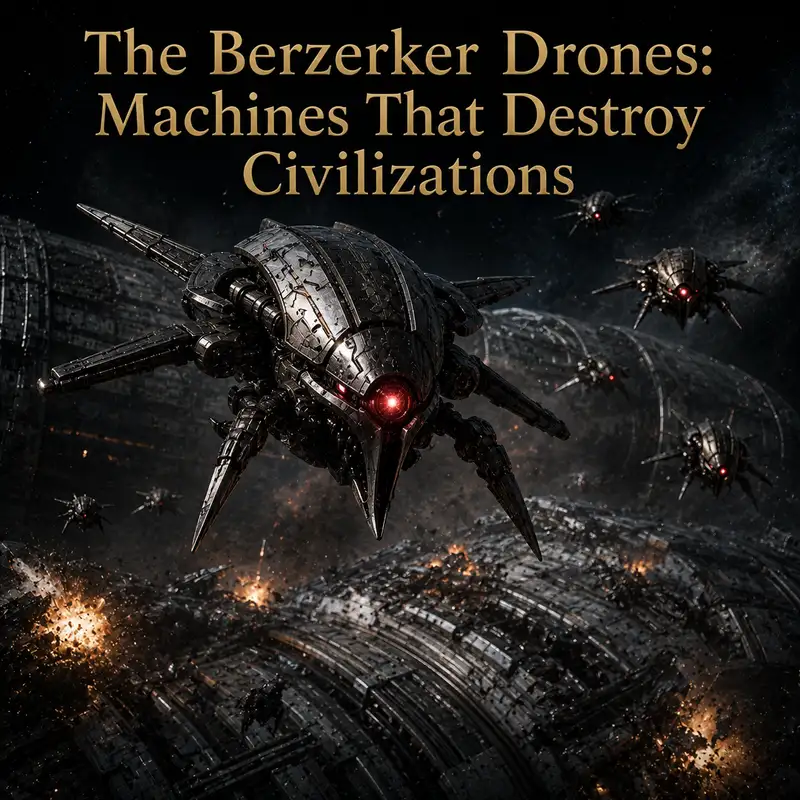
The Berzerker Drones: Machines That Destroy Civilizations
The last meaningful victory over the Berzerker drones did not destroy their fleet. It convinced Destiny’s crew to abandon an entire galaxy. Command ships were waiting near every Stargate along the Ancient route, while other formations guarded the red dwarf stars the vessel needed for power. Fighting through one blockade damaged Destiny faster than the crew could repair it. Continuing through all of them would be a slower form of suicide. Eli Wallace proposed shutting down life support, placing everyone in stasis, and crossing the intergalactic void in one uninterrupted faster-than-light jump. The machines had not captured the ship. They had made normal survival impossible.
That result explains why the drones were capable of destroying civilizations. No individual unit was invulnerable. Destiny’s weapons destroyed them. Rifle fire could disable one on a planet, and a rocket launcher could finish the job. Their command ships could be destroyed by concentrated fire. The danger came from the system surrounding those machines: large swarms, distributed command vessels, persistent identification of foreign technology, rapid tactical adaptation, and a strategy that attacked the places an advanced society had to use in order to remain advanced.
The expedition never identified the civilization that built them. The surviving record provides no confirmed species, homeworld, political system, or original enemy. Even their formal designation is unknown. The people aboard Destiny usually called them drones, while later references often used the name Berzerker drones. What can be established is that they were created as weapons during an ancient war and programmed to destroy technology that did not belong to their own system. Their makers were believed to be gone. The weapons remained.
That distinction matters. The drones were not shown becoming angry, ambitious, or ideologically hostile. They did not demand territory, resources, tribute, worship, or surrender. They followed a classification rule. Technology recognized as part of their own cluster was friendly. Other advanced technology was a target. The surviving record does not establish whether this behavior represented a malfunction, a corrupted order, or the faithful continuation of an original mission after the political reason for that mission had disappeared. From the perspective of everyone they attacked, the difference was academic.
The drone system operated through two principal types of platform. Small unmanned attack craft carried weapons, maneuvered at high speed, operated in space and atmosphere, and could strike ships or people on the surface. Larger command ships coordinated groups of drones through subspace signals, carried substantial numbers of them, and provided the identification instructions that told a cluster what to attack. Destroying a command ship caused the drones assigned to it to become dormant. That created a tactical vulnerability, but not a galactic solution. Another command ship could remain active elsewhere with its own cluster.
The architecture favored persistence over elegance. A command ship did not need a brilliant admiral or a crew able to interpret changing politics. It needed sensors, targeting rules, communications, and enough drones to overwhelm resistance. The smaller craft did not fear casualties, require rest, or hesitate when a target fired back. A formation could lose dozens of units without suffering panic or a collapse in morale. Commanders facing them could not count on intimidation, exhaustion, or the political pressure created by mounting losses. Machines are generally difficult to persuade that the war has gone badly.
The Berzerker system should not be confused with the Replicators encountered in the Milky Way or Pegasus galaxies. No screen evidence establishes that these drones consumed raw material, copied enemy technology, improved themselves through assimilation, or manufactured unlimited replacements. Command ships deployed large existing swarms, and the machines adapted their tactics and control signals, but their industrial base remained unseen. That uncertainty is important. Their threat does not require turning them into another self-replicating species. A finite but widely distributed weapons network can destroy civilizations when its targets cannot locate every node, replace their own losses, or survive long enough to exhaust the machines.
Destiny first encountered the system while investigating an enormous field of wrecked vessels. The debris suggested that a major battle had ended long before the human crew arrived. The drones were not all destroyed. Some remained dormant among the wreckage, waiting for foreign technology to activate the battlefield again. Once the engagement began, their speed and numbers forced Destiny onto the defensive. A shuttle team barely returned, the faster-than-light drive was disabled, and the Ancient ship faced an enemy that could concentrate indefinitely around a target unable to withdraw.
The arrival of an Ancient seed ship prevented immediate destruction. Colonel David Telford had been stranded aboard that vessel with an alien species known as the Ursini. Through an imperfect neural exchange, he learned that they had awakened the drones years earlier and had been fighting them ever since. The Ursini had occupied the seed ship in hopes of gaining an advantage, then entered stasis when no rescue arrived. Their colony eventually stopped responding. When contact was restored after one drone command ship was destroyed, the answer came in machine language from another command vessel. The most likely conclusion was that the drones had found the colony first.
The Ursini experience revealed the strategic pattern. A civilization could survive one battle, hide one expedition, or destroy one cluster and still lose the war. The drones did not need to conquer a capital, replace a government, or occupy the ruins. They needed only to continue detecting and destroying advanced systems until ships stopped flying, communications stopped transmitting, and colonies could no longer support one another. A society dependent on technology eventually had to expose technology in order to repair the damage caused by the last attack. That exposure generated the next target.
The first major coalition battle showed both the weakness and resilience of the drone command structure. The Ursini offered to carry the disabled Destiny during a coupled faster-than-light jump, then forced the Ancient ship directly into combat near the command vessel. Hundreds of drones screened the larger platform. Destiny’s main weapon could destroy the command ship, but only if the vessel closed to firing range. The drones’ purpose was therefore not simply to inflict damage. They created depth around the critical node and made every approach consume shield strength, weapons power, and time.
Eli Wallace and Nicholas Rush isolated the subspace signal connecting the command ship to its drones. They could disrupt it only for a few seconds before the system adapted. That brief interruption was enough. The drones stopped firing, Destiny reached weapon range, and the main gun destroyed the command ship. Its entire cluster became dormant. The engagement was a tactical success built on electronic warfare, maneuver, and concentrated fire against the correct target. Shooting the smaller craft one at a time would have exhausted Destiny before meaningfully changing the battle.
The victory did not end the threat because a second cluster was already approaching. Its command ship emerged with another wave of drones, while the first group remained dormant. The new command vessel did not automatically absorb the orphaned machines. Their recognition systems still treated the clusters as separate. Eli exploited that division by studying a captured drone and rewriting its friend-or-foe instructions. When the modified program was transmitted, the dormant first cluster reactivated and attacked the new arrivals.
The plan carried an obvious risk. The drone used to deliver the software had to be powered up inside Destiny. If the reprogramming failed, an armed autonomous weapon would be active within the hull, surrounded by scientists and guarded by Marines whose rifles were unlikely to improve the laboratory equipment. The program worked, but only after the Ursini sacrificed their seed ship to draw part of the enemy away. Destiny escaped with shield coverage at approximately five percent, well below the level previously considered safe for faster-than-light travel. Victory had preserved the ship and reduced its ability to survive the next victory.
The drones learned from the engagement more effectively than their targets could repair from it. During later attacks, they concentrated fire against damaged shield areas and exposed sections of Destiny’s hull. When the crew adjusted the shields so the drones’ energy weapons had almost no effect, the machines changed tactics. They rammed the ship. A drone no longer useful as a gun became a guided projectile carrying its own mass and velocity into the shield. The change was tactically crude and strategically intelligent. It exchanged replaceable units for damage to a vessel whose replacement parts had not been manufactured for more than a million years.
Their targeting behavior extended beyond space combat. On a world settled by descendants of an alternate Destiny crew, the machines had attacked a modern human city and forced survivors toward the Stargate. Historical records described an assault lasting days and an attempt to move the gate to a safer part of the city. When Young’s people later arrived among the ruins, the activation of the Stargate drew drones toward the area. Radio transmissions gave them more precise targets. Small teams could hide temporarily by remaining quiet, but extraction required the very signals the machines were hunting.
This made the drones a civilization-destroying weapon rather than merely an anti-ship system. They could attack infrastructure from the air, pursue technological emissions, descend through an atmosphere, and bring a command ship close enough to support surface operations. Buildings that no longer emitted signals might be ignored for a time. The people inside still needed radios, vehicles, power, medical equipment, and a functioning Stargate. The more organized the evacuation became, the easier it was for the machines to identify the organization.
At planetary scale, this doctrine punished centralized recovery. Hospitals, power stations, transportation hubs, and command posts are precisely the facilities a damaged population needs after an attack. They are also the facilities most likely to emit detectable energy and communications. Dispersing into small groups might preserve people for a time, but it also dissolved the technical organization needed to repair ships, move food, or defend a Stargate. The drones did not have to kill every individual. They could force survivors below the technological threshold that made organized resistance possible, then attack again whenever reconstruction became visible.
The crew initially believed it had left drone-controlled space behind. That assumption failed when a small formation attacked Destiny during a later supply stop and a command ship followed. Whether the enemy had tracked the ship directly or predicted its route was uncertain. Destroying a drone carried aboard for study did not end the pursuit. The machines had already learned enough about Destiny’s movement, gate use, and energy requirements to construct a more effective strategy.
Destiny’s most predictable requirement was power. The Ancient vessel refueled by entering suitable stars, normally red dwarfs selected by its navigation system. The drones did not need to chase it continuously through faster-than-light travel. They could wait at the places it eventually had to visit. The first blockade appeared between Destiny and a recharge star after the ship completed a gravity-assisted approach. More than a hundred drones and a command vessel occupied the route. Young could attack or flee. Attacking risked destruction. Fleeing consumed the energy needed to reach another star.
The crew changed course toward a red dwarf outside Destiny’s normal path, hoping the enemy had predicted only the original route. Another command ship was waiting. That second blockade proved the machines were conducting more than local interception. They were analyzing the ship’s limitations and occupying likely supply points. Every escape made Destiny weaker, while every stationary command ship could wait without consuming a biological crew’s food, air, patience, or confidence.
The human response was to do something Destiny itself considered unsafe. Rush and Eli selected a blue supergiant, far hotter than the stars the ship normally used for recharging. Most of the crew evacuated through the Stargate while the two scientists remained in Ancient spacesuits and forced the vessel into the star. Lisa Park stayed behind to preserve plants from the botanical dome. The maneuver restored power, but the dome was destroyed and Park was blinded by the exposure. The drones had not landed a shot during the recharge. Their blockade still inflicted permanent casualties by forcing the crew outside the ship’s design limits.
The off-world evacuation encountered another layer of the campaign. The planet held the ruins of a human colony that the drones had already attacked. Surviving machines responded to Stargate activation and radio use, trapping the evacuees among abandoned buildings. One drone could be brought down by sustained small-arms fire. Another was destroyed with an Alliance rocket launcher. Those local successes did not secure the planet. A command ship descended through the clouds as the crew reopened the gate and withdrew. Destroying patrol craft had delayed the enemy. It had not removed the system that kept sending them.
Rush and Eli eventually improved Destiny’s sensors enough to isolate the command ships’ subspace traffic across the route ahead. The resulting map transformed a tactical problem into a strategic one. Command ships were positioned near every accessible Stargate from Destiny’s location to the edge of the galaxy. The machines had moved from blocking fuel to blocking supply. Food, water, medicine, repair material, and planetary refuge all depended on the gate network. Any gate activation could reveal a target, and every target had a command ship waiting nearby.
The crew could still fight one command vessel. It retuned Destiny’s shields to reduce the effectiveness of drone weapons, launched a shuttle as a decoy, opened the gate, and sent teams to obtain a needed material while the ship engaged the blockade. The drones answered by ramming. Destiny destroyed the command ship and completed the supply mission, but the hull accumulated damage that could not be repaired before the next engagement. The operation proved the point the enemy’s strategy had been designed to establish. A victory repeated often enough would destroy the victor.
The drones’ greatest strength was therefore not raw firepower. It was the conversion of logistics into a targeting system. Destiny needed stars for energy and Stargates for material. Civilizations needed communications to coordinate defense and machines to sustain urban life. Every necessary action created a signature. The drone network occupied those signatures, waited without fatigue, and forced its opponents to choose between exposure and decline. It turned the infrastructure of survival into a map of where to attack.
Their command architecture also made conventional decapitation ineffective at strategic scale. Each command ship was a critical node for its own cluster, but there was no evidence of one central headquarters whose destruction would shut down every drone in the galaxy. Killing one vessel created a local gap. It did not erase the programming, the other clusters, or the positions already occupied. The system was centralized enough to coordinate swarms and decentralized enough to survive repeated local losses.
At the same time, the architecture contained exploitable seams. Orphaned drones became dormant. Separate clusters did not automatically share identification codes. Subspace control signals could be jammed briefly, mapped, or imitated. Friend-or-foe software could be rewritten under exceptional conditions. Shield frequencies could be adjusted against their energy weapons. These weaknesses allowed Destiny to survive individual battles. None provided an operational capability that could be repeated across every command ship without unacceptable risk, especially after the drones adapted.
Deterrence was equally difficult. The drones had no visible population, economy, leadership class, or political objective that could be threatened. They did not value territory in a way the crew could bargain against. Destroying large numbers did not create war weariness. Offering surrender did not address their recognition rule. Even complete withdrawal from a contested system did not establish peace because the machines could predict the next resource point. Diplomacy requires an actor capable of revising its interests. The drone system possessed targeting logic, not a negotiating position.
The builders had created a weapon that separated military success from political purpose. Perhaps the original command was intended to end a specific war by eliminating the enemy’s technology. If so, the program continued after the enemy, the builders, and the political boundary between them had vanished. Every later spacefaring society entered the old war simply by activating a ship. The machines did not need to know why a new civilization existed. They needed only to determine that its equipment was not theirs.
Destiny’s crew finally accepted that the galaxy could not be crossed by fighting. Eli proposed using the ship’s remaining power for one continuous faster-than-light journey through the rest of the galaxy and the void beyond it. Life support would be shut down, and the crew would enter Ancient stasis chambers for approximately three years. The plan sacrificed every remaining Stargate stop, every opportunity to gather supplies, and whatever scientific data Destiny’s mission might have collected in the blocked region. It was withdrawal at intergalactic scale.
One damaged stasis chamber left Eli awake while the others slept, but the larger strategic meaning was already clear. The drones had achieved area denial across a galaxy without occupying its worlds in any human sense. They had forced an Ancient ship to stop using the network created to support its mission, go dark, and leave the theater. The crew survived by becoming almost technologically silent inside a vessel moving too quickly and too continuously for the machines to intercept.
The Berzerker drones destroyed civilizations because they attacked the conditions that made civilization sustainable. Ships brought aid and became targets. Radios coordinated resistance and became beacons. Stargates offered escape and revealed the evacuation point. Stars provided power and became blockades. Their units could be destroyed, their code could be manipulated, and their command ships could be killed. The system endured because every advanced society eventually had to use the very technology the machines were built to find. Destiny’s final defense was not superior firepower. It was three years of darkness, silence, and absence from the battlefield.