The Daedalus Arrives: Reinforcing Pegasus
John Sheppard was seconds from detonating a Genii nuclear weapon inside a Wraith hive ship when an unfamiliar voice ordered him to decloak. The transmission carried a valid Earth authentication code, but Sheppard had no reason to expect an Earth ship in Pegasus and no time to investigate politely. He lowered the Puddle Jumper’s cloak. An Asgard transporter locked onto him, removed him from the aircraft, and placed him aboard the newly arrived Daedalus before the weapon destroyed both the Jumper and the hive.
Atlantis had expected Sheppard to die. Its defenders had watched his signal enter the enemy vessel and disappear in the nuclear flash. Then his voice returned over the radio, followed by Colonel Steven Caldwell identifying himself as commander of the Daedalus. The ship had crossed the distance between galaxies, arrived in the middle of an active siege, and turned a suicide attack into a survivable mission. Reinforcement had reached Pegasus at the last possible moment.
The arrival mattered because Atlantis was no longer merely short of ammunition or personnel. Its entire defense was collapsing. The city’s Ancient drone stockpile had been spent against Wraith Darts. Ground teams were fighting warriors inside the towers. Colonel Dillon Everett had been fed upon and gravely injured. Aiden Ford had disappeared into the ocean after a Wraith attack. The city shield remained offline, and another hive ship still held position above Lantea. Atlantis possessed remarkable technology and almost no strategic depth.
Earth’s response had been built around one newly recovered zero-point module. The device had first powered an intergalactic Stargate connection long enough to send Everett, Marines, railguns, ammunition, and nuclear weapons directly to Atlantis. Once that wormhole closed, the module was transferred to the Daedalus. Connected to the ship’s power systems, it pushed the Asgard hyperdrive far beyond its normal transit performance and reduced the journey to less than four days.
That decision turned one irreplaceable power source into a sequence of capabilities. It opened the gate for reinforcements, accelerated a battlecruiser across intergalactic space, strengthened the ship during transit, and then became the power source Atlantis needed for its shield. The module could not perform all of those missions simultaneously. Each transfer created a new vulnerability. When it left the Daedalus for the city, the ship’s shields became weaker. When it remained in Atlantis, routine gate travel to Earth became impossible.
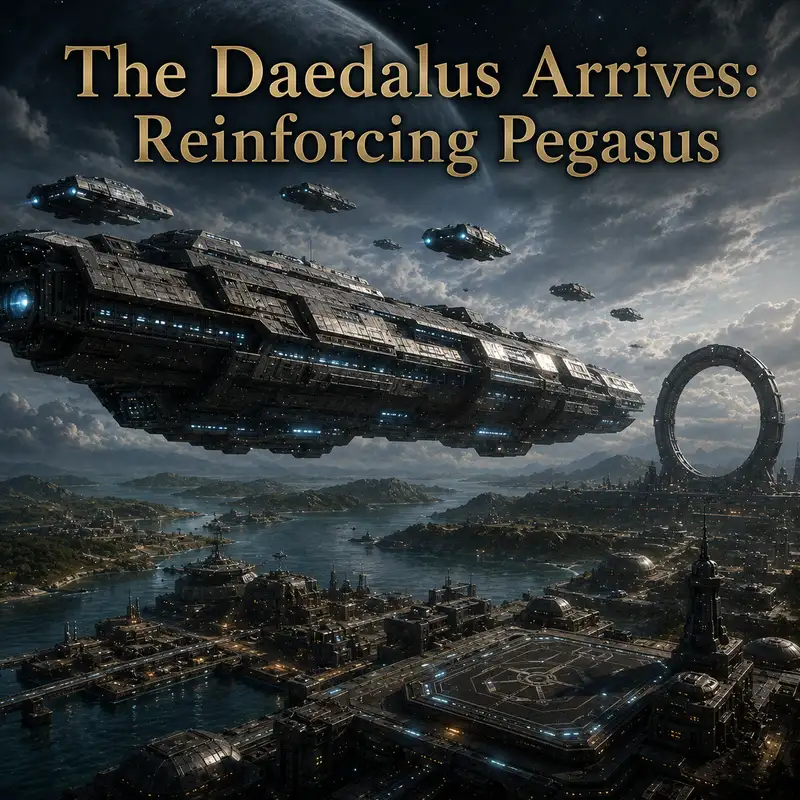
The Daedalus was the first of Earth’s B C three-oh-four battlecruisers and the clearest sign that the Tau’ri had moved beyond adapting one captured device at a time. Its hull, crew, railguns, missiles, fighter wing, and much of its operating doctrine were human. Its hyperdrive, shields, and transporter systems reflected Asgard assistance. An Asgard engineer named Hermiod remained aboard because intergalactic propulsion and several integrated systems were still new enough that Earth wisely kept the technical support close to the machinery.
The ship did not yet carry the Asgard plasma-beam weapons later associated with Earth battlecruisers. Caldwell had Earth-built railguns, F three-oh-two fighters, and Mark Eight tactical nuclear missiles. These were powerful weapons, but they still had to reach their targets. The Wraith used Darts to intercept incoming missiles before they approached the hive. Earth had brought a modern warship into Pegasus. It had not brought a weapon that made Wraith defenses irrelevant.
Caldwell also arrived with a command problem. He commanded the ship, while Elizabeth Weir commanded the expedition and Sheppard possessed the best local understanding of Wraith tactics. Everett’s condition had removed the officer Earth had sent to direct the ground battle. The Daedalus could not be used effectively through rank alone. Caldwell needed Sheppard to identify vulnerable areas of the hive, McKay to integrate the zero-point module with Atlantis, and Weir to coordinate the city’s scientific and civilian personnel.
The first priority was not the enemy ship. It was the module. Caldwell used Asgard transporters to place two Marines and the power source directly inside the Atlantis control room. McKay then had to carry it through a city still occupied by Wraith soldiers and reach the Ancient power station. The Daedalus could cross millions of light-years and beam cargo from orbit, but the final movement still depended on people protecting one small container through hostile corridors.
The escort was killed before reaching the installation. McKay survived because Teyla encountered him and eliminated the Wraith blocking the route. Together they reached the power room while Darts began a final attack on the city. The zero-point module initially failed to seat correctly. With seconds remaining before aircraft struck the towers at ballistic speed, McKay forced it into position. Atlantis raised its shield, and the incoming Darts destroyed themselves against the field.
In orbit, Caldwell had learned that conventional missile fire was not enough. Darts intercepted the first salvos, and closing the distance exposed the Daedalus to heavier Wraith fire. Sheppard suggested targeting a fighter bay to create internal explosions, but the missiles still could not penetrate the defensive screen. The ship needed a way to place a nuclear weapon inside the hive rather than fight through every layer outside it.
Asgard transporter design included safeguards intended to prevent precisely that use. The Asgard had provided transportation technology, not an effortless method of placing nuclear devices inside any ship Earth disliked. Caldwell ordered his engineering team to find a way around the restriction. Hermiod objected, which was a reasonable response from the representative of the civilization that had installed the safety system. He nevertheless completed the transport.
The warhead appeared inside the hive and detonated seconds later. The last capital ship in the immediate assault force was destroyed, and the remaining Wraith cruisers withdrew. The method looked decisive because, for that engagement, it was. Earth had combined a human nuclear weapon with Asgard precision transport and used the Wraith hull itself to contain the blast. The tactic bypassed missile interception, armor, and the need for a long exchange of fire.
The battle still did not end when the hive exploded. Its Darts remained in the air, and many turned toward Atlantis in a mass ballistic attack. The city shield saved the base with almost no margin remaining. Wraith warriors already inside Atlantis had to be cleared by Marines, Athosians, expedition security personnel, and teams beamed down from the Daedalus. The ship had won in orbit, but ground control still required soldiers moving through the city one corridor at a time.
The transporter also became a medical and recovery system. When Atlantis sensors detected Ford in the ocean outside the shield, the Daedalus pulled him from the water and sent him directly to the infirmary. He arrived with the dead Wraith still attached to his chest. The recovery saved his life, although the enzyme released during feeding altered him in ways the expedition did not yet understand. Reinforcement could recover a casualty. It could not guarantee that the casualty returned unchanged.
Atlantis had survived the first assault, but the Wraith cruisers that escaped carried warning of Earth’s new ship and its transporter tactic. Their retreat was not strategic defeat. It was an intelligence transmission conducted at hyperspace speed. Soon, sensors detected a far larger force. Twelve hive ships and their escorts were moving toward Atlantis, while expedition estimates suggested that at least sixty hives existed across Pegasus.
The Daedalus gave the defenders an option they had never possessed before. They did not have to wait beneath the city shield. McKay knew that Wraith hyperdrives were slower than the Asgard system and required ships to make a series of jumps. He calculated the location of the fleet’s final pause, roughly fifty light-years from Atlantis. Caldwell could reach that point first, ambush the formation as it emerged, and attempt to disrupt the attack before it entered the Lantean system.
This was a genuine change in operational posture. Before the Daedalus, Atlantis could send Puddle Jumpers through Stargates, conduct reconnaissance, and strike exposed targets. It could not maneuver a capital ship between systems, choose a battle site in deep space, or threaten a Wraith fleet along its route. The expedition had gained more than firepower. It had gained initiative.
The ambush began well. As the Wraith formation left hyperspace, Hermiod transported nuclear warheads into the nearest ships. Two hives disappeared before their commanders understood the method. Caldwell then drove the Daedalus toward the remaining force, using speed, shields, railguns, and surprise to keep the Wraith off balance. For a brief period, one Earth vessel imposed losses on a formation large enough to destroy Atlantis many times over.
The Wraith adapted during the same battle. They activated countermeasures that prevented the transporter from locking onto their ships. The nuclear method stopped working after two successful attacks. The Daedalus still had missiles and railguns, but those weapons could not compensate for the number of enemy vessels surrounding it. Shields weakened, weapons positions failed, and a cruiser moved into a possible boarding position.
Caldwell withdrew before damage became fatal. The Asgard hyperdrive allowed the Daedalus to break contact and outrun the Wraith, but it did not turn retreat into victory. Ten hives remained. The enemy had studied an unfamiliar attack, developed a countermeasure, and continued toward Atlantis. The weapon that had saved the city during the first engagement had become unreliable before the next one ended. In a laboratory, two successful trials might justify further development. In combat, the enemy had already completed the review.
The ship returned damaged and landed on an Atlantis pier because it needed the city shield as much as the city needed the ship. The Wraith followed and began sustained orbital bombardment. McKay estimated that the zero-point module could maintain the shield for days under that pressure, not indefinitely. Caldwell’s engineers could return the Daedalus to combat readiness within about a day, but another direct engagement would probably produce the same result.
This was the strategic limit of reinforcement. One battlecruiser could destroy individual hives, deliver personnel, recover casualties, and force the Wraith to alter their plans. It could not defeat every faction willing to send ships toward Atlantis. The city and the Daedalus now formed a stronger defensive system, but both depended on the same finite power source and both could be worn down by repeated attacks.
The final solution used the Daedalus as part of a deception rather than as the centerpiece of another gun battle. McKay and Radek Zelenka proposed connecting a Puddle Jumper cloak generator to the Atlantis shield system. The city would become invisible to Wraith sensors, but the cloak would replace the shield and leave Atlantis physically unprotected. If the enemy recognized the ruse, one barrage could end the expedition.
A disappearance by itself would be suspicious. The defenders therefore planned to fake the city’s destruction. Teyla would enter the Wraith telepathic network and convince them that Atlantis intended to self-destruct rather than be captured. The Daedalus would place a nuclear weapon above the city and detonate it. During the resulting flash and sensor interference, McKay would switch Atlantis from shield to cloak. When the debris cloud cleared, the Wraith would see only ocean.
The ship provided the pieces the plan required. It carried the warhead. Its Asgard transporters could place the weapon precisely outside the shield. Its sensors could observe the Wraith reaction. Its own shields and hyperdrive offered an escape route if the deception failed. Nonessential personnel and casualties boarded the Daedalus so that at least part of the expedition might survive even if Atlantis did not.
Teyla’s message caused the bombardment to stop because the Wraith wanted the city intact. Hermiod transported the nuclear weapon into position, and the detonation produced the appearance of a catastrophic self-destruct. McKay waited long enough for the lethal radiation front to pass, then activated the cloak. The Wraith scanned, found no city, and eventually broke orbit. Atlantis survived by becoming a target the enemy believed no longer existed.
The Daedalus had not destroyed the twelve-ship formation. It had destroyed two hives, survived counterattack, carried evacuees, delivered the final weapon, and preserved an escape option. The operation succeeded because military force, scientific improvisation, local intelligence, and deception were combined. The ship was essential, but it was not sufficient. Pegasus had provided another reminder that a platform can be powerful without being a strategy.
Its arrival nevertheless ended the expedition’s original isolation. Before the siege, Atlantis had no reliable way to send people home, receive heavy equipment, replace specialists, or move large numbers of wounded. Afterward, the Daedalus became the physical bridge between Earth and Pegasus. Without a second zero-point module to power regular intergalactic gate travel, the normal voyage took about eighteen days. That was inconvenient compared with walking through a Stargate, but considerably better than permanent separation.
Routine reinforcement was still a schedule rather than instant availability. Planners had to predict ammunition, medicine, food, specialist personnel, and replacement parts before shortages became emergencies. A damaged component could not be requested in the morning and delivered through the gate that afternoon. Every round trip also committed the only Earth vessel capable of maintaining the route. If the Daedalus was damaged, diverted, or delayed, Atlantis could become isolated again.
The ship could carry ammunition, medical supplies, naquadah generators, scientific equipment, replacement personnel, food, messages, and recovered technology. It could evacuate people who required treatment unavailable in Atlantis. It could transport senior leaders to Earth for debriefing and bring them back with new staff. It could also deliver political oversight, revised orders, and arguments about who should command the military contingent. Supply lines carry bureaucracy with impressive reliability.
Earth’s international authorities approved a larger commitment once the expedition’s survival was confirmed. Atlantis could support more personnel because the zero-point module restored major city systems, and the Daedalus could sustain the movement of people and equipment. Scientific departments expanded. The military presence grew. Sheppard was promoted to lieutenant colonel, while Caldwell remained a senior officer with his own ship and a plausible claim to greater military authority.
That arrangement required careful boundaries. Weir retained command of Atlantis. Sheppard remained the expedition’s military commander. Caldwell commanded the Daedalus. The ship could support an operation without becoming subordinate to every local request, and Atlantis could set political policy without directing every maneuver on Caldwell’s bridge. The structure created friction, but it also prevented one person from controlling the city, the expedition, and Earth’s only intergalactic warship.
Maintenance required the same kind of divided expertise. Human crews could service the hull, fighters, railguns, and familiar shipboard systems. Asgard equipment still benefited from Hermiod’s direct support. Atlantis scientists understood the Ancient interfaces waiting at the destination. The reinforcement network worked because three technological traditions could cooperate under pressure. It was impressive, but not yet self-sufficient, and one missing specialist could still turn a sophisticated system into an inaccessible panel.
The new supply line remained vulnerable. The Daedalus was a recently commissioned vessel integrating human and Asgard systems that had not been tested across years of operations. On a later return voyage, a Wraith computer virus apparently inserted during the earlier fighting spread through navigation, communications, and propulsion systems. The ship that protected Atlantis also created a path by which enemy code could approach it. Intergalactic logistics had solved isolation and introduced a larger attack surface.
Nor could one ship protect the human population of Pegasus. The Daedalus could answer selected emergencies, support evacuations, strike hives, and move teams beyond the gate network. It could not remain above Atlantis, escort every expedition mission, defend Earth, and rescue every world facing a culling. Every deployment was a choice about which danger would be left without the ship.
The Wraith also understood what the Daedalus represented. Atlantis was no longer a stranded group living on salvaged Ancient equipment. Earth could now send warships, personnel, weapons, and power sources into Pegasus. Destroying the city would no longer guarantee that the Tau’ri presence ended. The expedition had become the forward base of an intergalactic power, even if that power still possessed only a small fleet and depended heavily on allied technology.
For the people of Pegasus, that change offered both protection and escalation. Atlantis could rescue larger populations, challenge hives in space, and maintain longer operations. It could also attract Wraith attention, deepen factional competition, and bring weapons into conflicts that had developed long before Earth arrived. Reinforcement made the expedition more capable. It also made its decisions more consequential.
The Daedalus differed from the Ancient relics scattered around Atlantis in one crucial respect. Earth had built the ship’s hull, trained its crew, supplied much of its armament, and could eventually build others of the same class. Some of its most valuable systems still depended on Asgard knowledge, and its first mission required a zero-point module Earth could not reproduce. It was not technological independence. It was the beginning of an industrial capability rather than the temporary possession of one surviving artifact.
That is why the ship’s arrival changed Pegasus more than the destruction of any single hive. The Daedalus gave Atlantis mobility beyond the Stargate, a recurring supply line, an orbital reserve, an evacuation platform, and a direct military connection to Earth. It did not end the Wraith threat, and it could not make the city secure. It made continued operations possible.
Sheppard began the battle alone inside a cloaked shuttle, carrying a weapon he expected to detonate with himself still aboard. He ended it aboard an Earth-built battlecruiser that could recover him, deliver the power Atlantis needed, and return after the immediate crisis had passed. The distance between those two conditions was the true reinforcement. Atlantis had stopped being an isolated expedition hoping someone remembered where it had gone. It had become a forward base with a ship on the route home.