The Dakara Weapon and the Destruction of the Replicators
Jacob Carter pressed the Ancient control at Dakara while Replicators were already inside the temple. The calibration was still imperfect. Mechanical blocks were moving through the ruins, the rebel Jaffa fleet was being destroyed in orbit, and Stargate Command was preparing to bury its own installation beneath a nuclear blast. Samantha Carter had one instruction left for her father. Activate the device now, before there was no one remaining to activate it.
The weapon answered with an energy wave. Stargates across the Milky Way opened almost simultaneously, carrying that wave into occupied worlds, captured ships, Earth’s gate room, and every other location reached by the improvised network. Replicator blocks fell apart. Human-form Replicators lost cohesion. The machine offensive ended in seconds because the defenders had finally created an attack the enemy could not survive, study, and adapt to in sequence.
The Dakara operation was not simply the firing of an Ancient superweapon. It was a coalition mission conducted by forces that normally distrusted, opposed, or actively tried to kill one another. Earth supplied the disruptor concept and scientific analysis. Jacob and Selmak interpreted the Ancient system. The rebel Jaffa held the planet. Ba’al modified the Stargate network. Daniel Jackson interfered with the Replicator collective from inside it. Every contribution was necessary because no participant possessed the complete solution.
The crisis began with Replicator Carter’s campaign against the Goa’uld. Her forces were consuming ha’tak vessels, industrial systems, weapons, and naquadah technology faster than the System Lords could organize a response. Jacob and Selmak estimated that the Replicators could overrun the Milky Way within weeks. The prediction reflected the machines’ growth model. Every enemy ship captured was not merely removed from the defender. It became transportation, material, and manufacturing capacity for the attacker.
The Goa’uld were an ideal target. Their empire contained extraordinary technology but weak political coordination. System Lords concealed intelligence from rivals, protected private fleets, and waited for competitors to absorb the first losses. Replicator Carter exploited that fragmentation while sharing information across a machine collective able to adapt almost instantly. The empire’s normal habit of surviving through mistrust had become a liability against an enemy that treated communication as part of its body.
The Replicator offensive also threatened the Jaffa rebellion. Thousands of frightened Jaffa began returning to their former masters, interpreting the machines as punishment for abandoning their gods or believing the Goa’uld offered the only available protection. Teal’c and Bra’tac needed a victory that was military, political, and religious at the same time. They chose Dakara.
Dakara was one of the holiest places in Jaffa tradition. It was remembered as the site where the first prim’ta ceremony had bound Jaffa bodies to larval Goa’uld and where the supposed gods had granted their servants strength and longevity. Capturing the temple would therefore do more than seize a planet. It would place rebel warriors at the symbolic center of the system used to justify their enslavement.
Ba’al’s forces were occupied fighting Replicators, and the rebel attack succeeded quickly. The temple fell with less resistance than its importance suggested. That tactical success created a larger emergency. Dakara lay deep inside Ba’al’s territory, and Anubis understood that the ruins concealed something far more valuable than a religious symbol.
Replicator Carter learned the same secret by probing Daniel Jackson’s buried memories of ascension. She discovered that an Ancient device capable of destroying her was hidden inside the temple. Ba’al then contacted Stargate Command with a warning. Anubis had ordered his fleet to break away from the Replicator war, retake Dakara, and secure a device capable of destroying all life in the galaxy.
Anubis was uniquely positioned to use it. His existence was no longer fully corporeal, so a wave directed against ordinary life might leave him untouched. He could erase the population of the Milky Way, preserve the infrastructure he wanted, and begin shaping a new galaxy without rivals. Even Ba’al considered that objective excessive, which in Goa’uld strategic planning is a useful indication that the situation had become serious.
General Jack O’Neill initially authorized Carter and Jacob to find and destroy the device. Simply placing a bomb near the ruins was not enough. No one knew the exact location, whether the chamber was shielded, or whether even a naquadah-enhanced nuclear weapon would penetrate its protection. The team had to expose the system before it could guarantee denial.
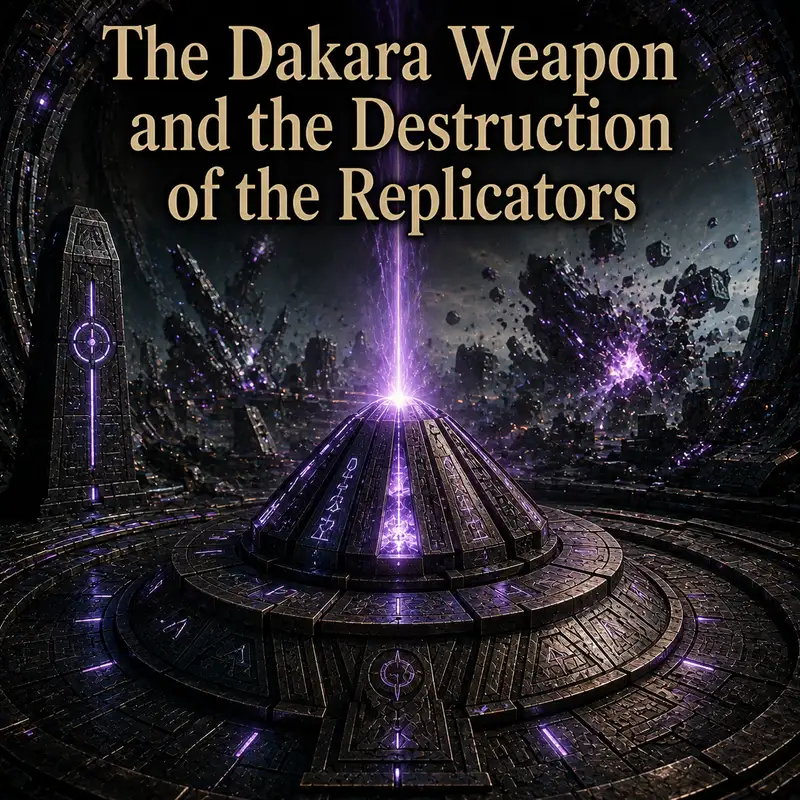
Ancient writing concealed the entrance inside a monument at the temple. Carter used Daniel’s notes, while Jacob and Selmak interpreted an old dialect and the physical arrangement of the inscriptions. Rotating sections of the wall in the correct sequence opened a chamber hidden from ordinary sensors. Inside stood a control system designed on a scale that made the word weapon both accurate and incomplete.
Later evidence established that the Ancients had used the device to reseed life in the Milky Way after a plague devastated the galaxy. It was not created solely as an extermination system. Its purpose depended on calibration. The same machinery that could act on matter to support life could also reduce matter on a planetary surface and in nearby space to basic molecular components.
That dual use was the first important limitation. The device did not explode a planet or provide a conventional beam that could be aimed at a ship. It generated a broad energy wave whose effect depended on the frequency selected by its controls. The target was not a political faction, military formation, or geographic coordinate. It was a particular material structure.
Jacob recognized that the mechanism resembled the Ancient-derived disruptor O’Neill had previously designed while carrying repository knowledge. That handheld weapon separated the components holding Replicator bodies together. If the Dakara device could be adjusted to match the disruptor’s spectrum, its wave might destroy Replicators while leaving biological life and ordinary matter intact.
The original plan therefore changed from demolition to modification. Carter connected Tau’ri analysis equipment and a naquadah generator to systems Earth could operate but could not reproduce. Jacob and Selmak studied the Ancient output while Carter compared it with data from the disruptor. Movable panels on the control console altered the wave, though not in a way that offered the convenience of labels, presets, or a technical manual.
The required tolerance was extremely narrow. The two waveforms had to match within point seven six percent. Moving one panel could improve the result, worsen it, or interact with other controls in ways the team did not fully understand. Carter and Jacob were not programming familiar equipment. They were conducting live experimental calibration on a device able to erase a planet’s surface while hostile fleets moved into firing range.
Even a perfect match would not solve the entire problem. Thor and Carter had already modified the original disruptor after Replicator Carter developed resistance. The machines adapted after limited exposure. A wave fired at one world would destroy the Replicators there, but survivors elsewhere could study the result, alter their cohesion pathways, and make the next use ineffective.
The only reliable solution was simultaneity. Every major Replicator force in the Milky Way had to be struck before any surviving element could distribute an adaptation. A weapon able to clear one planet was insufficient. The defenders needed to turn one pulse on Dakara into a nearly instantaneous galaxy-wide event.
The Stargate network provided the distribution system. Carter determined that the Ancient wave could translate through an active wormhole. Anubis had probably intended to use the gates to extend the device beyond Dakara. The difficulty was that a Stargate normally connects to one destination at a time. Reaching every relevant gate simultaneously required an exceptional manipulation of the network, not a routine dialing procedure.
Only Ba’al had demonstrated the necessary expertise. He had previously exploited the gates’ automatic update system to spread a dialing program through the network. That earlier operation grew from a virus first introduced into his own Stargate, a detail he was considerate enough to mention while discussing cooperation with his enemies. The history did not improve anyone’s trust, but it proved the capability existed.
Carter asked Ba’al to reprogram Dakara’s gate and dial-home device so the activation signal would establish connections throughout the Milky Way at once. She refused to allow his troops into the chamber, forcing him to provide instructions by hologram. Ba’al agreed because the Replicators threatened his fleet, Anubis threatened his independence, and the destruction of the device afterward would solve several additional problems from his perspective.
His cooperation remained self-interested. Ba’al approached Dakara more slowly than his ships were capable of traveling, giving Carter and Jacob time to work while preserving an excuse for Anubis. If the Jaffa destroyed the device before he arrived, Ba’al could claim he had tried to recover it. If the plan succeeded, the Replicators would disappear and Ba’al would retain much of the strongest surviving Goa’uld fleet.
The rebel Jaffa also had to preserve the chamber long enough for the calibration. Their available force was small compared with Ba’al’s approaching fleet. Some commanders argued that defending Dakara would deliberately sacrifice Jaffa lives for a technical plan that might fail. Teal’c and Bra’tac understood the objection. They also understood that losing the planet to either Anubis or the Replicators would end the rebellion for different reasons.
The Jaffa used maneuver and deception to buy time. Rebel ships withdrew at sublight speed, inviting Ba’al to pursue and separate his fleet from the temple. Ba’al recognized the tactic but followed because doing so delayed his own recovery operation without openly defying Anubis. The battlefield had become a negotiation conducted through engine settings and carefully misunderstood orders.
Replicator Carter removed the remaining margin. Her fleet arrived at Dakara and attacked Ba’al’s ships. Mechanical forces landed near the temple and advanced on the chamber. Teal’c ordered the rebel vessels to engage the Replicators rather than wait for the two enemy fleets to destroy each other. If the machines won and captured the device, there would be no independent Jaffa force left to benefit from the result.
At the same time, Replicators attacked Earth. An incoming wormhole established at Stargate Command, remote code penetrated the gate systems, and the iris opened beyond local control. Mechanical Replicators entered the gate room and spread into the mountain. O’Neill ordered a lockdown, emergency evacuation, and preparations to destroy the installation rather than allow the machines to reach the surface.
That order reflected the same containment doctrine used throughout the Replicator war. Cheyenne Mountain, the Stargate, and the personnel still inside were less valuable than preventing one viable machine from reaching Earth’s industrial base. When Replicators cut O’Neill and Colonel Reynolds off from the self-destruct controls, the fallback plan was to place a nuclear weapon down the missile silo after the remaining personnel escaped. The technical terminology for this was denial. The practical version involved being inside the facility one intended to deny.
The Dakara plan was therefore being executed under pressure at four separate locations. Carter, Jacob, and Selmak calibrated the wave inside the temple. Ba’al directed the network modification and fought for survival in orbit. Teal’c and the rebel Jaffa defended the planet and their ships. O’Neill’s personnel fought room by room to prevent Replicators from escaping Stargate Command.
Daniel Jackson occupied a fifth front inside Replicator Carter’s mind. Her effort to recover Ancient knowledge created a connection that worked in both directions. Daniel learned to enter the collective network and became aware of the attacks on Earth and Dakara. The machines had treated his mind as an intelligence source. They had also opened a route into their command system.
As Replicators reached the temple chamber, Daniel gained temporary control of the network. Mechanical blocks stopped in the corridors of Stargate Command. Replicator ships ceased maneuvering. The machines advancing on Carter’s position froze in place. No one at Dakara initially understood why. The pause was simply used because every defender on the battlefield had learned not to waste unexplained good fortune.
Replicator Carter broke Daniel’s control and stabbed him. The machines resumed moving almost immediately. His intervention had not defeated them, and it appears to have cost him his life. It did provide the final seconds Jacob needed to reduce the difference between the two waveforms to the required margin.
At point seven six percent, Carter ordered activation. The Ancient structure opened above the temple. Dakara’s Stargate engaged, followed by gates across the network. This was not a standard wormhole connection that could become ordinary doctrine after one successful test. It was a one-time combination of Ancient hardware, Ba’al’s network exploit, a modified dial-home device, and a control system no participating government could manufacture.
The wave expanded across Dakara and entered the active Stargates. It emerged inside Stargate Command, aboard Replicator-held ships, and on worlds throughout the Milky Way. The effect was selective because Carter and Jacob had matched the Replicator disruptor spectrum. Human personnel, Jaffa, Goa’uld, buildings, ships, and the Stargates themselves survived. Replicator bodies separated into inert components.
Replicator Carter was destroyed aboard her ship before the collective could adapt. Mechanical swarms inside Cheyenne Mountain collapsed while O’Neill’s defenders were running out of ammunition and time. Replicators on the surface of Dakara disappeared in front of the temple. Captured vessels in orbit became dormant almost at once. The campaign ended across multiple theaters before the enemy could convert the first loss into a new defense.
The weapon succeeded because it attacked the common architecture beneath the Replicators’ different forms. Mechanical blocks and human-form cells looked different, performed different missions, and demonstrated different levels of intelligence. Both depended on an organized cohesion that the tuned wave disrupted. Their shared design had made collective learning possible. It also made collective destruction possible.
The Stargate network was equally important. For years, Earth had treated the gates as transportation, reconnaissance, diplomacy, and a dangerous invasion route. At Dakara, the network became a weapons-distribution system. The same infrastructure that allowed civilizations to remain connected across interstellar distance carried a destructive effect to every reachable battlefield at once.
That success should not be mistaken for a permanent Earth capability. Stargate Command did not understand how to build another Dakara device, could not reproduce the Ancient control system, and required Ba’al to modify the network. O’Neill’s disruptor supplied the targeting concept, but the handheld weapon alone had already become unreliable. Victory came from integrating unique systems and temporary access, not from fielding a new production model.
The human cost continued after the wave passed. Daniel had been mortally wounded and disappeared from the Replicator ship. Jacob and Selmak were exhausted, and Selmak’s condition soon became terminal. Rebel Jaffa ships and crews had been lost in the fighting. Stargate Command had nearly destroyed its own base. The operation prevented a galactic defeat, but it did not produce an inexpensive victory simply because the final pulse was fast.
The political consequences arrived almost immediately. Ba’al ordered squads to reclaim dormant Replicator-controlled ships and expected to emerge from the battle stronger than his rivals. Jaffa aboard his own vessels turned against him. Teal’c and Bra’tac confronted the supposed god in front of warriors who had just watched Goa’uld fleets fail, Replicators vanish, and rebels hold Dakara. Ba’al escaped, but the political order around him did not.
Dakara became the founding center of the Free Jaffa Nation. The seizure of the temple had already challenged Goa’uld divinity. The destruction of the Replicators made that challenge visible across the galaxy. Jaffa had defended the holy world, participated in the coalition, and survived an enemy their masters could not defeat. A technical victory over machines became a revolution against gods.
The device remained a danger after serving that revolution. Anubis soon moved to retake Dakara and use Ba’al’s network modifications to erase biological life throughout the Milky Way. The same system calibrated to destroy Replicators could be retuned against living beings. Preventing that second activation required intervention beyond conventional military power, not confidence that the weapon would remain in responsible hands.
The Free Jaffa later retained the device rather than immediately destroying it. During the Ori war, Jaffa leaders used it against an occupied world, killing Ori troops, Priors, and others caught within the field. Adria then led an attack on Dakara and destroyed both the planet’s defenses and the Ancient system. The device’s later history confirmed the danger Carter and Jacob had temporarily mastered. Selectivity did not make the weapon politically safe. It made control over its settings the most important position in the galaxy.
The destruction of the Replicators was therefore a strategic success produced by exceptional convergence. A Jaffa uprising seized the correct planet. A Goa’uld enemy possessed the necessary gate knowledge. A Tok’ra partnership could interpret the Ancient controls. Earth had disruptor data derived from O’Neill’s borrowed knowledge. Daniel gained access to the collective at the precise moment the defenders needed time.
Remove any one of those conditions and the operation probably fails. Without Dakara, there is no transmitter. Without the disruptor spectrum, there is no selective setting. Without Ba’al, there is no simultaneous network. Without the Jaffa defense, there is no time to calibrate. Without Daniel’s interruption, the machines reach the chamber before Jacob completes the match.
The Dakara weapon did not win because it was simply more powerful than the Replicators. Power had failed repeatedly against an enemy able to survive, learn, and reproduce. It won because one pulse reached the entire connected threat before learning could begin. The machine collective was defeated by a temporary coalition that behaved, for a few critical seconds, like a better network.
The final contradiction remained inside the device itself. The Ancients had once used it to restore life after catastrophe. Carter, Jacob, Selmak, Ba’al, and the Jaffa turned it into a mechanism for destroying an entire artificial species. That choice saved the populated galaxy and ended the Replicator offensive. It also left Dakara holding proof that the difference between creation and extermination could be no more than a frequency setting and the person whose hand reached the control first.