The Death of Apophis and the End of Earth’s First Great Rival
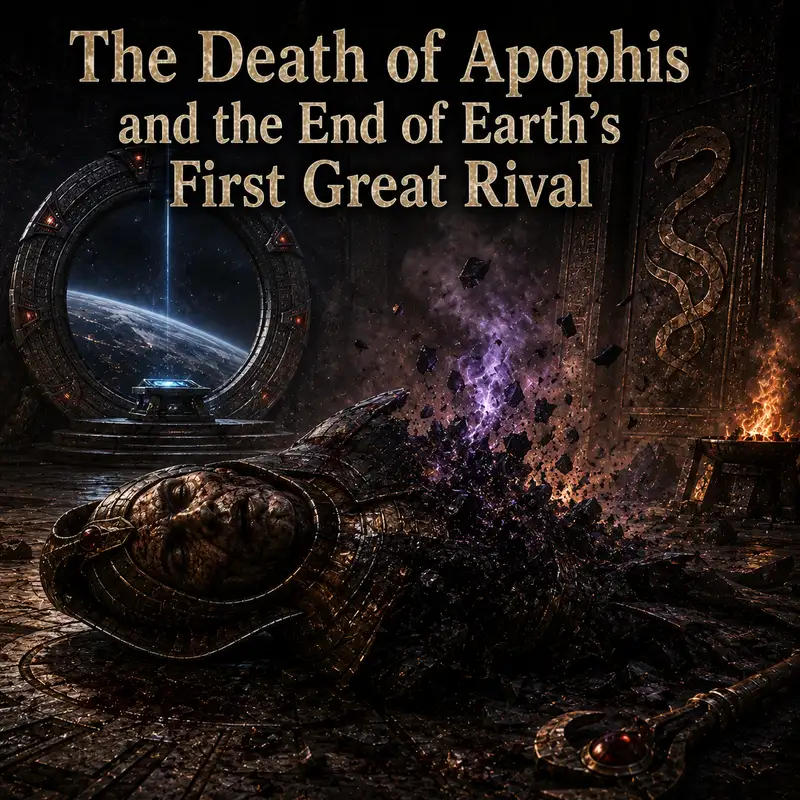
Apophis’s last defense was a personal shield. Replicators climbed over it as the captured Ha’tak fell toward Delmak, but they could not touch him. The shield worked. That was the problem. It protected one body inside a ship whose engines, navigation, crew, and escape routes no longer belonged to him. Seconds later, the vessel struck the planet. The first ruler to bring the modern Goa’uld war to Earth died not in a duel with S G One, but inside a captured command ship turned into an unguided missile.
His death ended Earth’s first sustained personal war with a Goa’uld System Lord. It did not end Goa’uld rule, Jaffa servitude, or the danger to Earth. The question is why this death became final after so many earlier defeats, and what disappeared with him. The answer lies in the destruction of his fleet, the loss of his recovery systems, the collapse of his command structure, and one enemy that neither he nor Stargate Command had expected to meet.
Apophis had opened the modern conflict by raiding Earth and Abydos for human hosts. He later sent two Ha’taks to destroy Earth, only to lose them to S G One’s sabotage. That defeat should have ended his rise. Instead, Sokar captured him, tortured him, revived him, and sent him to Netu as a humiliated subordinate. Apophis escaped the destruction of that prison moon, seized Sokar’s armies on Delmak, destroyed Heru’ur, and absorbed much of another rival’s military power. Every apparent ending had enlarged the next version of the threat.
By the time he attacked Vorash, Apophis was no longer merely the ruler who had first entered Cheyenne Mountain. He commanded forces inherited from Sokar and Heru’ur, possessed a more powerful mothership, and had enough strength to threaten the remaining System Lords. The Tok’ra therefore chose an extraordinary solution. They evacuated Vorash, sent its Stargate into the local sun while the wormhole was connected to a black hole, and forced the star into a premature supernova. The blast destroyed the main body of Apophis’s fleet.
The operation also caught two ships as they entered hyperspace. One was the Ha’tak Earth had captured from Cronus and loaned to the Tok’ra. The other was Apophis’s flagship. The supernova’s subspace effects threw both vessels roughly four million light-years from home. They emerged in an uncharted region with no nearby Stargate, no friendly base, and no realistic prospect of rescue. Even a functioning Goa’uld hyperdrive would have required more than a century to return. The captured ship’s hyperdrive was not functioning.
Apophis recovered first. His vessel retained weapons powerful enough to penetrate the other Ha’tak’s shields even at full strength. S G One and Jacob Carter attempted communication, partly because surrender might buy time and partly because both ships were stranded beyond known support. Apophis refused. He had lost his fleet, but not his instinct for personal revenge. Earth’s team had destroyed his invasion force, exposed his mortality, helped ruin Sokar, and now annihilated the largest army he had ever commanded. He intended to settle the account before considering navigation.
An unidentified vessel interrupted the execution. It emerged behind the damaged Earth-controlled Ha’tak and exchanged fire with Apophis. Jacob used the distraction to withdraw toward a blue giant. By taking the ship into the star’s outer corona, he could use intense radiation to mask it from sensors. The same radiation blinded the crew’s own instruments and slowly overwhelmed the hull’s protection. The maneuver provided concealment, not safety. Carter and Jacob had several hours to restore shields and determine whether any hyperdrive control crystals could be salvaged.
They restored the shields but found the hyperdrive crystals burned beyond use. No backups remained. When the ship left the corona, its sensors detected only Apophis’s motionless flagship. The unknown attacker was gone, and no life signs appeared aboard the Goa’uld vessel. The tactical picture invited caution. The logistical picture demanded risk. Without replacement crystals, S G One could not maneuver through hyperspace or avoid another attacker. Apophis’s apparently dead ship was the only spare-parts warehouse available.
O’Neill, Carter, and Jacob used the ring transporters to board. A Goa’uld warning announced that the self-destruct system had been armed with only minutes remaining. Dead Jaffa lay throughout the corridors. Carter moved toward the hyperdrive controls while Jacob attempted to stop the countdown. Then they found the real victor of the earlier battle. Replicators had infested the ship, killed the crew, and begun consuming its technology. The alien vessel appears to have targeted Apophis’s larger, more advanced ship. It had not come to rescue Earth’s team.
The Replicators changed the meaning of the entire campaign. Apophis was still the immediate enemy, but the machine swarm represented a threat capable of learning from every system it consumed. A Ha’tak provided weapons, shields, engines, power systems, and navigation data in one very generous package. Carter and O’Neill recovered the replacement crystals while gunfire held back the advancing machines. Jacob could not cancel the self-destruct. The boarding party ringed home with seconds remaining, and Daniel moved the captured Ha’tak away before Apophis’s flagship exploded.
At that point, S G One believed Apophis might have died aboard his own ship. The assumption was reasonable and wrong. He had escaped in a Tel’tak with a small group of Jaffa, a sarcophagus, Teal’c, and enough supplies to continue. Teal’c had been wounded and captured on Vorash. Apophis revived him in the sarcophagus, then subjected him to a powerful form of conditioning that restored his old identity as First Prime. The body returned to life. The loyalties inside it were rearranged for Apophis’s benefit.
The Tel’tak approached the Earth-controlled Ha’tak after the replacement crystals had been installed. Teal’c appeared on the communications display and reported that friendly Jaffa had helped him escape. O’Neill opened the cargo bay. It was exactly the response Apophis expected. S G One’s commitment to recovering Teal’c had been one of its strengths for years. In this case, it became the access procedure for a boarding party.
Teal’c took O’Neill’s weapon, the supposed defectors surrounded the team, and Apophis stepped from concealment. In a few minutes, the ruler who had lost almost everything captured a functioning Ha’tak, the people who had destroyed his fleet, and the Tok’ra operative Selmak. He also regained his former First Prime. It was an impressive recovery built from deception, personal knowledge of the enemy, and the willingness to use a psychologically altered prisoner as an authentication signal.
Apophis ordered a course for Delmak, Sokar’s former homeworld and his own new base. His surviving Jaffa warned that they lacked enough replacement symbiotes to survive the journey. The answer offered in his service was not logistical relief. They were expected to remain loyal until death while Apophis lived on. The exchange summarized his military system with unusual clarity. Jaffa were the crews, guards, and soldiers who made the ship function. The ruler’s survival remained the only strategic objective that could not be questioned.
The capture also brought the sarcophagus aboard. That device had made Apophis unusually difficult to eliminate. His earlier death at Stargate Command had briefly allowed the human host to surface, but Sokar recovered the body and restored the Goa’uld. A sarcophagus could reverse injuries that would kill an ordinary person, provided a recoverable body, functioning machinery, time, and loyal personnel remained available. Apophis had survived because enemies preserved him for their own purposes and followers carried him back to the technology.
This time, the cargo carried something else. Replicators had hidden inside the crates transferred from the Tel’tak. They had apparently escaped the destruction of Apophis’s first ship and multiplied while the cargo vessel approached S G One. When Apophis ordered his equipment unloaded, his Jaffa unknowingly imported the infestation into Cronus’s Ha’tak. The same boarding action that restored Apophis to command delivered the force that would remove him permanently.
The Replicators first attacked the ship’s systems rather than its ruler. Internal sensors failed. Power shifted away from the engines. Doors opened and closed without authorization. The Ha’tak dropped from hyperspace as the machines took the engine room and spread through the structure. Jaffa weapons destroyed individual units, but the swarm already numbered too many and could rebuild from available material. Apophis ordered his soldiers to eliminate them because command culture had trained him to answer resistance with obedience and firepower. Neither was useful against self-replicating machinery.
His surviving Jaffa were cut down in the corridors. Their staff weapons could damage Replicators, but the engagement favored the machines. They attacked from walls, floors, and ventilation spaces, while every piece of damaged technology supplied more material. Apophis withdrew to the bridge behind a personal shield. The shield protected him from direct contact, but it did nothing to restore sensors, engines, navigation, or crew. He had preserved the commander's body after command itself had ceased to exist.
The infestation unintentionally freed S G One. A system failure opened the room where the prisoners had been confined. The team recovered weapons from its stored equipment and divided the mission. Jacob and Daniel moved to secure the Tel’tak, their only possible escape craft. O’Neill and Carter went after Teal’c. The decision increased risk and consumed time, but leaving him meant abandoning a teammate whose actions were not voluntary. Rescue required treating the brainwashed First Prime as both an armed enemy and a captive.
A Goa’uld shock grenade disrupted Teal’c’s Jaffa escort. O’Neill and Carter fought through the survivors and tried to persuade Teal’c to stop. He continued firing. O’Neill shot him only when no safer option remained, and Carter confirmed that he was alive. They carried him to the Tel’tak and restrained him. The tactical problem was solved. The psychological one remained. Apophis’s final operation had turned the person most responsible for the Jaffa rebellion back into a defender of Goa’uld divinity.
Before the Tel’tak could leave, the Replicators forced the Ha’tak into hyperspace and locked the cargo-bay doors. S G One was again trapped inside the enemy’s movement. The ship accelerated beyond every known limit of its original design. It reached ten times its former maximum, then thirty, and eventually more than eight hundred times that speed. The Replicators had combined themselves with the engine systems and reshaped Goa’uld technology for their own purpose.
Their destination was Delmak because the last coordinates remained in the ship’s navigation system. That created a brief temptation. The modified hyperdrive could return S G One to the Milky Way in hours rather than generations. The cost was unacceptable. Once the Replicators reached Apophis’s base, they would gain access to ships, weapons, industrial resources, and the Stargate network of an occupied Goa’uld world. The Asgard had already failed to contain them in prolonged war. Allowing the swarm into the Milky Way could turn one escape into a much larger disaster.
Destroying the Ha’tak became the mission, even though it was also the vessel carrying them home. Carter proposed adapting the method used against the Replicators aboard Thor’s ship. A vessel leaving hyperspace at extreme velocity depended on sublight engines to decelerate and maneuver. If the control crystals were destroyed immediately after emergence, the ship would continue on its existing course and strike Delmak before the Replicators could redirect it.
Remote explosives were unreliable. The Replicators had learned the Goa’uld computer systems and could disable a detonator. Someone had to enter the engine room, wait until the ship exited hyperspace, and physically destroy the controls with gunfire. Jacob would prepare the Tel’tak. O’Neill, Carter, and Daniel would attack the engine controls. Their estimated window from sabotage to extraction was measured in seconds. The plan required the Replicators to remain focused on the mothership and the ring transporters to function after the engines were damaged. It was not burdened by an excess of contingency options.
The engine room no longer resembled a normal machinery space. Replicator blocks had formed a large integrated structure around the hyperdrive, effectively becoming part of the propulsion system. Carter located the sublight control crystals and waited. Firing too early would give the machines time to compensate. Firing too late would leave no distance for the ship to become uncontrollable. When the Ha’tak emerged above Delmak, O’Neill opened fire and shattered the controls.
The Replicator structure broke apart and the swarm pursued the team. The direct route to the cargo bay was cut off, so Carter redirected the escape toward a ring room. Jacob activated the Tel’tak’s transporter remotely and recovered O’Neill, Carter, and Daniel. The Replicators then began closing the cargo-bay doors, overriding the escape controls as the smaller ship accelerated toward the narrowing opening. The Tel’tak cleared the bay with little margin. Behind it, the Ha’tak continued toward the planet without the ability to slow or turn.
Apophis remained on the bridge. Replicators climbed across his personal shield and surrounded the command chair while Delmak filled the forward display. The barrier denied them his body for a few more seconds. It could not move the ship, operate the rings, summon Jaffa, or carry him to a sarcophagus. The Ha’tak struck the planet at uncontrolled speed and exploded. This time there was no intact vessel, no loyal rescue party, no recoverable body, and no rival interested in reviving him. The conditions that had made resurrection possible were destroyed together.
The crash also eliminated Earth’s captured Ha’tak and a large Replicator infestation. Stargate Command gained no capital ship, no recoverable engine modifications, and no captured archive from Apophis’s empire. The technology had functioned long enough to complete the mission, which was not the same thing as becoming an Earth capability. Earth returned in a Tel’tak with its people and another example of alien machinery that could not enter production because it was now part of a crater.
The strike against Delmak was not precise. The world had served as Sokar’s home base and then Apophis’s center of power, but the surviving record does not establish the population near the impact or the casualties caused on the surface. The mission’s immediate necessity was preventing the Replicators from reaching a Goa’uld technological base. That necessity does not make the unknown people below irrelevant. An uncontrolled Ha’tak became the weapon because no cleaner option remained.
Apophis’s death was strategically significant because his power had become unusually concentrated. He had combined the surviving military structures of his own domain, Sokar’s empire, and Heru’ur’s forces. The supernova at Vorash destroyed most of that fleet. The crash at Delmak removed the ruler, his surviving command group, and the ship that could have reconnected the remnants. Tok’ra analysis predicted a vacuum in dominant power and years of conflict among the remaining System Lords. No immediate successor inherited the coalition Apophis had assembled.
That chaos benefited Earth and the Tok’ra by preventing a unified Goa’uld offensive. It also meant more rivalry among rulers whose wars were fought by Jaffa and endured by subject populations. Apophis’s fall did not liberate his worlds automatically. Garrisons, subordinate Goa’uld, local commanders, religious structures, and systems of forced labor remained. Some would submit to other System Lords. Others would fight for pieces of the former domain. Removing the apex predator changed the balance. It did not create political institutions capable of replacing imperial rule.
For Earth, the personal meaning was immediate. Apophis had been the enemy who first entered Stargate Command, abducted Skaara and Sha’re, launched the first modern assault on Earth, targeted Teal’c’s family, and returned repeatedly after apparent defeat. His campaigns had shaped S G One’s formation and forced the Stargate Program to become a permanent planetary-defense organization. No later Goa’uld rivalry carried exactly the same origin. Apophis was not merely one System Lord among many. He was the opponent present at the beginning of the war.
His death therefore closed a relationship without closing the conflict. Other System Lords remained. Anubis was returning with capabilities more dangerous than Apophis had possessed. The Replicators had demonstrated that threats beyond the Goa’uld political system could seize and improve the empire’s technology. Earth had become more experienced and more connected, but it still lacked a dependable capital-ship force. The first great rival was gone just as the strategic environment became less personal and more complex.
The human host inside Apophis also died at Delmak. That person had been suppressed for thousands of years and had briefly reemerged when the symbiote first died at Stargate Command. Sokar’s resurrection returned the host to captivity along with the Goa’uld. The final crash ended both lives without separation or recovery. Apophis’s repeated survival is usually described as the persistence of the villain. For the host, it was the repeated continuation of imprisonment.
Teal’c showed that Apophis’s influence outlived his body. Aboard the escaping Tel’tak, O’Neill told him that Apophis was dead. Teal’c refused to accept it because his conditioning had restored the deepest structure of Jaffa belief. A destroyed ship was physical evidence. It was not enough to overcome a lifetime of religious authority reinforced by the sarcophagus and deliberate mental control. Recovering Teal’c required Bra’tac and the dangerous Rite of M’al Sharran, forcing him to confront his memories and choose freedom again.
That aftermath gives the death its most accurate scale. Tactically, S G One destroyed the sublight controls and escaped. Operationally, the Replicator-infested Ha’tak was prevented from reaching the Milky Way intact. Strategically, Apophis and his remaining command element were eliminated after the destruction of his fleet. Politically, the System Lords entered another struggle for power. Psychologically, one of Apophis’s most important captives still believed the dead ruler was divine. Victory occurred at every level except the one where belief could be switched off by order.
Apophis finally died because every mechanism that had saved him before failed at the same time. His fleet was gone. His Jaffa were dying. His ship belonged to the Replicators. His sarcophagus was trapped aboard a vessel about to impact a planet. His personal shield protected him from the nearest threat while leaving him inside the larger one. S G One did not overpower him in a conventional battle. It removed his ability to decelerate and let momentum finish the campaign.
The irony suited the ruler who had built authority on the appearance of immortality. Apophis survived execution, torture, imprisonment, sarcophagus revival, and the collapse of two rival empires. He convinced followers that every return proved divinity. The last evidence of his power aboard the escape craft was Teal’c, who still believed that a god could not be killed after the command ship vanished into Delmak. Earth’s first great rival ended in fire. The system that had taught people to deny his mortality took longer to destroy.