The Descendants of Destiny: A Civilization Born From One Crew
Jason and Ellie did not raise their weapons when Matthew Scott and Ronald Greer emerged from the Stargate. They stared at the two men with the disbelief normally reserved for ghosts. Both young settlers spoke English. Both already knew their names. Then Jason supplied the explanation that changed the encounter from first contact into family history. Scott and Greer were not visitors from another world. They were the ancestors whose images had been preserved for two thousand years.
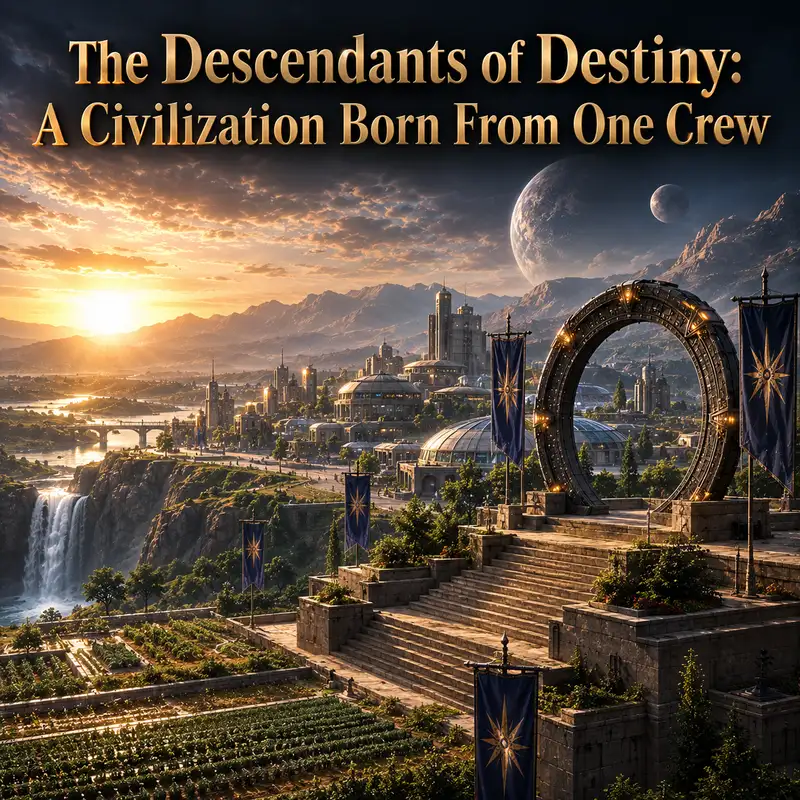
The civilization that remembered them had begun with a single, accidental crew. Its founders were military personnel, scientists, technicians, civilians, and former Lucian Alliance prisoners who had never trained as colonists and had not expected to leave Destiny permanently. They possessed modern education but almost no industrial equipment. From that narrow beginning came the planet Novus, two rival nations, a population numbering in the millions, interstellar colonies, advanced medicine, and ships large enough to evacuate a dying world. The central question is how one stranded crew became an entire civilization.
Their arrival in the past was the result of a failed attempt to dial Earth while Destiny recharged inside a star. Colonel David Telford reached Earth. Nicholas Rush remained aboard a damaged duplicate of Destiny. Most of the other evacuees were diverted through an unstable wormhole and emerged approximately two thousand years before the ship would enter that region. They had crossed the event horizon expecting hospitals, families, and Homeworld Command. They received a sandstorm, thin air, and four gate addresses.
Their first advantage was not a weapon or power source. It was reconnaissance discipline. Eli Wallace and several others had carried kinos through the gate despite the rushed evacuation. The small floating devices could be sent through unfamiliar Stargates before people followed. With members of the group already losing consciousness in the weak atmosphere, Young ordered the available addresses tested. One safer world offered forests, water, usable air, and enough time to begin again. The settlers named it Novus, simply meaning new.
The name understated the problem. The founders knew how electrical grids, antibiotics, irrigation systems, firearms, computers, and spacecraft were supposed to work. They did not possess the mines, refineries, chemical plants, machine tools, factories, or global supply chains that made those systems possible. Scientific knowledge gave them a direction. It did not produce insulated wire or sterile surgical instruments on demand. Novus began with crude shelters, hand tools, gathered food, planted seeds, and a fence around the settlement.
This was a human-capital crisis before it was an engineering crisis. Every founder carried knowledge that might exist nowhere else in the community. Tamara Johansen held most of the medical experience. Eli, Adam Brody, Dale Volker, Lisa Park, and the other scientists each understood different technical fields. Young, Scott, Greer, Vanessa James, Varro, and the remaining security personnel knew how to organize defense and field operations. Camile Wray understood administration and civilian institutions. If one specialist died without training a replacement, an entire capability could disappear.
The danger became clear within six weeks. Volker developed symptoms that Johansen believed might indicate kidney failure. She had no laboratory, imaging equipment, dialysis system, or effective treatment. The same knowledge that allowed her to recognize the likely problem made the lack of equipment more painful. Volker became the first person to die on Novus. His funeral was also an institutional loss. The settlement had buried a scientist whose experience could not be recovered from a supply crate.
Medicine on early Novus depended on improvisation rather than advanced theory. Johansen treated construction injuries with needles Brody fashioned from available material and sutures made from animal tendon. Childbirth occurred without a hospital, blood bank, or specialist team. Infection, trauma, pregnancy, and chronic disease became community-level security concerns because one serious medical event could remove a worker, a parent, and a body of knowledge at the same time. Novus did not lack modern medicine because its founders had forgotten it. It lacked the industrial system required to practice it.
Military command offered the first framework for survival, but it could not remain the only framework. Young already had the authority to assign work, organize reconnaissance, defend the gate, and ration supplies. A permanent settlement required rules for property, family, education, dispute resolution, leadership succession, and the political voice of people who had never been under his military command. The difference between an expedition and a civilization appeared when emergency orders were no longer enough to answer ordinary life.
Wray became central to that transition. On Destiny, she had represented civilian authority without possessing an institution capable of enforcing it. On Novus, she could build one. She drafted a constitution, helped establish civil government, and later served two terms as mayor. Young remained an important leader and won reelection, but reelection itself mattered more than the individual result. Command was becoming an office accountable to a community rather than a rank carried through the gate.
Demography was equally strategic. A small founding population could not remain a civilization unless it produced another generation and protected enough genetic and social diversity to continue. Scott and Chloe Armstrong held the first wedding on Novus. Young and Johansen welcomed the first child, a son named Steven, and later had a daughter named Sara. Greer and Park built a large family. James and Varro formed another. Eli eventually built a life with Corporal Barnes. Private relationships became part of public survival without ceasing to be private human choices.
Those families also crossed the divisions that had nearly destroyed Destiny. Military officers, civilian scientists, administrators, and former Alliance personnel could not remain separate castes in a settlement founded by fewer people than many Earth organizations employed in one building. James and Varro represented the clearest former-enemy partnership. Their relationship did not erase the Lucian Alliance boarding action or make every prisoner trustworthy. It showed that permanent cooperation became possible when individuals were judged by conduct rather than the uniform they had worn during the crisis.
Children transformed the mission more completely than any government order. The founders could still describe themselves as stranded personnel waiting for rescue. Their sons and daughters had no memory of Earth and no duty aboard Destiny. Novus was their home from birth. Food production, housing, sanitation, defense, and education now had to serve people who would inherit the settlement rather than merely survive it. Planning moved from the next gate window to the next generation.
Education became the mechanism that preserved the founders’ advantage. Eli, once recruited as an unemployed gamer and college dropout, became a teacher. He wrote mathematics and science texts, organized instruction, and helped create an educational tradition later honored through a school bearing his family name. This was more consequential than preserving any single advanced device. Equipment eventually fails. A population trained to ask questions, reproduce knowledge, and teach successors can rebuild equipment after the original parts are gone.
The kinos became the settlement’s second memory system. They recorded the first searches, buildings, births, marriages, arguments, funerals, and political decisions. Eli’s habit of documenting daily life preserved technical explanations and personal testimony together. Later generations treated the original recordings as foundational texts, and the main kino became a revered artifact. That preserved evidence better than oral tradition alone. It also gave ordinary moments the authority of scripture, which is rarely what the person holding the camera expects.
Historical memory divided as well as united Novus. One political tradition formed the nation of Tenera, a name that could be read as the land of the young or the land of Young. Its people followed teachings preserved in a document called the Testament. Another movement blamed Eli for the failed return attempt and believed Rush had remained aboard Destiny and would eventually rescue them. That movement founded Futura and gradually elevated the absent scientist into a savior figure.
The division demonstrates how incomplete information becomes ideology. The settlers knew that a gate experiment had failed, that Rush had not emerged with them, and that Destiny might still exist somewhere along its route. They did not possess a complete explanation of the temporal event. Later generations inherited those gaps alongside family loyalties and political disagreements. One country organized identity around the leadership that built Novus. The other organized hope around the brilliant man who might still return. Both drew legitimacy from the same catastrophe.
Political tension eventually became serious enough that both nations possessed nuclear weapons. The surviving record does not establish a full war between them, and it would be wrong to invent one. The existence of those arsenals still matters. The descendants reproduced not only Earth’s science and government but also its ability to connect national survival with weapons capable of destroying the society they were meant to protect. Two thousand years of development did not remove fear, rivalry, or the usefulness of an enemy in domestic politics.
Novus also became technologically sophisticated without reproducing Destiny. Its cities used advanced communications, archives, renewable power, modern medicine, and large-scale industry. Its people built conventional interstellar vessels but never developed faster-than-light travel. That limitation reveals the difference between inherited knowledge and inherited manufacturing. The founders understood that faster-than-light travel existed. Their descendants still lacked the materials, energy systems, or engineering path required to reproduce an Ancient drive. Knowing that a mountain can be climbed is not the same as finding the route.
The surviving record does not describe every stage between hand tools and interstellar industry. The end state shows what had to occur. Novus rebuilt mining, metallurgy, standardized measurement, chemical production, electrical generation, precision manufacturing, transportation, and quality control across many generations. Each layer supported the next. The founders could identify useful goals because they remembered Earth, but their descendants still had to create the economic institutions and skilled workforce capable of reaching them. There was no Ancient factory waiting beneath the settlement and no automated shipyard accepting specifications from a kino recording.
The Stargate network allowed Novus to expand before it possessed interstellar ships. Expedition teams surveyed other gate-accessible worlds and founded colonies. This was strategic depth, economic opportunity, and insurance against disaster on the homeworld. It was also a dependence. A colony established through the gate could expect continuing equipment, specialists, medicine, and political contact from Novus. If the gate failed, the settlement lost its supply line in one instant.
Expansion also prevented the descendants from becoming one uniform society. Colonies developed under different resources, degrees of isolation, and political traditions. Some retained sophisticated communications and direct dependence on Novus. Others could advance more slowly or lose capabilities when the gate connection failed. Later records suggested that people from Novus had spread across many worlds over centuries. The civilization was therefore a network of related human societies, not one planet speaking with a single political or technological voice.
Jason, Ellie, and Yaozu belonged to such a colony. Their people had arrived thirty years earlier as one of several expeditions seeking viable worlds while earthquakes and volcanoes worsened on Novus. The settlement had radios, improvised solar power, agriculture, and historical records, but it had been designed around continued support through the Stargate. When the connection to Novus stopped, the colony survived only marginally. Its people could maintain a community. They could not replace the homeworld that had supplied it.
The appearance of Destiny seemed to fulfill Futuran prophecy and solve that isolation. The descendants welcomed the people from their oldest recordings, helped them collect food and life-support material, and then asked for passage home. Young could not place the entire colony aboard the already strained Ancient ship. He did agree to take Destiny to Novus, hoping to discover whether the homeworld survived and whether its gate could be restored. The ancestors had returned, but even ancestors remain subject to air capacity and supply calculations.
The drone attack made the reunion another evacuation. Active Stargates produced signals the automated machines could detect. Drones struck Destiny and the colony at the same time, destroying generators, communications, and part of the planetary gate. Some settlers escaped to the ship. Others, including members of the Destiny crew, were stranded on the surface after the connection failed. Eli eventually used the damaged gate’s low-power status transmitter to send a faint signal that Destiny could recognize. A civilization descended from stranded gate travelers was rescued through another improvised gate signal.
Novus itself offered no celebration. Destiny arrived over a modern city buried under ash and shaken by constant seismic activity. The planet was being torn apart by tidal forces from a black hole that had entered the system. Its Stargate had been buried in lava decades earlier. The population had already left. Skyscrapers, power systems, underground shelters, and archives remained as evidence of a civilization advanced enough to understand its death but unable to stop the astronomical cause.
The evacuation revealed the greatest political achievement of Tenera and Futura. When the gate was lost and the planet could no longer be saved, the rival countries pooled resources to build enormous ships. The vessels lacked faster-than-light drives, but they could carry the remaining population toward a previously established colony. The journey would take centuries. Novus had spent generations dividing its history into competing national stories, then cooperated when survival required an industrial effort neither country could complete alone.
That achievement should not be romanticized into an easy escape. The ships had to sustain large populations across a voyage longer than many human political systems survive. Food production, maintenance, medicine, governance, childbirth, education, and social order all had to function without outside support. When Destiny reached Novus, those vessels were still somewhere in interstellar space and would not arrive for roughly another two hundred years. The civilization survived planetary collapse by becoming a moving civilization with no immediate destination.
The underground archive was therefore more than a historical museum. It contained thousands of kino recordings, political documents, textbooks, scientific research, medical knowledge, and the accumulated experience of two millennia. Its power grid drew from solar, wind, and geothermal sources. The data represented the intellectual infrastructure that had allowed the descendants to turn memory into industry. As the city collapsed, Destiny’s team began compressing and transmitting the archive to the ship.
Only part of it escaped. Tremors cut power after roughly one third of the database had been transferred. The loss became painfully specific when Yaozu told Johansen that Novan scientists had cured the disease that would eventually kill her alternate self. The cure had been developed more than two hundred years earlier, along with treatments for other diseases. It was not found in the recovered data. A civilization descended from Johansen had solved the problem that defeated her, but geological collapse and incomplete archival access kept the answer out of her hands.
The partial archive still had enormous value. Novan filtration material could support Destiny’s life-support system for years. Food and medical stores reduced immediate shortages. Historical data showed which colonies had existed along the route and how different societies had developed. The knowledge gained from the descendants was not merely sentimental. It became logistics, medicine, navigation, and intelligence for the ship whose failed evacuation had created them.
The records also confronted the prime crew with lives they had not lived. Scott and Chloe saw a marriage, a son, and grandchildren. Greer and Park saw a large family. James and Varro saw that former enemies could build a household together. Eli saw himself as a husband, father, teacher, and founder of an educational system. Young saw a life with Johansen and children who stood beside him at the end. These were alternate possibilities, not predictions. Their power came from showing what the same people became when return was no longer the organizing purpose of every decision.
Young’s final recorded moments on Novus captured the founders’ central contradiction. Near death, he apologized because he had never brought the group home. Chloe answered that Novus was home. The officer who had measured command by the possibility of returning to Earth had spent a lifetime helping create a society that no longer needed Earth to justify its existence. His failure as an evacuation commander became success as a founder, although he did not fully accept that judgment himself.
The descendants inherited more than DNA. They inherited the crew’s technical knowledge, political disputes, loyalties, humor, fears, and habit of improvising when the planned support system disappeared. They also changed that inheritance. Rush became a religious figure without ever setting foot on Novus. Eli became an educational patriarch. Wray became a constitutional founder. Young became a symbol of government. The actual people could not control what later generations made of them, which is one of history’s more durable operating conditions.
A civilization was born from one crew because the survivors stopped treating knowledge as personal expertise and converted it into institutions. Military discipline secured the first settlement. Agriculture and medicine kept bodies alive. Families created another generation. Schools preserved science. Archives preserved memory. Civil government made authority transferable. The Stargate provided expansion, while industry eventually provided an escape when the gate failed. No single invention accomplished the transformation.
The result was neither a utopia nor a copy of Earth. Novus produced rival nations, dangerous weapons, political mythology, uneven colonial development, and arguments over who had caused the founding disaster. It also produced millions of people, constitutional government, advanced medicine, interstellar engineering, and enough cooperation to evacuate a planet. Its imperfections are evidence that it was a civilization rather than a monument built to flatter its founders.
The descendants of Destiny changed the meaning of the original expedition. The alternate crew had believed its mission ended when the wormhole failed to reach Earth. In reality, that failure gave another galaxy a human history extending across two thousand years. When the prime crew finally encountered that history, the descendants supplied food, technology, archives, and a vision of lives larger than the ship. One crew became a civilization because it lost the road home and decided that survival required building a future where it stood.