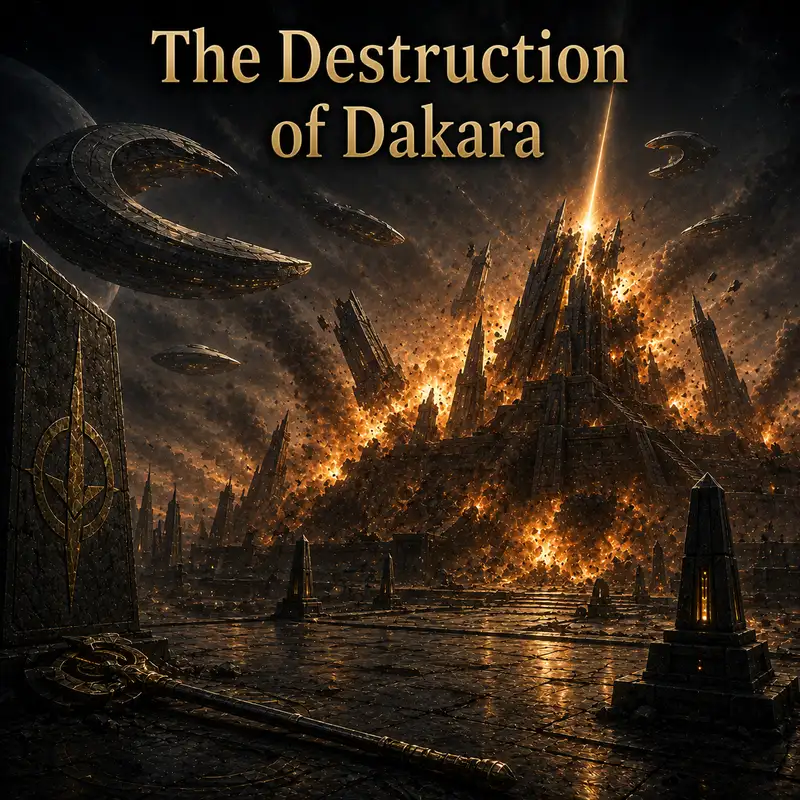
The Destruction of Dakara
Se'tak stood in the Ancient control chamber while the ceiling came apart above him. The first energy wave had crossed Dakara, passed through the Ori warship in orbit, and killed every Jaffa soldier aboard. It had not killed Adria. Her ship was now firing directly into the mountain that housed the device. Bra'tac pulled General Hank Landry toward the unguarded Stargate. Se'tak remained at the controls and ordered the weapon fired again. Seconds later, the mountain that had symbolized Jaffa freedom was blown open.
Dakara was destroyed because the Free Jaffa Nation tried to turn a unique Ancient system into a routine instrument of war before it possessed the intelligence, political restraint, or technical understanding needed to control the consequences. The device produced one spectacular tactical success against the Ori. That success encouraged its operators to ignore the civilians it killed, the allies it endangered, and the survivor it failed to detect. Adria's counterattack ended the weapon, the capital, and much of the political unity built around both.
The planet carried an importance far greater than its military position. Jaffa tradition identified Dakara as the site of the first prim'ta ceremony, where the Goa'uld began placing larval symbiotes inside Jaffa and transformed biological dependence into religious authority. For generations, the temple represented the origin of Jaffa strength, long life, and servitude. The Goa'uld used the world as evidence that their rule was sacred. Controlling Dakara therefore meant controlling one of the central stories through which the Jaffa understood themselves.
The rebellion seized the temple while Ba'al's forces were distracted by the Replicator assault on the Goa'uld. The operation was intended to prove that the supposed gods could lose their holiest ground. Beneath the ruins, Samantha Carter and Jacob Carter, blended with the Tok'ra Selmak, discovered an Ancient device capable of emitting a precisely tuned energy wave. Recalibrated against Replicator technology and transmitted through the Stargate network, it destroyed the mechanical swarm across the Milky Way. That victory helped collapse Goa'uld power and secured Jaffa independence.
The device had not necessarily been built as a weapon. Ancient records and later interpretation indicated that it could manipulate life at a fundamental level and may once have been used to reseed the galaxy after a devastating plague. Its output could be adjusted to affect a selected form of life while leaving other matter untouched. The same principle allowed it to disassemble Replicators, erase organic beings, or perhaps create life under different settings. A system designed to rewrite biology does not become morally neutral merely because the control panel lacks a firing trigger labeled weapon.
After liberation, Dakara became the political center of the Free Jaffa Nation. The temple hosted leaders who were trying to turn former slave armies into a government. The Ancient device gave that government a deterrent no Ha'tak fleet could match, but it also threatened every inhabited world connected to a Stargate. Earth and the Jaffa reached an understanding that it would not be used. The arrangement depended on political continuity, technical custody, and leaders willing to accept that possessing ultimate power did not require demonstrating it.
The Ori invasion attacked every weakness in that arrangement. Their warships had crossed the Supergate, broken the allied fleet, occupied Chulak, and struck additional Jaffa strongholds. Conventional Jaffa weapons could not penetrate Ori shields reliably. Every lost Ha'tak represented a captured Goa'uld vessel that could not be replaced quickly. Worlds that had celebrated liberation were now choosing between Origin and destruction while the new government struggled to provide protection.
Se'tak emerged as the leader of the Jaffa council during that crisis. He argued that the agreement restricting the Ancient device had been made by previous leaders and did not bind him. His reasoning began with facts no responsible commander could ignore. Jaffa forces were losing. Earth had not yet suffered an Ori fleet over its homeworld. The alliance had failed to provide a conventional answer. The device on Dakara was the only known system that had already demonstrated the ability to eliminate an advanced enemy across enormous distances.
His proposed campaign was brutally efficient. The weapon would be recalibrated to destroy organic life, then fired through a selected Stargate at a world occupied by Ori forces. Soldiers, Priors, and crews would disappear while ships, buildings, weapons, and infrastructure remained. Jaffa boarding parties could then claim intact Ori vessels. Repeat the process often enough, Se'tak believed, and the Free Jaffa could build a fleet from the enemy's own warships.
The plan solved the shield problem by avoiding it. It also concealed several assumptions. The Jaffa did not know whether the wave would affect every enhanced human, whether Ori protections could block it, or whether the ships could be operated without Priors. They had no mature training program for captured Ori technology and no proven way to verify that every hostile person aboard had died. A captured warship is not a fleet if no one can command its systems, repair its power core, or survive the original owner's return.
The first target was a human world that had accepted Origin. An Ori warship rested beside a village while a Prior and Adria addressed the population. S G One and Vala Mal Doran were on the ground conducting reconnaissance in local clothing. The inhabitants had not merely been occupied. Many were celebrating conversion, and Adria was urging them to join the Ori armies. That made the world a recruiting center and military staging point. It did not make every villager a lawful or necessary target.
The Odyssey detected a wave spreading from the planet's Stargate and beamed the team away moments before it reached the village. Sensors then found no remaining life signs. Clothing, armor, homes, and the Ori warship remained. Human beings, Ori soldiers, and the Prior were gone. The wave had crossed the entire surface and affected living tissue without leaving chemical, biological, or residual radiological contamination that Earth personnel could identify.
At the tactical level, the strike worked almost exactly as Se'tak intended. It killed the occupying force, bypassed the warship's defenses, and left an extraordinarily valuable vessel intact. At the human level, it was mass killing on a planetary scale. The villagers had faced an enemy capable of annihilating worlds and had chosen submission. The Jaffa response declared that people coerced into the wrong decision could be erased along with their occupiers.
Bra'tac had opposed the plan inside the council and become increasingly isolated. He went to Stargate Command because internal persuasion had failed. Landry reacted not as a distant observer, but as the commander whose team had nearly been killed by an allied weapon. He traveled to Dakara with Bra'tac to confront Se'tak directly. He deliberately did not bring a Marine security detail because the mission was diplomatic and the Jaffa were still allies. The decision respected Jaffa sovereignty and left him with little leverage once the meeting turned hostile.
Se'tak defended the strike as the price of survival. He argued that conventional weapons from both the Jaffa and Earth had failed, while the Dakara device had destroyed an Ori force in one action. If repeated attacks yielded enough captured ships, the Jaffa could regain the initiative. Landry answered that killing entire populations as incidental damage was not a legitimate route to victory. The disagreement was not about whether the weapon worked. It was about whether effectiveness could excuse the deliberate destruction of everyone near the target.
The choice of the first target made Se'tak's position weaker. Several Jaffa worlds had already fallen to the Ori, yet he tested the weapon against a human population. Landry challenged him on that point, and Se'tak ended the discussion without answering. The surviving record does not establish his reason. He may have been unwilling to kill converted Jaffa, may have selected the clearest available Ori concentration, or may simply have considered the human world politically expendable. None of those possibilities was confirmed.
While the leaders argued, Earth and Jaffa forces competed over the abandoned Ori warship. S G One and Vala boarded from the Odyssey to search for intelligence, determine whether the ship could be controlled, and prepare to destroy it if recovery failed. Mitchell and Teal'c placed C four in the power generation chamber as a contingency. Carter located a command chair resembling Ancient neural interfaces and began examining the control systems.
A Jaffa boarding force under Bo'rel arrived with orders to claim the vessel. He treated the ship as the lawful spoil of a Jaffa victory and regarded Earth interest as another attempt to monopolize alien technology. His suspicion reflected a real imbalance. Stargate Command had repeatedly gained technology from wars fought across former Goa'uld territory. It also ignored the immediate operational need for cooperation. The two allied groups began fighting inside a ship neither could yet fly.
Carter's examination suggested that the command interface was keyed to the unusual brain physiology of a Prior. That finding struck directly at Se'tak's fleet-building theory. The wave could remove a crew and leave the hull, but the resulting vessel might still require a biologically enhanced operator. The Jaffa boarding party had possession, weapons, and confidence. It lacked the one qualification the ship's designers had embedded into the controls.
The boarding force also failed to secure the vessel before declaring it captured. Adria had survived the wave because her pendant contained material from Celestis that protected her. She remained hidden aboard while the Jaffa and Earth teams concentrated on one another. The initial strike had therefore eliminated the visible force and missed the single individual most capable of restoring the ship, commanding the crusade, and identifying the source of the attack.
Adria overpowered the Jaffa guarding Daniel and Vala, then tried to extract the weapon's location from Daniel's mind. He resisted. She turned to a wounded Jaffa, compelled him to answer, and killed him after he named Dakara. This was the intelligence failure that decided the fate of the planet. Se'tak's weapon had announced a capability the Ori could not tolerate, and his own boarding force supplied the target location to the surviving enemy commander.
Carter temporarily shut down the warship, but Adria restored its power through her mental abilities. The vessel lifted from the planet, destroyed all three Ha'taks in orbit, and entered hyperspace for Dakara. The Jaffa operation had begun with the expectation of acquiring one Ori warship. It ended with three additional capital ships lost and the enemy using the desired prize to attack the Jaffa capital.
Se'tak interpreted the destruction through the political assumptions he already carried. No Ori life signs had survived the first wave, no other ship had been detected near the planet, and Stargate Command personnel were known to be aboard. He concluded that Earth had seized the vessel, destroyed the Ha'taks, and was moving against Dakara to remove the strategic imbalance created by the Ancient device. The hypothesis required him to discount the possibility that the original enemy still controlled the ship. Paranoia supplied certainty where intelligence had failed.
He placed Landry and Bra'tac under guard. The crisis had now moved beyond disagreement over targeting. The head of Stargate Command was effectively detained by an allied government while an enemy capital ship approached. A confrontation that began with the unauthorized use of a weapon was close to becoming an armed break between Earth and the Free Jaffa Nation.
Colonel Paul Emerson aboard the Odyssey reached the correct conclusion with limited evidence. S G One had not escaped through the planet's gate, their transmitters were no longer detectable, and the Ori ship had departed unexpectedly. If the team remained aboard and the surviving controller had learned about the weapon, Dakara was the likely destination. Emerson ordered a pursuit rather than assuming the ship was returning to the Ori fleet. That decision placed the Odyssey close enough to attempt a rescue during the final engagement.
On Dakara, Se'tak prepared the device for local release. The system could send a tailored wave through an active Stargate, as it had during the first strike, but it could also radiate across Dakara and into surrounding space. The control chamber was shielded to protect its operators. Se'tak intended to kill every living being aboard the Ori ship while preserving the vessel itself. He expected Landry and Bra'tac to survive inside the chamber and witness the moment the Jaffa became a true galactic power.
Inside the warship, S G One had reunited with the surviving Jaffa boarders against the common threat. Mitchell attempted to detonate the C four placed near the power system. The charges failed, and Adria indicated that she had neutralized them before they could destroy the ship. Carter worked from the bridge to lower the shields so the Odyssey could establish a transport lock. Every available option depended on seconds: disable the ship, escape through the Stargate, or be beamed out before Se'tak fired.
Landry warned that his personnel might still be aboard. Se'tak ordered the weapon activated anyway. The decision sacrificed Jaffa boarders as readily as Earth personnel and civilians on the first target. By this stage, the device was no longer being used as a carefully controlled countermeasure. It had become Se'tak's answer to every uncertainty, including the possibility that his own forces were in the firing area.
Carter lowered the Ori shields just before the wave reached orbit. The Odyssey beamed S G One and Vala onto its bridge and entered hyperspace. The Dakara energy passed through the warship and erased the remaining Jaffa aboard. Adria survived again. Her Celestis pendant had already defeated the weapon once, yet Se'tak's forces had never learned that the protection existed. The second strike repeated the first assumption and produced the same exception.
Adria answered with concentrated fire against the mountain housing the Ancient device. The attack shook the shielded control room and brought down its ceiling. Se'tak's operators reported that the wave had failed against the ship's controller. Bra'tac pulled Landry away and led him toward the Stargate. The surrounding area had been evacuated, leaving the gate unguarded and providing the only reliable extraction route.
Se'tak remained behind and demanded another firing sequence. The command had lost its strategic purpose. The target had survived, the control center was collapsing, friendly personnel were dead, and there was no evidence that another wave would produce a different result. Continuing to fire offered no credible path to victory. It expressed refusal to accept that the system on which Se'tak had based his authority was no longer decisive.
Landry and Bra'tac reached the active Stargate as Ori beams tore the mountain apart behind them. They crossed to Earth before the Ancient complex collapsed. A later cargo-ship survey reported complete devastation and no survivors. The screen record does not establish that the entire planet physically broke apart, but Dakara ceased to exist as an inhabited capital, sacred center, and functioning military installation. Se'tak and the personnel who remained in the control chamber died with the weapon.
The immediate tactical exchange was disastrous for every Jaffa objective. The first strike killed an Ori garrison, but the Jaffa failed to secure the ship. Their boarding force was lost. Three Ha'taks were destroyed. The second strike killed additional Jaffa and failed against Adria. The Ori then destroyed the one device the operation had been intended to exploit. A weapon capable of planetary extermination produced no lasting captured capability and removed the Free Jaffa's strongest strategic asset.
The operational consequences were worse. Dakara had served as a governmental center, meeting place, symbol of liberation, and repository of Ancient technology. Its destruction removed the physical location around which rival Jaffa factions had gathered. The council fell into disarray, and regional commanders again relied more heavily on private fleets and personal loyalties. The Free Jaffa Nation survived, but its ability to act as one state weakened at the moment a unified response to the Ori was most necessary.
The alliance with Earth also suffered. Se'tak had violated a prior agreement, nearly killed S G One twice, detained Landry, and interpreted an enemy action as Tau'ri betrayal. Earth had boarded the same captured ship without a negotiated division of authority and had its own history of acquiring technology from common victories. Those facts did not make the actions equivalent. They did explain why the alliance lacked enough trust to manage a strategic prize without turning weapons on one another.
Dakara's destruction was not caused by one irrational order alone. It emerged from military desperation, technological inferiority, unstable government, weak command safeguards, poor coalition coordination, and a weapon whose power exceeded the institutions controlling it. Se'tak's core fear was justified. The Jaffa were being defeated, and their allies had no immediate conventional solution. His answer converted that fear into a doctrine of indiscriminate attack and treated opposition as evidence of disloyalty.
The Ancient device had once given the Jaffa the victory that made national freedom possible. It destroyed the Replicators, broke the final structure of Goa'uld power, and turned Dakara from a shrine of enslavement into the capital of liberation. When the new nation used the same system against ordinary human life, it surrendered the moral distinction that made the symbol valuable. Adria destroyed the mountain, but Se'tak had already damaged what Dakara represented.
The destruction of Dakara was therefore more than the loss of a planet. It was the collapse of a strategy built on the belief that one unique device could compensate for weak fleets, divided politics, and incomplete alliances. The weapon worked against nearly everyone it touched. It failed against the one person who mattered most. The Jaffa gained proof that the Ori could be hurt, then lost their capital proving that destructive power without intelligence and restraint is not control.